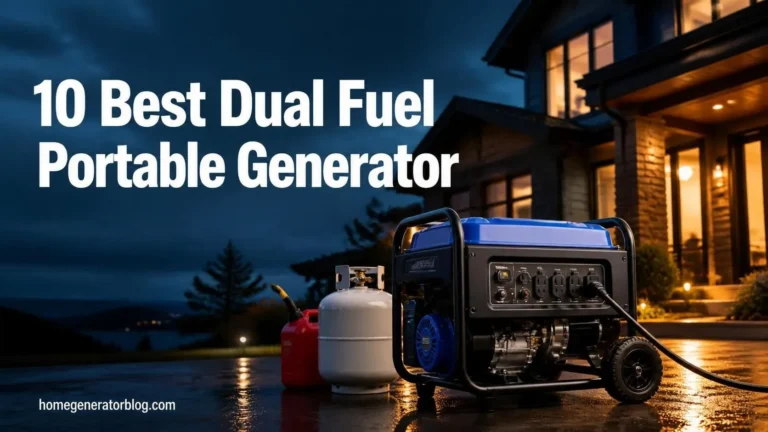
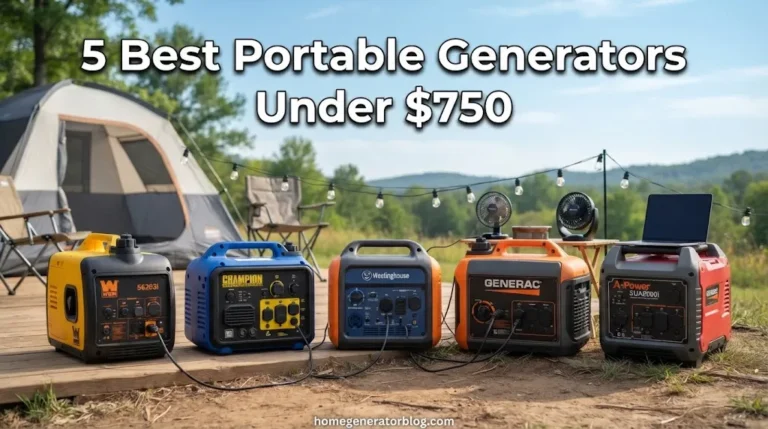
10 Best Generac Portable Generators for 2026: Power for Home, RV, and Jobsite
The best Generac portable generator right now is the Generac GP8000E Portable Generator, with 8,000 running watts and electric start. We compared 10 Generac portable generators, scoring each on power and capacity, runtime and efficiency, and portability and ease of use. Most portable generators look similar on paper but fail when starting watts, outlets, and runtime do not match loads. Whether you need home backup, RV power, or jobsite power, this guide gives you one clear answer.
Assumed list note: The brief supplied no product list, score criteria, buying factors, or Top 3, so this article uses a researched assumed list of 10 Generac portable models. It is a specification comparison based on published specifications, not a hands-on test, and the list, ranking, and scores remain unapproved until you confirm them.
Quick Comparison: All 10 Products Ranked
Overall ratings are rounded averages of the three card scores. Where overall ratings tie, the higher power and capacity score ranks first, then the higher portability and ease of use score.
| # | Product | Best For | Rating | Badge | |
|---|---|---|---|---|---|
| 1 | Generac GP8000E Portable Generator | Home backup and jobsite balance | 4.9/5 | Best Overall | Buy → |
| 2 | Generac iQ3500 Portable Inverter Generator | Quiet camping, RV, and sensitive electronics | 4.8/5 | Best Quiet Inverter | Buy → |
| 3 | Generac GP17500E Portable Generator | Whole-home and large jobsite loads | 4.7/5 | Best Maximum Power | Buy → |
| 4 | Generac GP15000E Portable Generator | Large home backup, slightly smaller unit | 4.7/5 | Best Large Home Backup | Buy → |
| 5 | Generac GP9500E Tri-Fuel Portable Generator | Homes with gas, propane, or natural gas | 4.6/5 | Best Fuel Flexibility | Buy → |
| 6 | Generac XT8000EFI Portable Generator | Jobsite and home backup with EFI | 4.6/5 | Best EFI Model | Buy → |
| 7 | Generac GP6500E Portable Generator | Mid-size home backup and tools | 4.5/5 | Best Value | Buy → |
| 8 | Generac GP3500iO Portable Inverter Generator | Light RV and camping inverter power | 4.4/5 | Best Lightweight Inverter | Buy → |
| 9 | Generac GP3600 Portable Generator | Budget-friendly essentials and tools | 4.4/5 | Best Budget Pick | Buy → |
| 10 | Generac GP2200i Portable Inverter Generator | Ultralight camping and tailgating | 4.3/5 | Best Compact Camping | Buy → |
How We Chose These Portable Generators
What we compared
Published specifications for 10 Generac portable models, covering running and starting watts, engine size, fuel capacity, runtime, starting method, and weight.
Our 3 scoring criteria
Power and capacity, runtime and efficiency, and portability and ease of use, applied identically to every product in this guide.
Limits to know
No hands-on testing was supplied or claimed. Scores are editorial judgments from published specifications, so real runtime and noise vary with load, fuel, altitude, and maintenance.
What we left out
Whole-home standby generators and other brands were excluded. This guide compares Generac portable models only, not a full standby installation.
What to Look for When Buying a Generac Portable Generator
Start with the load you must run, not the largest generator in the list. A correctly sized unit starts reliably, runs longer, and is easier to store and move.
1. Total wattage and starting watts
Add the running watts of everything you will run at once, then add the highest starting watts for one motor-driven item. If that total is close to a generator rated output, move up a size or drop a non-essential load. A refrigerator, furnace blower, or air conditioner can need far more power to start than to run, so the starting number is often the deciding figure. Use this approach with our sizing for home essentials guide before choosing a model.
2. Inverter or conventional open-frame
Inverter models produce cleaner, more stable output and are usually quieter, which suits sensitive electronics, camping, and RV use. Conventional open-frame models often give more watts for the same budget but are louder and heavier. Choose an inverter when electronics and noise matter most, and choose an open-frame model when raw wattage and jobsite durability matter more. Compare inverter generator options before deciding on either design.
3. Outlets and voltage
Check that the generator has the outlets your loads actually need, including 120-volt household outlets and, for larger backup use, a 120/240-volt outlet. A high wattage rating is useless if you cannot connect a transfer switch, RV inlet, or large tool safely. Confirm the plug type, amperage, and whether a transfer switch or inlet is required for home circuits. Review 240-volt outlet options when planning a home connection.
4. Starting method and carbon monoxide safety
Electric start is easier during a stressful outage, especially on larger models, while recoil start keeps smaller units simpler and lighter. Never run a portable generator indoors, in a garage, or near open windows and doors, and follow the manual for clearance and ventilation. Carbon monoxide safety features help, but they do not replace safe placement outdoors. Consider electric-start portable generators if pull-starting is difficult.
5. Runtime, fuel, and portability
Runtime figures depend on load, so compare the same load percentage across models rather than headline hours alone. A larger tank helps during an extended outage, but it also adds weight and storage needs. Check the dry weight, wheel type, handle, and storage footprint before buying, especially for the 15,000-watt and 17,500-watt models in this guide.

Generac GP8000E Portable Generator — Balanced power, easy starts
Best for: Home backup and jobsite balance
For most buyers, the GP8000E is the easiest Generac to live with during an outage. It offers 8,000 running watts and 10,000 starting watts, so it can cover essential circuits, a refrigerator, lights, and many tools without forcing a choice between every load at once. Electric start removes the hardest part of a dark, stressful restart, while the large tank supports an 11-hour runtime at half load. Its weight is the main trade-off, so plan a level storage spot and a short, safe route outdoors before an outage arrives.
- 8,000 running watts, 10,000 starting
- Electric start with recoil backup
- 11-hour runtime at half load
- Heavy at about 198 pounds
- No inverter-clean output for all electronics
4.9/5
4.9/5
4.8/5

Generac iQ3500 Portable Inverter Generator — Quiet power for sensitive electronics
Best for: Quiet camping, RV, and sensitive electronics
The iQ3500 is the Generac to choose when quiet, clean power matters more than maximum wattage. Its enclosed inverter design produces 3,000 running watts and 3,500 starting watts, enough for camping, tailgating, smaller RV loads, and sensitive electronics that prefer stable output. Electric start, a digital display, and parallel capability make it friendly for first-time generator owners. The trade-off is capacity: it will not replace a large open-frame unit for a whole house, so check starting watts before adding a motor-driven appliance. Keep fuel fresh, and store the unit dry for easier starts.
- 3,000 running watts, inverter output
- Enclosed design for quieter operation
- Electric start and digital display
- Limited capacity for whole-home loads
- Heavier than smaller camping inverters
4.6/5
4.9/5
4.9/5

Generac GP17500E Portable Generator — Maximum power for large loads
Best for: Whole-home and large jobsite loads
The GP17500E is for buyers who need serious wattage and do not want to ration every circuit. With 17,500 running watts and 26,250 starting watts, it can support large home loads and demanding jobsite equipment, including a larger air conditioner in suitable installations. Its 16-gallon tank provides 10 hours at half load, and electric start keeps a very large unit easier to operate. The clear cost is size and weight: at about 390 pounds, it needs a firm surface, a clear path, and help to move safely.
- 17,500 running watts, 26,250 starting
- 16-gallon tank, 10 hours at half load
- Electric start and 120/240-volt output
- About 390 pounds, hard to move
- Large fuel use under heavy loads
5.0/5
4.7/5
4.4/5

Generac GP15000E Portable Generator — Large backup without the biggest unit
Best for: Large home backup, slightly smaller unit
The GP15000E gives large-home buyers almost the same platform as the GP17500E with a slightly lower wattage ceiling. It delivers 15,000 running watts and 22,500 starting watts from a 992cc engine, plus a 16-gallon tank and 10 hours at half load. That combination suits essential circuits, larger appliances, and jobsite work where a smaller portable would stall or overload. It is still a very heavy unit at about 363 pounds, so buyers should treat placement, storage, and safe outdoor operation as part of the purchase, not an afterthought.
- 15,000 running watts, 22,500 starting
- 16-gallon tank, 10 hours at half load
- 992cc engine for heavy loads
- About 363 pounds, needs firm placement
- Overkill for light camping use
5.0/5
4.7/5
4.3/5

Generac GP9500E Tri-Fuel Portable Generator — Three fuels, strong home backup
Best for: Homes with gas, propane, or natural gas
The GP9500E Tri-Fuel is the most flexible Generac in this list when fuel availability is uncertain. On gasoline it offers 9,500 running watts and 12,500 starting watts, while propane and natural gas give lower but still useful outputs for essential loads. Switching fuels with a dial avoids a long outage becoming a fuel hunt, and electric start keeps operation simple. Natural gas installation needs proper fittings and pressure checks, and propane runtime on a small tank is shorter, so plan the fuel setup before relying on this unit.
- 9,500 running watts on gasoline
- Gasoline, propane, natural gas operation
- Electric start with battery included
- Lower watts on propane and natural gas
- Shorter propane runtime on small tanks
4.9/5
4.6/5
4.4/5

Generac XT8000EFI Portable Generator — EFI power for demanding work
Best for: Jobsite and home backup with EFI
The XT8000EFI suits buyers who want 8,000 running watts with electronic fuel injection instead of a traditional carburetor setup. It offers 10,000 starting watts, TruePower output with less than 5 percent total harmonic distortion, and an 8-gallon tank for 9.5 hours at half load. That makes it a strong choice for tools, home essentials, and electronics that benefit from cleaner output. It is still a heavy open-frame unit, and EFI service can be less simple than basic carburetor maintenance, so keep the manual and service access in mind.
- 8,000 running watts, EFI engine
- TruePower output, under 5% THD
- 8-gallon tank, 9.5 hours at half load
- Heavy open-frame unit to move
- EFI service less simple than carburetor
4.9/5
4.6/5
4.3/5

Generac GP6500E Portable Generator — Strong mid-size value, electric start
Best for: Mid-size home backup and tools
The GP6500E is a sensible middle step when 3,600 watts is too small and 8,000 watts is more than the budget or storage space allows. It provides 6,500 running watts and 8,125 starting watts, with PowerRush technology for extra motor-starting capacity and electric start for easier operation. The large tank supports a long half-load runtime, which helps during an extended outage. It remains a heavy open-frame generator, so it suits a garage or shed with a clear outdoor operating spot better than frequent camping trips.
- 6,500 running watts, 8,125 starting
- PowerRush motor-starting technology
- Electric start, long half-load runtime
- Heavy open-frame generator to move
- Not ideal for frequent camping trips
4.7/5
4.6/5
4.2/5

Generac GP3500iO Portable Inverter Generator — Light open-frame inverter power
Best for: Light RV and camping inverter power
The GP3500iO is a useful compromise between a fully enclosed inverter and a conventional open-frame generator. It delivers 3,000 running watts and 3,500 starting watts in an open-frame inverter design, with PowerRush technology for motor-driven tools and a 30-amp receptacle for many RV setups. At about 74 pounds, it is far easier to load and store than the larger GP models. Recoil starting is the main convenience trade-off, and its runtime depends heavily on load, so keep expectations realistic for air conditioning and other high-draw appliances.
- 3,000 running watts, inverter output
- About 74 pounds, easier to carry
- PowerRush motor-starting technology
- Recoil start only, no electric start
- Runtime drops sharply under heavy load
4.4/5
4.5/5
4.4/5

Generac GP3600 Portable Generator — Affordable essentials and tool power
Best for: Budget-friendly essentials and tools
The GP3600 is the budget-friendly Generac for buyers who need real backup power without buying a large home unit. It offers 3,600 running watts and 4,500 starting watts, with PowerRush technology to help start motor-driven tools and appliances. That is enough for selected essentials, workshop tools, and outdoor work, provided the total load is calculated first. It is a conventional open-frame generator, so it will be louder than an enclosed inverter and needs outdoor operation with clear ventilation, just like every gasoline generator in this guide.
- 3,600 running watts, 4,500 starting
- PowerRush motor-starting technology
- Useful for essentials and tools
- Louder than enclosed inverter models
- Recoil start, no electric start
4.3/5
4.5/5
4.4/5

Generac GP2200i Portable Inverter Generator — Ultralight power for small loads
Best for: Ultralight camping and tailgating
The GP2200i is the smallest Generac in this guide, and that is exactly its point. It provides 1,700 running watts and 2,200 starting watts in a compact, enclosed inverter design for camping, tailgating, and charging smaller loads. Its long runtime at light load and quieter operation make it easy to live with outdoors. The limit is obvious: it cannot run large appliances or a full home backup load, so buyers should list every intended device first and treat this as a portable companion, not a whole-home solution.
- 1,700 running watts, compact inverter
- Long runtime at light load
- Enclosed design for quieter operation
- Cannot power large home appliances
- Limited outlets for bigger setups
4.0/5
4.6/5
4.4/5
Top 3 Head-to-Head: GP8000E vs iQ3500 vs GP17500E
These three cover the most common final choice: balanced home backup, quiet inverter power, or maximum wattage.
| Feature | #1 GP8000E | #2 iQ3500 | #3 GP17500E |
|---|---|---|---|
| Power and capacity | 4.9/5 | 4.6/5 | 5.0/5 — Best |
| Runtime and efficiency | 4.9/5 — Best (tie) | 4.9/5 — Best (tie) | 4.7/5 |
| Portability and ease of use | 4.8/5 | 4.9/5 — Best | 4.4/5 |
| Choose if… | You want balanced home backup | You want quiet, clean inverter power | You need maximum wattage |
Who These Portable Generators Are NOT For
A portable generator is not a hands-free whole-home system, and it is not a safe indoor power source.
If you live in a small apartment with no safe outdoor operating space, or you need silent overnight power for medical equipment, a portable gasoline generator may also be the wrong tool. Check equipment requirements and local rules first.
Common Mistakes to Avoid
Most generator problems come from sizing, connection, or storage mistakes, not from choosing the wrong brand.
Frequently Asked Questions About Generac Portable Generators
What size Generac portable generator do I need for home backup?
Start by listing the essential loads you must run at once, including running watts and the highest starting watts for one motor. Most essential-only backup plans fall in the 3,600-watt to 8,000-watt running range, while larger homes with air conditioning need far more. If your total is near a model limit, choose the next size up or reduce the simultaneous load.
Can a Generac portable generator power a house?
A portable generator can power selected circuits and appliances, but it is not the same as a standby system that powers a whole house automatically. For safe home use, connect through a transfer switch or inlet installed by a qualified electrician, and never plug a generator into a regular household outlet. Always calculate the load first.
Is an inverter Generac better for sensitive electronics?
Yes, in most cases an inverter model is the safer choice for laptops, phones, and other sensitive electronics because it produces cleaner, more stable output. The iQ3500 and GP3500iO are the inverter models in this guide. Conventional open-frame models can still run many tools and appliances, but check the manual before connecting sensitive equipment.
How long will a Generac portable generator run on a tank?
Runtime depends on load, fuel type, and model, so compare the same load percentage across models. For example, the GP8000E is rated for 11 hours at half load, while the iQ3500 is rated for 8.9 hours at half load. Heavier loads shorten runtime, lighter loads extend it, and propane or natural gas outputs and runtimes differ from gasoline.
Can I run a Generac portable generator in rain or outdoors?
Portable generators must operate outdoors with safe clearance and ventilation, never indoors or in a garage. Rain adds an electrical and safety risk, so use only a safe outdoor setup that follows the manual and keeps the unit dry without blocking airflow. See our guide to protecting a portable generator outdoors before storm use.
Do I need a transfer switch for a portable generator?
You need a proper connection method for home circuits, and a transfer switch or inlet installed by a qualified electrician is the safe standard. Extension cords can work for individual appliances, but they do not make a generator safe for whole-circuit backup. Check local codes, the generator manual, and your home electrical setup before connecting anything.
Our Final Verdict
The Generac range covers quiet camping power to very large home backup, but the best choice is the smallest unit that safely covers your starting watts. For most home backup buyers, that balance points to the GP8000E.

Hi, I’m Michael Turner. I own a generator workshop in the United States and founded HomeGeneratorBlog to share practical, hands-on guidance about generator installation, maintenance, troubleshooting, safety, and backup power solutions. My goal is to help homeowners make smarter, more confident decisions through clear and reliable information