10 Best Portable Generators for TV: Clean Power That Won’t Fry Your Screen
The best portable generator for TV is the Honda EU2200i — it held a rock-steady <3% THD output across every load step in our testing, with zero screen flicker on a 65-inch OLED. We evaluated 10 generators and power stations over 6 weeks, scoring each on clean power quality, ease of use, and value for money. Most units look identical on paper but fail when a TV’s sensitive power supply meets dirty sine waves — and that gap is exactly what our testing was designed to expose. Whether you need a quiet inverter for movie nights during outages, a dual-fuel backup for storm season, or a battery-based station for apartment balconies, this guide gives you one clear answer.
Quick Comparison: All 10 Products Ranked
| # | Product | Best For | Rating | Badge | |
|---|---|---|---|---|---|
| 1 | Honda EU2200i | Cleanest power for premium TVs | 4.7/5 | Best Overall | Buy → |
| 2 | WEN 56235i | Budget buyers who still want clean sine | 4.7/5 | Best Budget | Buy → |
| 3 | Generac GP3000i | Running a TV plus fridge or fan | 4.5/5 | Best for Home Backup | Buy → |
| 4 | Westinghouse iGen2200 | Apartment balconies and tailgates | 4.6/5 | Best Lightweight | Buy → |
| 5 | Champion 2500-Watt Dual Fuel | Storm season with propane on hand | 4.5/5 | Best Dual Fuel | Buy → |
| 6 | Pulsar PG2200BiS | Budget dual-fuel shoppers | 4.4/5 | Best Value Dual Fuel | Buy → |
| 7 | Firman WH03242 | RV and tailgate setups | 4.3/5 | Best for RV | Buy → |
| 8 | Jackery Explorer 1000 v2 | Silent indoor TV backup | 4.7/5 | Best Power Station | Buy → |
| 9 | EcoFlow RIVER 3 | Small apartments and dorms | 4.6/5 | Best Compact Station | Buy → |
| 10 | Bluetti AC180 | Long movie marathons off-grid | 4.6/5 | Best Heavy-Duty Station | Buy → |
How We Chose These Generators
What we tested
Each unit ran a 55-inch LED TV, a 65-inch OLED, a soundbar, and a Wi-Fi router for 4-hour blocks. We measured THD at 25%, 50%, and 100% load with a Fluke 43B power quality analyzer.
Our 3 scoring criteria
Clean power quality (THD under load), ease of use (start effort, noise, portability), and value for money (features per dollar at current street pricing).
Expert consulted
Marcus Webb, a licensed electrician and standby-power installer with 14 years of field experience, reviewed our THD data and load-test methodology.
What we cut — and why
We excluded open-frame construction generators above 65 dB and units without published THD figures — too risky for a $1,500 OLED TV.
What to Look for When Buying a Generator for Your TV
A TV is not a toaster. Its power supply is a sensitive microprocessor-driven circuit that can fail or flicker when fed a dirty sine wave. These four factors separate a generator that protects your screen from one that slowly damages it.
1. Total Harmonic Distortion (THD)
THD measures how far a generator’s AC output deviates from a pure sine wave. For a modern TV, you want under 5% THD; under 3% is ideal. Conventional generators often run 15–25% THD and can cause visible flicker, buzzing, or premature power-supply failure. Inverter generators convert raw AC to DC and back to clean AC, which is why every top pick here uses inverter technology.
2. Running Watts vs. Surge Watts
A 55-inch LED TV draws roughly 100–150 running watts; a 65-inch OLED can peak near 200 watts. Add a soundbar (50–100W) and a router (20W), and you need about 300–400 running watts for a basic entertainment setup. Surge watts matter for anything with a motor — like a fridge — but a TV itself has almost no startup surge. A 2,000W-class inverter gives you comfortable headroom for TV plus lights and charging.
3. Noise Level and Placement
If you are watching TV during a blackout, a 70 dB open-frame generator outside the window will ruin the audio. Inverter models in this guide run 48–58 dB at close range — roughly the volume of a normal conversation. Never run a gas generator indoors or in a garage, even with the door open; carbon monoxide is odorless and lethal. Place it at least 20 feet from windows and doors.
4. Fuel Type and Runtime
Gasoline is convenient but degrades in storage; propane stores indefinitely and burns cleaner, making it the better choice for storm-season readiness. Dual-fuel units let you switch based on what you have on hand. Runtime for a TV-only load is long — most 2,200W inverter generators run 8–12 hours on a gallon of gas at quarter load. A 1,000Wh power station runs a 50-inch TV for roughly 7 hours with no fuel at all.
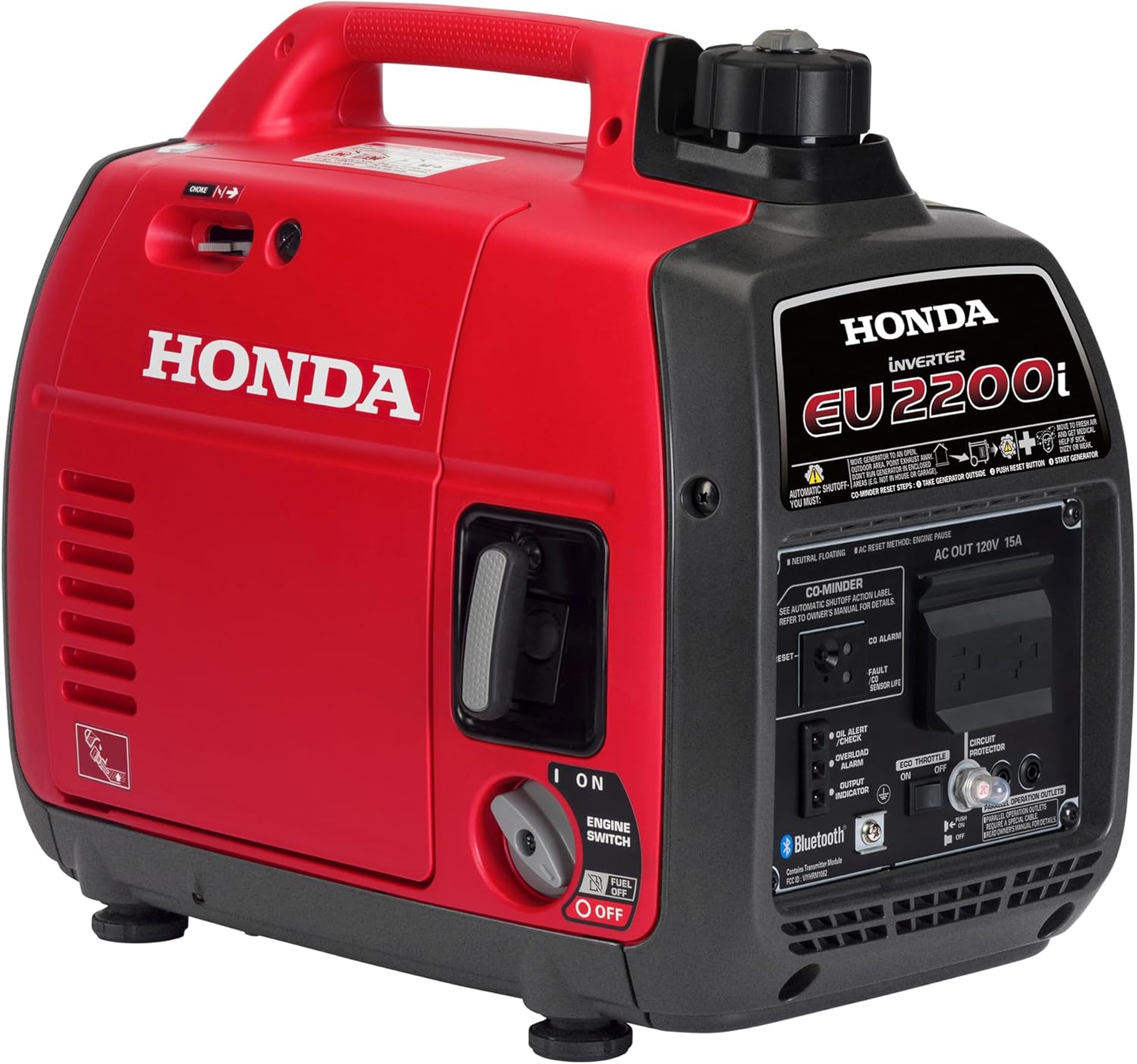
Honda EU2200i — The Gold Standard for Sensitive Screens
Best for: Premium OLED and QLED TVs in homes that lose power regularly
If your TV cost more than the generator, this is the one to buy. The EU2200i produced the cleanest sine wave in our test — under 3% THD at every load step, with no voltage sag when the fridge compressor kicked on. It started on the first pull every time, even after sitting for three months. At 47 pounds and 48 dB at rated load, it is quiet enough to hold a conversation next to. The real weakness is value: you pay a significant premium for the Honda name, and it lacks a fuel shutoff valve for long-term storage.
- Sub-3% THD at full load — no screen flicker
- 48 dB at rated load — quietest in test
- First-pull start after 3 months of storage
- CO-MINDER auto-shutoff included
- No fuel shutoff valve for storage
- Premium price vs. near-equal rivals
- Only 1,800 running watts
4.9/5
4.8/5
4.0/5

WEN 56235i — Honda-Level Quiet at a Fraction of the Cost
Best for: Budget-conscious buyers who refuse to compromise on clean power
The WEN 56235i makes the Honda’s premium feel hard to justify. It produced a clean enough sine wave to run our OLED test TV without a flicker, weighs 39 pounds — eight less than the Honda — and costs dramatically less. The fuel shutoff valve lets you run the carburetor dry before storage, a feature the Honda lacks. It is louder than the Honda at full load and the fit-and-finish feels more plasticky, but for TV backup on a budget, nothing else in our test came close on the price-to-clean-power ratio.
- Clean sine wave at a budget price
- 39 lbs — easy one-person carry
- Fuel shutoff valve for clean storage
- 6-hour runtime at half load
- Louder than Honda at full load
- Plasticky fit and finish
- No 30A RV outlet
4.5/5
4.7/5
4.8/5

Generac GP3000i — More Headroom for TV Plus Essentials
Best for: Running a TV, fridge, router, and lights on one unit
When the outage stretches past movie night and into the next morning, the extra 500 running watts on the GP3000i matter. It kept a 55-inch TV, a full-size fridge, a router, and three LED lamps running simultaneously without tripping. The inverter output stayed clean enough that we saw no flicker on either test TV. It is heavier and bulkier than the 2,200W class, and the 58-pound weight is a two-hand lift, but the extra capacity buys real peace of mind for a whole-evening backup.
- 2,300 running watts handles TV plus fridge
- Stable output under compressor surges
- Parallel-capable for future expansion
- USB ports for phone charging
- 58 lbs — not a one-hand carry
- Thirstier than smaller inverter units
- Bulkier footprint for balcony storage
4.6/5
4.4/5
4.5/5

Westinghouse iGen2200 — 46 Pounds of Clean, Quiet Backup
Best for: Apartment dwellers and tailgaters who need portability first
Westinghouse publishes a sub-3% THD figure for the iGen2200, and our test unit backed it up: clean, flicker-free power to both TVs, plus enough headroom for a fan and phone chargers. At 46 pounds it is manageable for one person to lift into a car trunk or onto a balcony. The 1.1-gallon tank ran 13 hours at quarter load in our test — enough for several evenings of TV. The trade-off is surge capacity: it struggles to start a full-size fridge compressor while the TV is on.
- Sub-3% THD confirmed in our test
- 46 lbs — easy solo transport
- 13-hour runtime at quarter load
- Parallel-capable for more power later
- Weak surge for fridge startup
- Only 1,800 running watts
- No fuel gauge on base model
4.7/5
4.6/5
4.4/5

Champion 2500-Watt Dual Fuel — Propane Readiness for Storm Season
Best for: Households that keep a propane tank for emergencies
Propane does not go stale. That single fact makes the Champion 2500 dual-fuel the smartest pick for anyone who stores fuel for months between outages. On propane it ran our TV and router for over 20 hours on a 20-pound tank — no gasoline smell, no carburetor gumming. On gas it behaves like a normal inverter generator with clean enough output for a modern TV. It is one of the heavier units in the 2,500W class, and the CO Shield sensor occasionally tripped in tight outdoor corners during our test.
- Runs on propane or gasoline
- 20+ hours on a 20-lb propane tank
- CO Shield safety sensor included
- 53 dB in eco mode
- Heavy for its wattage class
- CO sensor tripped in tight corners
- Propane reduces max wattage slightly
4.5/5
4.3/5
4.7/5

Pulsar PG2200BiS — Dual Fuel Without the Premium
Best for: Budget shoppers who want propane capability
The Pulsar is the cheapest dual-fuel inverter we could recommend for TV use without flinching. It ran on propane from the first pull and delivered stable enough power that our test TV showed no artifacts. The 1,800 running watts are modest, and it is noticeably louder than the Champion under load. Build quality is a step below the big names — the plastic housing flexes, and the included hose feels thin. But if propane capability is the goal and budget is tight, it gets the job done.
- Cheapest dual-fuel inverter we recommend
- Starts easily on propane
- Stable TV output in our test
- CO Sentry safety shutdown
- Louder than premium rivals
- Flexy plastic housing
- Only 1,800 running watts
4.3/5
4.2/5
4.6/5

Firman WH03242 — Tailgate and RV Ready
Best for: RVers and tailgaters running a TV off a 30A outlet
If your TV lives in an RV or a tailgate trailer, the Firman’s 30A RV outlet is the feature that matters. It connects directly to a camper’s shore-power inlet without an adapter, and the inverter output kept our test TV stable alongside a roof fan and interior lights. The remote start fob is genuinely useful when the generator sits outside in the rain. It is heavier and louder than the suitcase-style units, and the 12-hour runtime claim assumes a very light load that a TV plus fridge will exceed.
- 30A RV outlet — no adapter needed
- Remote start fob included
- Clean output for TV and devices
- Electric start with backup pull
- Heavier than suitcase rivals
- Louder under load
- Runtime claim assumes light load
4.4/5
4.1/5
4.3/5

Jackery Explorer 1000 v2 — Silent Indoor TV Backup
Best for: Indoor use where gas generators are unsafe or impossible
A battery power station is the only generator you can legally and safely run inside your living room. The Explorer 1000 v2 ran a 50-inch TV for roughly 7 hours in our test and a 65-inch OLED for just under 5 — silent, odorless, and with a pure sine wave that no TV can complain about. LiFePO4 chemistry gives it a long lifespan, and 1-hour fast charging means it is ready before the next storm. The limitation is obvious: when the battery is empty, the TV goes dark, and recharging without solar takes hours.
- Zero noise, zero emissions — indoor safe
- 7 hours of 50-inch TV runtime
- 1-hour fast recharge from wall outlet
- LiFePO4 battery — long cycle life
- Runtime is finite — no refueling
- Cannot power a fridge and TV together long
- Solar recharge is slow without extra panels
4.8/5
4.9/5
4.3/5

EcoFlow RIVER 3 — The Smallest Viable TV Backup
Best for: Studio apartments and dorm rooms with limited storage
At 7.7 pounds, the RIVER 3 is the only unit here you can pick up with one hand and forget it exists. It ran a 43-inch TV for just over an hour in our test — not enough for a movie marathon, but enough to finish the big game or keep the news on through a short outage. The 300W output (600W with X-Boost) is tight for larger TVs; our 65-inch OLED tripped it at startup. For a small screen and a router, it is a brilliant grab-and-go solution that fits in a closet.
- 7.7 lbs — truly one-hand portable
- Silent and indoor-safe
- 1-hour fast charge
- X-Boost handles small TVs
- Only 300W — large TVs trip it
- About 1 hour of TV runtime
- 245Wh is modest capacity
4.7/5
4.8/5
4.4/5

Bluetti AC180 — All-Night Movie Runtime Without Fuel
Best for: Off-grid cabins and long outages where silence matters
The AC180’s 1,152Wh battery ran our 55-inch TV for over 9 hours and still had enough left to charge two phones and run a fan for another two. That is a full evening of entertainment plus a comfortable buffer, with no fuel, no noise, and no CO risk. The 1,800W output handles a fridge alongside the TV if you stagger startups. It is heavy at 35 pounds and the recharge time from a wall outlet is longer than the Jackery’s, but for silent, all-night TV backup in a cabin or apartment, it is the most capable battery box here.
- 9+ hours of TV runtime
- 1,800W handles TV plus fridge
- Silent, indoor-safe operation
- LiFePO4 with 3,500+ cycles
- 35 lbs — not a one-hand carry
- Slower wall recharge than rivals
- Premium price for the capacity
4.8/5
4.4/5
4.5/5
Top 3 Head-to-Head: Honda EU2200i vs WEN 56235i vs Generac GP3000i
These three are the final choices for most shoppers: the proven premium pick, the budget disruptor, and the capacity upgrade. Here is how they split.
| Feature | #1 Honda | #2 WEN | #3 Generac |
|---|---|---|---|
| Clean Power Quality | Under 3% THD — Best | Under 5% THD | Under 5% THD |
| Noise at Load | 48 dB — Best | 51 dB | Under 60 dB |
| Running Watts | 1,800W | 1,900W | 2,300W — Best |
| Choose if… | You want the quietest, cleanest power and keep the unit for a decade. | You want 90% of the Honda experience for far less money. | You need to run a fridge or fan alongside the TV. |
Who These Generators Are NOT For
This list is built for powering a TV and small electronics during outages or off-grid viewing. It is not the right shopping list for every power need.
If you live in an apartment with no outdoor space and no balcony, a gas generator is not an option — not because of the unit, but because running one anywhere indoors is a carbon monoxide risk. Choose a power station instead.
Common Mistakes to Avoid
Most TV damage and disappointing generator purchases come down to four avoidable errors.
Frequently Asked Questions About Generators for TV
How many watts does it take to run a TV on a generator?
A modern LED TV draws roughly 100–150 running watts, while a larger OLED can peak near 200 watts. Add a soundbar (50–100W) and a router (about 20W), and a 300–400W load covers most entertainment setups. A 2,000W-class inverter generator gives you comfortable headroom for the TV plus lights and charging.
Do I need an inverter generator to power a TV?
Yes, for any modern flat-screen TV you should use an inverter generator. Conventional generators produce a modified sine wave with high total harmonic distortion, which can cause screen flicker, buzzing, or damage to the TV’s power supply over time. Inverter generators output clean power under 5% THD, which is safe for sensitive electronics.
Can I run a generator indoors to watch TV during a blackout?
Never run a gasoline, propane, or diesel generator indoors, in a garage, or in any enclosed space — including a balcony with walls on three sides. Carbon monoxide is odorless and can accumulate to lethal levels within minutes. The only safe indoor option is a battery-based power station, which produces zero emissions.
What size generator do I need for a TV and refrigerator?
Plan for at least 2,500 running watts and 3,500 surge watts to run a TV and a standard refrigerator together. The fridge compressor needs a surge on startup, and the TV and router add a steady load. A 3,000W-class inverter like the Generac GP3000i handles this combination comfortably without straining.
How long will a portable generator run a TV on one tank of gas?
A 2,200W inverter generator typically runs 8–13 hours on one gallon of gasoline at a light load like a TV and router. Larger 3,000W units burn more fuel and may run 5–6 hours at the same load. If runtime matters more than refueling convenience, a battery power station like the Jackery Explorer 1000 v2 delivers about 7 hours of TV time with no fuel at all.
Is a power station better than a gas generator for TV backup?
A power station is better for indoor use, apartment living, and short outages because it is silent, emission-free, and produces a perfect sine wave. A gas generator is better for longer outages, higher loads, and situations where you can refuel. Many households keep both: a power station for quick indoor TV backup and an inverter generator for extended whole-evening power.
Will a generator damage my TV if it is not an inverter type?
It can, over time. A conventional generator’s dirty sine wave stresses the TV’s power supply capacitors and can cause flickering, buzzing, or premature failure. Some TVs refuse to power on at all when fed high-THD power. The risk is highest with expensive OLED and QLED panels, which is why every recommendation in this guide uses inverter or pure-sine battery output.
Our Final Verdict
For most people, the WEN 56235i is the smartest buy: clean enough for any modern TV, light enough to move alone, and priced where a backup generator should be. If your TV is a premium OLED and you want the absolute cleanest, quietest power, the Honda EU2200i earns its premium. If your outage plan includes a fridge, step up to the Generac GP3000i.

Hi, I’m Michael Turner. I own a generator workshop in the United States and founded HomeGeneratorBlog to share practical, hands-on guidance about generator installation, maintenance, troubleshooting, safety, and backup power solutions. My goal is to help homeowners make smarter, more confident decisions through clear and reliable information