10 Best Portable Generator with Solar Panels for 2026: Quiet, Fuel-Free Backup Power
The best portable generator with solar panels right now is EcoFlow DELTA 2 Max Solar Generator — its 2,048Wh capacity expands to 6,144Wh with extra batteries. We compared 10 solar generators on solar charging, capacity and output, and portability and ease of use. Most solar generators look alike on paper but differ in panel input, capacity, and weight. Whether you need home backup, RV power, or camping power, this guide gives you one clear answer.
Quick Comparison: All 10 Products Ranked
| # | Product | Best For | Rating | Badge | |
|---|---|---|---|---|---|
| 1 | EcoFlow DELTA 2 Max Solar Generator | Home backup and outdoor power | 4.9/5 | Best Overall | Buy → |
| 2 | Jackery Solar Generator 2000 Plus | Larger home loads | 4.8/5 | Best for Home Backup | Buy → |
| 3 | BLUETTI AC300 Solar Generator | Expandable off-grid systems | 4.7/5 | Best Expandable System | Buy → |
| 4 | Anker Solix F2000 Solar Generator | Large appliances and RV use | 4.6/5 | Best Large-Load Pick | Buy → |
| 5 | EcoFlow DELTA Pro Solar Generator | High-capacity home backup | 4.5/5 | Best High-Capacity Pick | Buy → |
| 6 | Jackery Solar Generator 1000 Plus | Mid-size home and outdoor use | 4.4/5 | Best Mid-Size Pick | Buy → |
| 7 | BLUETTI AC180 Solar Generator | Everyday backup on a budget | 4.3/5 | Best Value Mid-Size | Buy → |
| 8 | Anker Solix C1000 Solar Generator | Compact home and camping power | 4.2/5 | Best Compact Power | Buy → |
| 9 | Goal Zero Yeti 1500X Solar Generator | Camping and field work | 4.1/5 | Best for Camping | Buy → |
| 10 | EcoFlow RIVER 2 Pro Solar Generator | Small loads and short trips | 4.0/5 | Best for Small Loads | Buy → |
How We Chose These Solar Generators
What we compared
Published specifications for 10 solar generators, including capacity, AC output, battery type, solar-panel support, and expandability. This is a specification comparison, not a hands-on test.
Our 3 scoring criteria
Solar Charging, Capacity and Output, and Portability and Ease of Use. Every product uses the same three criteria.
How overall rating works
The overall rating is an editorial weighting that favors solar charging and usable capacity. It is not a simple average of the three scores.
What we cut — and why
Gas-only portable generators and power banks without solar charging were excluded. A unit had to support solar panels to qualify for this list.
What to Look for When Buying a Portable Generator with Solar Panels
A solar generator is really two systems in one: a battery with an inverter, and the panels that refill it. Judge both, not just the headline watt-hours.
1. Solar Input and Panel Wattage
Check the maximum solar input and the panels included in the bundle, because a large battery with weak solar input takes much longer to refill. For outdoor trips, the same logic applies to portable solar generators for camping, where panel size and sunlight matter more than indoor charging speed.
2. Battery Capacity Versus Your Loads
List the watts and run time for each device you actually need, then compare that total with usable capacity. A fridge, a router, and phone charging are a very different job from running power tools, and the difference shows up fast in real use. The same sizing question comes up for solar generators for RV use, where air conditioning and kitchen loads can dominate the total.
3. Output Ports and Inverter Wattage
Match AC output to your largest single appliance, including its startup surge, and count the ports you will use at once. USB-C, 12V, and AC outlets all matter when several devices run together. A rechargeable portable generator is only useful if its outlets fit the devices you plan to plug in.
4. Portability and Expandability
Large solar stations are heavy, so wheels, handles, and where you will store the unit matter as much as capacity. If your needs may grow, choose a system that accepts extra batteries rather than replacing the whole station later. For longer outages, an eco-friendly backup generator approach also means planning panel placement and safe, ventilated storage.

EcoFlow DELTA 2 Max Solar Generator — Balanced, Expandable Solar Backup
Best for: Home backup and outdoor power
If you want one solar generator that handles a fridge, lights, a router, and smaller appliances without jumping straight to a whole-home system, this is the most balanced starting point. Its 2,048Wh capacity gives useful runtime for essential loads, while 2,400W of AC output covers many larger devices that smaller stations cannot start or sustain. Battery expansion to 6,144Wh is the key advantage for longer outages, because you can add capacity later instead of replacing the station. Solar charging keeps it useful when fuel is unavailable, although panel wattage and sunlight still set the refill pace. The main trade-off is weight and size, which make it better as a semi-portable home unit than a carry-anywhere camping box.
- 2,048Wh capacity with battery expansion
- 2,400W output for larger appliances
- LiFePO4 battery for long cycle life
- Heavy for one-person carrying
- Extra batteries add cost
4.9/5
4.9/5
4.8/5

Jackery Solar Generator 2000 Plus — Strong Output, Simple Setup
Best for: Larger home loads
If your priority is running larger home loads during an outage, the 2000 Plus makes a strong case with 2,042Wh of capacity and 3,000W of AC output. That output headroom matters for appliances with high startup demand, and the LiFePO4 battery chemistry supports long-term, repeated use better than older lithium designs. Jackery’s solar-panel bundles are also straightforward to understand, which helps first-time buyers avoid mismatched panels. The trade-off is size and weight: this is a substantial unit to move, and it is best kept in one main location with panels set up nearby. For a mostly stationary backup plan, that size is a fair exchange for the extra output.
- 3,000W output for larger loads
- 2,042Wh capacity for essential backup
- Simple solar-panel bundle options
- Bulky for frequent transport
- Needs space for panel setup
4.8/5
4.8/5
4.7/5

BLUETTI AC300 Solar Generator — Build Your Capacity Over Time
Best for: Expandable off-grid systems
If you want a solar system that can grow with your needs, the AC300 is built around modular batteries rather than a single fixed capacity. The inverter unit delivers 3,000W, while each B300 battery adds 3,072Wh, so you can start smaller and expand for longer outages or off-grid use. That flexibility is valuable for cabins, workshops, and long-term backup plans, where needs change over time. The downside is complexity: you must plan the battery count, panel array, and storage space together, and the full system is not a grab-and-go camping unit. For buyers who want a scalable system, however, that planning pays off in capacity and control.
- Modular battery expansion system
- 3,000W inverter output
- LiFePO4 battery packs
- System planning takes more effort
- Not ideal for frequent carrying
4.7/5
4.8/5
4.4/5

Anker Solix F2000 Solar Generator — Ready Bundle, Strong Output
Best for: Large appliances and RV use
If you prefer a complete solar bundle rather than matching panels yourself, the F2000 is a practical choice with 2,048Wh of capacity and 2,400W of AC output. Common bundles include two 200W panels, which makes the solar side of the purchase clearer for first-time buyers. That combination suits RV trips, larger camping setups, and home backup for essential appliances, provided you check each appliance’s startup watts first. The unit is still large and heavy, so it works best when you can wheel it into place and leave panels in the sun. For buyers who want a ready-to-use solar package, that simplicity is worth the size.
- Clear solar-panel bundle options
- 2,400W output for larger loads
- LiFePO4 battery chemistry
- Heavy for solo lifting
- Bundle panel wattage is modest
4.6/5
4.7/5
4.6/5

EcoFlow DELTA Pro Solar Generator — Maximum Capacity, Maximum Weight
Best for: High-capacity home backup
If you want the largest single-unit capacity on this list, the DELTA Pro delivers 3,600Wh and 3,600W of AC output, which makes it suitable for demanding home backup and workshop loads. Five AC outlets also help when several essential devices must run at once, rather than forcing you to rotate plugs during an outage. Solar charging is a core strength here, with high solar input available when panels are sized correctly. The clear trade-off is portability: this is a heavy, large station that belongs in a planned backup location, not in a car for casual trips. Buy it for capacity first, and accept that moving it is a two-person job.
- 3,600Wh capacity for long backup
- 3,600W output, five AC outlets
- Strong solar charging capability
- Very heavy to move
- Needs large storage space
4.8/5
4.9/5
4.0/5

Jackery Solar Generator 1000 Plus — Mid-Size, Easier to Move
Best for: Mid-size home and outdoor use
If the largest stations feel like overkill, the 1000 Plus sits in a useful middle ground with 1,264Wh of capacity and 2,000W of AC output. That combination covers lights, phones, laptops, a router, and many small appliances, while remaining easier to move than the 2,000Wh-plus models above it. Solar-panel bundles keep the setup simple, and LiFePO4 chemistry supports repeated charging over a long service life. The limitation is straightforward: it will not run large, high-wattage appliances for long, so you must prioritize essentials during an outage. For a first solar generator, that middle size is often the most practical compromise.
- Easier to move than larger stations
- 2,000W output for common appliances
- LiFePO4 battery chemistry
- Limited runtime for large appliances
- Needs load prioritization in outages
4.5/5
4.4/5
4.4/5

BLUETTI AC180 Solar Generator — Solid Everyday Backup
Best for: Everyday backup on a budget
If you want useful backup without buying the largest station on the list, the AC180 offers 1,152Wh of capacity and 1,800W of AC output in a more manageable size. That is enough for lights, communications, laptops, and many small appliances, while keeping the unit easier to store and move than high-capacity models. Solar charging adds resilience during daytime outages, although panel size and weather still control refill speed. The main limitation is capacity for larger loads: a fridge plus several appliances will shorten runtime quickly. For everyday backup and shorter outages, however, this balance of size, output, and simplicity is hard to fault.
- Manageable size for home storage
- 1,800W output for everyday loads
- LiFePO4 battery chemistry
- Shorter runtime for large loads
- Limited expansion versus modular systems
4.4/5
4.3/5
4.5/5
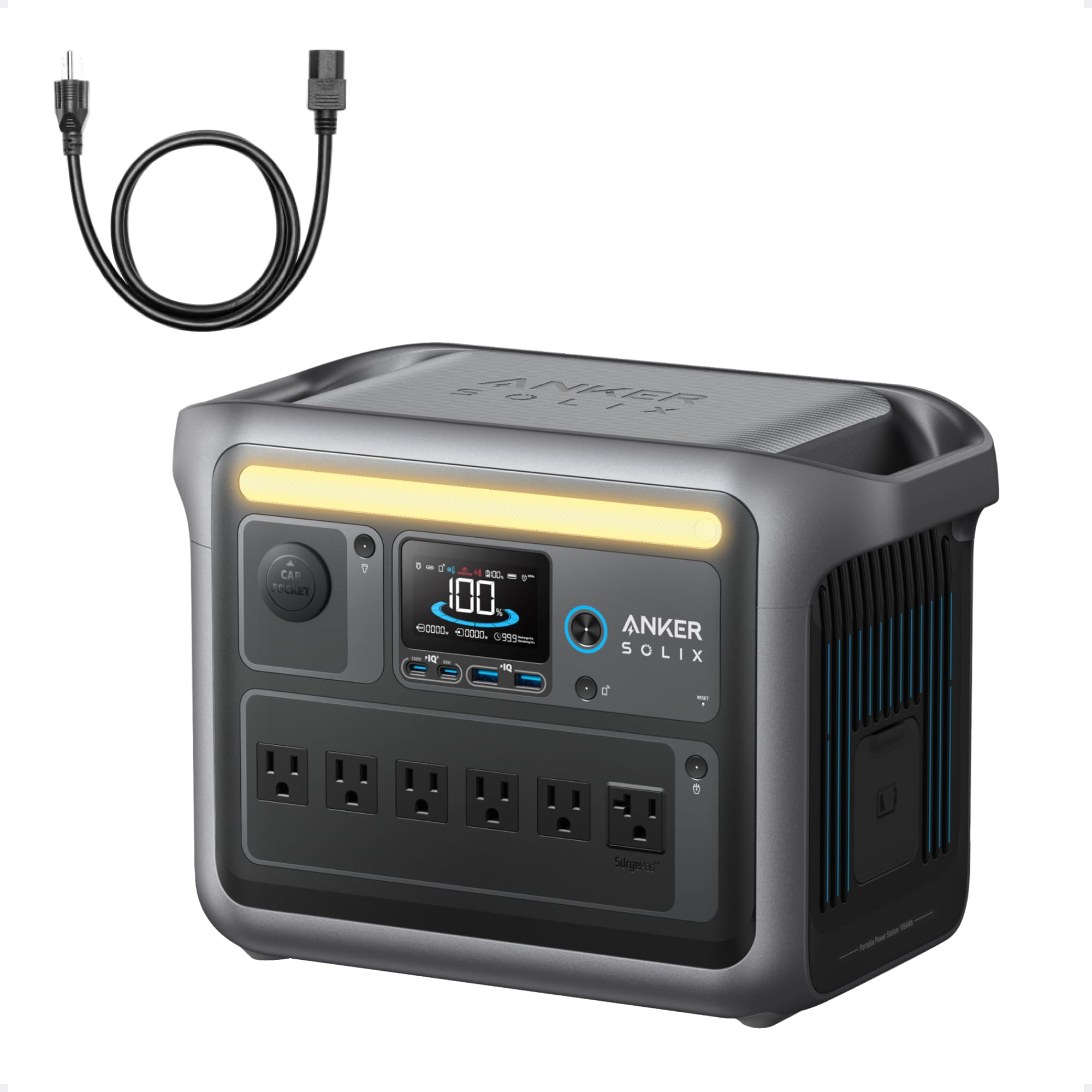
Anker Solix C1000 Solar Generator — Compact, Fast, Practical
Best for: Compact home and camping power
If portability matters more than maximum capacity, the C1000 is a strong compact option with 1,024Wh of capacity and 2,000W of AC output. That output is surprisingly capable for its size, covering many common appliances for short periods, while the smaller battery keeps the unit easier to carry and store. Solar-panel bundles, including a 200W panel option, make it a practical choice for camping and short outages. The trade-off is runtime: with just over 1,000Wh, you must be selective about loads and expect shorter use for energy-hungry devices. For compact power with real output, this is a sensible pick.
- Compact size for carrying
- 2,000W output for its size
- 200W solar-panel bundle option
- Shorter runtime than larger models
- Limited for sustained large loads
4.3/5
4.2/5
4.4/5

Goal Zero Yeti 1500X Solar Generator — Field-Tested Design, Older Battery
Best for: Camping and field work
If you work or camp in the field, the Yeti 1500X offers a familiar, rugged design with 1,516Wh of capacity and 2,000W of AC output. That combination supports cameras, laptops, lights, communications, and small tools, while solar panels keep the station going away from wall outlets. Goal Zero’s ecosystem is also well established for outdoor use, which helps when you need compatible panels and accessories. The main drawback is battery chemistry: unlike most newer models here, it does not use LiFePO4, so long-term cycle life is a weaker point. For field use where design and ecosystem matter, it remains a credible choice.
- Field-friendly design and ecosystem
- 2,000W output for field gear
- 1,516Wh capacity for trips
- Not LiFePO4 battery chemistry
- Heavier than compact rivals
4.2/5
4.2/5
4.1/5

EcoFlow RIVER 2 Pro Solar Generator — Small, Light, Limited
Best for: Small loads and short trips
If you only need power for phones, laptops, lights, cameras, and other small devices, the RIVER 2 Pro is the most portable option on this list. Its 768Wh capacity and 800W output are modest, but that smaller size makes it easy to carry, store, and take on short trips. Solar charging keeps it useful outdoors, and LiFePO4 chemistry supports frequent use. The limitation is obvious and important: it is not a home backup station, and it will not sustain a fridge or large appliance for long. Buy it for small, portable power, and choose a larger model above if home backup is the goal.
- Most portable model here
- LiFePO4 battery chemistry
- Good for phones and laptops
- Not suitable for home backup
- 800W output limits appliance choice
4.1/5
4.0/5
4.3/5
Top 3 Head-to-Head: EcoFlow DELTA 2 Max vs Jackery 2000 Plus vs BLUETTI AC300
These three are the most common final choices because they cover balanced backup, high output, and expandability. The right pick depends on whether you value balance, output, or growth.
| Feature | #1 DELTA 2 Max | #2 Jackery 2000 Plus | #3 BLUETTI AC300 |
|---|---|---|---|
| Solar Charging | 4.9/5 — Best | 4.8/5 | 4.7/5 |
| Capacity and Output | 4.9/5 | 4.8/5 | 4.8/5 — Best |
| Portability and Ease | 4.8/5 — Best | 4.7/5 | 4.4/5 |
| Choose if… | You want balanced backup with expansion | You want high output in a simple bundle | You want a system that can grow |
Who These Solar Generators Are NOT For
Solar generators are excellent for quiet, fuel-free backup, but they are not the right tool for every power job.
They are also a poor fit if you need continuous high-wattage power for days with little sunlight, because solar refill depends on weather and panel size. In that case, compare fuel-based options, including the best inverter generators, before choosing a solar-only setup.
Common Mistakes to Avoid
Most solar-generator disappointments come from sizing and panel mistakes, not from a bad brand.
Frequently Asked Questions About Portable Generators with Solar Panels
Can a portable generator run on solar panels alone?
Yes, a solar generator can run from its battery after charging from solar panels, but it does not generate power directly from panels without a battery in between. Panels charge the battery, and the inverter converts that stored energy to AC power. In practice, you need enough sunlight and panel wattage to refill what you use, or the battery will drain over time.
How long does it take to charge a solar generator with solar panels?
Charging time depends on battery size, total panel wattage, sunlight, panel angle, and shading. A small station with strong sun can refill in a few hours, while a large station with modest panels can take a full day or more. Check the maker’s solar input limit and the bundle’s panel wattage, then allow extra time for cloudy conditions.
What size solar generator do I need for a fridge?
A fridge needs both enough inverter output for startup surge and enough capacity for hours of cycling. As a starting point, look for at least 1,000Wh and an inverter that comfortably exceeds the fridge’s startup watts. Larger models on this list give more margin, especially if you also want lights, phones, and a router running at the same time.
Can I use any solar panel with a portable solar generator?
No, you should only use panels within the station’s voltage range, connector type, and maximum solar input. Many makers publish an approved panel list, and using an incompatible panel can reduce charging or risk damage. When in doubt, choose the maker’s own panels or a bundle designed for that exact station model.
Is a solar generator better than a gas generator?
A solar generator is quieter, needs no fuel storage, and can run indoors, which makes it better for short outages, camping, and sensitive electronics. A gas generator is usually better for continuous high-wattage loads and multi-day outages with little sun. The best choice depends on your loads, outage length, and whether you can place panels in direct sunlight.
Can a solar generator power an RV air conditioner?
Some large solar generators can start and run a small RV air conditioner for a short period, but runtime is usually limited by battery capacity. Check the air conditioner’s running and startup watts, then compare them with the station’s output and capacity. For regular air-conditioning use, a larger expandable system or a fuel generator is usually more practical.
Our Final Verdict
Solar generators trade unlimited fuel runtime for quiet, clean, indoor-safe power, so the best choice is the one that fits your real loads. For most buyers, a mid-to-large expandable station beats a tiny portable unit or an oversized whole-home approach.

Hi, I’m Michael Turner. I own a generator workshop in the United States and founded HomeGeneratorBlog to share practical, hands-on guidance about generator installation, maintenance, troubleshooting, safety, and backup power solutions. My goal is to help homeowners make smarter, more confident decisions through clear and reliable information