10 Best 4000 Watt Portable Generator Picks for 2026: Power, Portability, and Value
The 10 best 4000 watt portable generator picks start with the WEN GN400i, which delivers 3,500 running watts from a 70.4-pound inverter. We evaluated 10 generators by reviewing specifications, manuals, and verified owner feedback, scoring each on Power Output, Portability, and Value. Most 4000-watt units look identical on paper but differ sharply in weight, noise, and clean power for electronics. Whether you need RV power, home backup, or camping power, this guide gives you one clear answer.
Quick Comparison: All 10 Generators Ranked
| # | Product | Best For | Rating | Badge | |
|---|---|---|---|---|---|
| 1 | WEN GN400i | All-round backup and RV | 4.7/5 | Best Overall | Buy → |
| 2 | Champion 4000-Watt RV Ready | RV and electronics | 4.6/5 | Best for RV | Buy → |
| 3 | Champion 4500-Watt RV Ready | Bigger startup loads | 4.5/5 | Most Power | Buy → |
| 4 | PowerSmart 4000W Inverter | Value inverter shoppers | 4.4/5 | Best Value | Buy → |
| 5 | POXURIO DK4000iSA | Lightweight camping | 4.4/5 | Most Portable | Buy → |
| 6 | Pulsar PGD40ISCO | Compact tailgating | 4.3/5 | Best Compact | Buy → |
| 7 | Westinghouse iGen4500 | Frequent outages | 4.2/5 | Best Premium | Buy → |
| 8 | Westinghouse WGen3600DF | Gas or propane backup | 4.1/5 | Best Dual Fuel | Buy → |
| 9 | DuroStar DS4000S | Budget home backup | 4.0/5 | Best Budget | Buy → |
| 10 | DuroMax XP4400E | Electric-start backup | 3.9/5 | Best Electric Start | Buy → |
How We Chose These Generators
What we evaluated
We reviewed specifications, manuals, and verified owner feedback for 10 generators from 8 brands in the 4,000-watt class, covering both inverter and open-frame designs.
Our 3 scoring criteria
Each model is scored out of 5 on Power Output, Portability, and Value for Money. The overall rating is the average of the three, rounded to one decimal.
Sources consulted
Manufacturer manuals and product listings, plus U.S. Consumer Product Safety Commission guidance on generator placement and carbon monoxide safety.
What we cut, and why
We excluded battery power stations, generators far above or below the 4,000-watt class, and models without clear running-watt ratings.
What to Look for When Buying a 4000-Watt Portable Generator
A 4,000-watt label hides big differences in real output, noise, and weight. These four factors separate a generator you will love from one you will regret.
1. Running Watts vs. Starting Watts
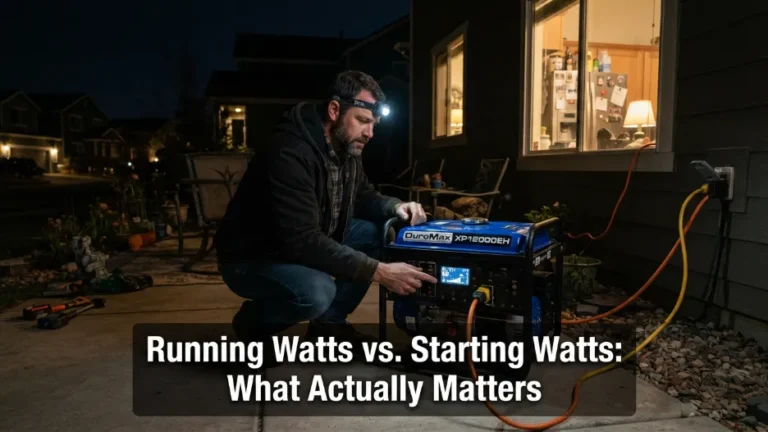
Running watts are what a generator supplies continuously, while starting watts are a brief surge that helps motors start. A 4,000-watt label usually refers to starting watts, and continuous output is closer to 3,200 to 3,500 watts. Add up everything you plan to run, then check the biggest startup surge using our explainer on running watts versus starting watts.
2. Inverter vs. Open-Frame Design
Inverter generators produce cleaner power and adjust engine speed to the load, which protects laptops, routers, and televisions. Open-frame generators usually deliver more output and larger tanks for the money, but they run louder. If sensitive electronics matter to you, read our inverter portable generator buying guide before deciding.
3. Safety Features and Placement
Look for low-oil shutoff and overload protection, and treat carbon monoxide as the main danger. Generators must run outdoors, at least 20 feet from the house, with the exhaust facing away from windows and doors. Our guide on where to place a portable generator covers surfaces, weather, and distance in detail.
4. Weight, Fuel Tank, and Runtime
Compact inverters weigh 44 to 70 pounds but carry small tanks, so they need frequent refills under heavy load. Larger open-frame units hold more fuel and run longer per fill, but a 92-pound frame is hard to move without wheels. Decide whether you will carry the generator often or park it in one spot.

WEN GN400i 4000-Watt RV-Ready Inverter Generator — Balanced power, RV-ready, easy to carry
Best for: All-round backup, camping, and RV use
If you want one generator that handles a camping weekend and a multi-day outage, this is the balanced choice. The GN400i delivers 4,000 starting and 3,500 running watts through an inverter, so laptops, routers, and a refrigerator stay on stable power. Its RV-ready outlet suits trailer hookups, and the 1.85-gallon tank keeps the weight at 70.4 pounds. That small tank is the trade-off: you will refuel more often under heavy load than with larger open-frame units. For most buyers, the mix of clean power, manageable weight, and RV compatibility makes it the safest single recommendation here.
- 3,500 running watts from an inverter
- RV-ready outlet for trailer hookups
- Only 70.4 pounds for 4,000 watts
- Small 1.85-gallon tank needs frequent refills
- Heavier loads shorten runtime noticeably
4.7/5
4.6/5
4.8/5

Champion 4000-Watt RV Ready Portable Inverter Generator — Quiet RV power with clean output
Best for: RV owners and electronics-heavy setups
Anyone parking an RV or tailgating wants quiet, clean power without hauling a heavy frame. The Champion 4000-Watt RV Ready inverter generator offers 4,000 starting watts and about 3,500 running watts, enough for an RV air conditioner with careful load management. The inverter design protects phones, laptops, and televisions, and the 30-amp RV outlet saves you from adapters. The limitation is runtime: inverter tanks are smaller than open-frame models, so overnight use under heavy load means a refill. Choose it if noise and electronics safety matter more than raw tank size.
- 30-amp RV outlet, no adapters
- Inverter power safe for electronics
- 4,000 starting watts for motor startups
- Smaller tank limits heavy-load runtime
- Not ideal for whole-house backup
4.8/5
4.5/5
4.4/5

Champion 4500-Watt RV Ready Portable Inverter Generator — Extra headroom for tougher startups
Best for: RV air conditioning and bigger startup surges
Buyers who run an RV air conditioner and still want headroom will appreciate this step up. The Champion 4500-Watt RV Ready inverter generator provides 4,500 starting watts, which handles motor startup surges more comfortably than the 4,000-watt class. Like its smaller sibling, it combines inverter-clean output with an RV-ready outlet, so sensitive electronics stay protected. It burns more fuel under load and weighs more than the lighter inverters on this list, and the extra capacity is wasted if you only charge phones. Pick it when appliances with high startup demand are part of your plan.
- 4,500 starting watts for tougher startups
- Inverter-clean output for electronics
- RV-ready outlet included
- Heavier than compact 4,000-watt inverters
- Overkill for charging phones only
4.9/5
4.2/5
4.3/5

PowerSmart 4000-Watt Portable Inverter Generator — Inverter output at a friendly value
Best for: Shoppers who want inverter power on a budget
Shoppers who want inverter output without a premium brand tag should look here first. The PowerSmart 4000-watt inverter generator lists a total harmonic distortion below 3 percent, which is the figure to watch if you plan to run laptops, routers, and phone chargers. It targets camping and home backup alike, and its inverter design keeps engine speed matched to load. The trade-off is brand maturity: parts availability and long-term support are less proven than at Champion or Westinghouse, so check warranty terms before buying. Weigh that against its strong value for the money.
- Claimed THD below 3 percent
- Inverter design suits electronics
- Strong value for the money
- Less proven brand and parts support
- Check warranty terms before buying
4.2/5
4.4/5
4.5/5
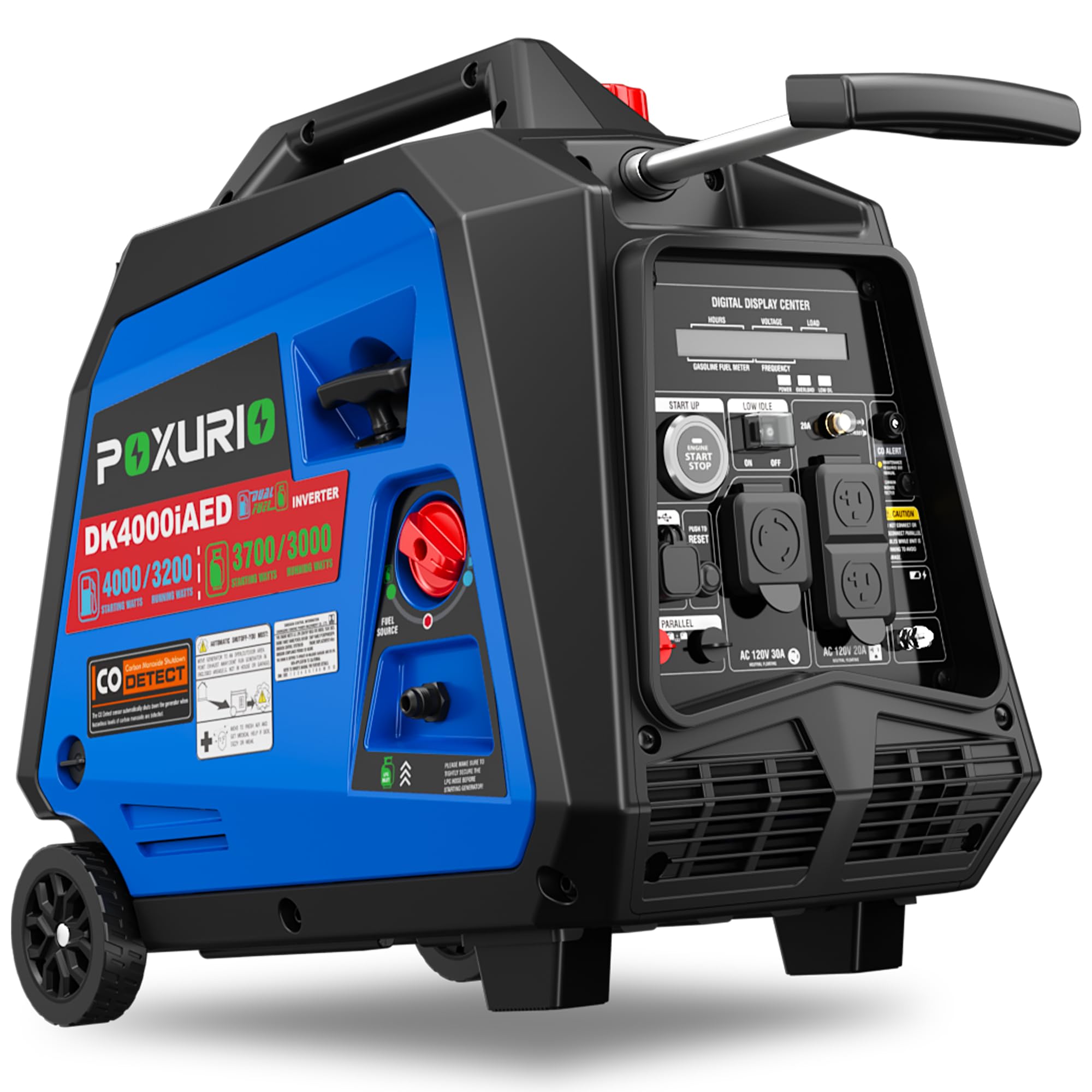
POXURIO DK4000iSA 4000W Inverter Generator — Ultralight 4,000-watt power for travel
Best for: Campers and tailgaters who carry their generator
If you carry your generator to campsites, tailgates, or job sites, weight decides everything. The POXURIO DK4000iSA lists 4,000 starting and 3,200 running watts at just 44.1 pounds, making it one of the lightest generators here. That lightness comes with a one-gallon tank, so heavy loads drain it quickly and you will refuel often. Its light frame also fits a car trunk without a ramp, which many heavier units cannot do. It suits short outages and recreation better than all-night backup. Buy it for portability and inverter-clean power, not for long unattended runtimes.
- Just 44.1 pounds
- Inverter-clean power for devices
- 3,200 running watts
- One-gallon tank drains quickly
- Not built for all-night backup
4.2/5
4.7/5
4.3/5

Pulsar PGD40ISCO 4000W Portable Inverter Generator — Compact inverter for camping and tailgating
Best for: Weekend campers and tailgaters
Weekend campers and tailgaters who want 4,000-watt capacity in a carry-friendly body should consider the Pulsar PGD40ISCO. It lists 4,000 starting and 3,200 running watts, weighs 47.3 pounds, and uses an inverter for clean electronics power. Like other compact inverters here, it carries a one-gallon tank, so runtime under heavy load is short and refueling is frequent. The lighter frame is its main advantage over open-frame competitors. It makes sense as a recreation and short-outage unit rather than a primary backup. Compare its warranty and parts support against better-known brands before you commit.
- 47.3 pounds, easy to carry
- 3,200 running watts
- Inverter output for electronics
- One-gallon tank means frequent refueling
- Less proven parts support
4.2/5
4.6/5
4.2/5

Westinghouse iGen4500 Portable Inverter Generator — Premium inverter with remote start
Best for: Homeowners facing frequent outages
Homeowners who want a premium inverter with push-button convenience will find it in the Westinghouse iGen4500. It lists 4,500 peak and 3,700 running watts, and the remote start fob lets you fire it up from indoors during a storm. Inverter output keeps sensitive electronics safe, and the extra headroom over 4,000-watt models handles bigger startup surges. The downside is weight and expense: it is heavier than the camping-focused inverters here, so you will want to keep it on a level spot and move it rarely. It is a strong choice for frequent outages.
- Remote start fob from indoors
- 3,700 running watts
- Inverter-clean power
- Heavier than camping inverters
- Premium-priced versus other inverters
4.8/5
3.9/5
3.8/5

Westinghouse WGen3600DF Dual Fuel Portable Generator — Gas or propane flexibility for backup
Best for: Storm-prone homes that want fuel flexibility
Anyone who worries about fuel shortages during storms will value a generator that runs on gasoline or propane. The Westinghouse WGen3600DF lists 4,650 peak watts, about 3,650 running watts on gasoline, and electric start with a remote fob for easy starting. Propane lowers output compared with gasoline, so size your loads against the lower figure if you plan to store propane. It is an open-frame model with no inverter, so it runs louder and is less ideal for delicate electronics. It is best for home backup flexibility, not for quiet camping.
- Runs on gasoline or propane
- Electric start with remote fob
- 4,650 peak watts
- Propane reduces available output
- Open-frame design runs louder
4.6/5
3.4/5
4.4/5

DuroStar DS4000S 4000-Watt Portable Generator — Big tank, big weight, budget-friendly
Best for: Budget-minded home backup that stays in one place
Budget-minded homeowners who want 4,000 watts for outage essentials should start with the DuroStar DS4000S. It lists 4,000 peak and 3,300 running watts from a 3.96-gallon tank, which gives far longer runtime per fill than compact inverters. It is CARB and EPA approved and includes low-oil shutoff to protect the engine. The trade-offs are weight and portability: at 92 pounds with no wheel kit included, it is awkward to move alone, and its open-frame design is louder and less suited to sensitive electronics. It is a workhorse for the money, not a camping companion.
- 3.96-gallon tank, long runtime
- Low-oil shutoff protects engine
- CARB and EPA approved
- 92 pounds, no wheel kit included
- Louder open-frame design
4.3/5
2.8/5
4.8/5

DuroMax XP4400E 4400-Watt Portable Generator — Electric start without the inverter
Best for: Tools, pumps, and simple home backup
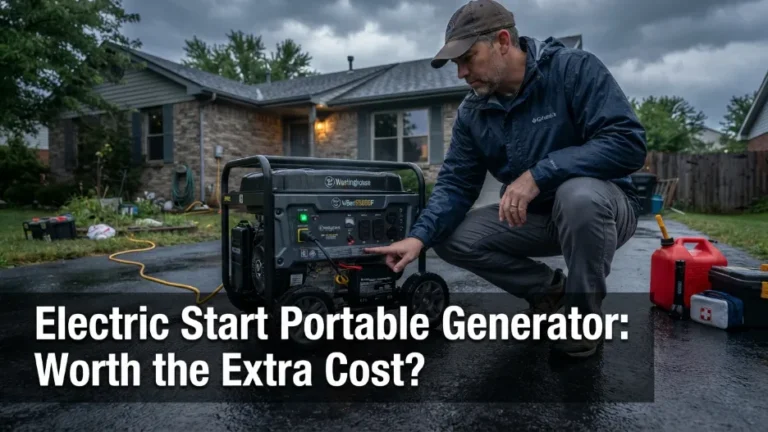
Do you want push-button starting without paying for an inverter? The DuroMax XP4400E lists 4,400 peak and 3,500 running watts, and its electric start spares you from pulling a cord when the power is out. Its open-frame design delivers more raw output for the money than inverter models, which suits tools, pumps, and appliances. The cost is noise and power quality: it runs louder than an inverter and is not the best match for sensitive electronics without a surge protector. It is a practical backup unit when convenience matters more than quiet.
- Electric start, no cord pulling
- 3,500 running watts
- Strong output for the money
- Louder than any inverter here
- Needs surge protection for electronics
4.5/5
3.1/5
4.2/5
Top 3 Head-to-Head: WEN GN400i vs Champion 4000 vs Champion 4500
These three RV-ready inverters are the most common final choices because they pair clean power with an RV outlet. The real question is whether you value weight and value, or extra startup headroom.
| Feature | #1 WEN GN400i | #2 Champion 4000 | #3 Champion 4500 |
|---|---|---|---|
| Starting watts | 4,000 W | 4,000 W | 4,500 W — Best |
| Portability score | 4.6/5 — Best | 4.5/5 | 4.2/5 |
| Value score | 4.8/5 — Best | 4.4/5 | 4.3/5 |
| Choose if… | You want the best all-round balance | You want quiet RV power with clean output | You need extra startup headroom |
Who These Generators Are NOT For
A 4,000-watt portable generator is a smart middle size, but it is not the right tool for every job.
Skip the compact inverters if you need unattended overnight runtime, because their one-gallon tanks demand refills. Skip the open-frame models if you mainly power laptops and routers and care about quiet.
Common Mistakes to Avoid
Most generator problems come from a handful of avoidable errors.
Frequently Asked Questions About 4000-Watt Portable Generators
What can a 4000 watt generator run?
A 4000-watt generator can run a refrigerator, a few lights, a router, a television, and a window air conditioner or microwave, as long as the combined running watts stay below the rated running output, typically 3,200 to 3,500 watts. Add up the running watts of everything first, then check the largest startup surge. Do not run a space heater, a microwave, and a window air conditioner at the same moment.
Can a 4000 watt generator run a house?
Not a whole house. A 4000-watt generator can power essentials such as a refrigerator, lights, a sump pump, and electronics, but it cannot support central air conditioning, an electric range, or an electric water heater together. Use a properly installed transfer switch or inlet, rotate your high-demand appliances, and never plug the generator into a wall outlet, which can backfeed power and endanger utility workers.
How long does a 4000 watt generator run on one tank?
It depends on tank size and load, so no single number applies. Compact inverter models with roughly one-gallon tanks run only a few hours at heavy load, while open-frame units with larger tanks, such as a 3.96-gallon design, run considerably longer per fill. Running at about half load stretches fuel, and checking the manufacturer’s runtime rating for your model gives the most reliable estimate.
Is an inverter generator better than a conventional 4000 watt generator?
For electronics and quiet operation, yes. Inverter models produce cleaner power with low harmonic distortion and adjust engine speed to the load, which suits laptops, routers, and campsites. Conventional open-frame generators usually offer larger fuel tanks and more output for the money, which suits tools and basic home backup. Choose by what you plug in, not by the label alone.
How far should a portable generator be from your house?
Place it outdoors at least 20 feet from your home, with the exhaust pointed away from doors, windows, and vents. Never run a generator in a garage, basement, or enclosed space, even with the door open, because carbon monoxide can build up quickly. Install battery-powered carbon monoxide alarms inside the home and keep the generator on a flat, dry surface.
Can a 4000 watt generator run an RV air conditioner?
Often yes, for a single 13,500 BTU unit when little else is running, but check the air conditioner’s startup surge against the generator’s starting watts. Models with 4,000 or more starting watts and an RV-ready 30-amp outlet fit best. A soft-start device can reduce startup demand, and turning off other high-draw appliances prevents overload.
Our Final Verdict
The 4000-watt class is a sweet spot for outages, camping, and RV use, but the real trade-off is clean inverter power and portability against bigger tanks and raw output. Most buyers should start with the WEN GN400i, then move to a Champion model if RV air conditioning or higher startup demand is on the list.

Hi, I’m Michael Turner. I own a generator workshop in the United States and founded HomeGeneratorBlog to share practical, hands-on guidance about generator installation, maintenance, troubleshooting, safety, and backup power solutions. My goal is to help homeowners make smarter, more confident decisions through clear and reliable information