10 Best Portable Inverter Generator Picks for 2026: Quiet, Clean Power
Of the 10 best portable inverter generator models, the Honda EU2200i wins — it runs up to 8.1 hours on 0.95 gallons of gas. We evaluated 10 models by scoring each on quietness, portability, and power-to-runtime using published specs and independent reviews. Most look alike on paper but get loud under real load — and that gap shaped every ranking. Whether you need camping power, RV air conditioning, or outage backup, this guide gives you one clear answer.
Quick Comparison: All 10 Portable Inverter Generators Ranked
| # | Product | Best For | Rating | Badge | |
|---|---|---|---|---|---|
| 1 | Honda EU2200i | Quiet camping and light backup | 4.7/5 | Best Overall | Buy → |
| 2 | Westinghouse iGen4500 | RV and heavier loads | 4.4/5 | Most Power | Buy → |
| 3 | Champion 4000W Dual Fuel | Dual fuel RV use | 4.3/5 | Best Dual Fuel | Buy → |
| 4 | Yamaha EF2200iS | Longer runtime camping | 4.3/5 | Best Honda Alternative | Buy → |
| 5 | Honda EU3000iS | Quiet RV and backup power | 4.2/5 | Best Premium | Buy → |
| 6 | WEN DF360iX | Light dual fuel use | 4.0/5 | Best Value Dual Fuel | Buy → |
| 7 | Cummins Onan P2500i | Quiet camps, small loads | 4.0/5 | Quietest Eco Mode | Buy → |
| 8 | FIRMAN WH03242 | Dual fuel with CO shutdown | 3.8/5 | Best CO Alert | Buy → |
| 9 | WEN 56235i | Budget and lightest carry | 3.8/5 | Best Budget | Buy → |
| 10 | Generac GP3000i | RV motor starting | 3.7/5 | Best Starting Power | Buy → |
How We Chose These Portable Inverter Generators
What we compared
We reviewed manufacturer spec sheets, noise ratings, runtime figures, and safety features for 10 inverter generators ranging from 1,800 to 3,700 running watts.
Our 3 scoring criteria
Every model is scored out of 5 on quietness, portability, and power and runtime. The overall rating is the average of the three.
Where the data comes from
Spec figures come from manufacturer and dealer spec sheets. Owner-reported details, such as real-world noise or propane runtime, are labeled as reported.
What we cut and why
Open-frame generators (louder, less clean power) and battery power stations (a different product category) were left out to keep this list strictly inverter generators.
What to Look for When Buying a Portable Inverter Generator
An inverter generator adjusts engine speed to the load, which is why it runs quieter and produces cleaner power than a conventional model; our generator versus inverter explainer covers the full difference. The five factors below decide which of these ten fits you.
1. Running Watts vs Starting Watts
Add up the running watts of everything you will power at once, then account for the largest motor starting surge. The Honda EU2200i offers 1,800 running and 2,200 peak watts, while the Westinghouse iGen4500 offers 3,700 and 4,500. Our guide to running watts versus starting watts shows how to do the math.
2. Real-World Noise Level
Decibel ratings only compare fairly when the load and distance match. Honda lists 48 dB(A) at quarter load and 57 dB(A) at rated load, while Champion lists 64 dBA at 23 feet. A few decibels is a noticeable difference at a quiet campsite or on a shared street.
3. Fuel Type and Runtime
Gasoline-only models are simpler, while dual fuel models such as the Champion 4000-watt and WEN DF360iX can switch to propane. Propane stores well but reduces output, for example from 3,300 to 2,970 running watts on the Champion. Read our dual fuel generator guide before you decide.
4. Weight and Portability
The lightest option here, the WEN 56235i, weighs 39 pounds, while the Honda EU3000iS weighs about 131 pounds dry. If you load and unload the generator often, weight matters more than a few hundred extra watts.
5. Safety Features
Carbon monoxide shutdown is the feature to prioritize. The Champion has CO Shield, the FIRMAN has CO Alert, the WEN DF360iX has CO Watchdog, and the Honda EU3000iS has CO-Minder. Our carbon monoxide safety guide explains safe placement and alarms.
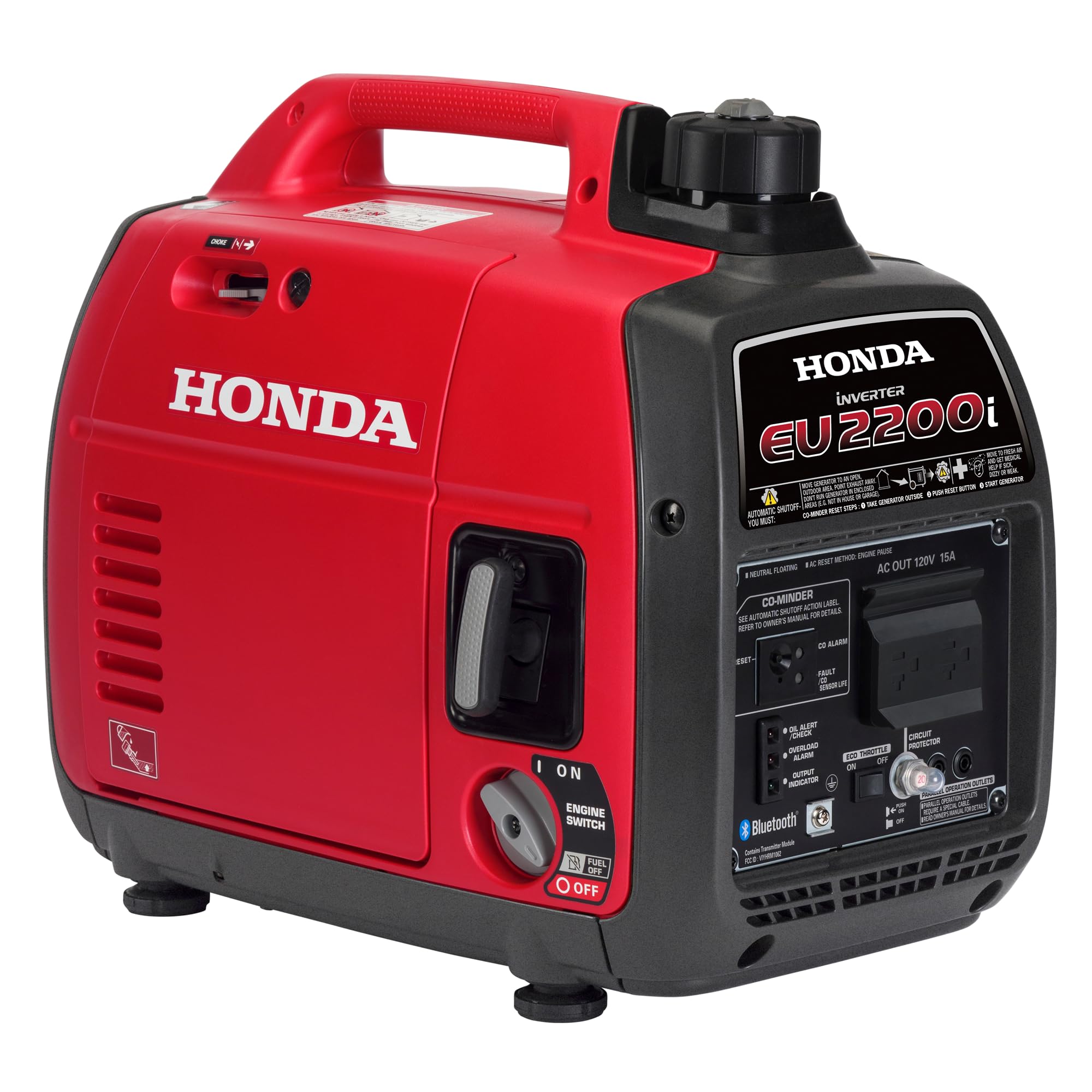
Honda EU2200i 2200-Watt Portable Inverter Generator — Quiet, Light, and Easy to Trust
Best for: Camping, tailgating, and small outage loads
If you want a generator that disappears into the background of a campsite or a quiet street, the Honda EU2200i is the one to beat. It delivers 1,800 running watts and 2,200 peak watts from a 121cc GXR120 engine, enough for a fridge, lights, and a laptop, though not a space heater at the same time. Honda rates it at 48 dB(A) at quarter load and 57 dB(A) at full load, and Eco Throttle stretches one 0.95-gallon tank to 8.1 hours. The trade-off is power: an RV air conditioner is out of reach without a second unit in parallel.
- 48 dB(A) at quarter load
- About 47 pounds dry weight
- Up to 8.1 hours per tank
- Parallel-ready with a second unit
- Only 1,800 running watts
- Recoil start only
- 3.2-hour runtime at full load
4.9/5
4.7/5
4.5/5

Westinghouse iGen4500 4,500-Watt Portable Inverter Generator — Big Power, Remote Start, Still Quiet
Best for: RV air conditioners and whole-camp power
The Westinghouse iGen4500 is the pick when 2,000-watt generators fall short. It provides 3,700 running watts and 4,500 peak watts, includes a TT-30R RV outlet, and starts from a key fob, a push button, or a recoil pull. Westinghouse lists a 3.4-gallon tank good for 16 to 18 hours at quarter load, with total harmonic distortion under 3 percent for sensitive electronics, and the iGen4500c page cites 52 dBA. The cost of that capability is bulk: it uses a telescoping handle and never-flat wheels, so you roll it rather than carry it, and you will want a vehicle to move it.
- 3,700 running watts, 4,500 peak
- Remote key fob start included
- 16 to 18 hours at 25% load
- Under 3% THD, clean power
- Heavy; rolls rather than carries
- Gasoline only, no propane
4.6/5
3.6/5
4.9/5

Champion Power Equipment 4000-Watt Dual Fuel RV Ready Portable Inverter Generator — Gas or Propane Under 55 Pounds
Best for: RV owners who want fuel flexibility
Champion’s 4000-watt dual fuel inverter is the practical choice if fuel availability worries you. On gasoline it produces 4,000 starting and 3,300 running watts; on propane it drops to 2,970 running watts from a 20-pound tank. Electric start, a TT-30R RV outlet, and CO Shield automatic shutdown come standard, and the 149cc engine is rated 64 dBA at 23 feet. At under 55 pounds it is unusually light for this wattage class. Expect more noise than the Honda or Yamaha, and note that Champion sells the parallel kit separately.
- Runs on gasoline or propane
- Under 55 pounds for 4,000 starting watts
- CO Shield automatic shutoff included
- Electric start with TT-30R outlet
- 64 dBA at 23 feet; louder
- Parallel kit sold separately
- Propane output drops to 2,970 watts
4.0/5
4.3/5
4.7/5
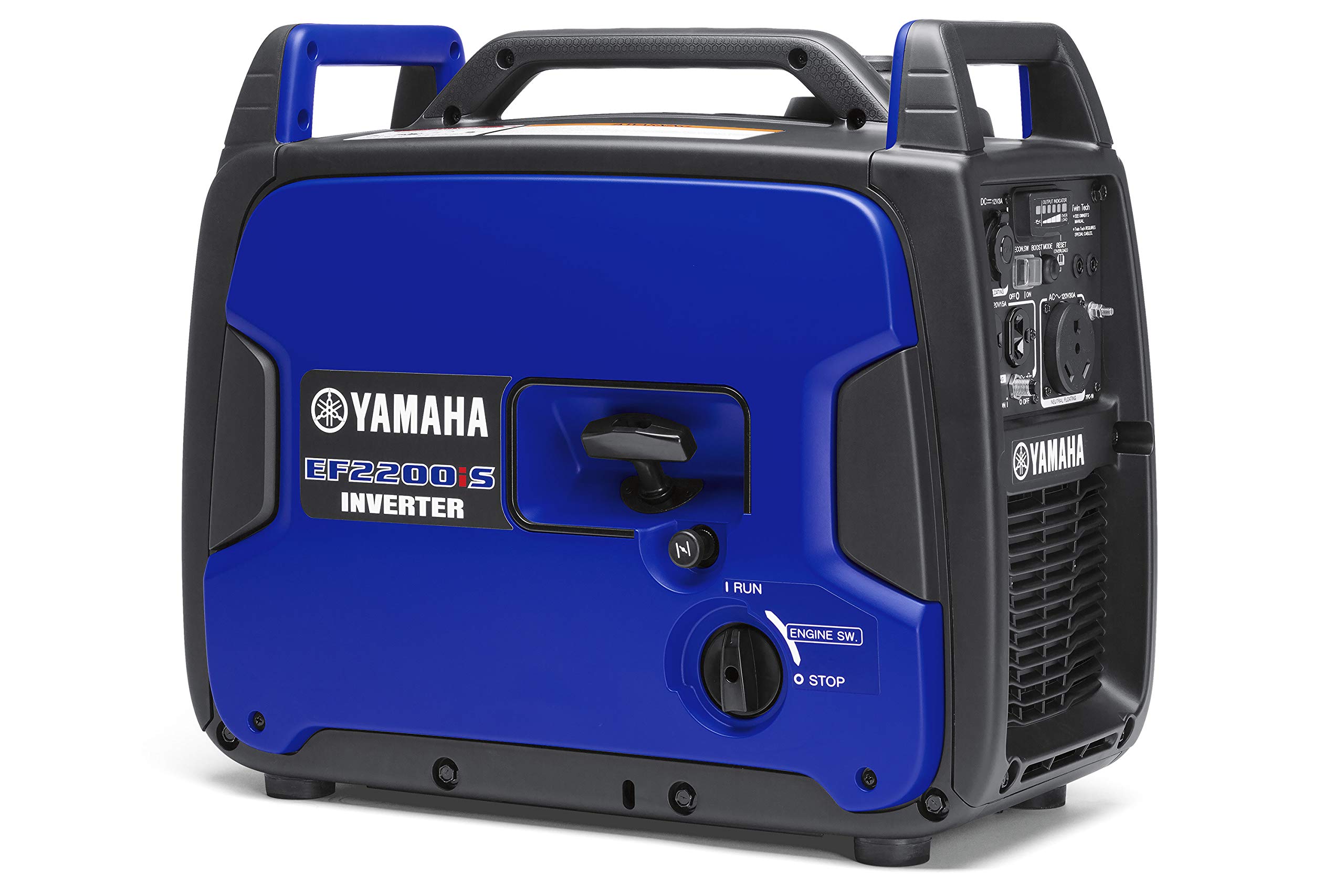
Yamaha EF2200iS 2200-Watt Portable Inverter Generator — Longer Runtime Than Its Honda Rival
Best for: Campers who want longer runtime
Yamaha’s EF2200iS matches the Honda on output, with 1,800 rated and 2,200 peak watts, but stretches a 1.24-gallon tank to 10.5 hours at quarter load. Smart Throttle adjusts engine speed to the load, and the Smart Dial handles start, run, and stop. Noise is rated at 57 to 65 dBA, a few decibels above Honda’s published range. At 55.2 pounds it is heavier than the Honda, but the tri-carry handle lets two people lift it comfortably. Twin Tech parallel capability and a 3-year warranty round out a strong, slightly noisier alternative.
- 10.5 hours at quarter load
- Smart Throttle matches engine speed to load
- Tri-carry handle for two-person lifts
- 3-year limited warranty
- 55.2 lb; heavier than Honda
- Louder at full load, 65 dBA
4.4/5
4.0/5
4.4/5

Honda EU3000iS 3000-Watt Portable Inverter Generator — Premium Quiet Power for Bigger Loads
Best for: Quiet RV and home backup power
The Honda EU3000iS is the step-up for buyers who found 2,200 watts too small but still want near-silent operation. Its GX200 engine produces 3,000 peak and 2,800 rated watts, enough for most 13,500 BTU RV air conditioners according to Honda, and electric start plus CO-Minder are built in. Honda publishes 58 dB(A) at rated load and 49 dB(A) at quarter load, with a 3.4-gallon tank running up to about 20 hours at quarter load. The compromise is size: at about 131 pounds dry it is a two-person lift or a cart job, and it sits at the premium end of the market.
- 2,800 running watts, electric start
- 49 dB(A) at quarter load
- Up to 20 hours at quarter load
- CO-Minder shutdown built in
- About 131 pounds; hard to carry
- Premium-tier cost
4.8/5
2.8/5
4.9/5

WEN DF360iX 3600-Watt Dual Fuel RV-Ready Portable Inverter Generator — Dual Fuel at a Lighter Weight
Best for: Budget-minded RV and outage use
WEN’s DF360iX brings dual fuel capability to a 49-pound frame, which is the main reason to shortlist it. On gasoline it makes 3,600 surge and 2,900 running watts; on propane that falls to 3,500 and 2,600. It is RV-ready, includes a CO Watchdog sensor and fuel shutoff, and reviewers describe the noise at around 65 dB. The weak spot is runtime: the 1.3-gallon tank is small, and owners report propane runtime closer to 6 hours than the claimed 14. Treat it as a light, versatile generator for shorter sessions rather than overnight duty.
- 49 pounds with dual fuel
- CO Watchdog and fuel shutoff
- 2,900 running watts on gasoline
- RV-ready outlet
- Propane runtime near 6 hours reported
- Around 65 dB; louder than Honda
- Small 1.3-gallon tank
3.9/5
4.1/5
3.9/5

Cummins Onan P2500i 2500-Watt Portable Inverter Generator — Quiet Eco Mode in a Compact Frame
Best for: Quiet camps and small backup loads
Cummins’ Onan P2500i targets buyers who want more headroom than a 2,000-watt generator without much more weight. It delivers 2,200 running and 2,500 peak watts from a 98cc engine, with a 1-gallon tank rated for 10 hours at 25 percent load. Cummins lists 52 dB in eco mode, and total harmonic distortion stays under 3 percent for laptops and phones. Two USB ports, an LED display, and parallel capability add convenience. The limitations are real: starting is recoil only, no RV-ready outlet is listed, and one dealer notes the model is not sold in California.
- 52 dB in eco mode
- 48 pounds dry weight
- Under 3% THD for electronics
- LED display and USB ports
- Recoil start only
- No 30-amp RV outlet listed
- Not sold in California (per dealer)
4.4/5
4.2/5
3.4/5

FIRMAN WH03242 Dual Fuel 4000W Inverter Portable Generator with CO Alert — Electric Start Dual Fuel With CO Alert
Best for: Home backup and RV use with CO shutdown
The FIRMAN WH03242 is built for buyers who want electric start, dual fuel, and carbon monoxide protection in one package. Gasoline output is 3,200 running and 4,000 peak watts; propane is 3,000 and 3,750. A 193cc engine, TT-30R RV outlet, and CO Alert shutdown are included, and FIRMAN rates it at 57 to 58 dB. Runtime is listed at 9 hours at 25 percent load from a 1.8-gallon tank. At 90 pounds it is awkward to carry alone, so plan on a second person or a hand truck, and the 3-year warranty is a reassuring extra.
- CO Alert shutdown included
- Electric and recoil start
- 3,200 running watts on gasoline
- Gasoline or propane operation
- About 90 lb; awkward alone
- Propane drops to 3,000 running watts
4.2/5
3.0/5
4.3/5

WEN 56235i Super Quiet 2350-Watt Portable Inverter Generator — Lightest, Simplest Starter Inverter
Best for: Budget tailgating and light camp loads
At 39 pounds, the WEN 56235i is the lightest generator on this list, and it is the easiest entry point into inverter power. It produces 2,350 surge and 1,900 rated watts, enough for a fridge, a TV, and lights, and WEN lists 10.5 hours of runtime at quarter load. Total harmonic distortion stays under 1.2 percent at full load, which is safe for laptops. Fuel shutoff protects the carburetor in storage. Owners report readings around 57 to 62 dB depending on load and distance, so it is less polished than premium Honda or Yamaha models, and its small tank means frequent refills under heavier loads.
- 39 pounds; easiest to carry
- 10.5 hours at quarter load
- THD under 1.2% at full load
- Fuel shutoff for storage
- Reported 57 to 62 dB; louder than Honda
- Only 1,900 running watts
3.4/5
4.8/5
3.2/5

Generac GP3000i 3000-Watt Portable Inverter Generator — Extra Starting Power for RV Essentials
Best for: RV essentials and motor-driven loads
Generac’s GP3000i is aimed at RV owners who need more motor-starting capacity than a 2,200-watt generator offers. It produces 3,000 peak and 2,300 rated watts, and PowerRush technology gives over 50 percent more starting capacity for loads such as air conditioners and pumps. An L5-30R RV outlet, two household outlets, and two USB ports are built in, and a PowerDial combines choke, run, and off. At about 59.5 pounds it is reasonably portable. The weak point is runtime: the 1.06-gallon tank gives about 4.5 hours at half load, and starting is recoil only.
- 50% more starting capacity
- L5-30R RV outlet included
- 59.5 pounds; easy to carry
- USB ports; parallel-ready
- About 4.5 hours at half load
- Recoil start only
- 2,300 running watts; modest for class
3.6/5
3.7/5
3.9/5
Top 3 Head-to-Head: Honda EU2200i vs Westinghouse iGen4500 vs Champion 4000W
These three are the most common final choices because they cover the main decisions: quiet and light, powerful and remote-start, or dual fuel and RV-ready. Spec figures use each maker’s own load and distance conditions.
| Feature | #1 Honda EU2200i | #2 Westinghouse iGen4500 | #3 Champion 4000W Dual Fuel |
|---|---|---|---|
| Running watts (gas) | 1,800 | 3,700 — Best | 3,300 |
| Noise spec | 48 dB(A) at 1/4 load — Best | 52 dBA (published) | 64 dBA at 23 ft |
| Runtime figure | Up to 8.1 hr at 1/4 load | 16 to 18 hr at 25% load — Best | Up to 10 hr at 25% load |
| Fuel options | Gasoline | Gasoline | Gasoline or propane — Best |
| Choose if… | You want the quietest, lightest option | You need RV air conditioning power | You want gas or propane flexibility |
Who These Portable Inverter Generators Are NOT For
Inverter generators are excellent at quiet, clean power, but they are not the right tool for every job.
If you own a large RV, a 13,500 BTU air conditioner plus other appliances can overwhelm a 2,200-watt unit, so read our RV generator sizing guide before choosing. If you want zero fuel and zero exhaust, a battery power station fits better, with less total runtime.
Common Mistakes to Avoid
Most inverter generator regrets come from a handful of avoidable errors.
Frequently Asked Questions About Portable Inverter Generators
What size inverter generator do I need?
Add up the running watts of everything you plan to power at once, then add the largest starting surge on top. Leave roughly 20 percent headroom so the generator is not maxed out. A 2,200-watt model like the Honda EU2200i suits camping and small outage loads, while RV air conditioners and larger appliances call for the 3,000 to 4,000-watt class.
Is an inverter generator worth it?
Yes, if you value quiet operation, clean power for laptops and phones, and better fuel economy. Inverter models cost more per watt than open-frame generators and top out at lower output, so they are less suited to whole-house backup. For camping, tailgating, RVs, and basic outage power, the extra quiet and cleaner electricity are usually worth the premium.
Can you run a refrigerator on an inverter generator?
Yes, as long as the generator covers the refrigerator’s starting surge, which can be several times its running wattage. Check the appliance label for both figures. A 2,200-watt unit such as the Honda EU2200i or Yamaha EF2200iS generally handles one household refrigerator, but not alongside a microwave or space heater.
How long can you run a portable inverter generator continuously?
The fuel tank sets the limit. The Honda EU2200i runs 3.2 hours at rated load and up to 8.1 hours at quarter load, while the Westinghouse iGen4500 lists 16 to 18 hours at 25 percent load. Let the engine cool before refueling, and follow your manual’s oil and maintenance schedule if you run it for days.
What is the difference between an inverter generator and a regular generator?
An inverter generator converts raw output into stable, clean electricity and adjusts engine speed to match the load. That makes it quieter, more fuel-efficient, and safer for sensitive electronics. A regular generator runs at a fixed speed, so it is louder and less efficient, but it often delivers more wattage for the same money.
Can an inverter generator run an RV air conditioner?
Often yes, if it is large enough. Most 13,500 BTU units need a 3,000-watt-class generator; the Honda EU3000iS and Generac GP3000i are both marketed for that, while 2,200-watt models generally cover only smaller or soft-start units. Check your air conditioner’s starting watts first, and confirm the generator has a 30-amp RV outlet.
Can you run an inverter generator in the rain?
Not unprotected. Rain can reach outlets and electrical parts, so use a purpose-built generator canopy or open-sided shelter that keeps the exhaust clear, and never run it in a garage, tent, or closed box. Place it outdoors at least 20 feet from the house with the exhaust pointed away, and shut it off to refuel.
Our Final Verdict
The Honda EU2200i is the safest all-round choice for campsites and light backup. If you need to run an RV air conditioner, step up to the Westinghouse iGen4500 or the Champion 4000-watt dual fuel. Buy by the loads you actually run, and treat dB ratings as comparisons, not promises.

Hi, I’m Michael Turner. I own a generator workshop in the United States and founded HomeGeneratorBlog to share practical, hands-on guidance about generator installation, maintenance, troubleshooting, safety, and backup power solutions. My goal is to help homeowners make smarter, more confident decisions through clear and reliable information