
Running Watts vs. Starting Watts: What Actually Matters
Quick answer: Running watts are the steady power a device needs once it’s already on. Starting watts (also called surge or peak watts) are the short, extra burst — often 2-3x higher — that motor-driven appliances need for a second or two at startup. Your generator has to cover both, which is why the “starting watts” number on the box matters more than most buyers realize.
If you’ve ever watched a generator’s display flicker and then shut down the instant a fridge kicked on, you already know why this distinction matters. It’s rarely the generator’s running capacity that fails you during an outage. It’s the surge.
What Are Running Watts?

Running watts — sometimes labeled rated watts — are the amount of power a device draws continuously while it’s operating normally. A microwave pulling 1,000 watts to reheat your coffee is drawing 1,000 running watts the entire time it’s on. There’s no spike, no surge. It’s a flat, predictable number.
Most electronics work this way: TVs, laptops, phone chargers, LED lights, routers. What you see on the label is what you get, for as long as the thing stays plugged in.
What Are Starting Watts?
Starting watts are the extra jolt of power a motor-driven appliance needs for a moment — usually two to five seconds — to overcome the mechanical resistance of getting a compressor, fan, or pump moving from a dead stop. Once the motor is spinning, power demand drops back down to the running watts number.
This is basic physics: it takes more force to get something moving than to keep it moving. Think about pushing a stalled car — the hardest part is the first few feet.
Refrigerators, sump pumps, well pumps, air conditioners, table saws, and garage door openers all do this. A refrigerator that runs at 700 watts might briefly demand 2,000+ watts just to get its compressor started.
Running Watts vs. Starting Watts at a Glance
| Factor | Running Watts | Starting Watts |
|---|---|---|
| Also called | Rated watts, continuous watts | Surge watts, peak watts |
| Duration | As long as the device runs | 2-5 seconds, at startup only |
| Applies to | Every powered device | Motor and compressor-driven devices only |
| Typical multiplier | 1x (baseline) | 1.5x to 3x running watts |
| What happens if under-supplied | Generator sags, breaker trips, overheating | Appliance simply won’t start, or generator stalls |
| Number to use for sizing | Add all of them together | Add only the single highest one |
Why This Trips Up First-Time Generator Buyers
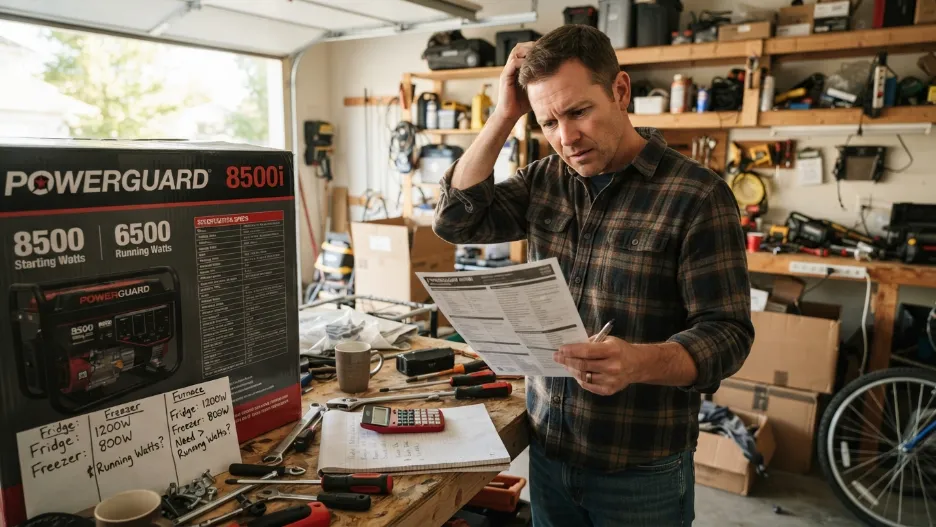
Here’s the part manufacturers don’t always make obvious: the big bold wattage number printed on a generator’s box is usually the starting watts, not the running watts. A “9,000-watt” generator might only sustain 7,200 watts continuously. That gap is real, and it’s spec’d that way on purpose to make the box number look bigger.
It cuts the other way too. If you only glance at an appliance’s running watts and ignore its starting draw, you can buy a generator that looks perfectly sized on paper and still can’t start your fridge. I’ve had customers call me convinced their new unit was defective, when really it just couldn’t clear the sump pump’s 2,150-watt surge.
The first time I ran a 7,500-watt dual-fuel unit through a five-day outage at a client’s farmhouse, the thing that caught me off guard wasn’t the fridge or the furnace blower — it was the well pump. Its running watts looked modest on the nameplate, but the starting surge nearly tripped the generator’s breaker the moment it kicked on, because I’d added the fridge and the pump’s starting watts together instead of just taking the higher of the two.
How to Calculate the Watts You Actually Need
The formula is simpler than most sizing guides make it sound:
Step 1: Add up the running watts of everything you want powered at the same time.
Step 2: Find the single appliance with the highest starting watts.
Step 3: Replace that appliance’s running watts (already counted in Step 1) with its starting watts.
Step 4: Add a 20-25% safety margin on top.
You don’t add every appliance’s starting watts together — in real-world use, appliances rarely all surge at the same instant, since thermostats and pumps cycle independently. Sizing for that worst case wastes generator capacity you’ll never use.
| Appliance | Running Watts | Starting Watts |
|---|---|---|
| Refrigerator (mid-size) | 700 | 2,200 |
| Chest freezer | 300 | 900 |
| Window AC (10,000 BTU) | 1,200 | 3,600 |
| Central AC (3-ton) | 3,500 | 9,000 |
| Sump pump (1/2 HP) | 1,050 | 2,150 |
| Well pump (1 HP) | 1,000 | 3,000 |
| Gas furnace blower | 800 | 2,400 |
| Microwave | 1,000 | 0 |
| Coffee maker | 1,000 | 0 |
| LED TV (50-inch) | 100 | 0 |
| Laptop | 65 | 0 |
| Wi-Fi router/modem | 20 | 0 |
| Ceiling fan | 75 | 150 |
| Box fan | 200 | 300 |
| LED light bulbs (x6) | 60 | 0 |
| Space heater | 1,500 | 0 |
| Electric water heater | 4,000 | 0 |
| Garage door opener (1/2 HP) | 550 | 1,100 |
| Table saw (1.5 HP) | 1,800 | 4,500 |
| Air compressor (1/2 HP) | 1,000 | 2,000 |
Worked Example: A Typical Outage Load
Say you want to run a refrigerator, a sump pump, a gas furnace blower, a microwave, six LED bulbs, and a Wi-Fi router at the same time during an outage.
Running watts add up to: 700 + 1,050 + 800 + 1,000 + 60 + 20 = 3,630 watts.
The highest single starting-watt item here is the furnace blower at 2,400 watts. Swap its running watts (800) out and its starting watts (2,400) in: 3,630 – 800 + 2,400 = 5,230 watts of peak surge capacity needed.
Add a 20-25% safety margin and you land at roughly 6,300-6,500 watts of starting capacity, with at least 3,700-4,000 watts of running capacity. That points you toward a generator in the 6,500-8,000 starting-watt class — a common size for mid-size dual-fuel units like a 7,500-watt dual-fuel portable generator, rather than a smaller 3,500-watt unit that would stall the moment two motors overlap.
What Happens If You Ignore Starting Watts
Undersize for the surge and one of three things happens. The generator’s breaker trips and cuts power entirely. The engine bogs down and stalls. Or, worst case on an older unit without good surge protection, the motor you’re trying to start gets damaged from repeated failed starts — compressors are not fans of being asked to start against a sagging voltage supply over and over.
None of this is catastrophic if you catch it early. Stagger your startups: let the fridge finish its surge before switching on the sump pump, rather than flipping every breaker at once. Most surge problems are really sequencing problems in disguise.
Which Appliances Have the Highest Starting Watts
Anything with a compressor or an induction motor is the usual suspect. In rough order of how much they typically surge relative to their running watts:
- Well pumps and sump pumps — often 2-3x their running watts, since they’re fighting water pressure from a standstill.
- Central air conditioners — the compressor surge is the single biggest starting load in most homes.
- Refrigerators and freezers — smaller in absolute terms but still 2-3x running watts.
- Table saws and shop tools — high starting watts relative to running watts because of blade or bit inertia.
- Garage door openers — modest in absolute numbers, but easy to forget when you’re doing quick mental math during an outage.
Devices with no motor at all — lights, electronics, space heaters, anything resistive — don’t surge. Their starting and running watts are the same number.
Portable Gas Generators vs. Solar Power Stations: Does the Math Change?
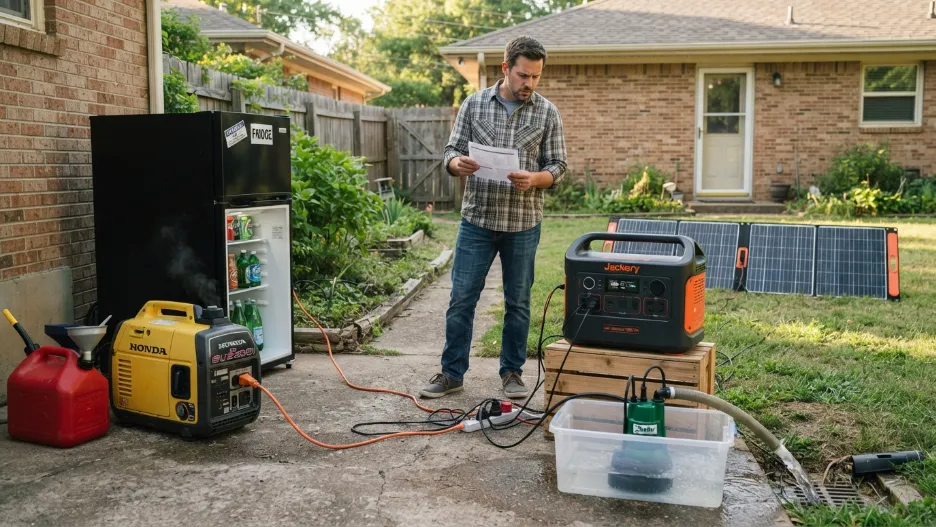
Most of what’s written about starting watts online today is aimed at solar generators and battery power stations, since that’s a fast-growing category. The physics is identical — a compressor still needs the same surge whether the power source is an inverter battery or a gas engine.
Where it differs is headroom. A quality inverter generator can typically deliver its full starting watts rating for several seconds without strain, because it’s limited only by the engine and alternator. A battery power station’s surge capacity is limited by its inverter’s peak output spec, and some cheaper units overstate it. If you’re buying a solar generator specifically to run a fridge or sump pump, check the manufacturer’s actual surge-watt spec sheet rather than the marketing number on the box.
Grounding, Breakers, and Not Overloading What You’ve Sized
Sizing correctly solves half the problem. The other half is safe setup: never connect a portable generator directly into your home’s wiring without a properly installed transfer switch, and never run one in a garage or near windows and doors — carbon monoxide from generator exhaust can incapacitate a person in minutes, according to EPA guidance on indoor air quality. Grounding and bonding rules for portable units connected through a transfer switch are laid out in OSHA’s fact sheet on portable generator grounding, and a licensed electrician should handle that connection. For general CO safety around the home, CPSC’s carbon monoxide safety resources are worth a look before your first outage, not during one.
Conclusion
Running watts tell you what a generator can sustain. Starting watts tell you whether it can get your appliances moving in the first place — and that second number is the one that actually determines the generator you need to buy. Add up your running loads, account for your single biggest surge, and build in a margin. Get that right, and the rest of your outage plan takes care of itself. — Michael Turner
If you’re shopping based on the math above, look for a generator with a clearly published starting-watts spec (not just the biggest number on the box) and at least 20-25% more capacity than your worked total. A mid-size dual-fuel portable is the most common fit for a whole-essentials outage load like the example here.
FAQ
Is starting watts the same as surge watts?
Yes. Starting watts, surge watts, and peak watts all refer to the same brief power spike a motor-driven appliance needs at startup, before demand drops to its running watts level.
Can a generator’s running watts be higher than its starting watts?
No. Starting watts are always equal to or higher than running watts on a generator spec sheet, since the starting number represents the machine’s maximum brief output capacity.
Do I need to add up all my appliances’ starting watts together?
No. Add up all running watts, then add only the single highest starting-watts value among your appliances, since motors rarely all surge at the exact same instant in normal use.
Will a 3,500-watt generator run a refrigerator?
Usually yes, since a typical fridge needs around 700 running watts and 2,200 starting watts, well within a 3,500-watt unit’s capacity, though there won’t be much room left for a second appliance.
Why does my generator shut off when an appliance turns on?
This is almost always a starting-watts problem: the appliance’s surge demand exceeds what the generator’s breaker or alternator can supply for those first few seconds, so it trips rather than risk damage.

Hi, I’m Michael Turner. I own a generator workshop in the United States and founded HomeGeneratorBlog to share practical, hands-on guidance about generator installation, maintenance, troubleshooting, safety, and backup power solutions. My goal is to help homeowners make smarter, more confident decisions through clear and reliable information


One Comment