Generator Power Capacity: How Many Watts Do You Actually Need?
Quick answer: Add up the running watts of everything you want on at once, then add the single highest starting watt spike on top of that (not every appliance’s spike — just the biggest one). Multiply the total by 1.2–1.25 for a safety margin. Most homes covering fridge, sump pump, furnace blower, and lights land in the 5,000–7,500 watt range.
Most people don’t find out their generator's power capacity is wrong until the breaker trips at 2 a.m. during a storm. That’s the wrong time to learn the difference between running watts and starting watts.
This guide walks through the actual math, a wattage table you can use right now, and a real sizing example — not just a rule of thumb.
The Simple Formula for Generator Power Capacity
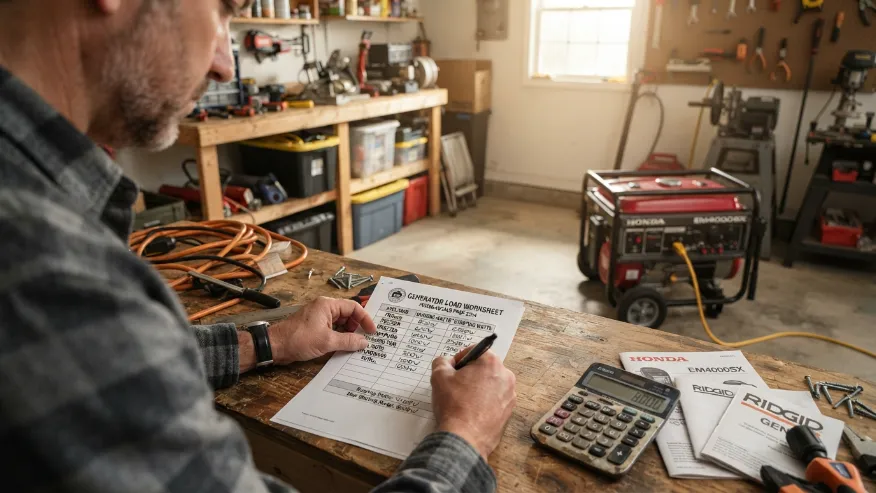
Generator power capacity comes down to two numbers on the spec sheet: running watts (the continuous power it can supply) and starting watts, sometimes called surge or peak watts (a short burst, usually 2–5 seconds, that motors need to kick on).
The formula homeowners actually need looks like this:
Total running watts of everything on at once + the highest single starting watt spike among those items = minimum starting capacity you need.
You don’t add every appliance’s starting watts together. Motors don’t all lurch to life in the same instant — you stagger them, whether by habit or by generator design. Only the single biggest spike matters, because that’s the moment your generator is working hardest.
Portable Generator Wattage Calculator (Common Appliances)
Here’s a reference table of typical running and starting watts for the appliances people actually run during an outage. Your appliance’s nameplate or manual will have the exact number — this table gets you in the right neighborhood for planning.
| Appliance | Running Watts | Starting Watts |
|---|---|---|
| Refrigerator | 700 | 2,200 |
| Upright freezer | 500 | 1,500 |
| Window AC (10,000 BTU) | 1,200 | 3,600 |
| Sump pump (1/3 hp) | 800 | 1,300 |
| Well pump (1/2 hp) | 1,000 | 2,100 |
| Gas furnace blower fan | 600 | 1,200 |
| Electric water heater | 4,000 | 4,000 |
| Microwave | 1,000 | 1,000 |
| Coffee maker | 1,000 | 1,000 |
| Toaster | 800 | 800 |
| Portable space heater | 1,500 | 1,500 |
| Box fan | 200 | 300 |
| LED lighting, whole house (~10 bulbs) | 100 | 100 |
| 55″ LED TV | 120 | 120 |
| Laptop charger | 90 | 90 |
| Phone charger | 15 | 15 |
| Garage door opener | 550 | 1,100 |
| CPAP machine | 60 | 60 |
| WiFi router/modem | 20 | 20 |
| If you ran every item above at once | ~14,255 | ~16,655 |
Notice that last row. Nobody actually runs everything on this list simultaneously — that’s the point. Central air conditioning isn’t even on here, because a 3-ton unit alone can pull 3,500 running watts and 7,000+ starting watts, which is a different conversation entirely (that’s standby-generator territory for most homes). The skill isn’t buying a generator big enough for everything — it’s picking which handful of things actually matter during an outage.
Worked Example: Sizing a Generator for a Real Power Outage
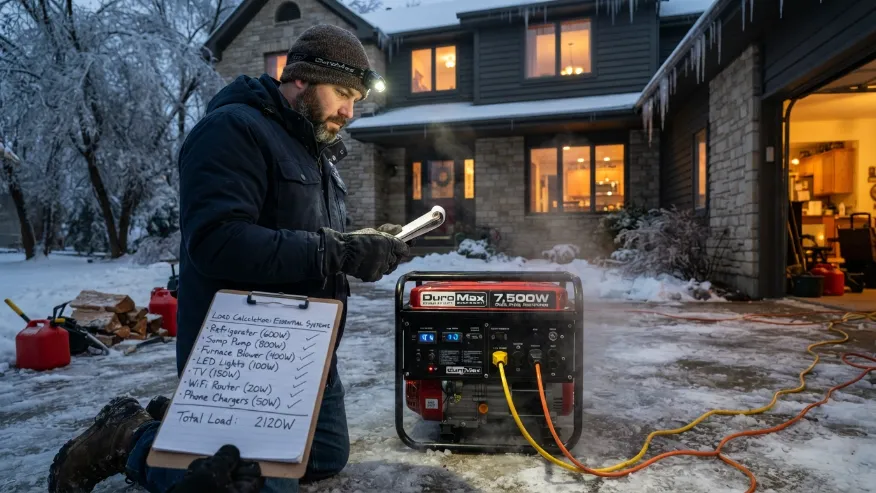
The first time I ran a 7,500-watt dual-fuel unit through a five-day outage after an ice storm, the thing that surprised me wasn’t the fuel use — it was how little wattage I actually needed once I stopped trying to run everything at once. Here’s the math I should have done beforehand.
Say your outage essentials are: refrigerator, sump pump, furnace blower, whole-house LED lighting, a TV, a WiFi router, and phone chargers. Running watts add up like this:
- Refrigerator: 700W
- Sump pump: 800W
- Furnace blower: 600W
- LED lighting: 100W
- TV: 120W
- WiFi router: 20W
- Phone charger: 15W
That’s 2,355 running watts total. Now find the biggest starting spike among them — the refrigerator’s 2,200W surge is the largest. Swap that in for its running watts: 2,355 − 700 + 2,200 = 3,855 minimum starting watts.
Apply a 20–25% safety margin (more on why below): 3,855 × 1.25 ≈ 4,819 watts. That points to a generator rated around 5,000 running watts with roughly 7,500 starting watts — which is exactly why that wattage range shows up so often on best-seller lists. It’s not a marketing number. It’s math that happens to fit a lot of households.
If your list is different — say you’re also running a window AC unit — redo the math with your own numbers rather than assuming this example fits. A dual-fuel portable generator in this wattage class gives most households breathing room without paying for capacity they’ll never use.
Why You Need a 20–25% Safety Margin
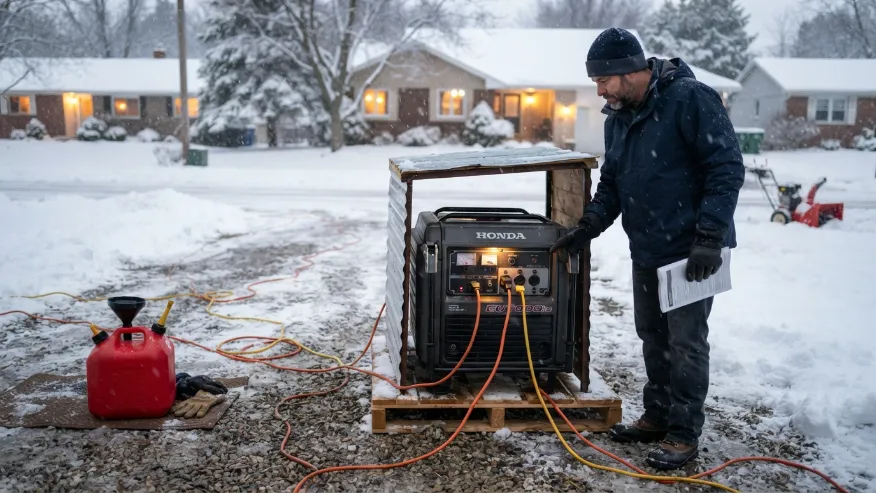
Generators lose a bit of efficiency as components heat up, and running a unit flat-out at 100% of its rated capacity for hours stresses the engine and shortens its lifespan. A 20–25% margin isn’t padding for padding’s sake — it’s the difference between a generator that lasts one bad storm season and one that lasts ten.
It also covers you for the appliance you forgot to count. There’s always one. A sump pump that kicks on mid-storm, a second phone charging, a neighbor’s extension cord — small draws add up fast when you’re already close to the ceiling.
Running Watts vs. Starting Watts: Why the Spec Sheet Confuses People
Generator boxes list two numbers, and manufacturers don’t always make it obvious which is which. Running watts is the number the generator can sustain continuously — this is your baseline capacity. Starting watts is a short, higher number that only lasts a few seconds, covering the initial surge when a motor-driven appliance kicks on.
A 5,000/7,500-watt generator means 5,000 running watts, 7,500 momentary starting watts. If a listing only shows one number, assume it’s the running watt figure and ask before you buy — undersizing on starting watts is the single most common reason a generator “won’t start the fridge” the first time someone uses it.
Capacity Derating: Altitude, Heat, and Fuel Type
This is the part most sizing guides skip, and it matters more than people expect. A generator’s rated capacity is measured under ideal lab conditions — and real conditions aren’t ideal.
Altitude: Gasoline engines lose roughly 3–4% of output for every 1,000 feet above sea level, since thinner air means less oxygen for combustion. At 5,000 feet, a generator rated for 7,500 watts may realistically deliver closer to 6,500.
Heat: Extreme heat reduces air density too, and it also affects how efficiently a generator’s alternator sheds heat. Expect a modest capacity dip on the hottest days — the same days you’re most likely to be running an AC unit and need every watt.
Fuel type: A dual-fuel or tri-fuel generator typically delivers about 10–12% less output on propane or natural gas than it does on gasoline, because those fuels burn at a lower energy density. If you’re planning to run primarily on propane for the convenience and shelf life, size up accordingly rather than buying to the gasoline-rated number on the box.
Portable vs. Whole-House Capacity — When Portable Isn’t Enough
Portable generators generally top out in the 3,000–12,000 watt range, which comfortably covers a fridge, sump pump, furnace, lighting, and electronics. Whole-house standby generators start around 8,500 watts and run up to 26,000+ watts, sized to carry central air, an electric water heater, and major appliances all at once, automatically, without you touching an extension cord.
If your must-run list includes central air conditioning or an electric range, portable capacity stops making sense fairly quickly — you’d need a generator large enough that fuel consumption and noise become their own problem. That’s the point where a standby unit, installed with an automatic transfer switch, is usually the better investment even though the upfront cost is higher.
Common Capacity Mistakes That Waste Money or Trip Breakers
Buying too small is the obvious mistake, but buying too big wastes money too — a generator running well under its rated capacity burns fuel inefficiently and can suffer from carbon buildup over time, sometimes called “wet stacking” in diesel units.
A cheap plug-in wattage meter solves the guessing game — plug it in between the wall and the appliance, and you’ll get the exact running and starting draw instead of relying on nameplate estimates, which manufacturers sometimes round generously.
One mistake that isn’t about wattage at all: placement. Whatever capacity you land on, the generator still needs to run outdoors, at least 20 feet from doors, windows, and vents — carbon monoxide from a generator can build to lethal levels indoors or in a garage within minutes, according to guidance from the CDC. Sizing the generator right doesn’t help if it’s not run safely.
Conclusion
Generator power capacity isn’t complicated once you do the math instead of guessing: add your running watts, add the biggest single starting spike, then build in a margin. Most households land in a predictable range, but your list — and your climate, altitude, and fuel choice — will shift the number slightly. Run your own numbers before you buy, not after the power’s already out. — Michael Turner
For most households landing in the 4,800–5,500 running watt range from the math above, a 7,000–8,000 watt dual-fuel portable generator gives enough starting-watt headroom to run a refrigerator and sump pump without tripping, plus flexibility to switch fuel types if gasoline runs short during an extended outage.
How do I find the running and starting watts for my specific appliances?
Check the nameplate or data plate on the appliance itself, usually on the back or bottom, or the owner’s manual. If only amps and volts are listed, multiply them together to get running watts — a plug-in wattage meter gives you the exact number, including the starting surge, for a few dollars.
Can I run my whole house on a portable generator?
Only if your “whole house” list excludes central air conditioning and electric heat, which draw far more than most portable units can supply. Portable generators are built for essentials — fridge, sump pump, furnace blower, lighting, and electronics — not full-home coverage.
What size generator do I need for a 2,000 sq ft house?
Square footage alone doesn’t determine wattage — what you plan to run does. A typical essentials list for a home that size lands in the 5,000–7,500 running watt range, but a house with a well pump or window AC units will need more.
Does a higher wattage generator always mean better performance?
No. Oversizing wastes fuel, since generators run most efficiently between 50–90% of rated load, and running one mostly idle can lead to carbon buildup over time. Match capacity to your actual needs plus a margin, not to the biggest number available.
Is it safe to run a generator at its maximum rated capacity?
Only briefly. Manufacturers generally recommend against running at 100% of rated capacity for extended periods — it stresses the engine and shortens its lifespan. Staying within 80–90% of rated capacity during normal use is safer and extends the generator’s life considerably.

Hi, I’m Michael Turner. I own a generator workshop in the United States and founded HomeGeneratorBlog to share practical, hands-on guidance about generator installation, maintenance, troubleshooting, safety, and backup power solutions. My goal is to help homeowners make smarter, more confident decisions through clear and reliable information