Portable Generator Parts: Names, Functions & Where to Buy Replacements
Quick answer: A portable generator has eight core parts: the engine, alternator, fuel system, starting system, control panel with circuit breakers, voltage regulator, frame, and cooling/exhaust system. Most repairs involve consumables — spark plugs, air filters, oil filters, carburetors, and batteries — not the engine or alternator itself.
The dataplate on my Champion 7500-watt dual-fuel unit is so faded I can barely read the model number anymore. Three winters of storage and one very confused mouse nest in the air filter housing will do that. What surprised me the first time I had to source a replacement carburetor wasn’t finding the part — it was realizing how many “universal fit” listings online were actually wrong for my specific serial range. Get the part identification step wrong and you’ll be returning packages for weeks.
This guide breaks down every major portable generator part, what it actually does, which ones fail first, and how to order the right replacement the first time.
The 8 Core Parts of a Portable Generator
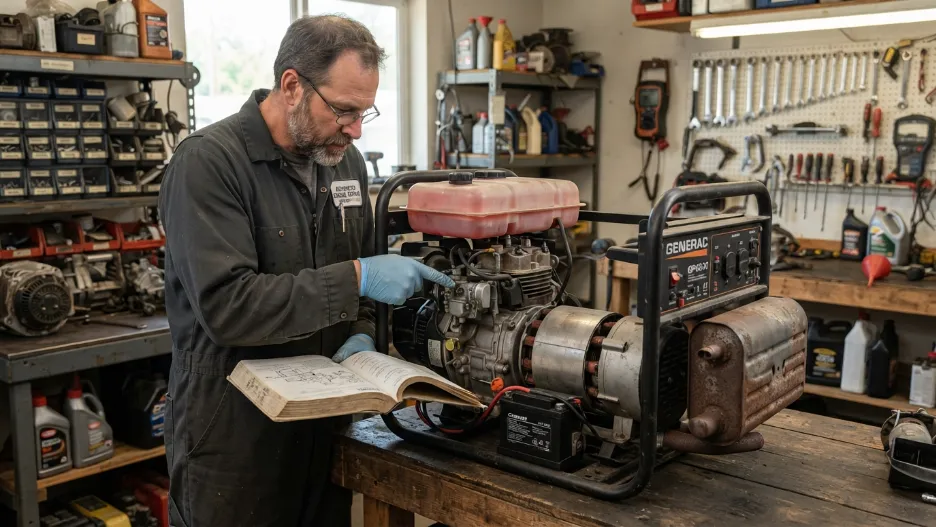
Strip a portable generator down to its frame and you’ll find the same basic architecture whether it’s a $400 open-frame unit or a $2,000 inverter model. Fuel goes in, mechanical energy comes out of the engine, and the alternator turns that spin into usable electricity.
| Part | What It Does | Typical Lifespan | Replacement Cost |
|---|---|---|---|
| Engine | Burns fuel to create the mechanical spin that drives the alternator | 1,000–2,000 hours | $300–$900 (short block) |
| Alternator | Converts the engine’s mechanical spin into AC electricity | Life of the unit if kept dry | $150–$500 |
| Carburetor | Mixes fuel and air in the right ratio for combustion | 2–5 years (fails from stale fuel) | $25–$80 |
| Fuel tank & valve | Stores fuel and controls its flow to the carburetor | Life of the unit | $40–$150 |
| Recoil / electric starter | Spins the engine over to begin combustion | 3–7 years | $20–$70 |
| Battery (electric start) | Powers the electric starter motor | 2–4 years | $25–$60 |
| Spark plug | Ignites the compressed fuel-air mixture | 100–200 run hours | $5–$12 |
| Air filter | Keeps dust and debris out of the carburetor and cylinder | 50–100 run hours | $8–$20 |
| Oil filter (larger units) | Removes debris from lubricating oil | Every oil change | $8–$18 |
| Control panel & breakers | Houses outlets, switches, and overload protection | Life of the unit | $15–$60 per breaker |
| Voltage regulator (AVR) | Smooths out voltage swings from the alternator | 3–8 years | $30–$120 |
| Frame & wheel kit | Protects internal parts and makes the unit mobile | Life of the unit | $40–$100 |
| Muffler / exhaust | Vents combustion gases and reduces noise | 5–10 years | $25–$70 |
Notice a pattern? The parts that fail fastest — spark plugs, air filters, carburetors, batteries — are exactly the parts a generator owner can replace at the kitchen table with a screwdriver and ten minutes. The parts that rarely fail — frame, tank, alternator windings — are also the most expensive to replace, which is why they’re usually not worth chasing on an older unit.
Which Part Actually Failed? A Symptom-First Diagnostic Table
Before ordering anything, match your symptom to the part most likely to blame. This saves you from buying a $300 short block when the real problem is an $8 spark plug.
| Symptom | Likely Part | Fix |
|---|---|---|
| Won’t start, or takes 10+ pulls | Fouled spark plug or gummed carburetor | Replace plug; clean or rebuild carb if fuel sat unused |
| Starts, then dies within a minute | Clogged carburetor jet or bad fuel filter | Clean carb passages; replace inline fuel filter |
| Runs fine unloaded, stalls under load | Dirty air filter or overloaded circuit | Clean/replace air filter; reduce connected load |
| Output voltage swings or lights flicker | Failing voltage regulator (AVR) | Replace AVR module |
| Electric start does nothing (just a click) | Dead or sulfated battery | Charge or replace the starting battery |
| Outlets show no power, unit still runs | Tripped breaker or failed GFCI receptacle | Reset breaker; replace GFCI outlet if it won’t reset |
If the carburetor is the culprit, a carburetor cleaning kit handles most gummed-jet problems without a full teardown. If it’s been sitting for over a season, drain the old fuel first — stale gas is the single biggest cause of no-start calls I get from neighbors.
Genuine OEM Parts vs. Aftermarket: When Each Makes Sense
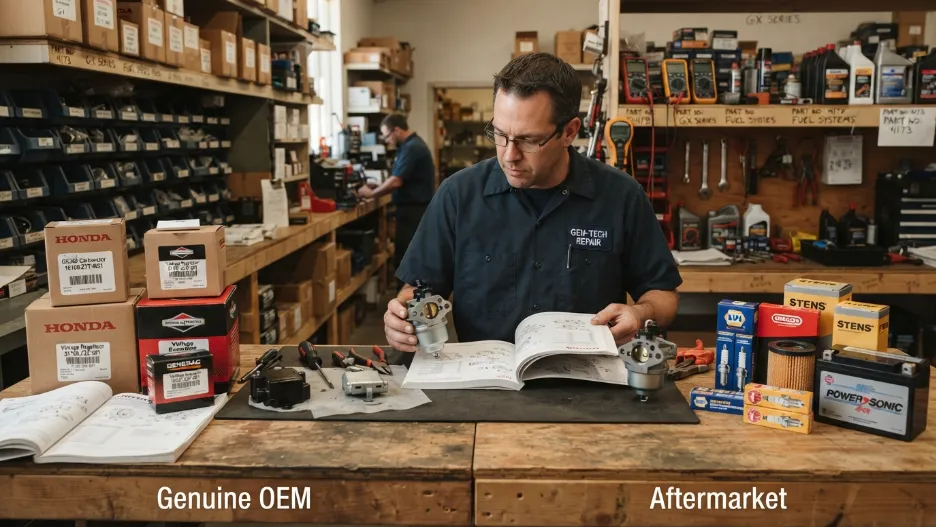
Not every part deserves the same shopping strategy.
Stick with OEM (original equipment manufacturer) parts for anything that affects timing, compression, or electrical output: the carburetor, alternator, AVR, and ignition coil. These parts are built to tolerances matched to your specific engine, and a slightly-off aftermarket carburetor jet can cause a lean-running condition that eventually damages the piston.
Aftermarket is fine — often better value — for consumables: spark plugs, air filters, oil filters, batteries, and recoil starter ropes. These are wear items with simple, standardized specs. A quality aftermarket spark plug from a reputable brand performs identically to the OEM version at a fraction of the price.
How to Find the Right Part for Your Model
Every misordered part traces back to the same mistake: skipping the dataplate. Part numbers live in the owner’s manual, and most generator manufacturers publish exploded-view diagrams that list each individual component alongside its matching part number. Before you search anywhere, find:
- The full model number (usually on a sticker near the control panel)
- The serial number — this matters because manufacturers revise parts mid-production run
- The engine brand and displacement, if the generator uses a separate engine (Briggs & Stratton, Honda, or a generic Chinese-clone engine like a 168F)
With that information, you have three realistic sourcing paths:
- Manufacturer’s parts lookup tool. Generac and similar brands offer online product lookup tools that pull up the exploded view and part numbers directly from your model and serial number. This is the most reliable route for anything still in production.
- Authorized dealer network. For warranty-relevant repairs or parts not sold retail, a dealer can often special-order what you need.
- Independent small-engine parts suppliers. For older, discontinued, or generic-engine units, specialty suppliers that stock parts across thousands of models tend to have better luck than the original manufacturer, especially once a model has been out of production for several years.
Keep a basic generator maintenance kit on the shelf so the next failed spark plug or dirty filter doesn’t turn into a multi-day outage with no backup power.
Maintenance Schedule That Prevents Most Part Failures
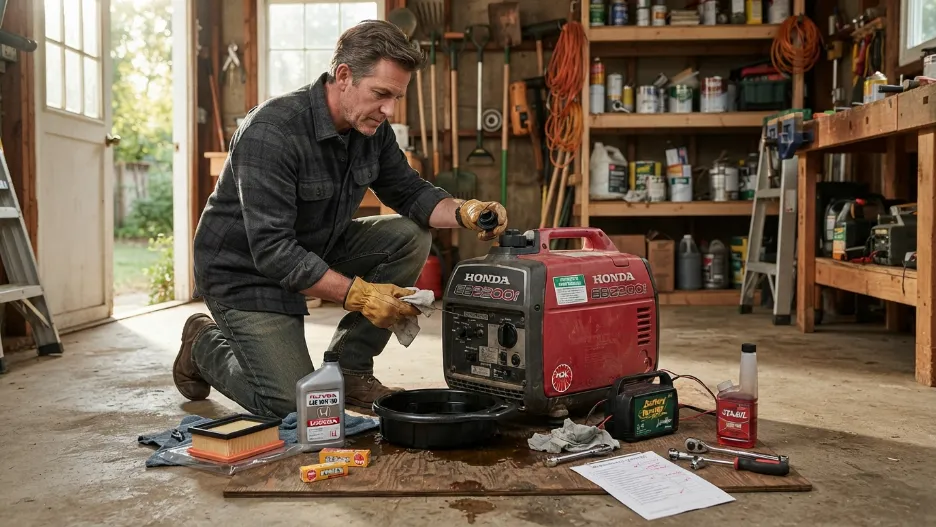
Most “broken” generator parts are really neglected ones. This schedule catches problems before they turn into replacement-part shopping trips.
| Task | Frequency | Why It Matters |
|---|---|---|
| Check oil level | Before every run | Low oil is the top cause of premature engine wear |
| Change oil | First 20–30 hrs, then every 50–100 hrs | Removes metal particles that accelerate engine wear |
| Clean/replace air filter | Every 25–50 hrs or seasonally | Keeps debris out of the carburetor and cylinder |
| Inspect/replace spark plug | Every 100 hrs or annually | Fouled plugs cause hard starts and rough running |
| Run fuel dry or add stabilizer | Before any storage over 30 days | Stale gas gums up the carburetor — the #1 repair call |
| Exercise the unit | Monthly, 20–30 min under light load | Keeps seals lubricated and confirms it’ll start when needed |
| Charge starting battery | Every 2–3 months in storage | Prevents sulfation that permanently kills lead-acid batteries |
Anytime you’re running the generator, remember it belongs outside, well clear of the house. Portable generators produce carbon monoxide, an odorless, colorless gas that can be fatal, according to the CDC’s generator safety fact sheet. The CPSC’s generator safety guidance calls for operating a portable unit at least 20 feet from the house with the exhaust pointed away from windows, doors, and vents. No part on this list matters if the CO safety basics get skipped.
Frequently Asked Questions
What is the most common part that fails on a portable generator?
The carburetor is the single most common failure point, usually from fuel left sitting too long. Ethanol-blended gas breaks down within 30–60 days and leaves gummy residue that clogs the tiny carburetor jets.
Can I use aftermarket parts on a Generac or Champion generator?
Yes, for consumables like spark plugs, filters, and batteries. For the carburetor, alternator, or voltage regulator, OEM parts protect performance and warranty coverage, especially on units still under warranty.
How do I find my portable generator’s model and serial number?
Check the metal or vinyl dataplate near the control panel or on the frame rail. It’s usually stamped with a model number, serial number, and sometimes the engine’s own model code if the engine is a separate brand.
Is it worth repairing an old portable generator, or should I replace it?
If the engine block or alternator windings have failed, replacement parts can approach half the cost of a new unit — at that point, buying new usually makes more sense. Consumable-part failures (carb, plug, filter, battery) are almost always worth fixing.
Where can I buy generator parts for a discontinued model?
Independent small-engine parts suppliers that stock across thousands of models are usually a better bet than the original manufacturer once a unit is a decade or older, since manufacturer stock for discontinued models runs out first.
Hi, I’m Michael Turner. I own a generator workshop in the United States and founded HomeGeneratorBlog to share practical, hands-on guidance about generator installation, maintenance, troubleshooting, safety, and backup power solutions. My goal is to help homeowners make smarter, more confident decisions through clear and reliable information