Is a Generator Just a Big Alternator? Key Differences Explained
Quick Answer
No, a generator isn’t just a big alternator. The alternator is the part that converts mechanical rotation into electrical power, while the complete generator also includes an engine, fuel system, voltage regulation, controls, cooling, and outlets. You can see the full process in this guide to how a portable generator works.
The easiest way to understand it
- Engine: Creates the mechanical rotation needed to generate electricity.
- Alternator: Converts that rotation into electrical energy.
- AVR: Helps keep output voltage within the intended range.
- Control panel: Provides breakers, receptacles, meters, and operating controls.
- Generator set: Combines these systems into one usable power source.
Bottom line
- An alternator can be the electrical heart of a generator, but it isn’t the whole machine.
It’s easy to look at a generator and assume the large electrical section is simply an oversized alternator. That idea is partly right, but it misses several systems needed to turn rotation into useful household power.
In my workshop, I find the easiest approach is separating the machine into two jobs. The engine creates motion, while the alternator and electrical components turn that motion into controlled electricity.
What Does “Generator” Actually Mean?
The word generator can describe an electrical machine that converts mechanical energy into electricity. In everyday use, however, people often use “generator” to mean the entire engine-driven generator set.
That distinction causes much of the confusion. Manufacturers often call the complete package a generator set or genset.
Definition: A generator set is a complete power system that combines a prime mover, usually an engine, with an alternator plus the controls and supporting components needed to deliver electricity.
Cummins’ power-generation overview describes generator sets as self-contained systems built around an engine and alternator. The engine supplies mechanical power, while the alternator converts that motion into electricity.
Is the Alternator the Part That Actually Makes Electricity?
Yes. In a typical engine-driven portable or standby generator, the alternator is the section that converts mechanical rotation into electrical energy.
The engine itself doesn’t send electricity to your refrigerator or power tools. Its main job is spinning the alternator at the speed required by the generator’s design.
If you want a deeper look at that section, my guide to the portable generator alternator explains its major parts and common failures.
How do the rotor and stator make electricity?
Most AC generator heads contain a rotating magnetic field and stationary windings. These two major assemblies are called the rotor and stator.
- Rotor: The rotating component connected to the engine shaft.
- Stator: The stationary section containing electrical windings.
- Magnetic field: Rotation moves the magnetic field relative to the windings.
- Induced voltage: That changing magnetic field produces electrical voltage in the windings.
The U.S. Department of Energy’s Electrical Science handbook describes generators as machines that convert mechanical energy into electrical energy through electromagnetic action.
What does the AVR do?
Producing electricity isn’t enough. A usable generator also needs to control its output as loads switch on and off.
Many conventional generators use an automatic voltage regulator, or AVR. It monitors output and adjusts excitation to help maintain the intended voltage.
If you’re diagnosing unstable voltage, the portable generator AVR guide explains the regulator’s role in more detail.
- Light load: Less electrical demand is placed on the generator.
- Heavy load: The alternator must supply more current.
- Motor startup: Compressors and pumps can create a sudden temporary load.
- Voltage regulation: The excitation system responds to changing operating conditions.
Caterpillar’s explanation of generator excitation systems shows why excitation and voltage regulation are important parts of generator performance.
Generator vs. Alternator: What’s the Actual Difference?
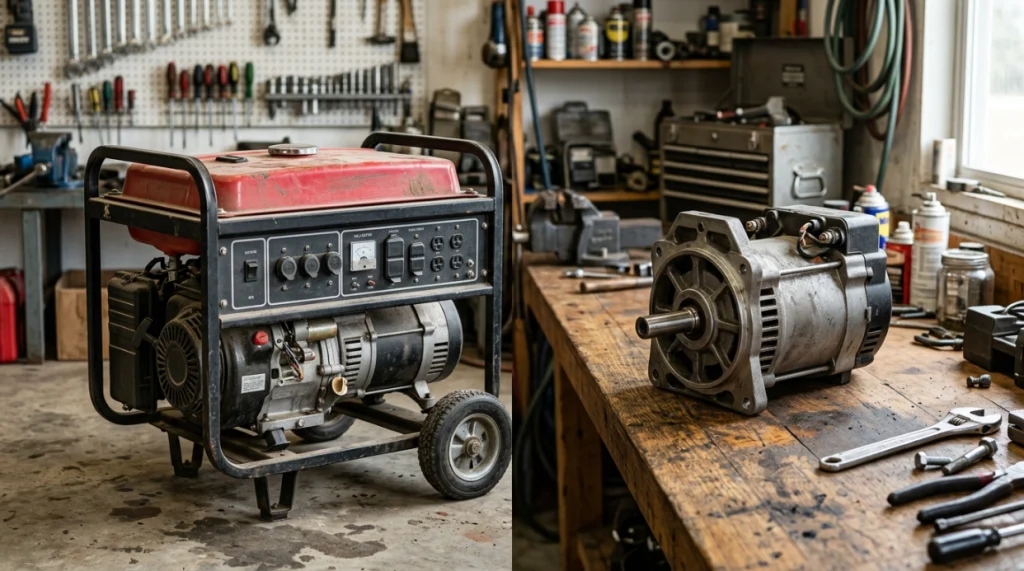
The simplest difference is scope. An alternator is an electricity-producing component, while a generator set is a complete power-producing system.
| Feature | Complete Portable Generator | Generator Alternator / Generator Head |
|---|---|---|
| Creates mechanical rotation | Yes, using its engine | No, requires an external prime mover |
| Converts rotation to electricity | Yes, through its alternator | Yes |
| Fuel system | Normally included | No |
| Engine | Included | Not part of the alternator |
| Voltage regulation | Normally integrated into the system | Depends on alternator design and external controls |
| Outlets and breakers | Usually included | No |
| Ready to power appliances | Yes, when operated correctly | Not by itself |
So, calling a portable generator “a big alternator” is like calling a pickup truck “a big engine.” The engine is essential, but several other systems are required before you have a functioning vehicle.
Why Doesn’t an Alternator Alone Work Like a Portable Generator?
An alternator needs mechanical input before it can generate electricity. A standalone generator head sitting on a bench won’t produce useful power unless something turns its shaft correctly.
A complete generator solves that problem by combining several systems into one package.
- Prime mover: A gasoline, propane, natural-gas, or diesel engine supplies rotation.
- Speed control: The engine governor helps maintain the speed needed as electrical load changes.
- Excitation system: Creates or controls the magnetic field needed for generation.
- Voltage regulation: Helps maintain usable voltage.
- Circuit protection: Breakers help protect the generator and connected circuits from overloads.
- Control panel: Gives you receptacles, switches, meters, and operating controls.
- Cooling system: Removes heat created by the engine and electrical components.
The engine’s role is especially easy to misunderstand. My guide to understanding a portable generator engine explains why stable engine speed matters to electrical performance.
Is a Car Alternator the Same Thing as a Generator Alternator?
The operating principle is related, but the complete systems serve different jobs. Both use electromagnetic induction to turn mechanical rotation into electrical energy.
A vehicle alternator is designed around the vehicle’s electrical and battery-charging system. A portable generator alternator is designed to supply usable AC power through the generator’s output system.
The term alternator originally helps describe a machine producing alternating current. However, everyday industry terminology isn’t always perfectly consistent.
- Automotive alternator: Works as part of the vehicle’s charging system.
- Portable generator alternator: Supplies the electrical output of the generator set.
- Industrial alternator: May be coupled to large diesel, gas, turbine, or other prime movers.
- Generator: Can refer either to the electrical machine or, casually, the complete generator set.
That’s why two technically knowledgeable people can use “generator” and “alternator” slightly differently. Context tells you whether they’re discussing the electrical machine or the entire power system.
What Changes in an Inverter Generator?
An inverter generator still has to convert mechanical energy into electrical energy. The big difference is what happens to that electricity before it reaches the receptacles.
Inverter designs use power electronics to process the generated electricity and create the final AC output. This also lets many inverter generators vary engine speed instead of holding one fixed speed under every load.
For a deeper comparison, see my inverter portable generator guide.
- Conventional generator: Engine speed and alternator design are closely tied to output frequency.
- Inverter generator: Generated power passes through electronic conversion before reaching the outlets.
- Both designs: Still need a source of mechanical energy and an electrical generating stage.
So an inverter generator isn’t simply an alternator with a different name. It’s a complete generator system using extra electronic power conversion.
How Can You Tell Whether the Engine or Alternator Is the Problem?
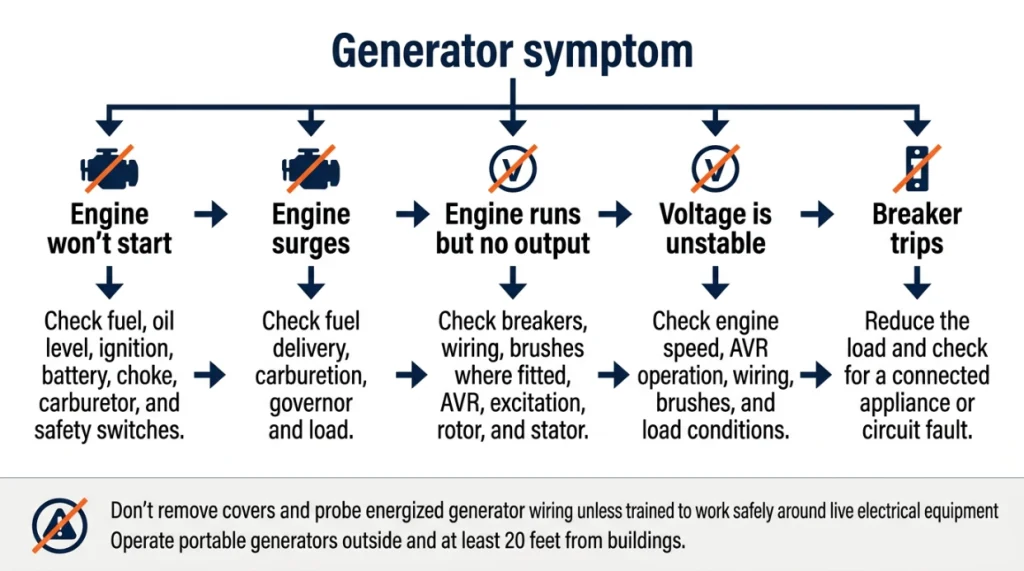
A useful troubleshooting rule is to separate mechanical symptoms from electrical-output symptoms. That keeps you from replacing expensive parts before checking the simple possibilities.
If the engine won’t run properly, start on the engine side. If it runs smoothly but the outlets have no usable voltage, investigate the electrical side.
- Engine won’t start: Check fuel, oil level, ignition, battery, choke, carburetor, and safety switches.
- Engine surges: Check fuel delivery, carburetion, governor operation, and load.
- Engine runs but no output: Check breakers, wiring, brushes where fitted, AVR, excitation, rotor, and stator.
- Voltage is unstable: Check engine speed, AVR operation, wiring, brushes, and load conditions.
- Breaker trips: Reduce the load and check for a connected appliance or circuit fault.
One warning matters more than the diagnosis: don’t remove covers and probe energized generator wiring unless you’re trained to work safely around live electrical equipment. Internal testing can expose hazardous voltage and moving parts.
Fuel-powered generators also produce carbon monoxide. The U.S. Environmental Protection Agency’s generator safety guidance says portable generators should be operated outside and at least 20 feet from buildings.
Do Bigger Generators Just Use Bigger Alternators?
Higher-output generators generally need an alternator capable of carrying greater electrical load. However, increasing generator capacity involves more than simply enlarging one component.
The engine must provide enough mechanical power to drive the alternator under load. Cooling, wiring, breakers, excitation, controls, fuel delivery, and the frame also need to match the intended rating.
- More electrical output: Requires adequate alternator capacity.
- More alternator load: Requires enough engine torque and horsepower.
- More current: Requires appropriate conductors, breakers, and connections.
- More heat: Requires adequate cooling.
- Larger motor loads: May require stronger transient and excitation performance.
This is why generator manufacturers engineer the engine and alternator as a matched system. Simply attaching a much larger alternator doesn’t magically increase the available engine power.
What Tools Are Useful for Understanding Generator Output?
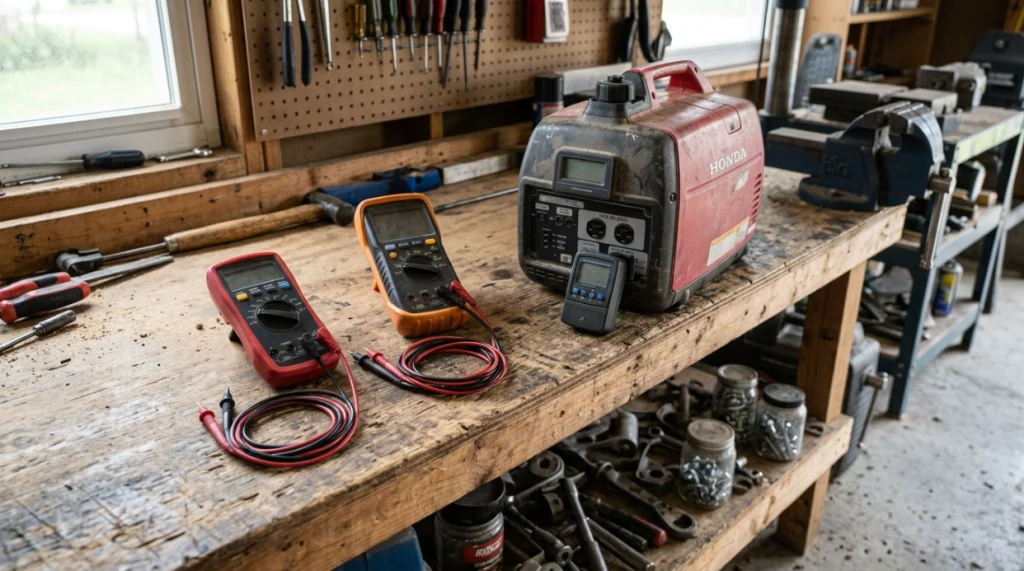
You don’t need to dismantle a generator to learn a lot about its electrical behavior. Outlet-level measurement can reveal voltage, frequency, appliance wattage, and load changes without opening the generator head.
If you’re building a practical generator troubleshooting kit, these are three tools I’d consider.
🏆 Best for Outlet Checks
P3 International Kill A Watt P4400
★★★★½ 4.7/5
The P4400 displays volts, amps, watts, frequency, VA, power factor, and energy use on compatible 120V loads. I like this approach for checking outlet-level behavior without opening the generator’s electrical housing.
💰 Best Budget Meter
Klein Tools MM325 Digital Multimeter
★★★★☆ 4.5/5
The MM325 measures up to 600V AC/DC and includes resistance, continuity, diode, and battery testing. It’s a straightforward meter for basic checks, but internal generator testing should only be done when you understand the circuit and safe procedure.
🛠️ Best for Experienced Users
Fluke 117 Electrician’s Multimeter
★★★★½ 4.8/5
The Fluke 117 provides true-RMS AC measurements, frequency, capacitance, and a 600V CAT III rating. It’s the one I’d favor for more serious electrical troubleshooting where measurement quality and additional functions matter.
Frequently Asked Questions
Is an alternator technically a generator?
Yes. An alternator is a type of electrical generator that produces alternating current through electromagnetic induction. However, when people say “generator” around backup-power equipment, they normally mean the entire generator set rather than only the alternator section.
Does a portable generator have an alternator inside it?
Most conventional engine-driven portable generators use an alternator, often called the generator head, to convert engine rotation into electrical power. The complete machine also includes the engine, controls, voltage regulation, fuel system, cooling, breakers, and receptacles.
Can you run a generator alternator without an engine?
You can generate electricity from a standalone alternator if another suitable prime mover spins it correctly. An engine isn’t the only possible power source, but the alternator still needs mechanical rotation plus the appropriate excitation, regulation, and electrical controls.
Why is it called a generator instead of an alternator?
“Generator” is the broader everyday term and is commonly used for the complete power-producing machine. “Alternator” more specifically describes the AC-generating electrical section, although manufacturers and technicians may use the terms differently depending on context.
Can the engine run even if the alternator is bad?
Yes. A generator engine can start and run normally while the electrical side produces little or no usable output. Breakers, brushes, excitation components, an AVR, wiring, rotor windings, or stator windings can fail without preventing the engine from running.
Final Takeaway
A generator isn’t simply a big alternator. The alternator makes the electricity, but the engine creates the mechanical power needed to drive it.
The complete generator then adds voltage regulation, controls, circuit protection, cooling, fuel delivery, and usable electrical connections. Think of the alternator as the electrical heart of the machine rather than the whole machine.
Once you understand that split, generator troubleshooting becomes much easier. Start by asking whether the problem is creating rotation, creating electricity, or controlling and delivering that electricity.

Hi, I’m Michael Turner. I own a generator workshop in the United States and founded HomeGeneratorBlog to share practical, hands-on guidance about generator installation, maintenance, troubleshooting, safety, and backup power solutions. My goal is to help homeowners make smarter, more confident decisions through clear and reliable information