How Does a Portable Generator Work? Fuel to Electricity Explained
The first time I ran a 7,500-watt dual-fuel generator through a four-day outage after a bad ice storm, what surprised me most wasn’t the machine — it was how little most people understood what was actually happening inside it.
They just knew it worked. Once you understand the process, you’ll also understand why certain mistakes (like backfeeding or running it in the garage) can be so dangerous. So let’s break it down step by step.
The Basic Idea: Fuel In, Electricity Out
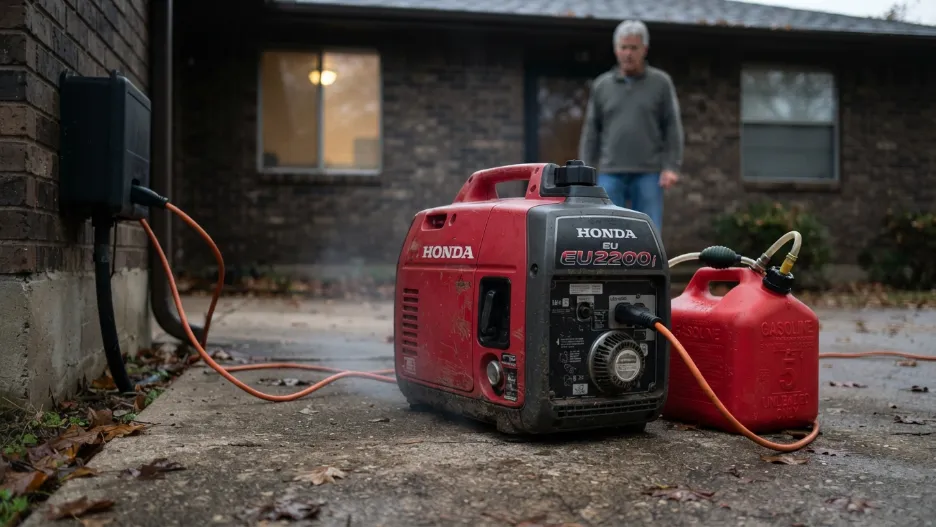
A portable generator doesn’t create electricity from nothing. It converts stored chemical energy in fuel into mechanical energy, then converts that mechanical energy into electrical energy. Every step in that chain has a dedicated component doing one specific job.
Think of it like a bicycle dynamo — only instead of your legs spinning a wheel, a combustion engine is doing the spinning. And instead of powering a single dim headlight, it’s powering your refrigerator, a few lights, and a window AC.
The Core Components and What Each One Does
| Component | Job | Analogy |
|---|---|---|
| Engine | Burns fuel to create rotational force (torque) | The legs on a bicycle |
| Alternator (rotor + stator) | Converts rotational force into AC electricity | The dynamo on the wheel |
| Fuel system | Stores and delivers fuel to the engine; carburetor mixes fuel with air | Gas tank + fuel pump in a car |
| Voltage regulator | Stabilizes the output to a consistent voltage (120V or 240V) so it doesn’t spike or dip | Pressure regulator on a garden hose |
| Starter | Initiates the engine — either a pull cord or an electric starter button | Ignition in a car |
| Control panel | Delivers regulated power to outlets; includes circuit breakers, meters, and GFCI protection | Breaker box on your house wall |
Step-by-Step: How Electricity Is Actually Made
Step 1 — Combustion Creates Spin
Pull the cord (or press the electric start button), and the spark plug fires. The fuel-air mixture in the engine’s combustion chamber ignites, pushing a piston down. That piston is connected to a crankshaft, which converts the up-and-down motion into a continuous rotation — the same principle as a car engine, just smaller.
Most portable generators run the engine at a fixed 3,600 RPM. That speed is deliberate: it produces exactly 60 Hz AC power, which matches the U.S. electrical grid standard. Every appliance in your house expects 60 Hz. Slow the engine down and your refrigerator motor suffers. This is why a sputtering engine is a real problem, not just an annoyance.
Step 2 — The Alternator Produces Electricity
The spinning crankshaft turns the rotor inside the alternator — a shaft with magnets attached. Those spinning magnets pass by a stationary ring of copper wire coils called the stator. Moving magnetic field past copper wire produces an electric current. That’s electromagnetic induction, the same principle Michael Faraday discovered in 1831, and it’s still how virtually all electricity in the world is generated.
The current produced here is alternating current (AC). The direction it flows reverses 60 times per second — again, that 60 Hz number. Most portable generators use permanent magnets in the rotor, which keeps the design simple and eliminates the need for a separate power supply to create the magnetic field.
Step 3 — The Voltage Regulator Cleans It Up
Raw output from the alternator isn’t perfectly smooth. It varies slightly with load changes — if you suddenly plug in a refrigerator, the engine momentarily slows and output dips. The voltage regulator constantly monitors output and adjusts the magnetic field to compensate, keeping the voltage stable at 120V or 240V within a narrow tolerance.
Without a voltage regulator, you’d see brownouts when you plug in heavy loads, and spikes when loads shut off. Either one can damage sensitive electronics — laptops, TVs, medical devices. This is why generators vary in “power quality,” and it’s a big part of what you’re paying for in a better machine.
Step 4 — Regulated Power Reaches the Outlets
Stable, regulated AC flows to the control panel outlets — standard 120V household outlets, plus a 30-amp or 50-amp outlet on larger models for running a house-connected cord to a transfer switch. Plug in an extension cord, and power flows to your devices exactly as it would from a wall outlet.
The circuit breakers on the control panel act like a fuse box. Overload the generator past its rated running watts, and the breaker trips before damage occurs. Reset it, shed some load, and you’re back in business.
Conventional vs. Inverter Generators: The Key Difference
Standard open-frame generators run the engine at a fixed 3,600 RPM regardless of how much power you’re using. Run just a lamp and a phone charger? The engine still screams along at full speed. That wastes fuel and produces noisier, slightly “dirtier” power (higher total harmonic distortion, or THD).
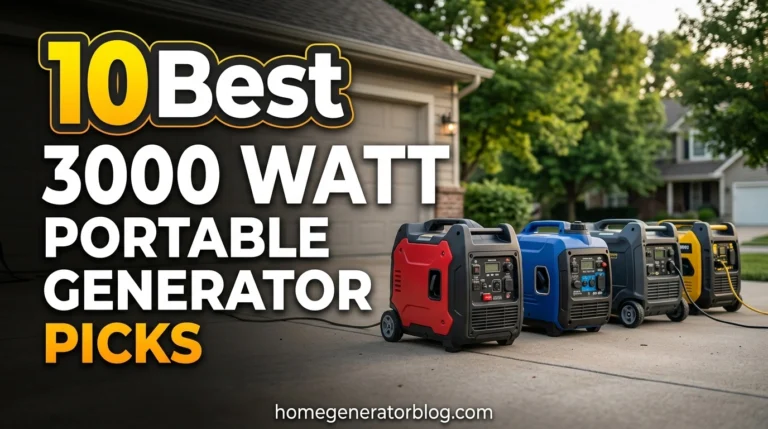
Inverter generators add an extra step. The alternator produces high-frequency AC, converts it to DC, then electronically “inverts” it back to clean 60 Hz AC — with THD typically under 3%. They also let the engine throttle down when loads are light. The result: quieter operation, better fuel economy, and cleaner power safe for laptops and medical devices.
| Conventional Generator | Inverter Generator | |
|---|---|---|
| Engine speed | Fixed 3,600 RPM | Variable (throttles to match load) |
| Power quality (THD) | ~5–25% | Under 3% |
| Noise level | 65–80 dBA | 50–65 dBA |
| Fuel efficiency | Lower | Higher (up to 40% better at light loads) |
| Safe for electronics? | Risky for sensitive devices | Yes |
| Power output | Up to 12,000+ watts | Typically 1,000–4,500 watts |
How Fuel Type Changes the Equation
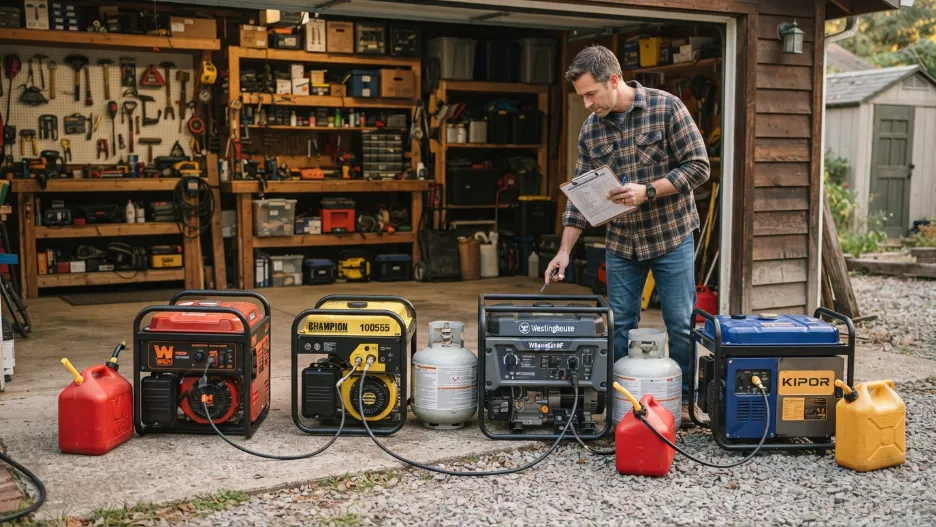
The combustion principle is identical across fuel types — what changes is how energy-dense the fuel is, how it’s stored, and how the carburetor handles it.
- Gasoline — The most common. Easy to find, high energy density, but degrades in about 30 days without a fuel stabilizer. Cold starts below 32°F can be difficult.
- Propane (LP) — Stores indefinitely, burns cleaner, easier cold starts. But propane contains about 25% less energy per unit than gasoline, so runtime per “tank” (LP cylinder) is shorter, and power output dips slightly.
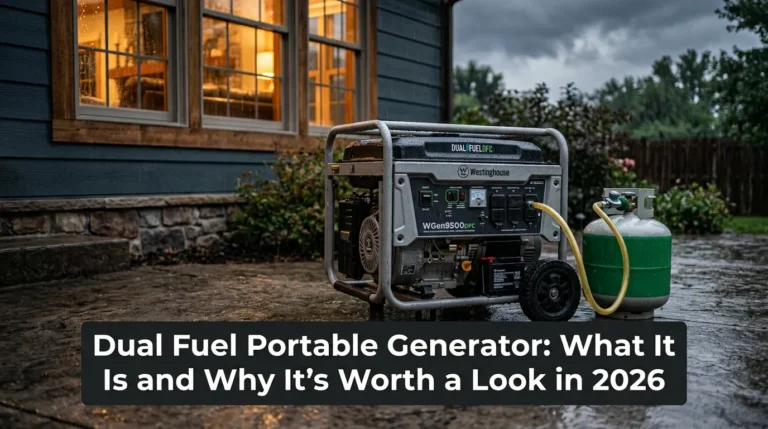
- Dual-fuel — Runs on either gasoline or propane through a switch on the carburetor. Best of both: gasoline when you have it, propane as long-term backup. Worth the small premium for most homeowners.
- Diesel — More durable, better fuel economy, longest runtime. Heavier and more expensive upfront, and harder to find in a residential emergency. More common on job sites.
The Safety Reality: Carbon Monoxide
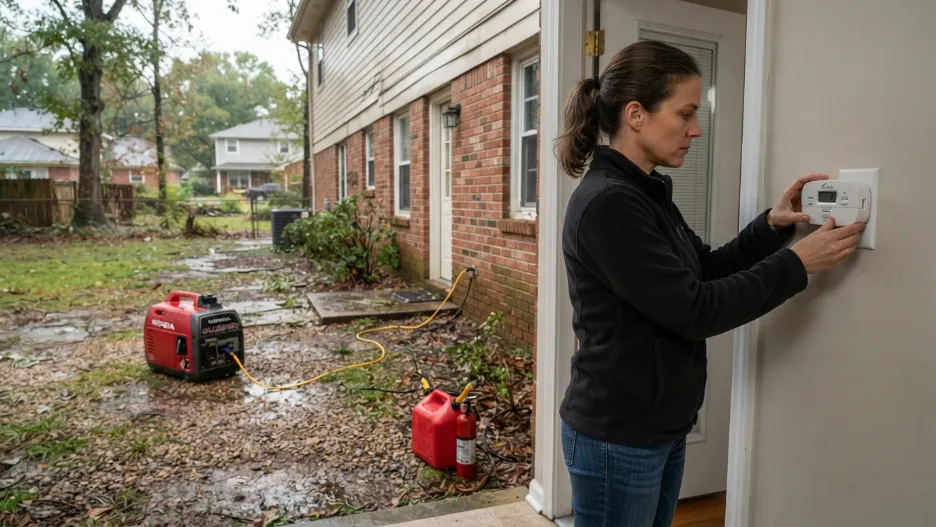
Many newer generators include a built-in CO shutoff sensor that automatically kills the engine if CO accumulates nearby. It’s one of the most important advances the category has seen in the past decade. If your generator doesn’t have one, install a battery-powered CO detector inside your home before your next outage. It’s a $20–30 decision that can save lives.
The other electrical hazard is backfeeding — running your generator power backward into the utility grid through an improperly wired connection. This can electrocute utility workers restoring power on the line, and it can destroy your generator and house wiring. Always use a properly rated transfer switch or interlock kit installed by a licensed electrician if you’re connecting to your home’s panel.
Running Watts vs. Starting Watts: The Number That Matters Most
Every generator has two wattage ratings. Understanding both prevents the most common buying mistake.
Running watts (also called rated watts) is how much power the generator can sustain continuously. This is the number you match against your total appliance load.
Starting watts (surge watts) is the brief spike of power the generator can deliver for 1–3 seconds when a motor-driven appliance starts up. A refrigerator that runs on 700 watts might demand 2,100 starting watts when it kicks on. If your generator can’t supply that surge, the compressor motor bogs down, the generator may trip its breaker, and in worst cases you shorten the motor’s life.
Rule of thumb: find your largest motor-driven appliance’s starting watts, add the running watts of everything else you want to run simultaneously, and make sure the generator’s starting watts cover that total.
If you’re shopping for a unit now, a good place to start is dual-fuel portable generators on Amazon — filtering by running watts helps narrow the options quickly.
Before the Conclusion: Recommended Generator
Conclusion
The whole process — fuel to spark to spin to electricity — takes less than five seconds from the moment you start the engine. Understanding each link in that chain helps you choose the right machine, use it safely, and diagnose problems when they happen. An inverter generator gives you cleaner power and better fuel efficiency at the cost of lower maximum output. A conventional open-frame unit gives you raw wattage at a lower price. Dual-fuel buys you flexibility.
The non-negotiables are the same regardless of which type you choose: run it outside, keep it 20 feet away from the house, and never connect it directly to your home wiring without a proper transfer switch. Get those right and a portable generator is one of the most useful things you can own.
Frequently Asked Questions
Does a portable generator produce AC or DC power?
Standard portable generators produce AC (alternating current) power, which is the same type your home’s wall outlets deliver. The alternator generates AC by design, and most home appliances require it. Some control panels also include DC outlets (typically 12V) for charging batteries or running DC-powered devices, but the main outlets are AC.
How long can a portable generator run continuously?
Most portable generators are designed for runs of 8–12 hours on a full tank, though this varies significantly by load and tank size. Running at 50% load is more fuel-efficient and extends runtime compared to running at full capacity. After extended operation, most manufacturers recommend a brief cooldown before refueling — always turn the engine off and let it cool before adding fuel.
Can a portable generator damage electronics?
A conventional open-frame generator can produce “dirty” power with high total harmonic distortion (THD), which may degrade or damage sensitive electronics like laptops, televisions, and CPAP machines over time. Inverter generators produce cleaner power with THD under 3%, making them much safer for sensitive devices. If you’re running electronics on a conventional generator, a quality surge protector adds a layer of protection.
Do you have to turn off your main breaker when using a portable generator?
Yes — if your generator is connected to your home’s wiring through a transfer switch or interlock kit, you must disconnect from the utility grid first by turning off the main breaker. Skipping this step causes backfeeding, where your generator’s power flows backward onto the utility lines. This is a electrocution risk for lineworkers and can damage your equipment. A properly installed transfer switch or interlock kit physically prevents backfeeding from happening accidentally.
What’s the difference between a portable generator and a standby generator?
A portable generator is stored and deployed manually — you wheel it out, add fuel, and start it yourself during an outage. A standby (whole-house) generator is permanently installed outdoors, connected directly to your home’s electrical panel, and starts automatically within seconds of detecting a power failure. Standby units run on natural gas or propane from a utility line or large tank, so they never run out of fuel during a long outage. They cost significantly more (typically $5,000–$15,000+ installed) but require no manual intervention.

Hi, I’m Michael Turner. I own a generator workshop in the United States and founded HomeGeneratorBlog to share practical, hands-on guidance about generator installation, maintenance, troubleshooting, safety, and backup power solutions. My goal is to help homeowners make smarter, more confident decisions through clear and reliable information