
What Size Generator Do You Need for an RV?
Quick answer: Most 30-amp RVs with a single rooftop AC need a 3,000-4,000-watt generator, while 50-amp rigs with two AC units usually need 6,000-8,500 watts. Add up the running watts of what you’ll use at once, then add the single largest starting-watt surge on top — that number, not your amp rating, is what actually sizes the generator.
If you’ve ever stood in an RV supply store staring at a wall of generators labeled 2000i, 3500i, and 7500-watt dual fuel, you already know the amp rating on your shore power cord doesn’t tell you much by itself. Two RVs can both be “30-amp” and need completely different generators depending on whether one of them runs a 15,000 BTU AC and a residential fridge.
This guide walks through the real math — running watts, starting watts, and the buffer you actually need — so you buy the right size once instead of returning an underpowered unit two weeks into a trip.
Amps vs. Watts: Why Your Shore Power Rating Isn’t the Whole Story
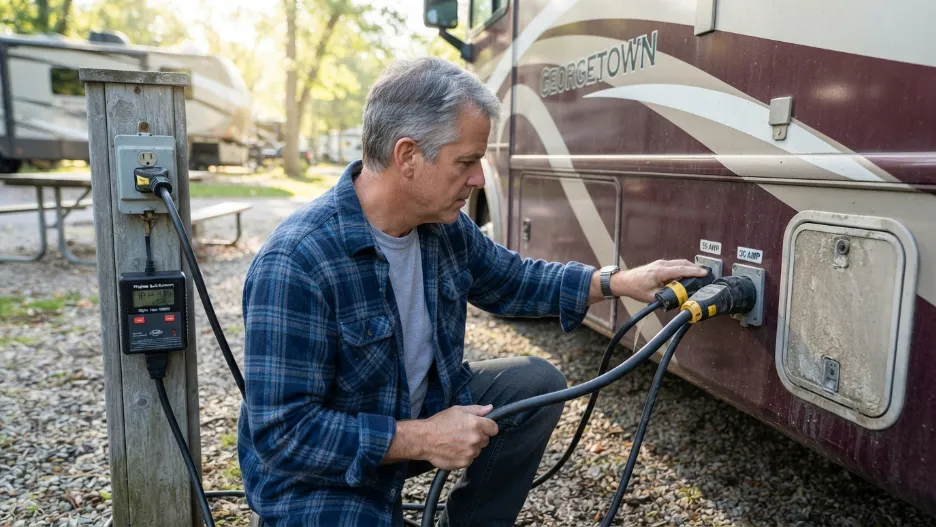
Your RV’s amp rating (30-amp or 50-amp) tells you the maximum current your electrical system is wired for, not how much you’ll actually draw. A 30-amp, 120-volt system caps out at 3,600 watts (30A × 120V). A 50-amp RV actually has two separate 120-volt legs, so its theoretical ceiling is closer to 12,000 watts combined.
But almost nobody runs every circuit at once. Sizing a generator off the amp rating alone tends to push people toward a unit that’s either oversized, heavier, and more expensive than needed, or — more dangerously — toward assuming a 3,600-watt generator is “enough” for a 30-amp rig without checking actual appliance load.
The Formula: Running Watts + Largest Starting Surge
Generator sizing comes down to one formula, and it’s simpler than most people expect:
Total generator size needed = (sum of running watts for everything on at once) + (starting watts of the single largest motor-driven appliance)
The key mistake people make is adding up every appliance’s starting watts. You don’t need that — appliances almost never start at the exact same instant, so you only need headroom for the one biggest surge, which is almost always the air conditioner compressor kicking on.
RV Appliance Wattage Chart
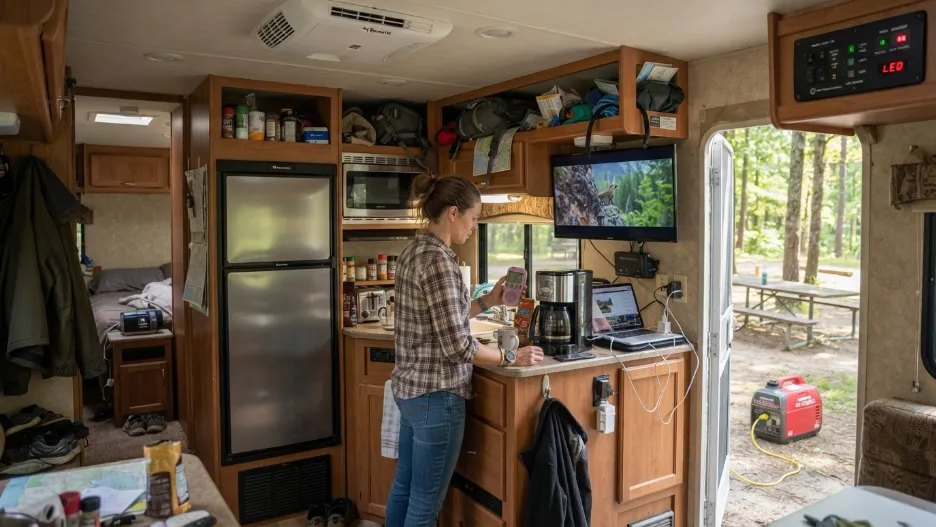
Use this chart to total up what you actually plan to run. Running watts are continuous draw; starting watts are the brief surge some motors need to kick on.
| Appliance | Running Watts | Starting Watts |
|---|---|---|
| RV AC, 13,500 BTU | 1,200-1,500 | 1,800-3,300 |
| RV AC, 15,000 BTU | 1,500-1,800 | 3,000-4,500 |
| Residential-style fridge (12V/AC) | 150-300 | 600-800 |
| Microwave | 1,000-1,500 | 1,000-1,500 |
| Coffee maker | 600-900 | 0 |
| Toaster | 800-1,200 | 0 |
| Hair dryer | 1,200-1,800 | 0 |
| Water heater (electric element) | 1,200-1,500 | 0 |
| Furnace fan / blower | 300-500 | 600-1,000 |
| Water pump | 50-100 | 200-300 |
| TV / entertainment center | 100-200 | 0 |
| Laptop / phone chargers | 50-100 | 0 |
| CPAP machine | 30-60 | 0 |
| Slide-out motor (per slide) | 1,000-1,500 | 1,500-2,000 |
| Electric fireplace / space heater | 1,200-1,500 | 0 |
| Instant Pot / electric skillet | 1,000-1,500 | 0 |
| Washer/dryer combo unit | 1,200-1,800 | 2,000-2,300 |
Worked Example: 30-Amp Travel Trailer With One AC
Say you’re running a single 13,500 BTU AC (1,350 running watts), a 12-volt fridge on AC power (250 running watts), a water pump (75 running watts), and phone chargers (75 running watts) at the same time. That’s 1,750 running watts.
The AC is your biggest motor load, with a starting surge of roughly 2,800 watts. Since the AC’s own running watts are already counted in your 1,750 total, you add only the extra surge above its running draw — about 1,450 watts of headroom.
1,750 running watts + 1,450 watts of surge headroom = 3,200 watts needed. A 3,500-3,600-watt generator covers this comfortably, which lines up with why so many single-AC 30-amp rigs run fine on that size class.
Why You Should Still Add a 20-25% Buffer
Even after doing the math, buy a little more headroom than your calculated number. Three things eat into a generator’s rated output in the real world:
- Altitude derating. Gas engines lose roughly 3-4% of output for every 1,000 feet above sea level — noticeable if you camp in the mountains.
- Heat. Generators run hotter and slightly less efficiently in extreme summer heat, which is exactly when your AC is working hardest.
- Aging components. An AC compressor’s starting surge can climb a bit as the unit ages and the motor works harder to overcome friction.
Take your calculated wattage and multiply by 1.20-1.25 to land on the generator size to actually shop for. In the example above, 3,200 watts becomes a real-world shopping target of roughly 3,800-4,000 watts.
Sizing by RV Type: Quick Reference
| RV Type | Typical Load | Recommended Generator |
|---|---|---|
| Pop-up / teardrop, no AC | Lights, charging, small fridge | 2,000-2,200W |
| Class B van, one AC | AC + fridge + basics | 2,800-3,600W |
| 30-amp travel trailer, one AC | AC + fridge + small appliances | 3,500-4,500W |
| Larger trailer, one AC + extras | AC + microwave + slide + fridge | 4,500-6,000W |
| 50-amp motorhome, two AC units | Two ACs + residential fridge + more | 6,000-8,500W |
| Large fifth-wheel, full boondocking setup | Two AC + washer/dryer + full kitchen | 7,500-10,000W |
Inverter vs. Conventional: Which Type Actually Matters Here
For RV use, an inverter generator is almost always the better fit over a standard open-frame unit, even at a higher price. RV electronics — microwave control boards, TV inverters, phone chargers — are sensitive to “dirty” power with voltage spikes. Inverter generators produce cleaner, more stable power with lower total harmonic distortion (THD), which protects that equipment.
Inverter models are also quieter, lighter for their output, and many support parallel capability — running two smaller units side by side to combine their wattage. That’s a real advantage: you can boondock on one small, quiet unit most of the time and pair a second one only on hot AC days, instead of hauling one large generator everywhere.
For weekend trips without AC, a compact unit like a 2000-watt inverter generator is often plenty, and it’s small enough to store in a pass-through compartment.
Physical Fit and Weight Matter Too
Before you buy based on wattage alone, check two more things: does it fit your generator compartment or storage bay, and does it push you over your RV’s cargo carrying capacity? A 7,500-watt dual-fuel unit can weigh well over 200 lbs — meaningful cargo weight on a smaller trailer that’s already loaded with gear.
If you have a built-in generator bay, measure it before shopping. Portable units that are a half-inch too tall or wide are a common and avoidable return.
Common Sizing Mistakes
- Adding up all starting watts instead of just the largest one. This leads to buying a generator two sizes bigger — and more expensive — than you need.
- Sizing off amp rating alone. A 50-amp RV doesn’t need a 12,000-watt generator unless you’re actually running that much load simultaneously.
- Ignoring the AC’s starting surge entirely. This is the single most common reason a “big enough” generator trips and shuts off the moment the AC compressor kicks on.
- Skipping the altitude and heat buffer. A generator that’s exactly enough on paper often isn’t enough in July at 6,000 feet.
Generator Safety While Boondocking
Wattage aside, portable generators produce carbon monoxide (CO), an odorless gas that can be lethal in an enclosed space. The CDC’s generator safety fact sheet recommends running generators well away from doors, windows, and vents, and installing a battery-powered CO alarm inside the RV regardless of how far outside the generator sits.
If you’re weighing a portable unit against a built-in RV generator, Cummins’ RV generator sizing guide is a solid reference for how shore power amperage translates into wattage capacity on both 30-amp and 50-amp systems.
Conclusion
Skip the temptation to size off your amp rating and buy the biggest number you see on the shelf. Add up your real running watts, account for the AC’s starting surge, and pad it by 20-25%. Get that right and you’ll have a generator that starts everything you need without being bigger, heavier, or louder than your camping style actually calls for. I’m Michael Turner, and after running a 3500-watt inverter through three summers of boondocking with a single rooftop AC, the buffer math above is the exact reason I’ve never once tripped a breaker mid-trip.
If your math lands in the 3,500-4,500-watt range, a dual-fuel inverter generator is worth a look — it gives you the flexibility to run on propane when gas isn’t handy at a remote campsite, without giving up the clean power your RV electronics need.
Frequently Asked Questions
Will a 2,000-watt generator run a 13,500 BTU RV air conditioner?
Not reliably on its own. Most 13,500 BTU RV ACs need 2,800-3,300 starting watts, more than a single 2,000-watt unit can supply. Two parallel-capable 2,000-watt units combined can often handle it, or step up to a single 3,000-3,500-watt generator.
What size generator do I need for a 30-amp RV?
Most 30-amp RVs with one rooftop AC and typical appliances need a 3,500-4,500-watt generator. The 30-amp rating caps your system at 3,600 watts theoretically, but real-world starting surges usually push the practical sizing target a bit higher.
What size generator do I need for a 50-amp RV?
A 50-amp RV running two AC units plus a residential fridge and other appliances typically needs 6,000-8,500 watts. Very few 50-amp owners actually need the full 12,000-watt theoretical maximum unless everything runs simultaneously.
Can I run my RV air conditioner on a smaller generator using soft start?
Yes — a soft-start capacitor device reduces an AC compressor’s starting surge by up to 65-70%, which can let a smaller generator handle an AC it otherwise couldn’t start. It doesn’t reduce running watts, only the starting spike.
Is it safe to run a generator under a slide-out or awning while boondocking?
No. Even partially enclosed spaces let carbon monoxide build up to dangerous levels. Keep the generator at least 20 feet from doors, windows, and vents, with the exhaust pointed away from the RV, regardless of awnings or slide-outs nearby.

Hi, I’m Michael Turner. I own a generator workshop in the United States and founded HomeGeneratorBlog to share practical, hands-on guidance about generator installation, maintenance, troubleshooting, safety, and backup power solutions. My goal is to help homeowners make smarter, more confident decisions through clear and reliable information

One Comment