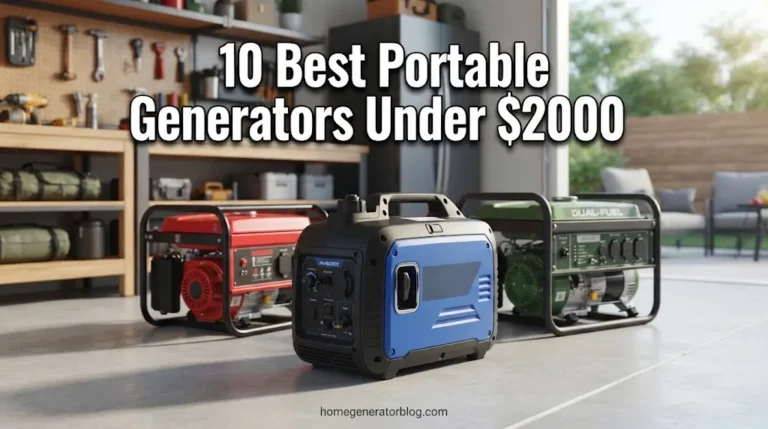
Gasoline Portable Generator: The Complete Buying Guide
Quick Answer: A gasoline portable generator is the right pick if you want the lowest upfront cost and easy refueling from any gas station. For most homes, a 7,000–10,000 running watt gasoline unit covers a fridge, well pump, furnace blower, and lights. Expect to pay $500–$1,200, run 8–10 hours per tank, and always operate it at least 20 feet from the house.
If you’ve ever stood in a dark kitchen wondering whether the fridge full of groceries is about to spoil, you already know why people buy these things in a hurry. Gasoline portable generators are the most common answer to that problem — not because they’re the fanciest option, but because gas stations exist on every corner and the machines themselves are cheap to buy and simple to run.
This guide walks through exactly what to look for, what to skip, and where people waste money. No fluff, no vague “consider your needs” filler.
Gasoline Generator Recommendation by Use Case
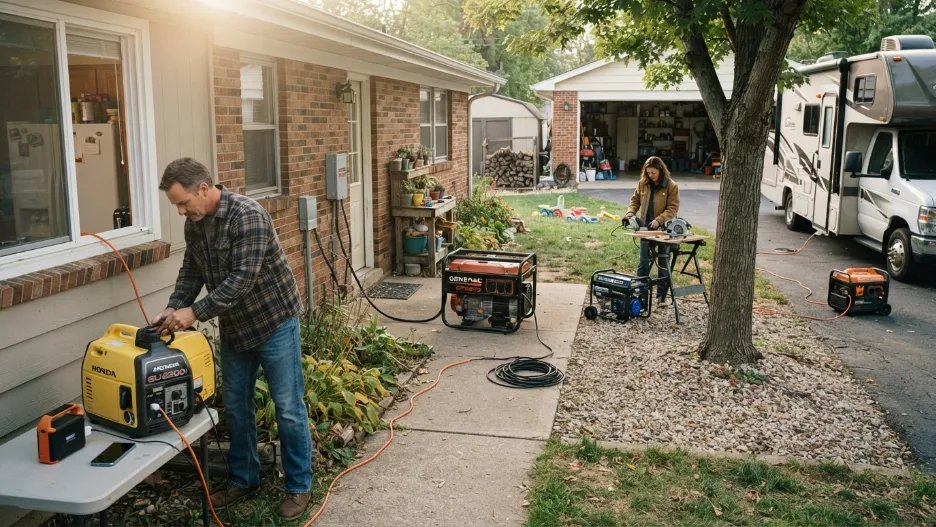
Not every household needs the same machine. Here’s a quick framework based on what you’re actually trying to keep running.
| Your Situation | Recommended Wattage | Why |
|---|---|---|
| Fridge + lights + phone charging only | 2,000–3,500W | Covers essentials without paying for capacity you won’t use |
| Fridge + furnace blower + well pump + some lights | 5,000–7,500W | Handles the starting-watt spikes of motors alongside steady loads |
| Whole-house partial backup, central AC, sump pump | 8,000–12,000W | Central AC compressors have a heavy starting-watt draw |
| Job site power tools, welders | 6,000–10,000W | Matches the surge demand of saws, compressors, and welders |
| RV or camping only | 2,000–4,000W | Lightweight, quieter units matter more than raw output here |
Why Choose Gasoline Over Propane or Dual-Fuel
Gasoline wins on three things: price, availability, and power output per dollar. A gasoline-only unit is typically $150–$300 cheaper than the same-size dual-fuel version, and gasoline packs more usable energy per gallon than propane, so you get slightly more running watts out of an identically sized engine.
The tradeoff is shelf life. Untreated gasoline starts breaking down in as little as 30 days, and even with a fuel stabilizer added, it’s only good for storage of about 3 to 6 months in a sealed can, or up to roughly a year in the tank with periodic stabilizer treatment. Propane, by contrast, stores indefinitely.
The first time I ran a 7,500-watt dual-fuel unit through a five-day outage a few winters back, the thing that surprised me wasn’t the noise or the fuel use — it was how much I underestimated how often I’d be running to the gas station with a jerry can at 11pm because I hadn’t rotated my stored fuel in months and half of it had gone stale. Gasoline only works as a backup plan if you actually maintain the fuel, not just the machine.
If your household loses power more than once or twice a year, or if you live somewhere gas station lines get long during storms, that shelf-life gap is worth thinking about before you buy straight gasoline over a dual-fuel portable generator.
Running Watts vs. Starting Watts
Every generator lists two numbers, and mixing them up is the single most common reason people buy the wrong size.
- Running watts (rated wattage): what the generator can supply continuously, hour after hour.
- Starting watts (surge watts): a short burst, usually 2–5 seconds, needed to get a motor spinning. This can be 2–3 times the running watts for things like refrigerator compressors, well pumps, and AC units.
A generator rated “9,000/7,000 watts” means 9,000 starting and 7,000 running. If your fridge alone needs 2,200 starting watts to kick on, and you’re already running 4,500 watts of other appliances, a 5,000-running-watt unit will stall the moment that compressor kicks in — even though the math on paper looked fine.
Noise: What the Decibel Rating Actually Means
Open-frame gasoline generators typically run 68–75 dBA at a distance of 23 feet — loud enough that neighbors will notice, and loud enough that OSHA considers 8 hours of unprotected exposure at the high end of that range a hearing-risk threshold. Inverter generators, which use electronic power regulation instead of a constant-speed engine, run closer to 52–60 dBA, similar to a normal conversation.
If you’re in a suburban neighborhood or plan to run the generator overnight near bedroom windows, that 15–20 dBA difference is the difference between a mildly annoying hum and a genuine “neighbor calls the HOA” problem. Gasoline open-frame units trade quiet for cheaper cost per watt — that’s the honest tradeoff, not a flaw to hide.
Portability: Wheels, Weight, and Real-World Handling
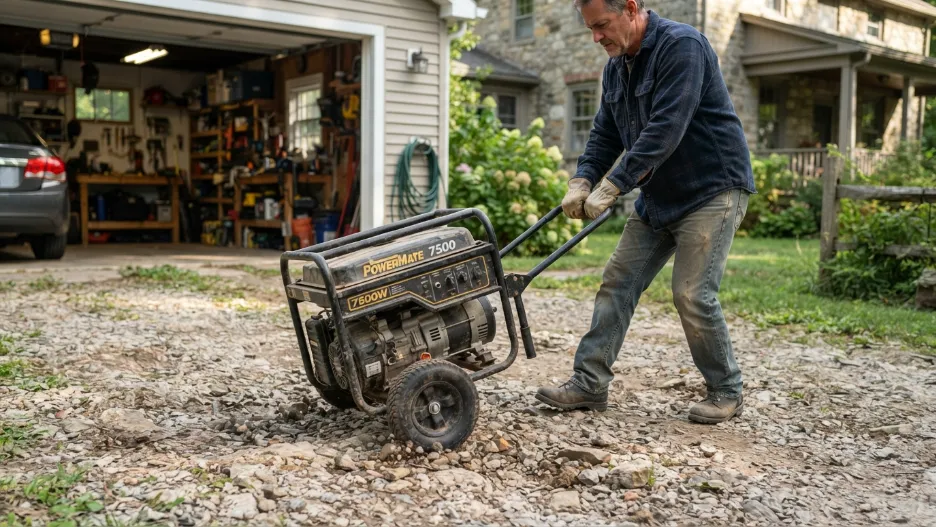
A 7,500-watt gasoline generator typically weighs 170–220 lbs. Most come with a wheel kit, but “has wheels” and “easy to move” are not the same thing once you’re pulling it across gravel or up a curb in the rain.
Look specifically for: never-flat wheels (pneumatic tires puncture and go flat in storage), a fold-down handle at a height you can actually pull without stooping, and a low center of gravity so it doesn’t tip when moved over uneven ground. If you’re over 60 or have any back issues, budget for a model under 150 lbs or plan on a hand truck.
Budget: What You Actually Get at Each Price Point
| Price Range | What You Get |
|---|---|
| $300–$500 | 3,000–4,000W, recoil start only, basic breaker panel, no CO shutoff sensor |
| $500–$900 | 5,000–7,500W, electric start, CO shutoff sensor, better fuel gauge |
| $900–$1,500 | 8,000–12,000W, remote start, transfer-switch-ready outlets, quieter engine tuning |
| $1,500+ | Inverter or dual-fuel models with parallel capability, low THD for electronics, premium brands |
A CO shutoff sensor is worth paying up for the moment you cross into the $500+ tier — it’s the single feature most linked to preventing accidental poisoning when a generator gets placed too close to a structure.
Runtime Per Tank: A Worked Example
Manufacturers usually quote runtime at 50% load, which is a fair real-world average for most backup use. Here’s what that looks like in practice for a common 7,500-running-watt gasoline unit with a 6.6-gallon tank:
| Load | Approx. Runtime | Fuel Burn |
|---|---|---|
| 25% (3,000W draw) | ~13 hours | ~0.5 gal/hr |
| 50% (5,600W draw) | ~9 hours | ~0.73 gal/hr |
| 100% (7,500W draw) | ~5.5 hours | ~1.2 gal/hr |
At current gasoline prices around $3.20/gallon, running that unit at 50% load for a 10-hour day costs roughly $23–$25 in fuel. Over a five-day outage running 10 hours daily, that’s about $115–$125 in gas alone — worth budgeting for before the storm hits, not during it.
Common Buyer Mistakes
- Sizing off running watts alone. Add up starting watts for anything with a motor before you buy, not after.
- Skipping the CO sensor to save $100. This is the feature that shuts the unit off automatically before CO builds to lethal levels indoors or in enclosed spaces — not a luxury add-on.
- Buying based on peak watts in bold ad copy. Retailers often headline the surge number because it’s bigger. Check the running watt spec before comparing price.
- Assuming any extension cord works. Undersized cords overheat and cause voltage drop. Match the gauge to the load and keep runs under 100 feet where possible.
- Forgetting the transfer switch. Backfeeding power into your home’s panel through a wall outlet is illegal in most jurisdictions and can electrocute utility line workers. A transfer switch or interlock kit, installed by a licensed electrician, is the only safe way to connect a generator to house wiring.
Sizing It Right: Don’t Guess
The table above gives ballpark ranges, but the only way to size a generator correctly is to add up the actual running and starting watts of everything you plan to power at once, then build in a safety margin of 20–25% on top.
Safety and Legal Basics
Beyond CO exposure, the other real risks are fire (from refueling a hot engine) and electrical backfeed (from connecting to house wiring without a transfer switch). Always let the engine cool for a few minutes before adding fuel, store gasoline in approved, labeled containers away from the generator itself, and check with your local building department before installing any transfer switch or interlock — permit requirements vary by jurisdiction. The CDC’s carbon monoxide poisoning guidance and the CPSC’s portable generator safety alert are both worth a five-minute read before your first use, not after.
Maintenance You’re Signing Up For
A gasoline generator is low-maintenance compared to a standby unit, but it isn’t zero-maintenance. Budget for these basics before you buy, not after the first oil light comes on.
| Task | Frequency | Why It Matters |
|---|---|---|
| First oil change | After 20–30 hours (break-in) | Clears metal shavings from engine break-in |
| Routine oil change | Every 50–100 hours or annually | Prevents premature engine wear |
| Fuel stabilizer treatment | Any time gas sits over 30 days | Stops ethanol-blended gas from gumming up the carburetor |
| Spark plug check | Annually | Fouled plugs are the top reason a stored generator won’t start |
| Exercise run (no load) | 15–20 minutes monthly | Keeps seals lubricated and confirms it’ll actually start when needed |
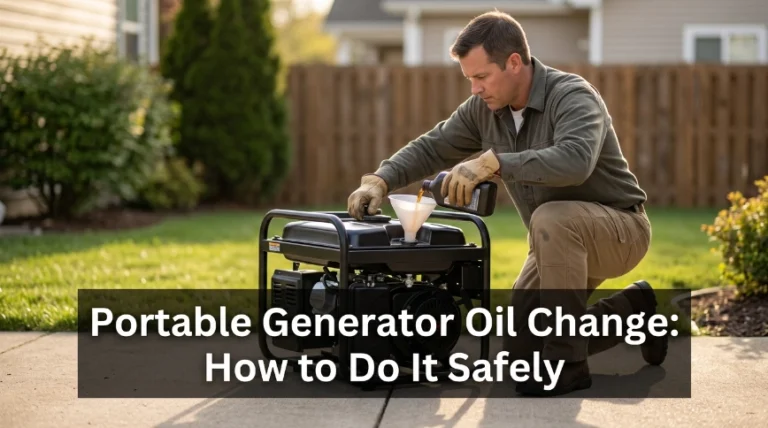
Skip the exercise run and there’s a good chance the one time you actually need the generator — three days into an outage — is the day you discover the carburetor is gummed up with stale fuel. Running it dry before long-term storage, or treating the tank with a stabilizer like fuel stabilizer, solves most of this. Ethanol-free gasoline also resists gumming better than the standard E10 blend at the pump, if you have access to it locally.
Conclusion
A gasoline portable generator earns its place as the default backup choice because it’s affordable, easy to refuel, and simple to maintain. The mistakes that get people hurt or disappointed almost always come down to sizing off the wrong wattage number or skipping the CO sensor to save a little cash. Get the wattage math right, buy the safety feature, and it’ll do exactly what you need it to do. Stay safe out there — Michael Turner.
If you’re shopping based on the sizing table above, a mid-range gasoline generator in the 7,000–8,500 running watt class with electric start and a CO shutoff sensor covers the vast majority of home backup needs without overspending.
Frequently Asked Questions
How long does a gasoline portable generator run on one tank?
Most 6–8 gallon tanks run 8–10 hours at 50% load. Full-load runtime drops to roughly 5–6 hours since fuel burn increases with demand.
Is it safe to run a gasoline generator in the rain?
Only under a generator-specific canopy or cover designed for ventilation — never a tarp that traps exhaust or blocks airflow. Water and the outlets/control panel don’t mix, so keep it dry and elevated off wet ground.
How far from the house does a gasoline generator need to be?
At least 20 feet from doors, windows, and vents, with the exhaust pointed away from the home. This distance is what the CPSC recommends regardless of what a specific owner’s manual states.
Can I run a gasoline generator in the garage with the door open?
No. Carbon monoxide builds to lethal levels in a garage even with the door fully open, and it can linger for hours after the unit shuts off. It must run outdoors only.
How much gasoline does a generator use per day during an outage?
For a 7,500-watt unit run 10 hours a day at 50% load, expect roughly 7–8 gallons per day, or about $22–$26 at current gas prices.

Hi, I’m Michael Turner. I own a generator workshop in the United States and founded HomeGeneratorBlog to share practical, hands-on guidance about generator installation, maintenance, troubleshooting, safety, and backup power solutions. My goal is to help homeowners make smarter, more confident decisions through clear and reliable information