
Portable Generator Watts: How Many Do You Actually Need?
Quick answer: Add up the running watts of everything you want on at once, then add the single largest starting-watt surge on top of that (not every appliance’s surge, just the biggest one). Most homes covering a fridge, well pump, furnace blower, and lights land between 5,000 and 7,500 watts. Whole-house coverage usually needs 10,000+.
If you’re standing in a store aisle or scrolling a listing right now trying to decide between a 3,500-watt unit and a 7,500-watt one, this is the only number that matters: your running watts total, plus your biggest single starting-watt surge. Everything else is detail.
Running Watts vs. Starting Watts (Why This Trips People Up)
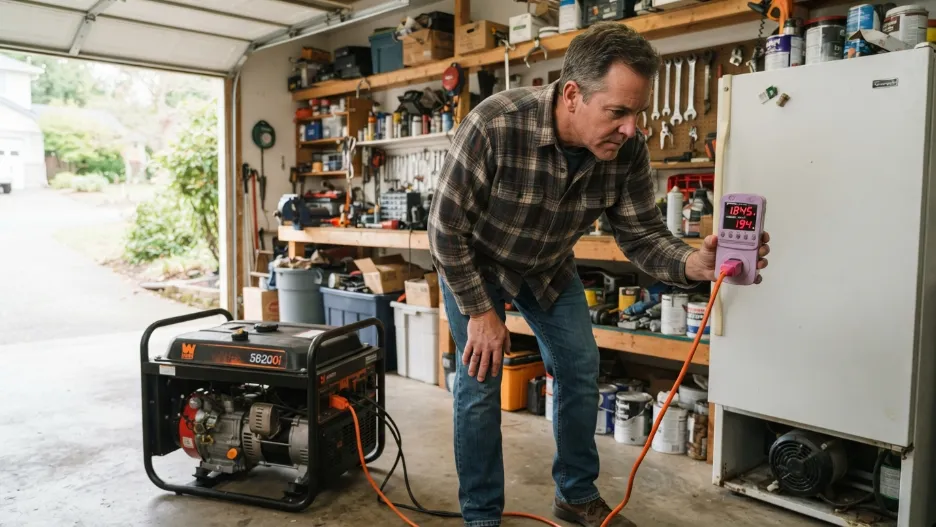
Running watts, sometimes called rated watts, are what a device draws once it’s already going. Starting watts — also called surge watts — are the short burst a motor needs to kick on, and it can be two to three times higher than the running number for a second or two.
A refrigerator might run at 200 watts but spike to 1,200 watts for a moment when the compressor kicks on. Buy a generator sized only for running watts and the fridge simply won’t start — the generator will bog down or trip its breaker the instant that compressor engages.
The Formula, in Plain English
Total running watts of everything running at once + the highest single starting-watt number among those devices = your minimum generator size.
You don’t add up every appliance’s starting watts — only the largest one, because in real use, motors don’t all kick on in the same instant. Stagger a chest freezer and a well pump by even a few seconds and you never stack their surges together.
Wattage Calculator: Common Household Items
Here’s a reference table for typical outage-day appliances. Use it to build your own list — write down what you’d genuinely run together, not everything you own.
| Appliance | Running Watts | Starting Watts |
|---|---|---|
| Refrigerator/freezer | 150–400 | 800–1,200 |
| Chest freezer | 100–350 | 700–1,000 |
| Sump pump (1/3 hp) | 800–1,050 | 1,300–2,600 |
| Well pump (1/2 hp) | 1,000 | 2,000–3,000 |
| Furnace blower fan | 300–800 | 1,000–2,350 |
| Window AC unit (10,000 BTU) | 1,200 | 3,600 |
| Central AC (3-ton) | 3,500–5,000 | 7,000–10,000 |
| Electric water heater | 3,000–4,500 | 0 |
| Microwave | 600–1,200 | 0 |
| Coffee maker | 800–1,400 | 0 |
| Space heater | 1,500 | 0 |
| Window fan / box fan | 100–200 | 0 |
| TV (LED, 40–55″) | 80–150 | 0 |
| Wi-Fi router/modem | 10–20 | 0 |
| Laptop charger | 60–90 | 0 |
| CPAP machine | 30–60 | 0 |
| Garage door opener | 450–600 | 850–1,100 |
| Power tools (circular saw) | 1,000–1,400 | 2,000–2,800 |
| Electric range burner (1) | 1,500–2,000 | 0 |
Worked Example: A Real Outage Scenario
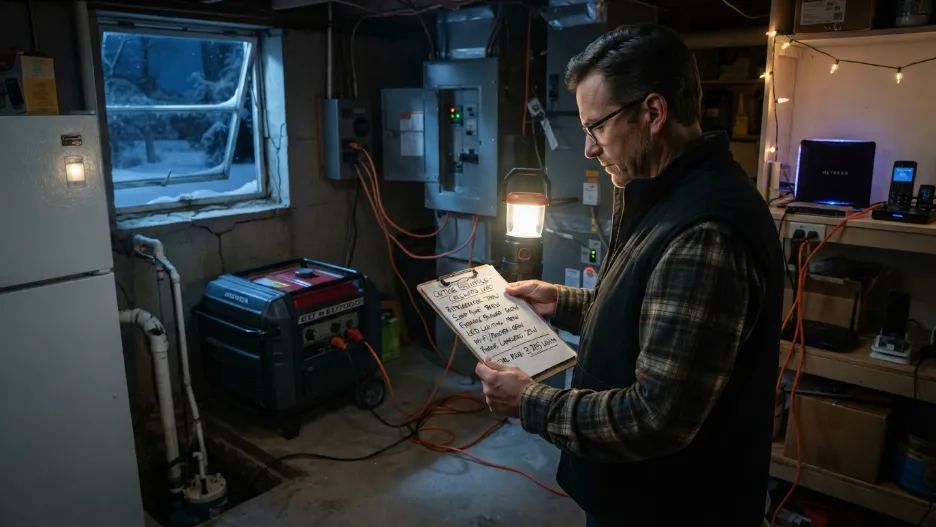
Say you’re running a fridge, a sump pump, a furnace blower, a few lights, a Wi-Fi router, and charging a couple of phones during a winter outage.
- Refrigerator running watts: 200
- Sump pump running watts: 900
- Furnace blower running watts: 600
- Lights (5 LED bulbs): 50
- Wi-Fi router: 15
- Phone chargers (2): 20
Running total: 1,785 watts. Now add the largest single starting surge in that list — the sump pump, at roughly 2,000 watts starting. That brings your real minimum to about 3,785 watts, which is why a “3,000 watt” generator on the shelf often can’t actually cover a setup that looks modest on paper.
The 20–25% Safety Margin
Don’t buy to the exact number. Generators lose some output at altitude, in heat, and as they age, and running one at 100% capacity for hours at a time shortens its life and increases fuel consumption per watt delivered.
Take your calculated minimum and add 20–25% headroom. In the example above, 3,785 watts becomes a real-world target closer to 4,700–4,800 watts — which is exactly why 5,000-watt units are such a common sweet spot for mid-size homes.
Quick Reference: What Size Fits Your Situation
| Use Case | Recommended Watts |
|---|---|
| Camping, charging devices, small fan, mini fridge | 1,000–2,000 |
| Job site power tools | 2,000–3,500 |
| Fridge + sump pump + lights + electronics | 4,500–5,500 |
| Above + furnace blower or window AC | 6,500–7,500 |
| Near-whole-house coverage with central AC or electric water heater | 10,000+ |
What Happens If You Size It Wrong
Go too small and the generator either won’t start your motor-driven appliances, or it will — and then trip its own breaker mid-cycle every time the compressor or pump kicks on. That’s not a defective unit; it’s an undersized one.
Go too big and you’ve spent extra money upfront, you’re burning more fuel per hour at low load than a right-sized unit would, and you’re hauling around more weight and noise than the job needs. There’s rarely a reason to buy double what your actual list adds up to.
A Note on Safe Connection
Sizing the wattage right doesn’t help if the generator is connected unsafely. Never run a generator inside a garage, basement, or near an open window — carbon monoxide from the exhaust builds to lethal levels fast and has no smell to warn you. The CDC’s guidance on CO poisoning recommends keeping any gas-powered generator well away from doors, windows, and vents, and using a battery-backed CO detector indoors regardless.
And never plug a generator directly into a wall outlet to “backfeed” your house wiring. Without a proper transfer switch or interlock kit, that can send power back down the line toward utility workers repairing the outage. OSHA’s portable generator safety guidance covers correct connection methods if you’re wiring one into your home’s circuits.
The first time I sized a generator for my own place — a mid-size ranch house with a well pump — I did the math on paper and landed at 4,200 watts. I bought a 7500 watt dual fuel portable generator anyway, and I was glad I did the first time the well pump and the furnace blower happened to kick on within a second of each other. That overlap almost never shows up in a spreadsheet, but it shows up in real life.
Inverter vs. Open-Frame: Does It Change the Wattage You Need?
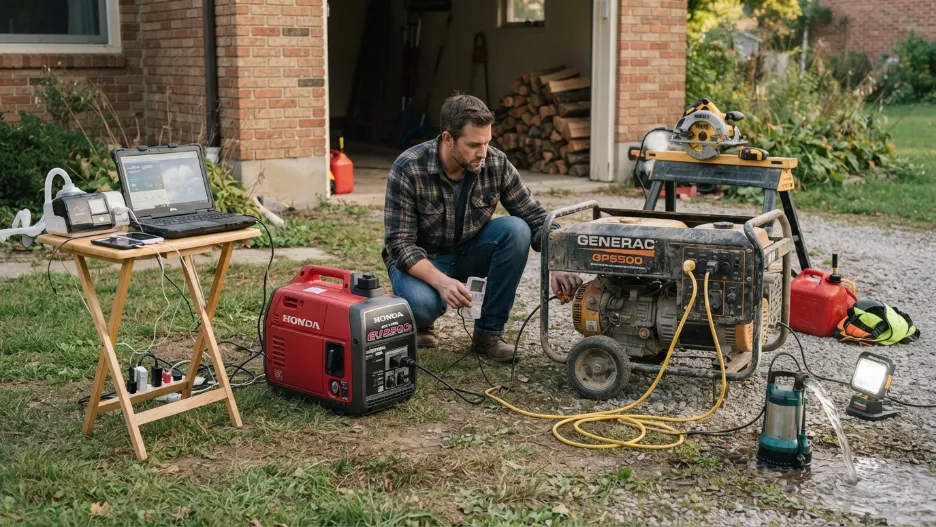
Not really — the watts you need are the watts you need regardless of generator type. What changes is how cleanly that power is delivered. Inverter generators produce power with lower total harmonic distortion (THD), which matters for sensitive electronics like laptops, medical equipment, and modern appliance control boards. Open-frame generators are usually louder and less fuel-efficient at partial load, but often deliver more raw wattage per dollar.
If your list includes a CPAP machine or anything with a circuit board you can’t afford to fry, lean inverter. If your list is mostly motors, pumps, and tools, an open-frame unit sized correctly will do the job for less money.
Fuel Type and Wattage: A Quick Cross-Check
Gasoline generators typically deliver the highest rated wattage per dollar of purchase price. Propane burns cleaner and stores indefinitely but usually derates a generator’s output by roughly 10%, so a “7,500-watt” dual-fuel unit often only delivers around 6,700–6,800 watts running on propane. Factor that into your safety margin if propane is your primary fuel plan.
Conclusion
The number that matters isn’t the biggest generator on the shelf — it’s your actual running-watts total plus your single largest starting surge, with 20–25% added on top. Do that math with your own appliance list before you buy, not after. Get the sizing right, and everything else about running a generator gets a lot less stressful. — Michael Turner
If your calculated total lands in the 4,500–7,500 watt range — which covers most homes running a fridge, pump, and blower together — a dual-fuel portable generator gives you flexibility between gasoline and propane without needing a second unit.
How many watts does a portable generator need to run a house?
Most homes running essentials — fridge, sump or well pump, furnace blower, lights, and electronics — need 5,000 to 7,500 watts. Covering central AC or an electric water heater as well usually pushes that to 10,000 watts or more.
Is a 3,500-watt generator enough for a refrigerator and a few lights?
Yes for the refrigerator and lights alone, but check what else is on that circuit. A 3,500-watt unit has little headroom left over if a well pump or sump pump also needs to start.
Can I just add up all my appliances’ starting watts to be safe?
No — that overestimates what you need. Add every device’s running watts, then add only the single highest starting-watt figure among them, since motors rarely all surge at the exact same instant.
Do I need to buy extra wattage beyond my calculated total?
Yes, add 20–25% margin. Generators lose some capacity to heat, altitude, and age, and running one flat-out for hours shortens its lifespan.
Does running on propane instead of gasoline change how many watts I get?
Yes. Propane typically derates a dual-fuel generator’s output by around 10% compared to its gasoline rating, so size up slightly if propane is your main fuel.

Hi, I’m Michael Turner. I own a generator workshop in the United States and founded HomeGeneratorBlog to share practical, hands-on guidance about generator installation, maintenance, troubleshooting, safety, and backup power solutions. My goal is to help homeowners make smarter, more confident decisions through clear and reliable information

One Comment