Generator for Air Conditioner: What Size Do You Actually Need?
Quick answer: Most window and portable air conditioners run on a 2,000–3,000-watt generator. Mini-splits up to 18,000 BTU need 3,000–4,000 watts. A single central AC (2.5–4 tons) needs 10,000–17,000 watts because of the compressor’s startup surge. Always size for starting watts, not just running watts.
If you’re reading this mid-outage with a sweating glass of water in one hand, here’s the short version: air conditioners need a lot more power to start than they do to run, and that gap is where most people buy the wrong generator. Get the starting watts wrong and the AC either won’t start or it’ll trip your generator every time the compressor kicks on.
I learned this the expensive way. The first summer I tested a 3,500-watt inverter generator against my own 10,000 BTU window unit, I watched it stall on startup three times before I checked the surge rating on the compressor label. The unit only needed 1,200 running watts — but it wanted almost 3,000 to kick on. That gap is the whole game.
Running Watts vs. Starting Watts: The Number That Actually Matters
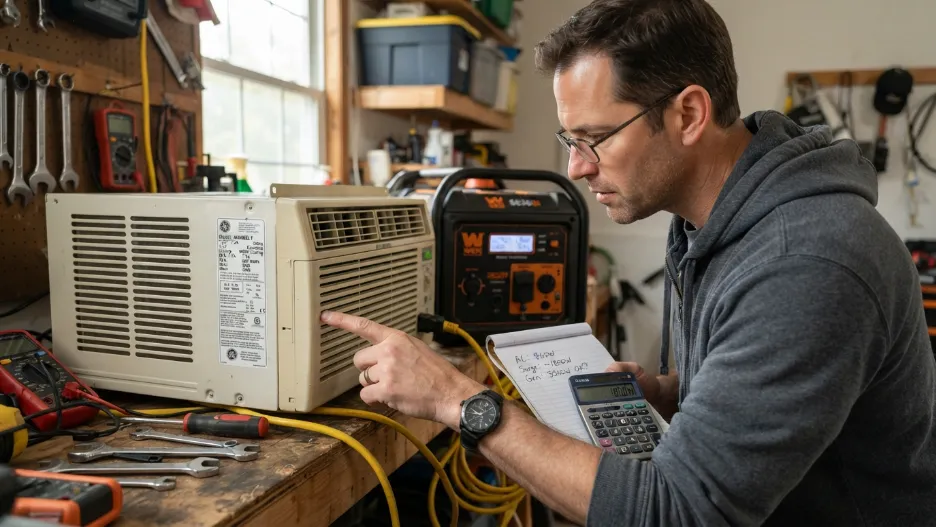
Every air conditioner has two power ratings. Running watts is what it draws once the compressor is up and spinning steadily. Starting watts (also called surge or inrush watts) is the momentary spike when the compressor motor first engages — typically 2 to 3 times the running wattage, sometimes more on larger central systems.
Your generator has to clear the starting number, even if only for a second or two. A generator rated for exactly your AC’s running watts will stall, trip its breaker, or shut down entirely the moment the compressor tries to start.
You’ll find both numbers on the AC’s data plate (usually inside the service panel or on a sticker on the back of the unit) or in the owner’s manual. If only one number is listed, assume it’s running watts and multiply by 2.5 to estimate the surge.
The Formula, in Plain English
Generator size needed = (AC starting watts) + (running watts of everything else you want powered at the same time), with roughly 20–25% headroom on top.
For central air specifically, contractors use a rule of thumb of about 3,500 watts of running power and up to 3–5x that in starting surge per ton of cooling capacity (1 ton = 12,000 BTU). That’s why a 3-ton central AC alone can demand a 12,000+ watt generator just to start, even though it only runs on roughly 10,500 watts once it’s going.
Generator Size by Air Conditioner Type
| AC Type | Running Watts | Starting Watts | Recommended Generator |
|---|---|---|---|
| Window AC, 5,000 BTU | 450–600W | 900–1,200W | 2,000W |
| Window AC, 8,000 BTU | 700–900W | 1,400–1,800W | 2,000–3,000W |
| Window AC, 12,000 BTU | 1,100–1,400W | 2,200–3,000W | 3,000–4,000W |
| Portable AC, 8,000 BTU | 800–1,000W | 1,600–2,000W | 2,000–3,000W |
| Mini-split, 12,000 BTU (1 ton) | 1,000–1,200W | 2,000–2,500W | 3,000W |
| Mini-split, 24,000 BTU (2 ton) | 1,800–2,200W | 3,500–4,500W | 4,500–5,000W |
| Central AC, 2.5 ton | ~5,500W | 11,000–16,500W | 10,000–12,000W (or soft start) |
| Central AC, 3 ton | ~7,000W | 14,000–21,000W | 12,000–14,000W (or soft start) |
| Central AC, 4 ton | ~9,500W | 19,000–28,500W | 15,000–17,000W (or soft start) |
Ranges are wide on purpose — compressor age, ambient temperature, and elevation all shift the real number. Barometric pressure and heat both push starting watts higher, which is exactly when you need the AC most.
Full Wattage Table: What Else You’re Probably Running Too
Nobody runs just the AC during an outage. Add up everything you’ll actually use at the same time — that combined number is your real target, not the AC number alone.
| Appliance | Running Watts | Starting Watts |
|---|---|---|
| Refrigerator | 150–400W | 800–1,200W |
| Chest freezer | 300–500W | 1,200–1,600W |
| Sump pump (1/3 HP) | 800W | 1,300–2,000W |
| Well pump (1/2 HP) | 1,000W | 2,000–3,000W |
| Furnace fan/blower | 500–800W | 1,000–2,300W |
| Microwave | 1,000–1,200W | n/a |
| Coffee maker | 800–1,200W | n/a |
| Box fan | 100W | n/a |
| TV (LED, 50″) | 100–150W | n/a |
| WiFi router/modem | 15–30W | n/a |
| Phone/laptop charging | 30–60W | n/a |
| LED light bulbs (each) | 8–12W | n/a |
| Electric kettle | 1,200–1,500W | n/a |
| CPAP machine | 30–60W | n/a |
| Space heater | 1,500W | n/a |
Worked Example: Sizing a Generator for AC Plus the Essentials
Say you’re running a 12,000 BTU window AC, a refrigerator, a WiFi router, four LED bulbs, and charging phones. Here’s how that actually adds up.
The AC’s starting watts (2,800W) is the highest single spike, so it sets the floor. You don’t add every appliance’s starting watts together — only the largest one, because appliances rarely all start at the exact same instant. Everything else contributes its running watts to that peak moment.
| Load | Watts Needed at Peak |
|---|---|
| Window AC (starting watts, worst case) | 2,800W |
| Refrigerator (running) | 200W |
| WiFi router | 20W |
| 4 LED bulbs | 40W |
| Phone charging x2 | 60W |
| Subtotal | 3,120W |
| +20% safety margin | 3,744W |
That points to a 4,000-watt (or a common 3,500–4,500W dual-fuel) generator as the practical buy — enough headroom that the AC’s surge doesn’t fight everything else for power at the same instant.
Why You Should Add a 20–25% Safety Margin
Generators lose output as they age, as temperatures climb, and at higher elevation — thinner air means less combustion efficiency, which can cut rated output by several percent per thousand feet. A generator sized to the exact number on paper has zero room for that drift.
The margin also covers the compressor cycling back on mid-afternoon when the generator’s already carrying the fridge and a fan. Undersizing here is the single most common mistake homeowners make, and it’s the one that ends with a generator that trips its breaker every 20 minutes on a 95-degree day.
Can a Soft Start Device Let You Use a Smaller Generator?
Yes — this is the gap most sizing guides skip entirely. A soft start capacitor (sometimes called a soft starter) installs on the AC’s compressor and stretches the startup surge over a second or two instead of delivering it as one instant spike. That can cut the starting-watt requirement by 50–70%.
Practically, that means a central AC that would otherwise need a 14,000-watt generator might start comfortably on a 7,000-watt unit with a soft starter installed. It’s a genuinely useful $150–$250 add-on if you’re trying to run central air off a portable generator rather than buying an oversized standby unit — though it doesn’t change the running wattage, only the surge.
Portable, Inverter, or Standby: Which Fits Central vs. Window AC
A window or portable AC unit almost always pairs fine with a mid-size inverter generator — quieter, more fuel-efficient, and clean enough power to protect the AC’s control board.
Central air is a different calculation. Getting 12,000+ watts of surge capacity from a portable unit means either a large dual-fuel open-frame generator or a soft start device paired with a mid-size unit. If you want the AC (and the rest of the house) to switch over automatically the moment the power drops, that’s the case for a standby generator — installed outside, wired through an automatic transfer switch, and sized by a licensed electrician against your whole panel, not just the AC.
Whichever route you take for central air, never connect a portable generator directly into your home’s wiring without a transfer switch or interlock kit. Backfeeding through an outlet can energize utility lines and is a genuine electrocution risk to repair crews — a licensed electrician needs to install the switch. PNNL’s operations guide covers how transfer switches isolate the two power sources.
Generator Safety While Running an AC
Carbon monoxide is the real risk here, not electrical. Run any generator outdoors, at least 20 feet from doors, windows, and vents, with the exhaust pointed away from the house — never in a garage, even with the door open. CPSC guidance on this is blunt for a reason: portable generators are a leading cause of post-storm CO deaths, and it can happen in minutes.
A few other habits matter specifically when you’re running an AC off it: keep the generator dry and covered if it’s raining, don’t overload it by adding a space heater or dryer on top of the AC load, and let it cool before refueling.
Common Sizing Mistakes to Avoid
- Sizing to running watts only. The AC will never start if the generator can’t clear the surge, even briefly.
- Ignoring elevation and heat. Both reduce real-world generator output below the rated number.
- Skipping the transfer switch for central air. Backfeeding is illegal in most jurisdictions and dangerous regardless.
- Buying oversized “just in case.” A 12,000-watt generator running only a window AC burns far more fuel per hour than a right-sized 3,000-watt unit — you’re paying for headroom you’ll never use.
- Forgetting simultaneous loads. The fridge cycling on at the same second the AC’s compressor kicks in is exactly the scenario that trips an undersized generator.
Conclusion
Size for the AC's starting watts first, add your other essential loads’ running watts, then pad the total by 20–25%. For window and portable units, a 2,000–4,000-watt generator covers nearly every case. For central air, plan on 10,000+ watts or a soft start device paired with a smaller unit — and always route it through a proper transfer switch. Get the number right once, and you won’t be doing this math again mid-outage. — Michael Turner
If you’re sizing up for a window or portable AC plus the essentials, a dual-fuel portable generator in the 3,500–4,500 watt range covers most households with room for the compressor’s startup surge and a few extra devices.
FAQ
Will a 2,000-watt generator run a window air conditioner?
It will run most units up to about 8,000 BTU, but check the starting-watts number on the AC’s data plate first. A 10,000–12,000 BTU window unit’s surge can exceed 2,000 watts and stall a generator that size.
What size generator do I need for a 3-ton central air conditioner?
Plan for 12,000–14,000 watts to safely clear the starting surge, or a 6,000–7,000-watt generator if you install a soft start capacitor on the compressor. Running watts alone are only around 7,000W, which is why sizing by running watts leads people astray.
Can I run my AC and refrigerator on the same generator?
Yes, as long as you size for whichever appliance has the higher starting watts — usually the AC — and add the other’s running watts on top, plus a margin. A 3,500–4,000-watt generator comfortably covers a window AC and a fridge together.
Does a generator need a transfer switch to run a window AC?
No — a window or portable AC can be plugged directly into the generator with a heavy-duty outdoor extension cord. Transfer switches are only required when you’re connecting to your home’s permanent wiring, which applies to central air and ducted mini-splits.
Is an inverter generator better than a standard one for running an AC?
Inverter generators produce cleaner, more stable power with less harmonic distortion, which protects the sensitive control boards in modern AC compressors. They’re a better fit for AC use than a basic open-frame generator, though open-frame dual-fuel units can still work fine at higher wattages where inverter models get expensive.

Hi, I’m Michael Turner. I own a generator workshop in the United States and founded HomeGeneratorBlog to share practical, hands-on guidance about generator installation, maintenance, troubleshooting, safety, and backup power solutions. My goal is to help homeowners make smarter, more confident decisions through clear and reliable information