Portable Generator Voltage: What’s Normal and What’s Not
Quick answer: Most portable generators put out 120 volts, 240 volts, or both at once, and no-load voltage should sit between about 120 and 125 volts per leg. Readings above 130V or below 110V under load point to a real problem — usually engine speed, a failing AVR, or an overloaded circuit — and can damage anything with a circuit board plugged into it.
If you just checked your generator’s output with a multimeter and the number looked off, you’re not imagining it. Voltage that drifts too high or too low is one of the most common — and most misunderstood — portable generator complaints, and it’s the reason laptops, routers, and refrigerator compressors sometimes die on a “perfectly good” generator.
Here’s what the number on your meter actually means, why it moves around, and when it’s telling you to stop using the machine.
What Voltage Should a Portable Generator Actually Put Out?
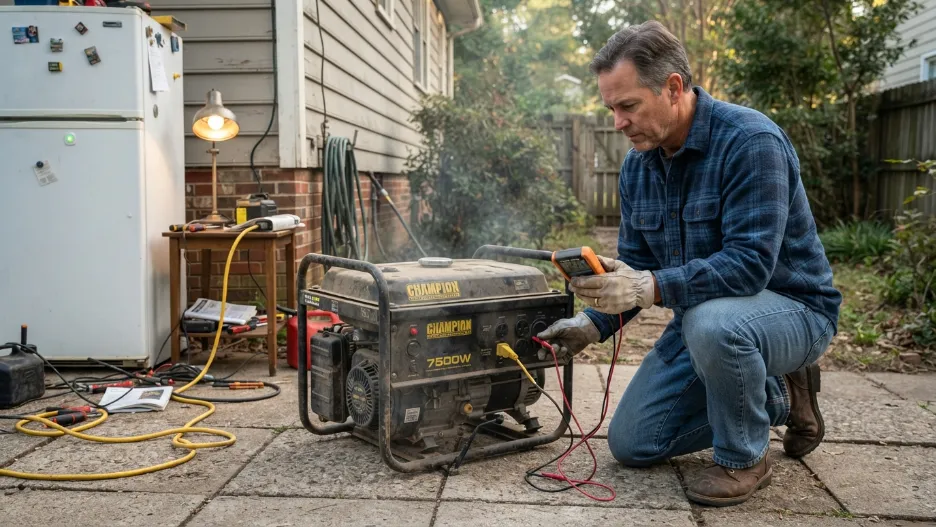
A portable generator is built to mimic household utility power, which runs at roughly 120 volts for standard outlets and 240 volts for larger appliances like a well pump or an electric range. Federal consumer product regulations define a portable generator as an engine-driven unit rated no higher than 15 kilowatts and 250 volts, which is why you’ll rarely see a portable model exceed that ceiling.
Smaller units — the kind you’d take camping or run a job site with — are often 120V only. Anything in the 3,000-watt-and-up range typically gives you a 120V/240V split, either through separate breakers or a single 120/240V twist-lock outlet.
With nothing plugged in, healthy no-load voltage usually reads 120–125V per leg. Under a real load — say, a fridge and a couple of lamps — it’s normal for that to sag slightly, into the 115–120V range. That’s not a defect; it’s how every AC generator behaves under demand.
Diagnosing Voltage Problems: Symptom, Cause, Fix
| Symptom | Likely Cause | Fix |
|---|---|---|
| No-load reading over 130V | Engine running too fast (governor or throttle out of adjustment) | Have the governor checked before running anything electronic; don’t use it until it’s fixed |
| Voltage sags badly under light load | Weak or worn brushes/capacitor, or engine can’t hold RPM under load | Check spark plug, air filter, and fuel delivery first; if RPM is fine but voltage still drops, the AVR or capacitor likely needs service |
| Lights flicker or dim in rhythm | Generator is close to its rated wattage limit | Unplug non-essential loads; stagger high-draw appliances instead of starting them together |
| Voltage reads normal but electronics still die | Poor waveform quality (high total harmonic distortion) on a non-inverter unit | Switch sensitive electronics to an inverter generator, which produces a cleaner sine wave |
| 240V leg reads fine, 120V leg reads low (or vice versa) | Uneven load distribution between the two legs | Rebalance which appliances run on which outlet/breaker |
| Voltage was fine, now consistently high after storage | Stale fuel or a gummed carburetor causing erratic RPM | Drain old fuel, clean the carb, and use a fuel stabilizer going forward |
Why Voltage Drifts: The Role of the AVR
Voltage is essentially electrical pressure — the force pushing current through a wire, the way water pressure pushes water through a hose. That pressure comes from how fast the generator’s alternator spins, which is why engine speed and voltage are directly linked.
Most modern portables use an automatic voltage regulator, or AVR, to keep that pressure steady as the load changes. When you plug in a compressor or a power tool, the sudden draw would otherwise cause a voltage dip; the AVR compensates almost instantly. Cheaper or older open-frame units sometimes skip a true AVR, which is part of why their output swings more under load.
Inverter generators take this further. Instead of sending raw AC straight from the alternator, they convert it to DC and then back to a clean, regulated AC sine wave — which is why manufacturers market them as safe for laptops and medical equipment where a standard portable might not be.
120V vs. 240V: Which One Do You Actually Need?
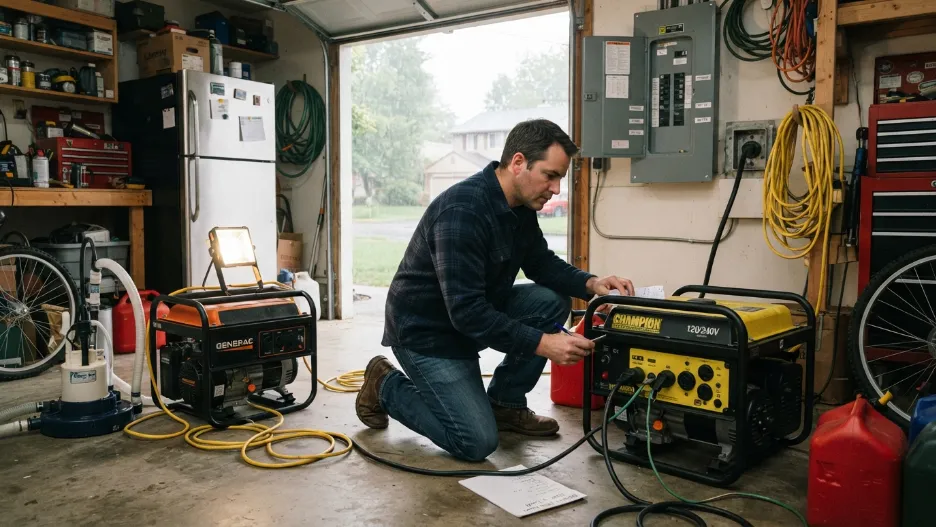
This trips up a lot of first-time buyers. A 120V-only generator will run lights, a fridge, a sump pump, and most household electronics without issue. But it won’t run a 240V well pump, an electric dryer, or a central air condenser — those need a generator with a genuine 240V leg, not just two 120V outlets wired together.
Home standby units and most mid-size-and-larger portables supply 120V and 240V simultaneously from the same alternator, split across breakers. If your outage plan includes anything hardwired at 240V, that’s a non-negotiable spec to check before you buy — not something to work around later with an adapter.
The Real Risk of Ignoring Voltage Problems
High or unstable voltage isn’t just an inconvenience — it’s the fastest way to fry a modern appliance. Circuit boards in refrigerators, routers, TVs, and furnace control panels are built for a narrow voltage window, and a generator running “hot” at 130-plus volts can cook that board in minutes, sometimes before you notice anything wrong.
The first time I ran a 7,500-watt dual-fuel unit through a five-day outage, the thing that caught me off guard wasn’t fuel consumption — it was watching my kill-a-watt meter creep past 128V every time the furnace blower cycled off and the load dropped. I ended up running everything sensitive through a small surge-protected power strip after that, and I’ve done it on every outage since. — Michael Turner
Beyond electronics, generators carry a separate and more serious hazard: carbon monoxide. It has nothing to do with voltage, but it’s the reason every unit should run outdoors, away from windows and doors — indoor use can be fatal within minutes, according to federal safety regulators.
How to Check and Protect Your Generator’s Voltage
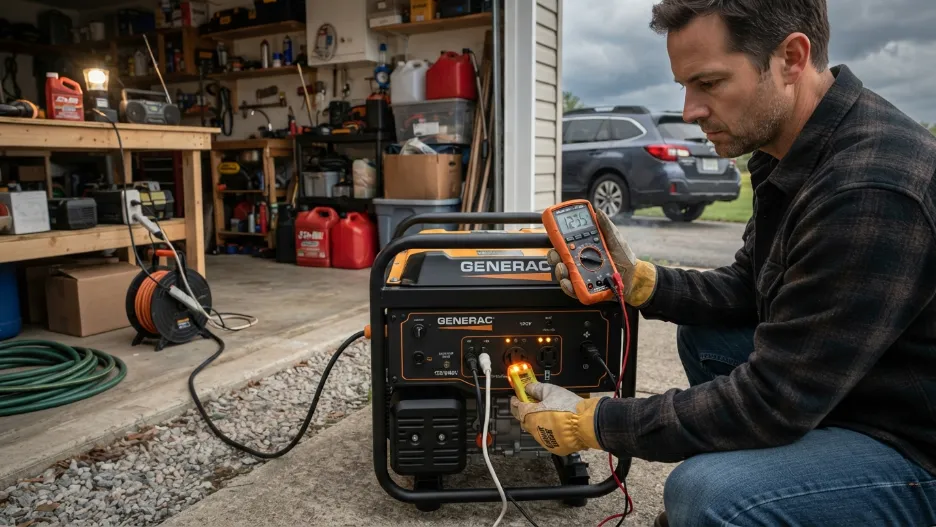
- Test before you rely on it. Run the generator with no load and check both legs with a multimeter or a plug-in voltage tester before an outage, not during one.
- Warm it up first. Voltage is often unstable for the first 30–60 seconds after startup; let it settle before plugging anything in.
- Use a surge-protected power strip for anything with a circuit board, even on generators with a built-in AVR.
- Don’t overload one leg. On a 120/240V unit, spread your load across both sides instead of stacking everything on one breaker.
- Service the governor and carburetor annually. Most voltage drift traces back to inconsistent engine speed, not the alternator itself.
Conclusion
Normal portable generator voltage sits close to 120V per leg at no load, with a modest, expected sag once you add real appliances. Anything wildly above or below that — especially readings north of 130V — means stop, unplug your electronics, and get the governor or AVR looked at before you run it again. Test your unit’s voltage now, while the power’s still on, so you’re not guessing during the next outage. — Michael Turner
If your generator’s output has been drifting, a simple plug-in voltage meter is the cheapest way to catch a problem before it takes out a fridge or a furnace board — worth keeping in the garage next to the unit itself.
Is 130 volts too high for a portable generator?
Yes. No-load voltage should stay in roughly the 115–125V range; a steady reading above 130V usually means the engine is running too fast and can damage sensitive electronics.
Can I run my whole house on a 120V-only generator?
Only if nothing in your home is hardwired at 240V. Central air, electric dryers, and most well pumps need a generator with an actual 240V leg, not just two 120V outlets.
Why does my generator’s voltage drop when I plug something in?
A brief dip is normal — it’s the AVR reacting to sudden demand. A dip that doesn’t recover, or that dims lights continuously, usually means you’re near the unit’s wattage limit.
Do I need an inverter generator for voltage-sensitive electronics?
Not strictly, but it helps. Inverter generators produce a cleaner, more stable sine wave than standard open-frame units, which lowers the risk to laptops, TVs, and medical equipment.
How often should I check my generator’s voltage output?
Test it at least once a season and always before a forecasted outage — voltage problems are far easier to catch on a workbench than mid-storm with the fridge already plugged in.

Hi, I’m Michael Turner. I own a generator workshop in the United States and founded HomeGeneratorBlog to share practical, hands-on guidance about generator installation, maintenance, troubleshooting, safety, and backup power solutions. My goal is to help homeowners make smarter, more confident decisions through clear and reliable information