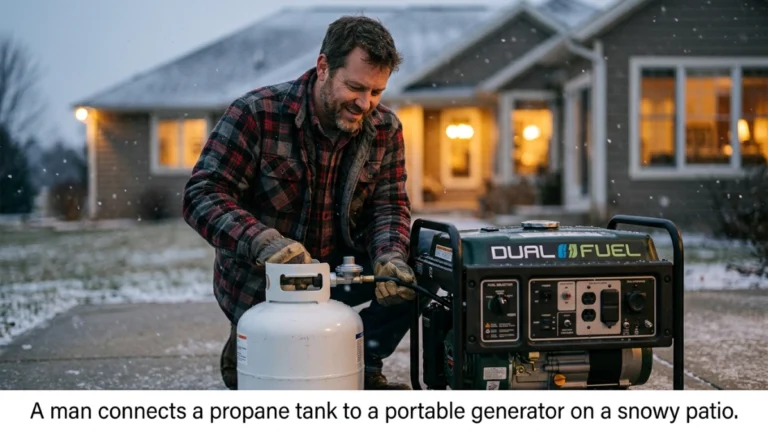
How Much AC Power Does a Portable Generator Give You?
Quick Answer: Every portable generator outputs standard AC (alternating current) power, but “enough AC power” for an air conditioner depends on running watts plus a 2–3x starting surge. A window AC needs roughly 2,000–4,000 watts; a portable AC needs 2,000–3,000 watts; central air can need 8,000–12,000+ watts or a soft-start kit.
If you searched “portable generator AC power,” you’re probably asking one of two different questions. Either you want to know what kind of electricity a generator actually produces, or you want to know whether your generator can run your air conditioner. Most articles online answer only the second question and skip the first — which leaves a real gap in understanding. Let’s clear up both.
“AC Power” on a Generator: Two Different Things
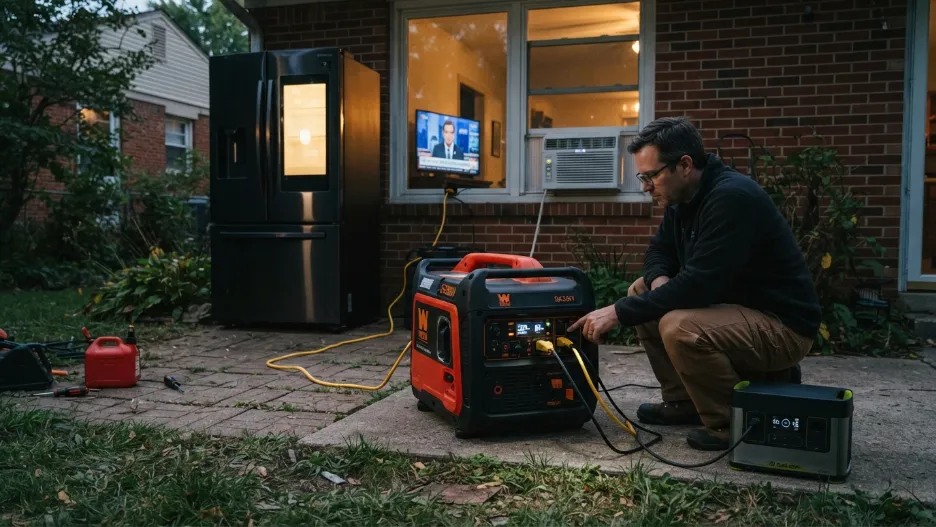
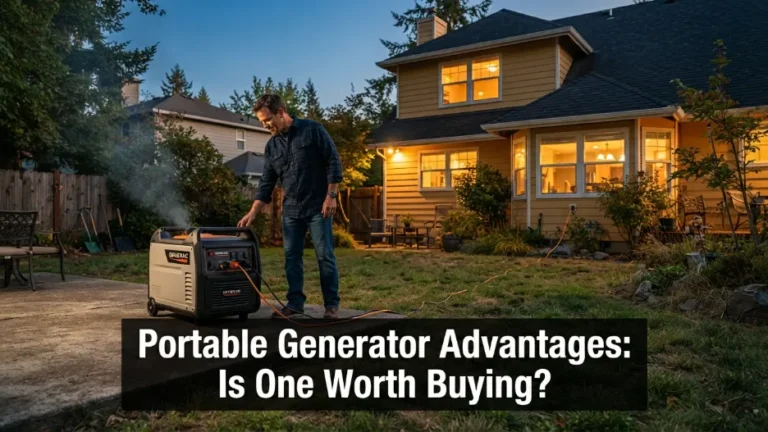
Every portable generator — gas, propane, dual-fuel, or inverter — produces AC power. That’s alternating current, the same type of electricity that comes out of your home’s wall outlets. It’s what powers your fridge, TV, and air conditioner without any conversion needed.
This is different from DC (direct current), the kind of power stored in batteries and solar power stations. Some portable power stations advertise “AC output” as a feature specifically because their internal storage is DC and needs an inverter to convert it — a true fuel-powered portable generator doesn’t have that limitation; AC is simply its native output.
So when someone asks “does my portable generator give AC power,” the answer is always yes. The real question — the one that actually matters for planning — is whether that AC output is enough to run an air conditioner. That’s what the rest of this guide covers.
Running Watts vs. Starting Watts: The Two Numbers That Matter
An air conditioner’s compressor is a motor, and motors don’t draw power evenly. Once running, the AC settles into a steady draw called running watts. But for a split second at startup, it can pull 2 to 3 times that amount — the starting watts, sometimes called surge or inrush current.
Generator shoppers get burned here constantly. They size the generator to the running watts, plug in the AC, and the generator trips or stalls the instant the compressor kicks on. The starting watts number — not the running number — is what actually determines the minimum generator size you need.
Wattage Calculator: AC Units and Common Household Loads
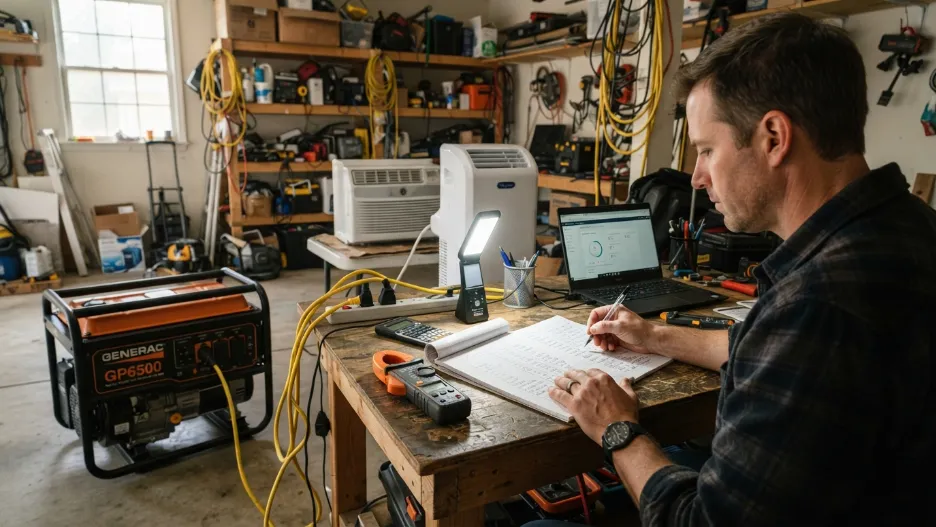
To size a generator: add up every device’s running watts, then add only the single highest starting-watts figure among them — not all of them stacked. Motors rarely surge at the exact same instant, so the calculation only needs the worst-case spike, once.
Worked Example: Sizing for a Real Outage Scenario
Say you’re keeping a bedroom cool during a summer outage with a 12,000 BTU window AC, plus a refrigerator, four LED lights, and phone charging.
- Running watts total: 1,500 (AC) + 700 (fridge) + 40 (lights) + 65 (phone) = 2,305 watts
- Highest single starting watts: 4,000 (the AC’s surge)
- Total generator requirement: 2,305 + 4,000 = 6,305 watts
The first time I sized a generator for a client running a 12,000 BTU window unit through a heat-wave outage, I underestimated the surge and watched a 4,500-watt unit stall on the very first compressor cycle. A 6,500- to 7,000-watt generator would have handled it cleanly — that gap between running watts and real-world surge is where most sizing mistakes happen.
The 20–25% Safety Margin, Explained
Generators lose some output as they age, run hot, or sit at altitude. Manufacturers rate them at a controlled bench test — real-world conditions rarely match that number exactly.
Take your calculated total and multiply by 1.20 to 1.25. In the example above, 6,305 watts × 1.25 = 7,881 watts. That rounds up to an 8,000-watt generator as the realistic, safe purchase — not the bare-minimum 6,305 the math alone suggests.
Soft-Start Devices: Cutting the Surge Down
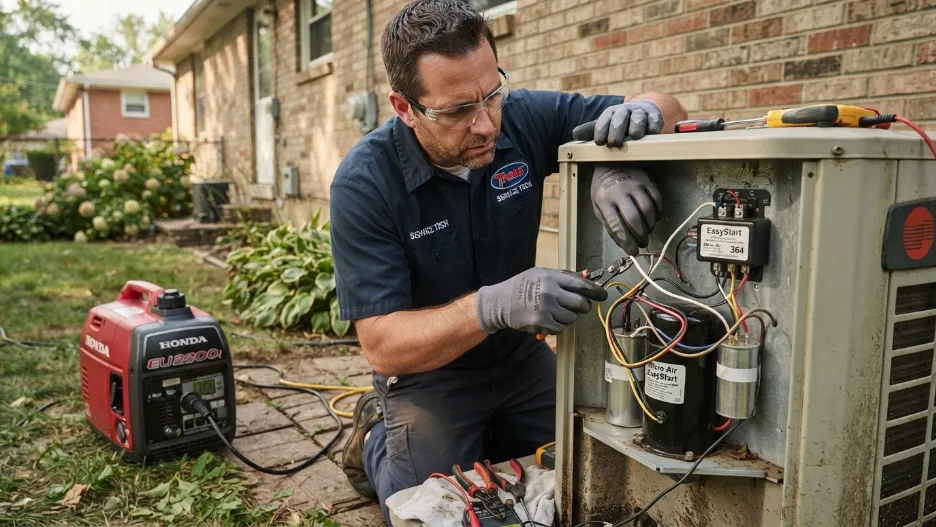
A soft-start capacitor (sometimes called a “soft start kit”) installs directly on the AC’s compressor and ramps the startup current up gradually instead of demanding it all at once. On many units, this cuts starting watts by 50–70%.
That means a 12,000 BTU window AC with a 4,000-watt surge might only need 1,200–1,500 watts to start once a soft-start kit is installed — which can drop your total generator requirement by a full size class. It’s a $50–$150 part that often pays for itself in generator cost alone, especially for central air and larger mini-splits.
Inverter vs. Conventional Generators for Running an AC
Standard open-frame generators produce power with more electrical “noise” — voltage fluctuations that a basic fan or light won’t notice, but a variable-speed compressor motor can. Inverter generators produce cleaner, more stable AC output, closer to what utility power delivers.
For AC units — especially modern inverter-driven mini-splits — a true inverter generator is worth the premium. It’s gentler on the compressor’s electronics and less likely to trigger error codes or premature shutdowns on units that are sensitive to voltage swings.
Common Mistakes When Sizing a Generator for AC
- Sizing to running watts only. The starting surge, not the running load, is what trips an undersized generator.
- Ignoring altitude and heat derating. Generators lose roughly 3–4% output per 1,000 feet of elevation and can lose additional capacity in extreme heat.
- Stacking every appliance’s starting watts together. Only the single largest surge counts toward your total — not the sum of all of them.
- Forgetting the extension cord gauge. A cord that’s too thin or too long causes voltage drop that can strain the AC’s compressor even if the generator itself is sized correctly.
- Running the AC and generator too close to windows or doors. Beyond the fire and CO risk, heat radiating off a nearby generator can work against the AC’s own cooling effort.
Portable generators should always run outdoors, at least 20 feet from windows, doors, and vents — carbon monoxide from generator exhaust is odorless and can build to dangerous levels in minutes, according to the U.S. Consumer Product Safety Commission. And regardless of generator size, an ENERGY STAR certified AC unit will draw meaningfully less power to begin with, which lowers your generator requirement across the board according to ENERGY STAR’s room air conditioner program.
Conclusion
Every portable generator already gives you AC power — the real question is whether it gives you enough of it for the surge your air conditioner demands at startup. Size to the starting watts, add a 20–25% margin, and consider a soft-start kit if you’re borderline on generator size. Get those numbers right, and a portable generator will keep a room genuinely cool through almost any outage — that’s the standard I use with every client, and it hasn’t failed me yet. — Michael Turner
If you’re shopping for a generator sized specifically for AC startup surge, a mid-size inverter or dual-fuel portable generator in the 7,000–9,000 watt range covers most window units, portable ACs, and single-zone mini-splits with margin to spare.
FAQ
Does a portable generator produce AC or DC power?
A fuel-powered portable generator produces AC (alternating current) power natively — the same type used by home outlets. Only battery-based portable power stations store DC and need an inverter to output AC.
What size generator do I need to run a window air conditioner?
Most window AC units need a 2,000 to 4,000-watt generator, depending on BTU size. A 12,000 BTU unit typically needs around 4,000 starting watts, so a 4,500- to 5,000-watt generator gives comfortable headroom.
Can a 3,500-watt generator run a portable air conditioner?
Usually yes, if the portable AC is 12,000 BTU or smaller. Its starting surge typically stays under 2,200–2,500 watts, leaving enough capacity for a few lights or phone charging at the same time.
Will a soft-start kit let a smaller generator run my AC?
Yes. A soft-start device can cut an AC compressor’s starting watts by 50–70%, often letting a generator one size class smaller handle the same unit safely.
Is it safe to run an air conditioner off a portable generator indoors?
No. The generator itself must always run outdoors, at least 20 feet from windows and doors, due to carbon monoxide risk. The AC unit and its power cord can be routed indoors from there.

Hi, I’m Michael Turner. I own a generator workshop in the United States and founded HomeGeneratorBlog to share practical, hands-on guidance about generator installation, maintenance, troubleshooting, safety, and backup power solutions. My goal is to help homeowners make smarter, more confident decisions through clear and reliable information