Propane Portable Generator: The Complete Buying Guide
Quick Answer: A propane portable generator is a backup power unit that runs on LP gas cylinders instead of gasoline. Propane stores indefinitely, burns cleaner, and won’t gum up a carburetor after months of sitting — but it delivers roughly 10-15% less running wattage than the same engine on gasoline, and a standard 20-lb tank only lasts 5-10 hours under real load. For most homeowners, a 5,000-9,000 watt dual-fuel unit hits the sweet spot between capacity and fuel flexibility.
I bought my first propane-capable generator after a windstorm knocked our power out for four days and the only gas station within 20 miles had a line wrapped around the block. Propane tanks, on the other hand, were sitting on shelves at three different hardware stores. That’s really the whole case for propane in one sentence: it’s there when gasoline isn’t.
This guide covers what actually matters before you buy — sizing, fuel tradeoffs, noise, portability, budget, real runtime numbers, and the safety rules that keep a good decision from turning into a bad night. No fluff, no ranked “top 10” list of products you’ll forget by tomorrow.
Which Propane Generator Fits Your Situation
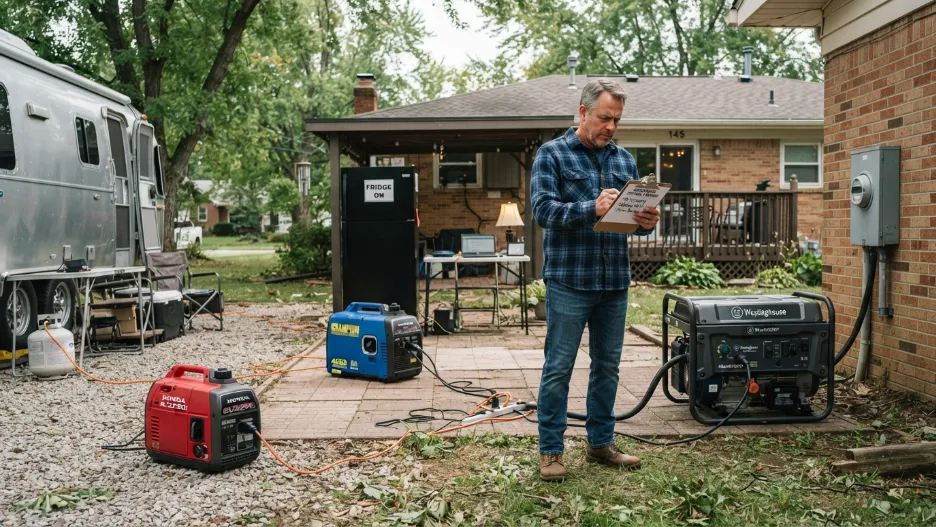
Different households need different amounts of power. Here’s a fast way to match your situation to a rough spec range before you go shopping.
| Your Situation | Recommended Wattage | Why |
|---|---|---|
| Camping, RV, tailgating | 2,000-3,500W inverter | Runs sensitive electronics cleanly, light enough to carry |
| Fridge + lights + Wi-Fi during an outage | 3,500-5,000W | Covers essential circuits without overloading |
| Fridge + well pump + window AC + some lights | 5,000-7,500W | Handles multiple high-draw appliances with a safety margin |
| Partial home backup (central AC, sump pump, several circuits) | 7,500-12,000W dual-fuel | Enough surge capacity for motors, works with a transfer switch |
| Full home backup, multi-day outages | Consider a standby generator instead | Portable units aren’t built for continuous week-long duty |
If you’re near the boundary between two rows, size up rather than down. Running a generator at 90% capacity for days at a time wears it out faster than running one comfortably under its limit.
How Much Power Do You Actually Need?
Add up the running watts of everything you plan to power at once, then add the single highest starting watts on top of that (starting watts are the short surge a motor needs to kick on — a refrigerator compressor can spike 3x its running wattage for a second or two).
A refrigerator runs around 150-400W but can surge to 1,200W on startup. A window AC unit runs 900-1,500W with a surge near 2,200W. A sump pump runs about 800-1,050W with a 2,000W+ surge. Add those three together at their running wattage, then tack on the biggest single surge number, and you land somewhere around 4,500-5,500W — which is exactly why that mid-size tier shows up so often in the table above.
A dual-fuel portable generator in the 7,500W class gives most three- or four-appliance households real breathing room without overspending on capacity they’ll rarely use.
Propane vs. Gasoline vs. Dual-Fuel
Propane’s biggest advantage is shelf life. Gasoline starts degrading in as little as 30 days without a stabilizer and can gum up a carburetor after a season of sitting untouched. Propane, stored properly in a sealed cylinder, keeps indefinitely.
The tradeoff is output. The same engine typically produces 10-15% less running wattage on propane than on gasoline, because propane carries slightly less usable energy per unit of fuel delivered to the engine. It’s also bulkier to store — a 20-lb steel cylinder takes up more room than an equivalent jug of gasoline.
Dual-fuel models solve the dilemma by letting you switch. Keep gasoline in the tank for day-to-day use or short outages, and switch to propane cylinders when an outage stretches past a day or two and gas station lines get long. It’s the setup I run at my own house, and it’s the one I recommend to most first-time buyers specifically because it removes the “which fuel do I commit to” decision entirely.
Noise: What “Quiet” Actually Means
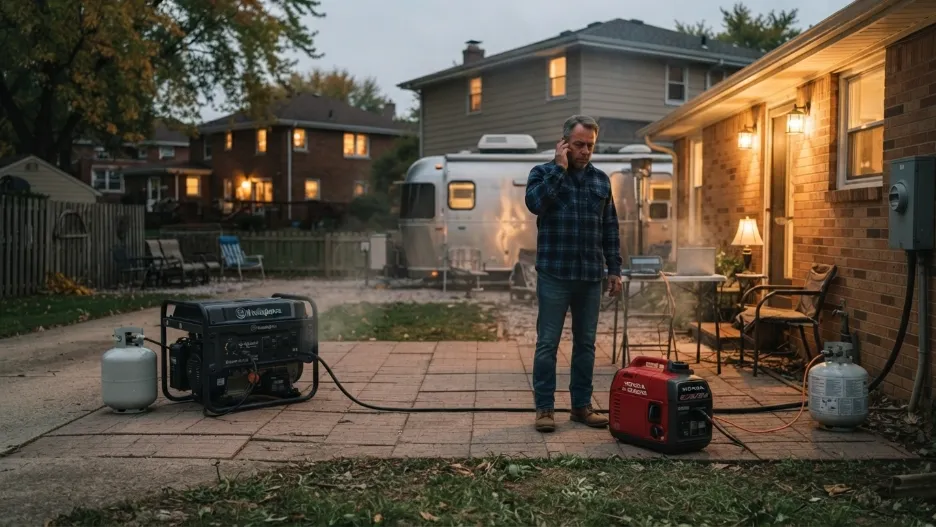
Decibel ratings aren’t linear — a jump from 65 dBA to 75 dBA isn’t a 10% increase in loudness, it’s roughly double. Open-frame propane generators in the 5,000-9,000W range typically run 68-76 dBA at a 23-foot distance under load. Enclosed inverter models in the 2,000-4,000W range often run 52-60 dBA at the same distance, which is closer to a normal conversation.
If you’re near neighbors or plan to run a generator through the night, an inverter design matters more than raw wattage. Bigger open-frame units get the job done, but they’re genuinely loud for as long as they run.
Portability and Physical Size
Weight climbs fast with wattage. A 2,000W inverter generator might weigh 45-55 lbs — one person can lift it into a truck bed. A 7,500W dual-fuel unit often weighs 180-220 lbs and needs the built-in wheel kit and a second set of hands, or a loading ramp, to move at all.
If portability matters — camping, jobsite use, moving the unit in and out of a shed every outage — weigh this as heavily as wattage. The most powerful generator on the market does you no good if it lives in the garage because it’s too heavy to roll out.
Budget: What You’ll Actually Spend
Entry-level 2,000-3,000W inverter generators typically run $350-$700. Mid-range 5,000-7,500W dual-fuel units land around $700-$1,400. Heavy-duty 9,000-12,500W dual-fuel models with electric start and remote start run $1,200-$2,200. Add a manual transfer switch or interlock kit if you want to power circuits directly from your panel — budget another $200-$600 installed by a licensed electrician.
Fuel cost is the recurring expense people forget to budget for. A 5,000W generator at 50% load burns roughly 0.75-1 gallon of propane per hour. At a typical propane price, that’s somewhere in the $2.50-$4 per hour range once you include tank refill or exchange fees — worth knowing before a week-long outage turns into a bigger fuel bill than expected.
How Long Will a Propane Portable Generator Actually Run?
This is the number most buying guides gloss over, and it’s the one that matters most once the power is actually out.
| Tank Size | Approx. Gallons | Runtime at 50% Load (5kW unit) |
|---|---|---|
| 20-lb (standard grill tank) | 4.6 gal | 5-10 hours |
| 100-lb cylinder | 23.6 gal | 1-2 days |
| 500-gallon buried/stationary tank | ~400 gal usable* | 5-16+ days |
*Tanks are typically filled to 80% capacity for safety, so a “500-gallon” tank holds about 400 usable gallons.
The math behind those numbers is simple: gallons of propane in the tank, divided by gallons burned per hour, equals hours of runtime. A 20-lb tank holding 4.6 gallons, burned at roughly 0.6-0.9 gallons per hour under moderate load, lands right around that 5-10 hour range. Heavier loads burn faster; lighter loads with an inverter’s variable-speed engine can stretch runtime noticeably longer.
If you’re planning around a multi-day outage, don’t rely on a single 20-lb tank. Most experienced owners keep two or three tanks on hand and rotate them, or step up to a 100-lb cylinder with the right hose and regulator rated for continuous use.
Safety: The 20-Foot Rule Isn’t Optional
Safety Note: Never run a portable generator inside a home, garage, basement, shed, or on a covered porch — even with doors and windows open. Opening a door does not provide enough ventilation to prevent lethal carbon monoxide buildup.
The CDC’s generator safety guidance is blunt about this: place the unit outside, at least 20 feet from any window, door, or vent, with the exhaust pointed away from the house. Carbon monoxide is odorless and colorless — by the time you notice symptoms, exposure has already been significant.
The Consumer Product Safety Commission specifically warns against running a generator on a porch or in a carport — it feels outdoors, but a roofline traps exhaust the same way an enclosed space does.
A few other non-negotiables: install battery-powered or battery-backup CO alarms on every level of the house, never plug a generator directly into a wall outlet (that’s backfeeding, and it can electrocute utility workers restoring power on the line), and let the engine cool completely before refueling. If you want whole-panel backup, hire a licensed electrician to install a proper transfer switch — check your local code before doing any panel-level wiring yourself.
Common Buyer Mistakes
- Undersizing for starting watts. A generator rated for your running load can still stall the instant a compressor or pump kicks on, because it can’t cover the surge.
- Buying based on gasoline wattage ratings. Remember the propane number is 10-15% lower — check the propane-specific spec sheet, not just the headline gas rating.
- Skipping the CO alarm. Even a perfectly placed generator can drift fumes back toward the house if wind shifts. An alarm is cheap insurance.
- Storing only one small tank. A single 20-lb cylinder covers less than half a day at real load — not much for a storm that knocks out power for a week.
- Ignoring noise until move-in day. Some HOAs and municipalities cap generator dBA levels or restrict run hours; check before you buy if you’re in a dense neighborhood.
Conclusion
For most households, a dual-fuel unit in the 5,000-9,000W range hits the right balance of capacity, runtime, and cost. Size for your actual appliance load, not just a round number, and never skip the 20-foot placement rule. If you’re still unsure exactly how many watts your specific setup needs, work through the math with your own appliance list before you buy — it takes ten minutes and saves you from returning an undersized unit. — Michael Turner
If you’re shopping for a dual-fuel model that runs on both gasoline and propane, it’s worth comparing a few current options side by side before you commit — capacity, electric start, and outlet configurations vary more between models than most spec sheets make obvious.
Can I run a propane portable generator in the rain?
Only if it’s rated for it or protected by an NFPA-rated non-combustible generator canopy — never a tarp draped directly over a running unit, since that traps exhaust and heat. Check your manual for the manufacturer’s specific weather guidance.
Do propane generators produce less carbon monoxide than gasoline ones?
Propane burns cleaner and produces somewhat less CO per hour than gasoline, but it still produces enough to kill in an enclosed space. The 20-foot outdoor placement rule applies exactly the same regardless of fuel type.
Can I convert a gasoline-only generator to run on propane?
Some models can be converted with a certified conversion kit matched to that exact engine, but it typically voids the manufacturer’s warranty unless the kit is factory-approved. Buying a dual-fuel model from the start avoids this problem entirely.
How much propane should I store for a week-long outage?
At moderate load on a mid-size unit, plan on roughly 100-150 lbs of propane (about five to seven 20-lb tanks, or a couple of 100-lb cylinders) to cover a full week without running dry.
Is a propane portable generator loud enough to bother neighbors?
Open-frame units in the 68-76 dBA range are noticeable at typical suburban lot distances and can draw complaints during overnight use. An enclosed inverter model in the 52-60 dBA range is much less likely to cause friction.

Hi, I’m Michael Turner. I own a generator workshop in the United States and founded HomeGeneratorBlog to share practical, hands-on guidance about generator installation, maintenance, troubleshooting, safety, and backup power solutions. My goal is to help homeowners make smarter, more confident decisions through clear and reliable information