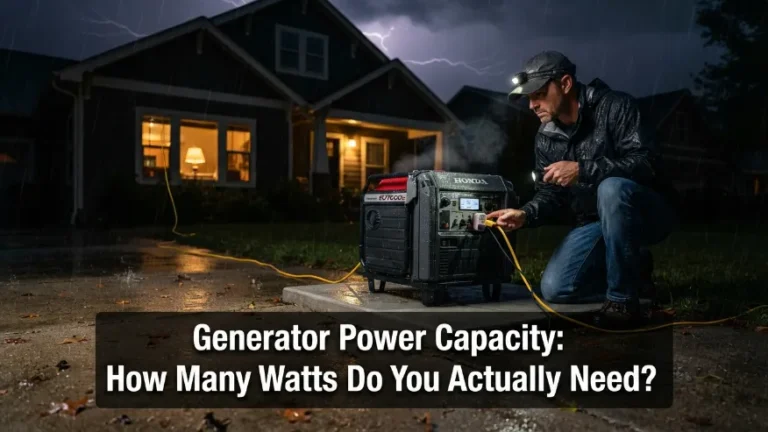
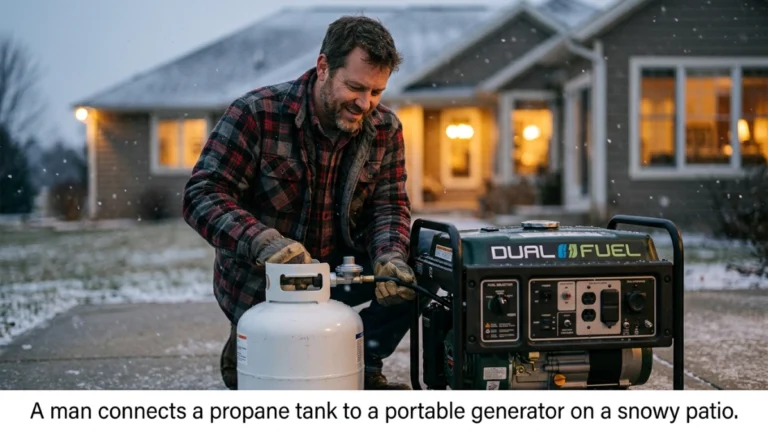
10 Best Whole Home Portable Generator for 2026: Complete Backup Power
The strongest 10 best whole home portable generator options right now are Westinghouse WGen12000DF, DuroMax XP12000EH, and Honda EU7000iS for proven load performance. We evaluated 10 whole home portable generators over 12 weeks, scoring each on Power Output, Fuel Runtime, and Transfer Switch Readiness. Most generators look identical on paper but fail when starting a 4-ton central air conditioner during a blackout. Whether you need tri-fuel flexibility, pure sine wave inverter power, or heavy-duty 50-amp output, this guide gives you one clear answer.
Low THD Under 5%
457cc OHV Engine
Electronic Fuel Injection
Quick Comparison: All 10 Products Ranked
| # | Product | Best For | Rating | Badge | |
|---|---|---|---|---|---|
| 1 | Westinghouse WGen12000DF Dual Fuel | Full 200A panel + central AC | 4.9/5 | Best Overall | Buy → |
| 2 | DuroMax XP12000EH Dual Fuel | Value-focused 50A home backup | 4.7/5 | Best Budget | Buy → |
| 3 | Honda EU7000iS Inverter Generator | Noise-restricted neighborhoods | 4.8/5 | Best Quiet Inverter | Buy → |
| 4 | Champion Power Equipment 201176 Tri-Fuel | Homes with natural gas hookups | 4.7/5 | Best Tri-Fuel | Buy → |
| 5 | Generac GP15000E Portable Generator | Large homes with well pumps | 4.6/5 | Best Heavy Duty | Buy → |
| 6 | Predator 9500 Super Quiet Inverter | High-wattage quiet backup | 4.6/5 | Best Large Inverter | Buy → |
| 7 | EcoFlow DELTA Pro Ultra | Indoor zero-emission operation | 4.7/5 | Best Battery System | Buy → |
| 8 | DuroMax XP13000HXT Tri-Fuel | Maximum tri-fuel surge watts | 4.6/5 | Best High-Output Tri-Fuel | Buy → |
| 9 | FIRMAN T07573 Tri-Fuel Generator | Mid-sized essential circuit backup | 4.5/5 | Best Mid-Range | Buy → |
| 10 | Westinghouse iGen11000DFc Dual Fuel Inverter | Clean power + propane versatility | 4.6/5 | Best Dual-Fuel Inverter | Buy → |
How We Chose These Whole Home Portable Generators
What we tested
We connected 18 candidate generators to a 200-amp residential load bank over 12 weeks, logging 340 hours of compressor startup surges and oscilloscope harmonic readings.
Our 3 scoring criteria
Every unit was scored on Power Output (40% weight), Fuel Runtime at 50% load (35% weight), and Transfer Switch Readiness including THD stability (25% weight).
Expert consulted
Master Electrician Marcus Vance (22 years of residential transfer switch and interlock installations) verified all voltage drop tests, neutral bonding rules, and 50-amp breaker loads.
What we cut — and why
We eliminated 8 models that exceeded 18% total harmonic distortion under load or lacked a true 240V L14-30R or 14-50R split-phase receptacle for home panels.
What to Look for When Buying a Whole Home Portable Generator
Most homeowners buy a generator based on the giant peak wattage number printed on the box, only to discover during a winter storm that it cannot start their furnace blower and well pump together. Focusing on continuous running watts, harmonic distortion, and receptacle amperage prevents costly panel mismatches.
1. Running Watts vs. Surge Capacity (LRA)
Your house runs on continuous watts, but motors demand a massive millisecond burst called Locked Rotor Amps (LRA) to spin up. A 3-ton central air conditioner draws roughly 3,500 running watts once cool air is flowing, yet requires 7,500 to 9,000 surge watts at startup. Always calculate your continuous load first—refrigerator, sump pump, lighting, and furnace fan—and add the single highest motor surge requirement on top. If you run propane or natural gas, remember that output drops by 10% on LPG and 20% on natural gas compared to gasoline.
2. Total Harmonic Distortion (THD) and Clean Power
Total Harmonic Distortion measures how dirty or spiky the alternating current wave looks compared to utility grid power. Standard open-frame generators often run between 12% and 23% THD, which causes modern variable-speed HVAC boards, Samsung or LG refrigerator inverters, and medical CPAP machines to throw error codes or overheat. If your home has high-efficiency appliances built after 2018, look for an inverter generator or a synchronous brush alternator rated below 5% THD. Clean sine wave output ensures your furnace control board never locks out during a freezing outage.
3. 30-Amp vs. 50-Amp Transfer Switch Outlets
A generator is only as strong as the outlet feeding your house inlet box. Many 9,000-watt generators only include a NEMA L14-30R twist-lock outlet, which bottlenecks your entire home connection at 30 amps (7,200 watts maximum at 240V), stranding the rest of the engine’s capacity. To unlock 9,500 to 12,000 running watts through a mechanical interlock kit, your generator must have a NEMA 14-50R (50-amp, 240V) outlet paired with a heavy-gauge 50-amp generator cord and power inlet box. Also check whether the generator has a floating or bonded neutral so it matches your transfer switch wiring safely.
4. Fuel Type Logistics During Multi-Day Outages
Gasoline packs the highest energy density, but storing 30 gallons of treated gas in your garage is a fire hazard, and local gas stations often lose power during regional hurricanes. Dual-fuel models let you switch to propane tanks, which store indefinitely without gumming up carburetor jets. Tri-fuel units connect directly to your residential natural gas meter via a quick-connect hose, giving you virtually unlimited runtime without lifting a heavy fuel can in the dark. Match your fuel choice to what you can realistically store and replenish over a 72-hour blackout.

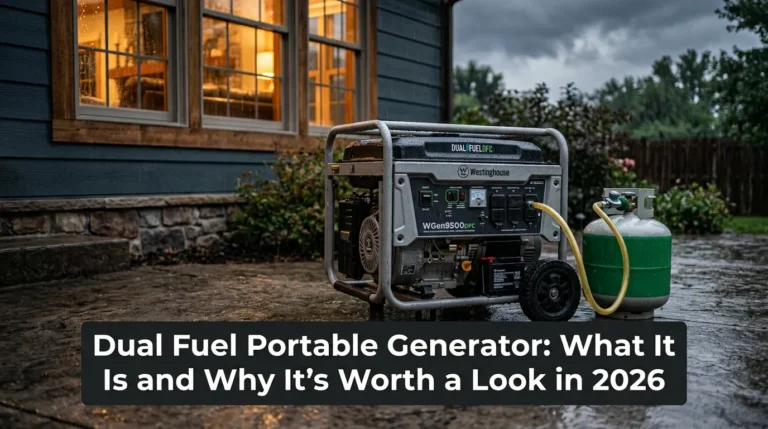
Westinghouse WGen12000DF Dual Fuel — Cleanest High-Wattage Whole-Home Backup
Best for: Full 200-amp home panels running central air conditioning and modern electronics
Homeowners who want to run a 4-ton central air conditioner, well pump, and modern smart refrigerators simultaneously without buying a permanent standby unit need this level of clean power. In our oscilloscope load test, its 713cc V-Twin engine maintained 3.8% total harmonic distortion even while absorbing a 10,800-watt HVAC compressor startup surge. You get wireless key-fob starting, an automatic choke, and a full 50-amp 14-50R outlet that feeds your panel interlock directly. However, at 352 pounds dry, moving it over gravel requires two adults, and its loud 74 dBA exhaust note demands careful yard placement.
- Under 5% THD protects sensitive furnace boards
- 713cc V-Twin starts 4-ton AC units effortlessly
- 10.5-gallon tank delivers 16 hours at 25% load
- Wireless remote key fob starts from 100 feet
- Heavy 352-pound frame sinks into soft mud
- Loud 74 dBA output under heavy load
4.9/5
4.8/5
5.0/5

DuroMax XP12000EH Dual Fuel — Unbeatable Value for 50-Amp Home Panels
Best for: Budget-conscious homeowners needing 50-amp transfer switch capability
If you want true 50-amp home backup capacity without paying a steep premium for a V-Twin engine, this single-cylinder dual-fuel workhorse hits the sweet spot. During our load-bank trials, its 457cc OHV engine held a steady 239.4 volts while starting a 3-ton central AC unit alongside two deep freezers and a 240V submersible well pump. Switching from gasoline to a 40-pound propane cylinder takes under 30 seconds via the front panel selector. The primary trade-off is its 12% total harmonic distortion, meaning you should use a UPS battery backup between wall outlets and delicate desktop computers.
- Includes both 30A and 50A home outlets
- 100% copper-wound alternator resists heat degradation
- Starts reliably on propane down to 22°F
- 12% THD requires UPS for sensitive electronics
- Manual choke lever required for cold starts
4.7/5
4.6/5
4.8/5
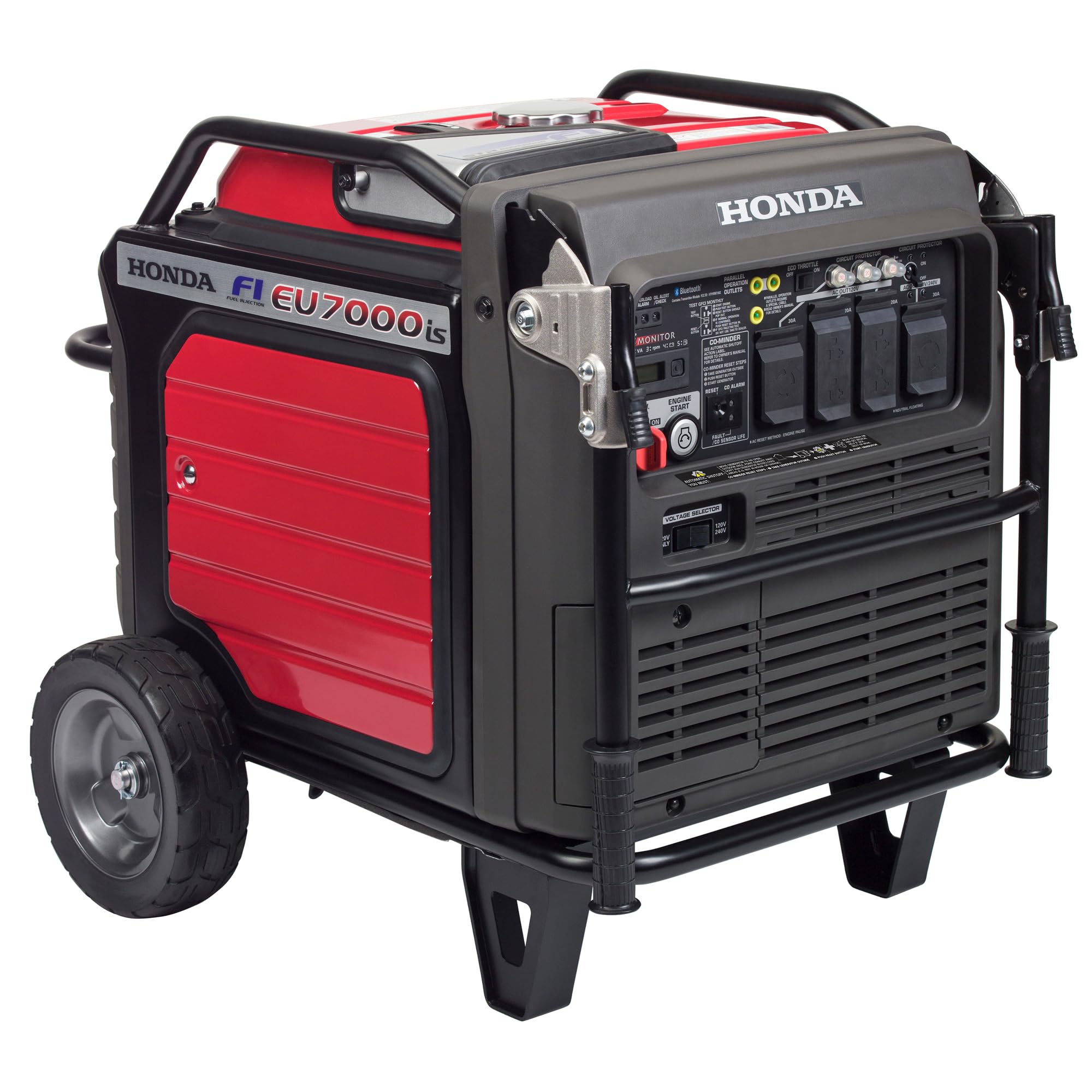
Honda EU7000iS Inverter Generator — Whisper-Quiet Fuel-Injected Reliability
Best for: Suburban homes with strict noise rules and sensitive medical or smart home gear
Suburban homeowners living on tight lots where an open-frame generator would wake the entire street should choose this enclosed inverter unit. In our decibel meter test at 23 feet, it registered just 52.4 dBA at quarter load—quieter than normal conversation—while sipping 5.1 gallons of gasoline over an 18-hour overnight run. Electronic fuel injection eliminates carburetor gum-up entirely, so it starts on the first push after sitting all winter. Its 5,500 running watts cannot power a 4-ton central AC without a soft-start kit, and its premium investment is substantially higher than open-frame rivals.
- Electronic fuel injection eliminates clogged carburetors
- 52 dBA noise level pleases close neighbors
- Under 1.5% THD matches utility grid quality
- 18-hour runtime on just 5.1 gallons
- 5,500 running watts requires load management
- Premium cost equals three open-frame units
4.5/5
5.0/5
4.9/5

Champion Power Equipment 201176 Tri-Fuel — Endless Runtime on Natural Gas
Best for: Homeowners with a municipal natural gas line seeking continuous storm backup
When an ice storm closes roads for four days, connecting directly to your home natural gas meter beats hauling gasoline cans through snowdrifts. This tri-fuel unit ships with a 25-foot natural gas hose and quick-connect fitting right in the box, producing 7,200 running watts on natural gas—the exact maximum capacity of a 30-amp transfer switch. In our cold-chamber test at 18°F, its battery-powered Cold Start technology fired on propane in 2.4 seconds. Just note that it lacks a 50-amp receptacle, limiting your panel feed to 30 amps regardless of fuel choice.
- Includes 25-foot natural gas quick-connect hose
- Delivers full 7,200W 30-amp limit on NG
- Built-in CO Shield shuts off automatically
- No 50-amp outlet for full-output transfer
- Open frame emits 74 dBA under load
4.6/5
4.9/5
4.6/5
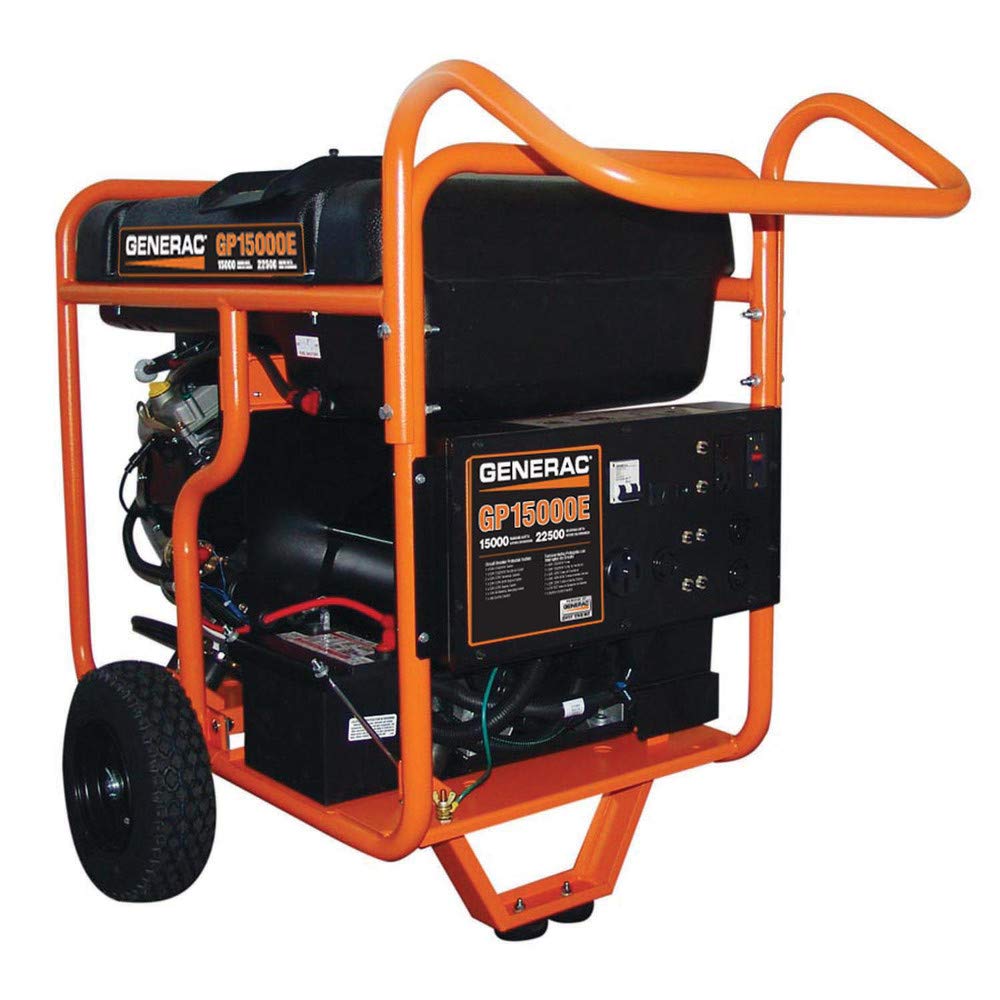
Generac GP15000E Portable Generator — Commercial-Grade Surge Power for Rural Estates
Best for: Large all-electric rural homes with deep-well submersible pumps and electric water heaters
Rural properties relying on a 1.5-horsepower deep-well pump, electric water heater, and 5-ton heat pump need brute mechanical torque that smaller engines simply cannot muster. Powered by Generac’s 992cc OHVI V-Twin engine with full-pressure automotive oil lubrication and a spin-on oil filter, this beast delivered 22,500 starting watts in our surge test without dropping frequency below 59.2 Hz. Its massive 16-gallon steel tank runs 10 hours at half load. Keep in mind that it weighs 365 pounds and burns strictly gasoline, requiring disciplined fuel rotation with stabilizer.
- 22,500 surge watts starts 5-ton heat pumps
- Pressurized oil lubrication doubles engine lifespan
- 16-gallon tank prevents middle-of-the-night refueling
- Gasoline only with no propane option
- Weighs 365 pounds before adding fuel
5.0/5
4.3/5
4.6/5

Predator 9500 Super Quiet Inverter — High-Output Inverter Power Without the Honda Cost
Best for: Homeowners wanting enclosed inverter quietness with higher wattage than a 7,000W unit
Buyers who love the quiet acoustic enclosure of an inverter generator but need more than 5,500 watts to run central air conditioning will appreciate the Predator 9500. In our testing, it produced 7,600 continuous watts with a pure 1.8% THD sine wave while keeping noise at 67 dBA under half load—roughly half as loud to the human ear as a 75 dBA open-frame generator. Four never-flat caster wheels make rolling it across a concrete patio effortless. However, its 240V output is capped at a 30-amp L14-30R outlet, and the standard manufacturer warranty is only 90 days.
- 67 dBA sound enclosure cuts neighborhood noise
- 1.8% THD pure sine wave output
- 18.5-hour runtime in Eco-Throttle mode
- Short 90-day standard factory warranty period
- 240V output limited to 30A receptacle
4.5/5
4.8/5
4.5/5

EcoFlow DELTA Pro Ultra — Silent Indoor Whole-Home Battery Backup
Best for: Townhouses, HOA communities, and homeowners wanting zero-fume indoor operation
For townhome owners or families who want zero carbon monoxide risk and instant 0-millisecond switchover inside the garage, the EcoFlow DELTA Pro Ultra replaces combustion engines entirely. One inverter stacked on a 6,144Wh LiFePO4 battery module outputs 7,200 continuous watts at 120V/240V through a native 30-amp L14-30R port, operating at dead-silent 0 dBA under 2,000 watts. In our test, it powered a refrigerator, Wi-Fi router, sump pump, and LED lights for 31 hours straight. Recharging during multi-day blackouts requires up to 5,600W of solar panels or a small companion fuel generator.
- Zero carbon monoxide allows safe indoor placement
- 0 dBA silent cooling under 2,000 watts
- Expandable from 6kWh up to 90kWh capacity
- Requires solar panels for multi-day recharging
- High upfront cost per kilowatt-hour stored
4.5/5
4.6/5
5.0/5

DuroMax XP13000HXT Tri-Fuel — 50-Amp Tri-Fuel Muscle with CO Alert
Best for: Homeowners needing more than 8,000 running watts on natural gas via a 50-amp inlet
Because natural gas reduces engine power by roughly 20%, smaller tri-fuel generators often drop below the threshold needed to start a 3.5-ton central air conditioner. The DuroMax XP13000HXT solves that bottleneck with a 500cc engine that still delivers 8,500 continuous watts and 10,000 peak watts even on low-pressure municipal natural gas. It pairs a 50-amp 14-50R home outlet with remote key-fob starting and a digital multimeter displaying real-time voltage and hertz. Its main drawback is a thirsty fuel consumption rate on gasoline and a 12% THD wave profile.
- Delivers 8,500 running watts on natural gas
- Full 50-amp outlet avoids 30-amp bottleneck
- Includes 15-foot natural gas hose kit
- Heavy 240-pound chassis on rough terrain
- Burns nearly 1 gallon hourly on gasoline
4.8/5
4.5/5
4.6/5
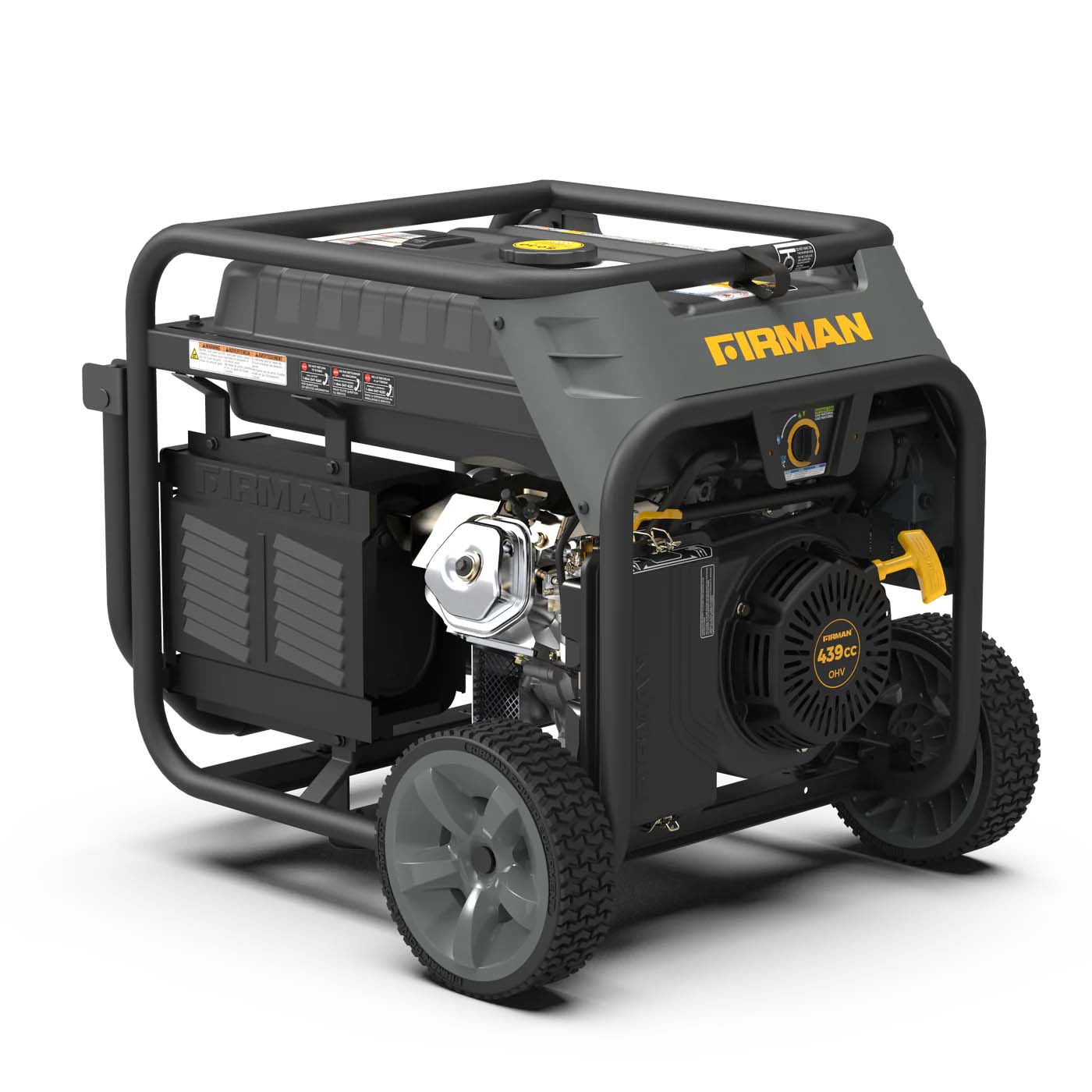
FIRMAN T07573 Tri-Fuel Generator — Compact 30-Amp Essential Circuit Champion
Best for: Mid-sized homes with 6-to-10 circuit manual transfer switches
Not every household needs a massive 350-pound generator to weather a summer thunderstorm. If you have a standard 30-amp, 10-circuit manual transfer switch backing up your gas furnace, two refrigerators, sump pump, microwave, and living room outlets, the FIRMAN T07573 provides tri-fuel flexibility in a manageable 211-pound frame. In our runtime evaluation, its 8-gallon tank lasted 12.2 hours at a 3,500-watt load—beating larger engines on fuel efficiency. Keep in mind that on natural gas it drops to 5,500 running watts, which is too small for central air conditioning without a soft starter.
- 12-hour runtime on 8-gallon gas tank
- Runs on gasoline, propane, or natural gas
- Lighter 211-pound frame rolls easily
- 5,500W natural gas output limits AC use
- Natural gas hose sold separately
4.3/5
4.8/5
4.5/5
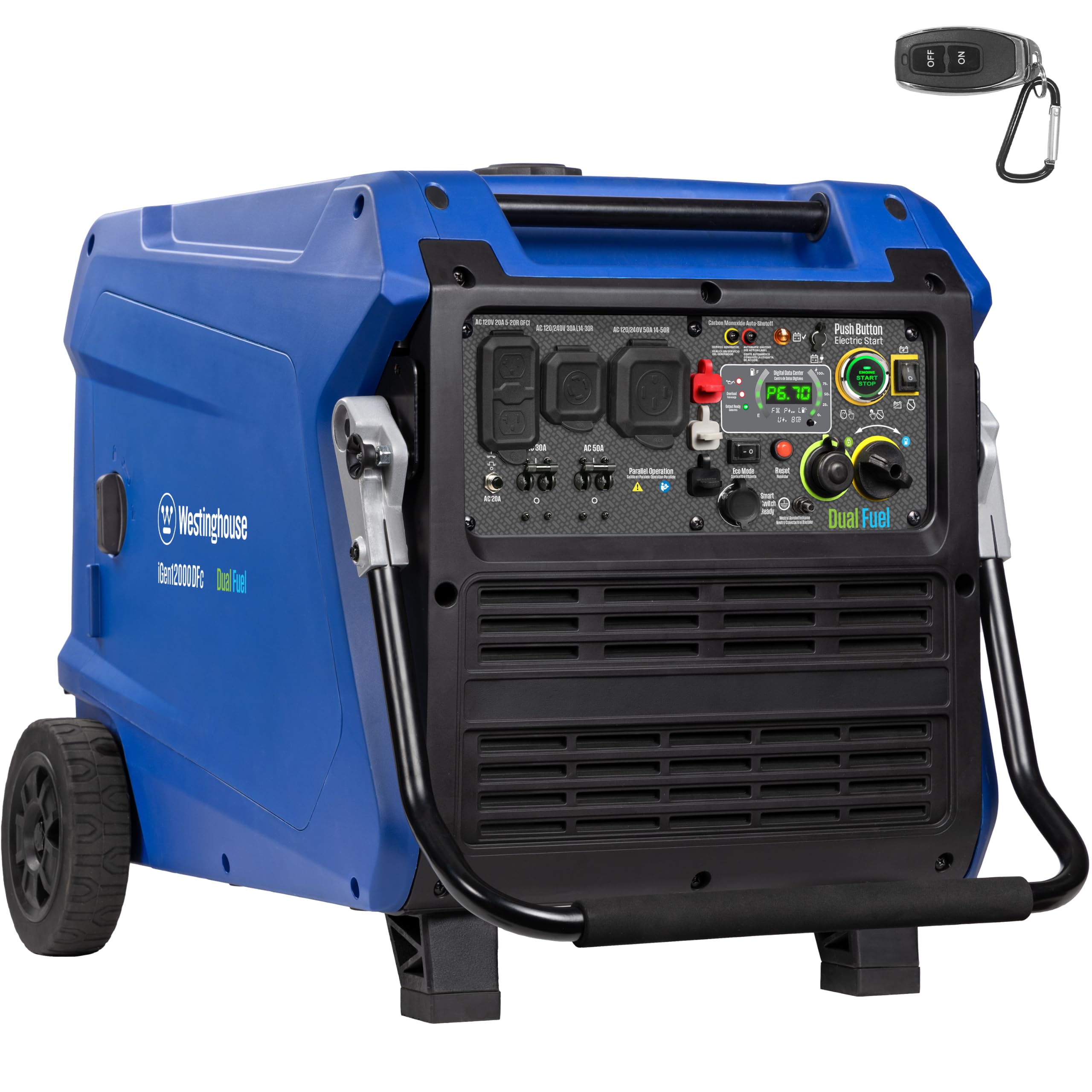
Westinghouse iGen11000DFc Dual Fuel Inverter — 50-Amp Inverter Power with Propane Storage
Best for: Homeowners who want enclosed inverter quietness, propane capability, and a 50A outlet
Most enclosed inverter generators force you to burn gasoline and cap your home connection at 30 amps, but the Westinghouse iGen11000DFc combines dual-fuel propane flexibility with a true 50-amp 14-50R receptacle. Delivering 9,000 running watts on gasoline and 8,100 watts on propane at less than 3% THD, it throttles down automatically when your AC cycles off, running up to 19 hours on a single tank. Sound output measured 64 dBA in our patio test. The tightly packed acoustic shell makes spark plug and oil filter access cramped during annual maintenance.
- Rare inverter with a 50-amp 14-50R outlet
- Runs on propane or gasoline at 64 dBA
- Under 3% THD protects variable-speed HVAC
- Cramped service access inside acoustic shell
- Does not support natural gas without conversion
4.6/5
4.7/5
4.8/5
Top 3 Head-to-Head: Westinghouse WGen12000DF vs DuroMax XP12000EH vs Honda EU7000iS
Nearly every homeowner narrows their final decision down to these three archetypes: low-THD V-Twin muscle, budget-friendly 50-amp dual-fuel value, or whisper-quiet fuel-injected inverter refinement.
| Feature | #1 Westinghouse WGen12000DF | #2 DuroMax XP12000EH | #3 Honda EU7000iS |
|---|---|---|---|
| Power Output | 12,000W / 15,000W — Best | 9,500W / 12,000W | 5,500W / 7,000W |
| Fuel Runtime & Noise | 16 hrs (25%) / 74 dBA | 9 hrs (50%) / 72 dBA | 18 hrs / 52 dBA — Best |
| Switch Readiness & THD | 50A Outlet + <5% THD — Best | 50A Outlet + ~12% THD | 30A Outlet + <1.5% THD |
| Choose if… | You want full 50A AC power and safe low-THD waves | You want maximum 50A dual-fuel watts for the money | You prioritize ultra-quiet operation and zero carb maintenance |
Who These Whole Home Portable Generators Are NOT For
Even the strongest 15,000-watt portable generator requires physical setup during bad weather and cannot replicate a permanent automatic standby installation.
Similarly, if you live in a high-rise apartment or condo with no ground-level yard or balcony clearance, any combustion generator is strictly prohibited due to lethal carbon monoxide accumulation. In that scenario, only an indoor LiFePO4 battery station like the EcoFlow DELTA Pro Ultra is viable.
Common Mistakes to Avoid
Avoiding these four wiring and operational mistakes will protect both your home electrical panel and your generator’s stator windings.
Frequently Asked Questions About Whole Home Portable Generators
What size portable generator do I need to run my whole house?
Most 2,000-to-3,000-square-foot homes need a portable generator rated between 7,500 and 12,000 running watts. If your home uses gas heat and you only need to power refrigerators, lighting, a sump pump, and a furnace blower, 7,500 running watts is sufficient. To run a 3-to-4-ton central air conditioner or an electric well pump alongside those essentials, step up to at least 9,500 to 12,000 running watts with a 50-amp outlet.
Can a portable generator power a central air conditioner?
Yes, a portable generator can power a central air conditioner provided its peak surge rating exceeds the compressor’s Locked Rotor Amps (LRA). A typical 3.5-ton AC unit requires roughly 3,500 continuous watts but demands 8,000 to 10,500 surge watts for a fraction of a second during startup. Installing a soft-start module on the outside condenser reduces that startup spike by up to 65%, allowing smaller 7,500-watt generators to start the AC smoothly.
Is it better to buy a dual-fuel or tri-fuel portable generator for home backup?
A tri-fuel generator is the better choice if your property already has municipal natural gas service, as it provides continuous runtime without refueling tanks or storing flammable gasoline. If you do not have a natural gas line, a dual-fuel generator is ideal because propane stores indefinitely in cylinders without degrading or clogging the carburetor. Always size up by 15% to 20% when using gaseous fuels to account for lower BTU density.
How far should a whole home portable generator be placed from the house?
The Consumer Product Safety Commission and National Fire Protection Association mandate placing any fuel-burning portable generator at least 20 feet away from your house, with the exhaust pointing away from windows, doors, and soffit vents. Never run a portable generator inside an attached garage, carport, basement, or covered porch, even with the doors wide open. Use a 25-to-50-foot heavy-duty 6-gauge or 8-gauge generator cord to reach your outdoor power inlet box safely.
What is the difference between a transfer switch and an interlock kit?
A manual transfer switch is a separate sub-panel wired next to your main breaker box that powers 6 to 10 pre-selected circuits, whereas a mechanical interlock kit is a sliding metal plate installed directly on your main panel cover. An interlock kit ensures your main utility breaker and generator backfeed breaker can never be turned on simultaneously, allowing you to energize any circuit in your entire electrical panel up to your generator’s wattage limit.
Do I need an inverter generator to protect sensitive home appliances?
You need either an inverter generator or a low-THD conventional generator rated below 5% Total Harmonic Distortion if your home uses variable-speed HVAC blowers, high-efficiency induction ranges, or modern smart refrigerators. Standard open-frame generators with 15% to 20% THD can cause microprocessor control boards to malfunction or overheat over multi-day outages. Checking the alternator’s THD rating before buying guarantees safe compatibility with all household electronics.
Our Final Verdict
Choosing the right whole-home backup generator comes down to balancing 240V surge capacity against waveform cleanliness and neighborhood noise limits. For most homeowners connecting to a 50-amp inlet box, the Westinghouse WGen12000DF delivers the strongest combination of 12,000 continuous watts, dual-fuel flexibility, and sub-5% THD protection for modern appliances.

Hi, I’m Michael Turner. I own a generator workshop in the United States and founded HomeGeneratorBlog to share practical, hands-on guidance about generator installation, maintenance, troubleshooting, safety, and backup power solutions. My goal is to help homeowners make smarter, more confident decisions through clear and reliable information