
Diesel Portable Generator: Buying, Sizing, and Safety Guide
Quick Answer
A diesel portable generator makes the most sense when you need long-duty-cycle power, a durable engine, and dependable output for outages, jobsites, farms, or remote work. Before buying, size the generator around your actual running and starting loads, check its weight and outlet configuration, and follow CPSC portable generator safety guidance whenever you operate it.
What matters most
- Power capacity: Add your normal running loads and the largest motor-starting surge you expect.
- Runtime: A larger diesel tank can reduce refueling during extended outages or work shifts.
- Real portability: Some diesel models weigh hundreds of pounds and need wheels, lifting equipment, or a trailer.
- Power quality: Check total harmonic distortion if you plan to run sensitive electronics or controls.
- Service access: Filters, batteries, oil changes, and replacement parts matter on a machine you expect to keep for years.
My rule of thumb
- Buy diesel for sustained, demanding use rather than simply assuming diesel is better for every homeowner.
I spend a lot of time around generators that look portable in a catalog but feel much less portable when you need to move them across a yard. Diesel units make that difference especially obvious.
This guide focuses on what I would check before spending the extra money: output, starting load, runtime, weight, fuel handling, electrical connection, maintenance, and safety.
What Is a Diesel Portable Generator?
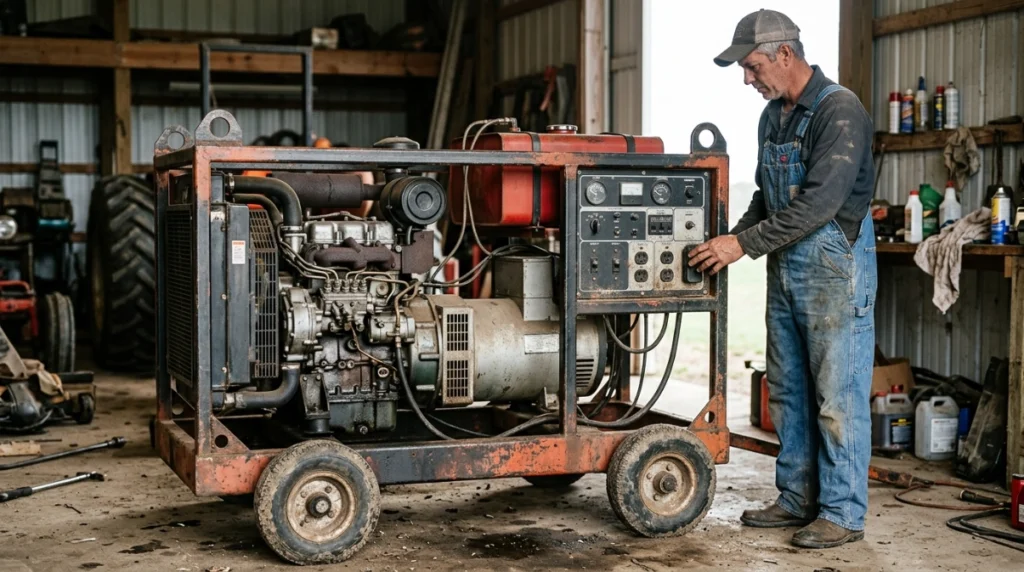
A diesel portable generator is an engine-driven generator that burns diesel fuel and produces electricity without needing a permanent utility connection. Portable models range from open-frame jobsite machines to enclosed commercial units that may require wheels or mechanical lifting.
The word portable can be misleading. A unit can be designed for relocation while still weighing several hundred pounds.
- Engine: Burns diesel fuel and supplies mechanical power.
- Alternator: Converts that mechanical power into electricity.
- Fuel system: Includes the tank, injection components, filters, and fuel lines.
- Control panel: Provides receptacles, breakers, meters, and operating controls.
- Frame or enclosure: Protects the equipment and provides lifting or transport points.
Most buyers looking at diesel are interested in durability and long operating periods. Those advantages matter most on jobsites, farms, commercial properties, workshops, and homes expecting extended outages.
Is a Diesel Portable Generator Better Than a Gas Generator?
A diesel generator can be better for demanding or extended operation, but gasoline remains easier to find in the consumer portable-generator market. Your expected workload should decide the fuel type.
I would not choose diesel based on fuel reputation alone. Purchase price, weight, cold-weather starting, service availability, noise, and the generator’s actual electrical output all matter.
| Factor | Diesel Portable Generator | Gasoline Portable Generator |
|---|---|---|
| Best fit | Longer-duty work, commercial use, farms, extended backup | General household backup, recreation, lighter use |
| Typical machine weight | Often heavy for its output class | Many lighter consumer choices |
| Initial cost | Usually higher for comparable portable equipment | More entry-level options |
| Consumer availability | More specialized | Very broad |
| My preference | Repeated, demanding operation | Occasional household use |
For a homeowner who runs a generator a few hours each year, diesel’s higher purchase price may never deliver much practical value. For a crew running equipment day after day, the calculation changes.
How Many Watts Should a Diesel Portable Generator Have?
Your generator should cover the running watts of everything operating together and the temporary starting surge of motors or compressors. Do not size it from the biggest wattage number printed on the box alone.
I start with a load sheet. It prevents both overspending and the far worse problem of discovering that a pump will not start during an outage.
- List essential equipment. Include appliances, pumps, lights, tools, chargers, heating controls, and refrigeration.
- Record running watts. Use equipment labels or manufacturer specifications whenever possible.
- Identify starting loads. Refrigerators, pumps, compressors, and other motors can briefly need more power at startup.
- Determine simultaneous use. You may not need every load running at the same time.
- Leave operating headroom. Avoid planning around continuous operation at the absolute limit.
What does 5,000 watts run?
A 5,000-watt-class generator can support a useful group of essential loads, but the exact combination depends on each appliance. Starting surges are usually where otherwise sensible plans fail.
For example, Generac currently rates its diesel XD5000E at 5,000 running watts and 5,500 starting watts. That small difference between running and peak capacity means load management still matters.
Do you need 120/240-volt output?
Check voltage before buying if you want to power a well pump, shop equipment, transfer equipment, or other 240-volt loads. A generator with enough total wattage can still be useless if it lacks the connection your equipment requires.
For home-panel connections, I recommend discussing the setup with a qualified electrician instead of improvising an inlet or backfeeding a receptacle.
How Long Can a Diesel Portable Generator Run?
Runtime depends on fuel-tank capacity, electrical load, engine design, and the manufacturer’s test conditions. Compare models using the same load percentage whenever possible.
A useful real-world example is the Generac XD5000E. Generac specifies a 12-gallon tank and 32.4 hours at 50% load.
That does not mean every 5,000-watt diesel generator will run for more than a day. Tank size can change the result dramatically.
- Higher load: Usually means faster fuel consumption.
- Larger tank: Extends time between refueling stops.
- Engine condition: Dirty filters and neglected maintenance can hurt performance.
- Ambient conditions: Temperature and operating environment can affect engine behavior.
- Load management: Turning off unnecessary equipment reduces demand.
For an extended outage, I care about refueling logistics almost as much as advertised runtime. You need a safe way to store, rotate, and replenish fuel.
How Portable Are Diesel Generators Really?
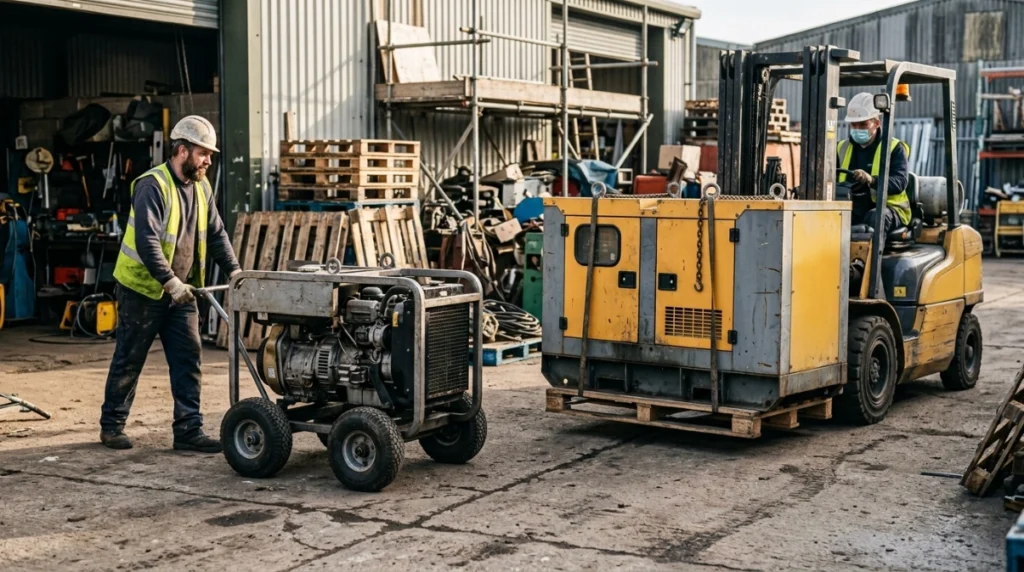
Check the dry weight before assuming you can roll a diesel generator around by yourself. Industrial diesel engines and large fuel systems can make these machines surprisingly heavy.
The Generac XD5000E weighs about 252 pounds, and its portability kit is a separate component. Kubota lists the GL7000-USA at about 518 pounds.
| Model | Rated Output | Fuel/Tank Detail | Weight |
|---|---|---|---|
| Generac XD5000E | 5,000 running W / 5,500 starting W | 12-gallon diesel tank | 252 lb |
| Kubota GL7000-USA | 6.5 kW prime / 7.0 kW standby | 7.4-gallon diesel tank | 518 lb |
| Yanmar YDG3700N | 3.2 kVA prime at 50 Hz / 3.7 kVA at 60 Hz | Diesel, open type | Check regional specification |
This is why I separate portable from easy to carry. For a heavy unit, look for lifting eyes, wheel kits, forklift access, trailer compatibility, and a clear storage route.
What Features Should You Look for Before Buying?
Output is only the first filter. A good diesel generator also needs to fit your electrical system, work environment, maintenance routine, and transport method.
- Electric start: Helpful on larger diesel engines, especially when several people may operate the generator.
- Fuel gauge: Makes long outage management easier.
- Low-oil protection: Helps protect the engine from lubrication problems.
- Suitable receptacles: Match voltage, amperage, and connection type to your loads.
- Breaker protection: Protects circuits during overload conditions.
- Lifting points: Important when the generator is too heavy for normal hand movement.
- Accessible filters: Reduces frustration during routine service.
- Parts support: A durable generator is only useful if you can maintain it.
Does power quality matter?
Yes, especially when powering sensitive electronics, chargers, controls, or communications equipment. Look for the manufacturer’s total harmonic distortion specification rather than assuming every conventional generator produces inverter-quality power.
Generac specifies about 6% total harmonic distortion for the XD5000E. Decide whether that meets the requirements of the equipment you intend to connect.
Are Diesel Portable Generators Safe for Home Backup?
They can provide home backup power, but a diesel engine still produces dangerous exhaust. Never treat diesel as safe for indoor operation.
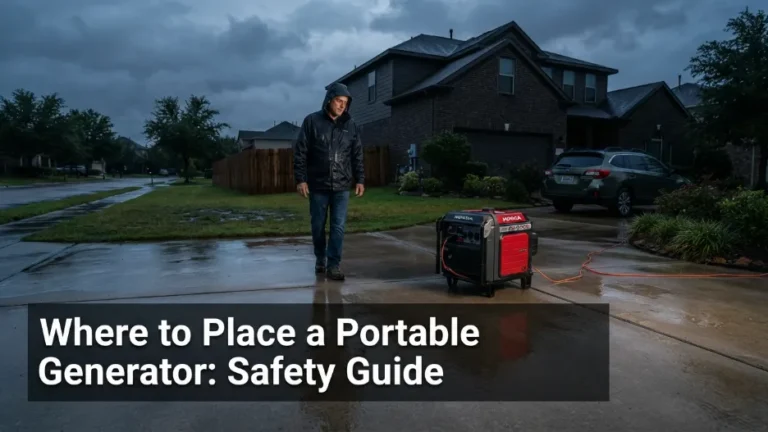
The U.S. Consumer Product Safety Commission says portable generators should operate outside and at least 20 feet from the home, with exhaust directed away from buildings, windows, doors, and vents.
- Never run indoors: Do not use a generator inside a house, basement, garage, crawlspace, or shed.
- Keep it far outside: Follow current CPSC placement guidance and the manufacturer’s manual.
- Use CO alarms: Keep functioning carbon monoxide alarms inside the home.
- Keep it dry: Follow manufacturer instructions for safe operation during wet weather.
- Never backfeed: Do not plug a generator into a household wall receptacle.
- Use proper cords: Match extension-cord rating and condition to the electrical load.
The Ready.gov power-outage guidance also recommends keeping generators outdoors and at least 20 feet from the home. I would make generator placement part of the buying plan, not something you figure out after the lights go out.
Does a portable generator need to be grounded?
There is no safe one-line answer for every installation because bonding and grounding depend on how the generator is connected. Follow the manufacturer’s instructions and applicable electrical rules.
For workplace use, OSHA generator guidance covers portable-generator grounding and electrical hazards. For a house connection, have a qualified electrician determine the correct transfer equipment and bonding arrangement.
How Do You Maintain a Diesel Portable Generator?
A diesel generator rewards regular maintenance. I would rather service a machine on a schedule than troubleshoot stale fuel, a weak battery, or a clogged filter during an outage.
- Check engine oil: Verify the level before operation and change it at the manufacturer’s interval.
- Inspect the air filter: Dusty jobsites can load a filter quickly.
- Service the fuel system: Watch filters, water contamination, hoses, and stored fuel condition.
- Maintain the battery: Electric-start diesel engines depend on adequate cranking power.
- Inspect receptacles: Look for heat damage, looseness, corrosion, or contamination.
- Test under load: A generator that idles successfully is not necessarily ready for a real outage.
Record service dates and running hours. That small habit makes preventive maintenance much easier when several months pass between uses.
Who Should Buy a Diesel Portable Generator?
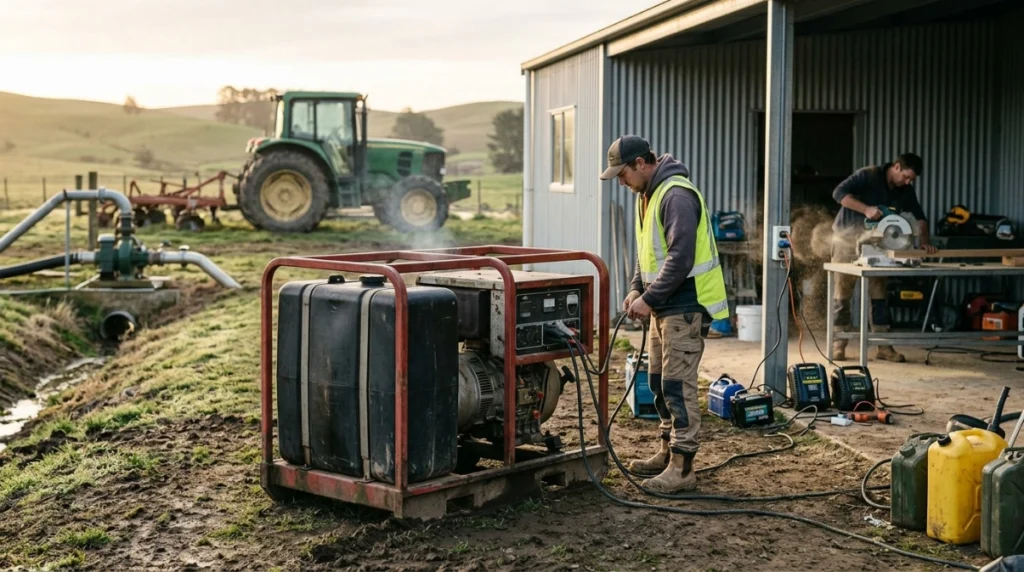
I would seriously consider diesel when the generator is expected to work hard and often. It is less compelling when low price and easy hand portability are your main priorities.
- Construction crews: Long workdays and repeated tool loads favor industrial equipment.
- Farms: Remote pumps, workshops, and agricultural operations may need dependable portable power.
- Commercial users: Temporary sites and emergency operations can justify a heavier machine.
- Extended-outage users: Long runtime and larger fuel systems can simplify backup planning.
- Diesel-equipped properties: Sharing an existing diesel fuel strategy can make the choice more practical.
I would lean toward gasoline or dual-fuel for someone who wants a light generator for occasional short outages. There are simply more consumer-oriented choices in that market.
If you’re ready to pick one, here are the diesel models I would put on the comparison list first:
🏆 BEST ALL-AROUND
Generac XD5000E
★★★★★ 4.7/5 my rating
5,000 running watts, electric start, a 12-gallon tank, and a manufacturer-rated 32.4-hour runtime at 50% load. I like it for buyers who want a genuine U.S.-market portable diesel model without stepping into a much larger commercial generator.
🔧 BEST HEAVY-DUTY
Kubota GL7000-USA
★★★★★ 4.6/5 my rating
Kubota rates this liquid-cooled diesel unit at 6.5 kW prime and 7.0 kW standby. At roughly 518 pounds, I see it as relocatable commercial equipment rather than something one person casually rolls around a backyard.
🚜 BEST COMPACT INDUSTRIAL OPTION
Yanmar YDG3700N
★★★★☆ 4.4/5 my rating
Yanmar lists 3.2 kVA prime output at 50 Hz and 3.7 kVA at 60 Hz for this open-frame diesel generator. I would shortlist it for industrial or agricultural work where Yanmar dealer support and the correct regional voltage configuration are available.
Frequently Asked Questions
Are portable diesel generators worth it?
They can be worth the higher price when you need frequent, demanding, or extended operation. For occasional household outages, a gasoline or dual-fuel generator may provide enough power with lower initial cost, less weight, and more consumer-model choices.
Can a diesel portable generator power a house?
Yes, if its output matches the loads you plan to run and it is connected through appropriate electrical equipment. Calculate both running and starting wattage first, then have a qualified electrician handle any connection to household wiring or a transfer system.
Can you run a diesel generator overnight?
A generator may have enough fuel for overnight operation, but runtime does not remove the safety requirements. It must remain outdoors, properly positioned away from the home, protected according to manufacturer instructions, and operated with functioning carbon monoxide alarms inside the building.
Are diesel portable generators quieter than gasoline generators?
Not automatically. Noise depends on engine speed, load, enclosure design, exhaust system, and the individual model. Compare manufacturer sound specifications under similar test conditions instead of choosing by fuel type alone.
What size diesel generator is best for home backup?
There is no single best wattage for every home. Add the running watts of essential loads, account for the largest motor-starting surge, decide which loads can operate together, and then select a generator with appropriate voltage, receptacles, and operating headroom.
Final Takeaway
A diesel portable generator is at its best when durability, long work periods, and dependable power matter more than low purchase price or easy carrying. That makes diesel especially attractive for jobsites, farms, workshops, commercial use, and serious outage preparation.
Start with your actual loads, then compare runtime, voltage, weight, transport method, power quality, and service support. Buy the generator that fits the job instead of buying diesel simply because it sounds more heavy-duty.

Hi, I’m Michael Turner. I own a generator workshop in the United States and founded HomeGeneratorBlog to share practical, hands-on guidance about generator installation, maintenance, troubleshooting, safety, and backup power solutions. My goal is to help homeowners make smarter, more confident decisions through clear and reliable information
One Comment