Portable Generator Error Codes: Meanings, Causes & Fixes
Quick Answer
Portable generator error codes usually point to low oil, overload, carbon monoxide detection, a CO sensor fault, unstable electrical output, or an internal control problem. Codes aren’t universal, so record the exact warning and model number before troubleshooting, especially when the shutdown involves portable generator carbon monoxide safety.
What the warning usually points to
- Low oil: Check the oil level with the generator sitting on level ground.
- Overload: Disconnect every load and reset the generator’s breaker or overload protection.
- CO shutdown: Move away from the area and relocate the generator outdoors before restarting it.
- CO sensor fault: Don’t bypass the sensor; follow the manufacturer service procedure.
- Output fault: Check breakers, GFCI outlets, voltage, frequency, and connected loads.
- Repeated fault: Stop resetting the unit and diagnose the underlying component.
Before clearing any warning
- Photograph the display or warning lights so you don’t lose the information after a reset.
A generator warning always gets my attention before I reach for a screwdriver. The message is the machine’s best clue about what caused the shutdown.
This guide explains the common portable generator error codes and warning lights I look at first. It also shows what you can safely check yourself in 2026 and when it’s smarter to stop.
What Are Portable Generator Error Codes?
Portable generator error codes are numbers, messages, icons, or warning-light patterns used to identify a detected operating fault. They can point you toward the system that needs attention, but they don’t always identify the failed part.
Definition: A generator error code is a diagnostic warning produced by the generator’s control, inverter, engine-protection, or safety system when operating conditions move outside an acceptable range.
There’s no single code list that applies to every portable generator. Champion, Generac, Honda, Predator, Westinghouse, FIRMAN, and other brands can use different displays and warning systems.
Some inverter generators use illuminated icons instead of numbers. Traditional open-frame units may only have a low-oil light, overload breaker, CO indicator, and hour meter.
- Numeric code: A number or letter-number combination appears on a digital controller.
- Warning icon: Oil cans, overload symbols, batteries, or service symbols identify the affected system.
- Colored LED: Red, yellow, or other flashing lights may identify CO or sensor conditions.
- Breaker trip: Electrical protection can trip without displaying a formal code.
- Shutdown behavior: The generator may stop completely when a safety system detects danger.
What Do Common Portable Generator Error Codes and Warning Lights Mean?
Most warnings fall into a small number of fault categories. Start by identifying the category rather than assuming a particular component has already failed.
| Warning or Symptom | What It Usually Means | First Check | Safe Next Step |
|---|---|---|---|
| Low-oil light or oil icon | Oil protection has detected a low level or related condition | Oil level and generator position | Correct the level using the specified oil |
| Overload light | Connected demand exceeded available output or a fault tripped protection | Disconnect all appliances | Reset and reconnect loads one at a time |
| Red CO warning | Some CO-equipped models detected elevated carbon monoxide | Generator location | Move to a safe outdoor location |
| Yellow CO/sensor warning | Some systems use yellow for a sensor or system fault | Manufacturer instructions | Arrange service if the fault returns |
| No output or output light off | Breaker, GFCI, inverter, AVR, alternator, or wiring problem | Breaker and receptacle reset | Check outlet voltage if qualified |
| Voltage/frequency fault | Engine speed or electrical regulation is outside the expected range | Load and engine behavior | Measure output before reconnecting sensitive electronics |
The exact wording can change even between generators from the same brand. Always match the warning to your full model number and owner manual.
How Do I Troubleshoot a Portable Generator Error Code?
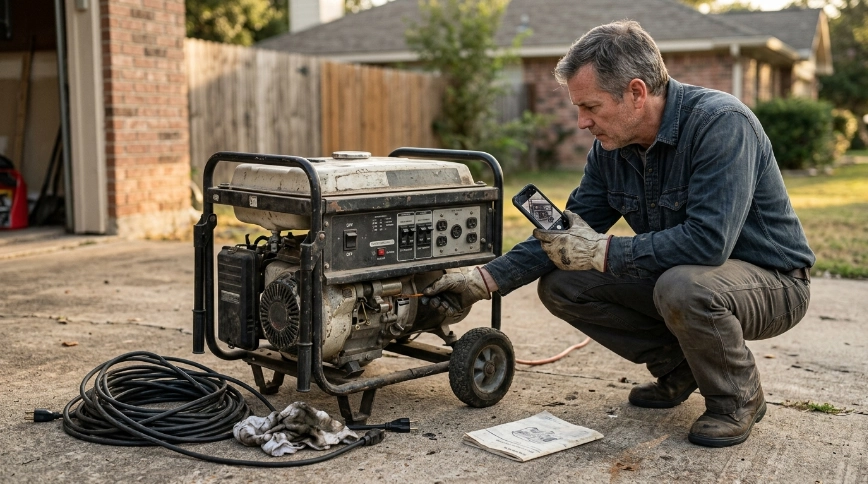
Start with safety, then work from simple causes toward electrical faults. Don’t keep clearing a warning until you understand why it appeared.
- Disconnect every load. Unplug extension cords, appliances, RV cables, and transfer equipment before restarting.
- Shut the generator down. Give hot components time to cool before checking oil, wiring, or engine parts.
- Record the warning. Photograph the code, icon, or flashing-light pattern and write down the model number.
- Check oil and fuel. Confirm the oil level, fuel supply, fuel valve, and selector position.
- Reset electrical protection. Inspect the main breaker, receptacle breakers, and GFCI reset buttons.
- Restart without a load. See whether the warning returns while nothing is connected.
- Use the manual. Match the exact indicator to your manufacturer documentation before replacing parts.
A generator that starts and then dies may have an engine-side problem rather than an electrical one. My portable generator fuel system guide covers fuel flow, carburetor, tank, valve, and delivery problems in more detail.
Generac also publishes a portable generator troubleshooting guide covering common startup and shutdown conditions.
Why Does My Generator Show Overload With Nothing Plugged In?
An overload warning with no external load can indicate a reset problem, damaged cord still connected somewhere, wet receptacle, internal short, inverter fault, or damaged output circuitry. Unplug everything before blaming the inverter module.
I always restart a generator completely unloaded after an overload trip. That simple test separates appliance problems from generator problems surprisingly quickly.
- Disconnect every cord: Don’t leave a transfer cord or RV cable attached during the test.
- Reset the breaker: Follow the reset sequence in the owner’s manual.
- Inspect outlets: Look for moisture, scorching, damaged receptacles, or loose connections.
- Restart unloaded: Let the engine stabilize before connecting anything.
- Add one load: Start with a small resistive or simple load instead of a large motor.
- Watch starting watts: Refrigerators, pumps, compressors, and air conditioners can draw extra power during startup.
What if the overload light comes back immediately?
If the warning returns with absolutely nothing connected, stop cycling the generator repeatedly. The fault may be inside the inverter, alternator, wiring harness, or output protection circuit.
An inverter generator can also shut off electrical output while the engine continues running. That behavior is different from an engine shutdown caused by oil or CO protection.
What Should I Do After a Carbon Monoxide Sensor Shutdown?
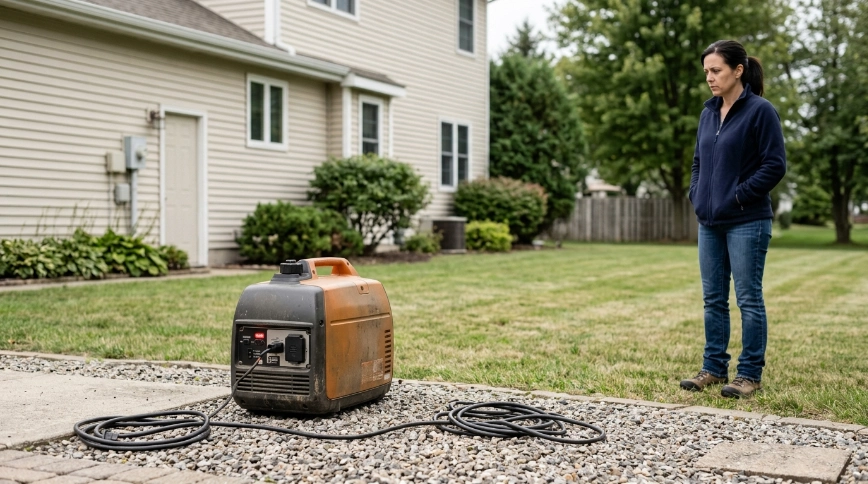
Treat a CO shutdown as a safety warning, not a nuisance code. Move away from the affected location and don’t restart the generator there.
The U.S. Consumer Product Safety Commission recommends operating portable generators outdoors at least 20 feet from the home, with exhaust directed away from the building.
- Red CO warning: On systems such as Champion CO Shield, a blinking or pulsing red indicator can mean elevated CO caused a shutdown.
- Yellow warning: Some CO-equipped generators use a yellow indicator for a sensor or system fault.
- Repeated shutdown: Don’t move the generator only a few feet and keep restarting it.
- Sensor failure: Never bypass, disconnect, cover, or modify the CO sensor.
Champion explains its red shutdown indicator and CO protection on its CO Shield information page. Exact indicator behavior still depends on your generator model.
The CDC generator safety guidance also stresses outdoor operation away from doors, windows, and vents.
Why Is My Portable Generator Showing Low Oil When the Oil Is Full?
A low-oil warning with a full crankcase can come from an incorrect checking procedure, an unlevel generator, sensor wiring trouble, or a failed oil-level sensor. Don’t assume the sensor is bad until you’ve confirmed the oil correctly.
- Place the generator on a stable, level surface.
- Shut the engine off and let the oil settle.
- Check the dipstick exactly as the manual specifies.
- Verify you’re using the recommended oil type and amount.
- Inspect accessible sensor wiring for obvious damage or loose connections.
Don’t permanently disconnect the low-oil sensor just to make the generator run. That protection exists to stop an engine from operating without adequate lubrication.
Can I Clear a Generator Error Code by Disconnecting the Battery?
Sometimes a power cycle clears a stored warning, but clearing the display doesn’t repair the cause. Battery disconnection also isn’t relevant to many recoil-start generators.
If your manual specifies a reset procedure, follow that procedure instead of experimenting with controller power. A warning that immediately returns should be diagnosed before the generator goes back into service.
Workshop rule: I treat a reset as a diagnostic step, not a repair. If the same warning returns twice under the same conditions, I stop resetting and find the underlying problem.
How Do I Check Generator Voltage After an Error?
If the generator runs but reports an electrical fault, output testing can help separate an engine problem from a regulation problem. Only perform live electrical testing if you know how to use the meter safely.
For a typical U.S. unit, a standard receptacle is designed around 120-volt, 60-hertz equipment. Larger portable generators may also provide 240-volt output.
- Start unloaded: Don’t test immediately with large appliances attached.
- Check AC voltage: Compare the reading with the generator’s rated output.
- Check frequency: If your meter supports hertz, compare it with the 60 Hz rating used by U.S. equipment.
- Add a modest load: Watch for severe voltage sag, surging, or loss of output.
- Stop on abnormal output: Keep computers and sensitive electronics disconnected until the fault is resolved.
For more detail, see my portable generator voltage guide. It explains what the outlet reading can tell you about the generator.
Could the AVR be causing the error?
On conventional brushed generators, the automatic voltage regulator can cause low, high, unstable, or missing output. An inverter generator regulates power differently, so don’t order an AVR until you know which design you own.
My portable generator AVR troubleshooting guide covers voltage checks, brushes, wiring, and common regulator symptoms.
What if the engine runs but I get no electricity?
Reset the breaker and GFCI first. If output remains dead, the problem may involve excitation, brushes, the regulator, inverter circuitry, wiring, or alternator components.
For conventional designs, this portable generator alternator guide explains the main components involved in producing AC power.
When Should I Stop Troubleshooting and Call a Technician?
Stop DIY troubleshooting when the fault involves damaged internal wiring, repeated CO sensor errors, abnormal high voltage, burnt components, or a generator that keeps tripping with no load. Those faults can require live electrical measurements or component-level testing.
- A burning electrical smell or melted insulation
- Visible arcing or scorched connectors
- Voltage far above the generator’s rated output
- A CO sensor fault that keeps returning
- An overload warning with every load disconnected
- No output after breakers and GFCI devices have been reset
- A repeated low-oil warning with the oil level correctly verified
- Loud mechanical knocking or unusual engine noises
Don’t use expensive appliances as test equipment. A proper meter and a small controlled test load cost far less than a damaged refrigerator, furnace board, or laptop.
Tools I Recommend for Diagnosing Generator Faults
If you’re going to troubleshoot portable generator error codes yourself, a few basic diagnostic tools make the process much easier. These are the types of tools I reach for before replacing parts.
🏆 Best Overall Diagnostic Tool
Klein Tools MM325 Digital Multimeter
★★★★☆ 4.7/5
The MM325 measures up to 600V AC/DC and also checks resistance and continuity. I like a basic meter like this for checking receptacle voltage, wiring continuity, and straightforward generator electrical faults.
⚡ Best for Output Monitoring
P3 Kill A Watt P4400
★★★★☆ 4.6/5
The P4400 displays volts, amps, watts, hertz, VA, and energy use on a standard 120V-style outlet. I find it handy for watching generator output while adding smaller loads without holding meter probes.
🔧 Best for No-Start Diagnosis
Lisle 20610 Inline Spark Tester
★★★★☆ 4.5/5
The Lisle 20610 connects between the spark plug and plug wire and gives a visible indication of ignition spark. It’s a simple way to separate an ignition problem from fuel trouble when a generator refuses to start.
Frequently Asked Questions About Portable Generator Error Codes
Are portable generator error codes the same for every brand?
No. Portable generator error codes, icons, and warning-light patterns vary by manufacturer and model. Always identify the full model number and compare the exact warning with that generator’s owner manual rather than using a code list from another generator.
How do I reset a portable generator error code?
Disconnect the loads, shut the generator down, correct the cause, and follow the reset procedure in the owner’s manual. Some units reset through a breaker or control switch, while others clear automatically after the fault condition disappears.
Why does my generator keep showing an overload error?
A repeated overload warning can come from excessive appliance demand, high motor starting watts, a shorted load, damaged wiring, or an internal inverter or output fault. Restart the generator with every load disconnected to determine which side of the system is causing the problem.
Can a low-oil sensor stop a generator from starting?
Yes. Many portable generators use low-oil protection that can prevent operation or shut the engine down when an unsafe oil condition is detected. Check the oil correctly on level ground before assuming the sensor itself has failed.
Can I bypass a generator’s CO sensor if it keeps shutting down?
No. A CO sensor is a safety device intended to reduce carbon monoxide exposure risk. If a sensor fault keeps shutting the generator down even in a safe outdoor location, stop using the generator and follow the manufacturer’s service procedure.
Final Takeaway
Portable generator error codes become much easier to troubleshoot once you stop treating every warning as a failed part. First identify whether you’re dealing with oil, overload, CO protection, fuel, or electrical output.
Record the warning before resetting anything, remove the loads, and work through simple checks first. If the same fault returns or the problem involves CO protection, burnt wiring, or dangerous voltage, get the generator professionally diagnosed before relying on it again.

Hi, I’m Michael Turner. I own a generator workshop in the United States and founded HomeGeneratorBlog to share practical, hands-on guidance about generator installation, maintenance, troubleshooting, safety, and backup power solutions. My goal is to help homeowners make smarter, more confident decisions through clear and reliable information