Understanding a Portable Generator Engine
Quick answer: A portable generator engine is a small gasoline, propane, or dual-fuel internal combustion engine that spins a rotor inside an alternator. That spinning creates a magnetic field, which induces the electrical current that comes out of the generator’s outlets. Almost every portable unit on the market uses a four-stroke engine, the same basic design as a car engine, just scaled down.
If you’ve ever popped the cover off a generator and stared at the mess of wires, cylinders, and fuel lines, you’re not alone. Most owners never look past the pull-cord and the outlets. But once you understand what the engine is actually doing, troubleshooting gets a lot less scary — and buying your next unit gets a lot easier too.
The first time I ran a 7,500-watt dual-fuel unit through a five-day outage after a windstorm, the thing that surprised me wasn’t the noise. It was how much the engine’s condition — oil level, air filter, fuel quality — mattered to whether it ran clean on day five or started surging like it was going to quit on me.
Safety note: Generator engines burn fuel and produce carbon monoxide (CO), an odorless gas that can be fatal in minutes. The CDC’s generator safety fact sheet and the CPSC’s generator safety guide both recommend running a generator outside, at least 20 feet from doors, windows, and vents, and never in a garage even with the door open.
What the Engine’s Job Actually Is
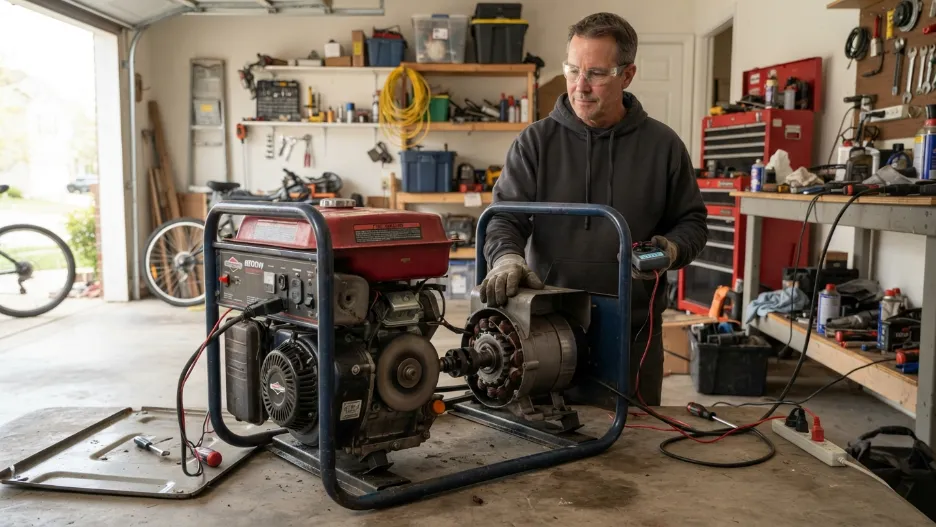
A generator’s engine doesn’t make electricity by itself. Its only job is to turn a shaft — the crankshaft — at a steady speed, usually around 3,600 RPM on a standard portable unit. That spinning motion is the mechanical energy that gets handed off to the alternator, which is the part that actually produces the current.
Think of the engine as the muscle and the alternator as the part that converts that muscle into something your refrigerator can use. Without a steady, consistent spin from the engine, the alternator can’t produce clean, stable power — which is why a rough-running engine often means flickering lights or a tripped breaker.
The Four-Stroke Cycle: How Fuel Becomes Motion
Nearly every modern portable generator runs a four-stroke engine, the same basic cycle used in cars and lawn equipment. One full cycle takes two complete turns of the crankshaft and moves through four stages:
- Intake: The piston drops, pulling an air-fuel mixture into the cylinder through the open intake valve.
- Compression: Both valves close and the piston rises, squeezing that mixture into a smaller space so it burns more efficiently.
- Power: A spark plug ignites the compressed mixture, and the expanding gases slam the piston back down — this is the only stroke that actually produces usable energy.
- Exhaust: The piston rises again, this time with the exhaust valve open, pushing the spent gases out through the muffler.
According to a small-engine training manual published by the University of Washington’s engineering department, this four-stroke design is the most common configuration used in small engines specifically because it separates intake and exhaust into their own strokes, which reduces wasted fuel and keeps emissions lower than a two-stroke design.
Key Components and What Each One Does
Popping the hood reveals a handful of parts that each have one clear job. Here’s what’s under there and why it matters if something goes wrong.
| Component | What It Does |
|---|---|
| Piston & cylinder | Compresses the fuel-air mix and converts the combustion blast into linear motion. |
| Crankshaft | Turns the piston’s up-and-down motion into the rotation that spins the alternator’s rotor. |
| Spark plug | Fires a high-voltage spark that ignites the compressed charge at the right instant. |
| Carburetor | Mixes air and fuel in the right ratio before it enters the cylinder (fuel-injected models skip this). |
| Flywheel | A heavy spinning disc that smooths out the engine’s power delivery between strokes. |
| Air filter | Keeps dust and debris out of the intake — a clogged one is the single most common cause of rough running. |
| Alternator (rotor & stator) | Converts the engine’s rotation into AC electrical current through electromagnetic induction. |
From Spinning Shaft to Usable Power
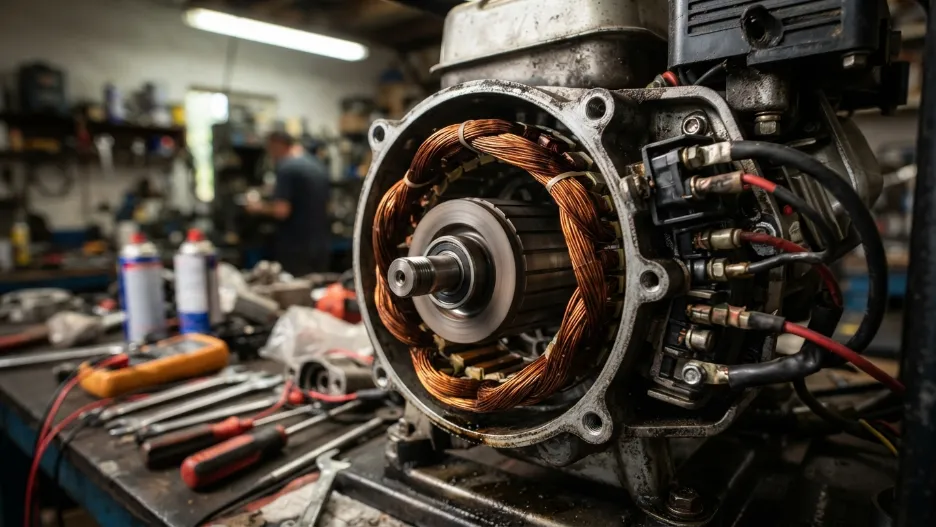
Once the crankshaft is turning steadily, it drives the rotor — a spinning magnet — inside the alternator. As that magnet spins past the stationary copper windings of the stator, it induces an alternating current. A voltage regulator then smooths that current before it reaches the control panel, where breakers and outlets deliver it to whatever you plug in.
This is also where engine speed matters more than most owners realize. A generator has to hold a steady RPM to keep the output at a clean 120/240 volts and 60 hertz. If the engine surges or bogs down under load — often from a dirty carburetor or stale fuel — that instability shows up as flickering lights or, in worse cases, damage to sensitive electronics. A quality inverter generator manages this differently, using electronic circuitry to regulate output rather than relying purely on mechanical engine speed, which is why inverter models tend to produce cleaner power for laptops and medical equipment.
Gasoline, Propane, and Dual-Fuel: What Changes Under the Hood
The four-stroke cycle stays the same no matter the fuel, but the fuel delivery system changes:
- Gasoline engines use a carburetor or fuel injector and are the most common — widely available fuel, strong power output, but gas degrades in storage within a few months without a stabilizer.
- Propane engines run cleaner and store almost indefinitely, but they typically produce about 10–15% less power than the same engine burning gasoline.
- Dual-fuel engines use a modified carburetor with a separate propane regulator, letting you switch fuel sources depending on what’s available during an outage.
None of this changes the basic intake-compression-power-exhaust cycle — it only changes how the fuel gets into the cylinder in the first place.
What Engine Trouble Is Usually Telling You
Most portable generator complaints trace back to the engine, not the alternator. Here’s a quick read on the common symptoms.
| Symptom | Likely Cause |
|---|---|
| Won’t start after sitting all season | Stale gasoline gumming up the carburetor jets |
| Starts, then dies within seconds | Clogged fuel filter or a stuck carburetor float |
| Runs rough, surges under load | Dirty air filter restricting airflow to the cylinder |
| Excess white or blue smoke | Oil leaking past worn piston rings into the combustion chamber |
If an engine problem goes beyond a filter swap or fresh fuel — think oil in the exhaust, knocking sounds, or a cracked block — that’s usually the point to call a small-engine repair shop rather than keep tinkering.
Keeping the Engine Running Longer
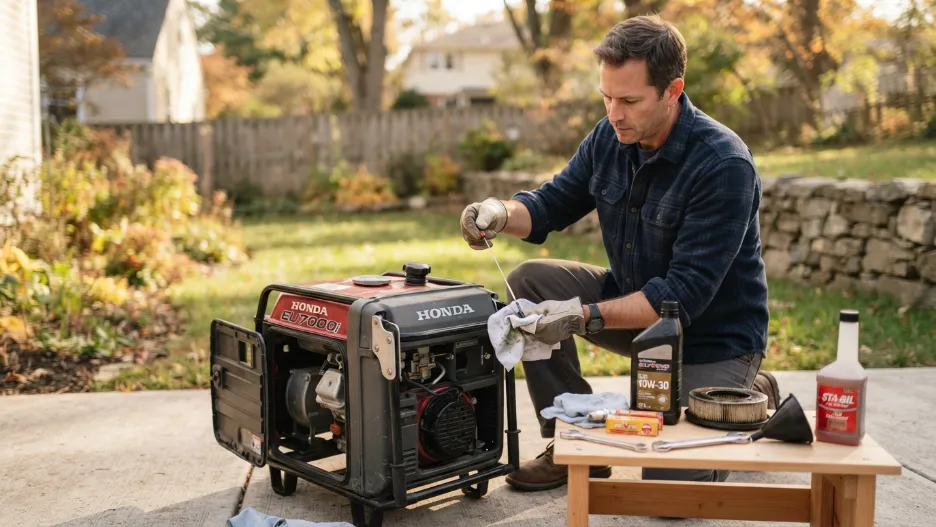
Engine wear is almost always about oil and fuel discipline. Check the oil before every use, change it after the first 20–30 hours on a new unit, and every 50–100 hours after that. Run the tank dry or add a fuel stabilizer before any storage stretch longer than a month — stale fuel is responsible for more no-start calls than any mechanical failure.
Conclusion
A portable generator engine isn’t complicated once you see the four strokes for what they are: a repeating cycle of pulling in fuel, compressing it, igniting it, and clearing it out. Keep the oil fresh, the air filter clean, and the fuel from going stale, and the engine will hold up its end of the deal for years. Stay safe out there — Michael Turner.
If your generator has been sitting since last season, a basic small-engine maintenance kit with a fresh air filter, spark plug, and fuel stabilizer is the cheapest insurance against a no-start when you actually need the power.
FAQ
Is a portable generator engine the same as a car engine?
Mechanically, yes — both typically use a four-stroke gasoline cycle with a piston, crankshaft, and spark plug. Generator engines are smaller, run at a fixed RPM instead of variable speeds, and are built for sustained, steady output rather than acceleration.
How many hours does a portable generator engine typically last?
Most consumer-grade portable generator engines are rated for roughly 1,000–2,000 hours of use before major wear sets in, though that number climbs significantly with regular oil changes and clean fuel.
Why does my generator engine run but produce no power?
This usually points to the alternator, not the engine itself — often a loss of “residual magnetism” in the rotor, which can sometimes be restored by a process called flashing the field. A tripped breaker on the control panel is worth checking first, since it’s the simpler fix.
Can I run a generator engine on old gasoline?
It’s not a good idea. Gasoline starts breaking down within a few months and can gum up the carburetor, causing hard starts or rough running. Use fuel within 30 days or add a stabilizer if it’ll sit longer.
Do all portable generators use four-stroke engines?
The vast majority do, including nearly every mid-size and large unit sold for home backup power. A handful of very small, lightweight generators use two-stroke engines, which are lighter but need oil mixed directly into the fuel.
Hi, I’m Michael Turner. I own a generator workshop in the United States and founded HomeGeneratorBlog to share practical, hands-on guidance about generator installation, maintenance, troubleshooting, safety, and backup power solutions. My goal is to help homeowners make smarter, more confident decisions through clear and reliable information