Portable Generator Battery: Charging, Testing, Replacement & Care
Quick Answer
A portable generator battery usually powers the electric starter, not the generator’s AC outlets. Most electric-start models use a small 12-volt lead-acid or AGM battery, although the exact size, capacity, and charging method vary by model. If you want more detail on the starting system, see my guide to an electric start portable generator.
What matters most
- Match the voltage: Never replace a 12V starting battery with a different voltage unless the manufacturer specifies it.
- Check physical size: Length, width, height, terminal position, and polarity must match the battery compartment.
- Verify capacity: Match the recommended amp-hour rating and starting specification in your owner’s manual.
- Charge correctly: Use the charger type and maximum charging rate listed for your generator battery.
- Test before replacing: A multimeter can quickly separate a discharged battery from a wiring or starter problem.
- Maintain during storage: Long periods of partial discharge can shorten lead-acid battery life.
Before buying a replacement
- Find the generator model number and check its manual before ordering any battery advertised as “universal.”
A portable generator battery seems simple until the starter clicks during an outage and nothing happens. I treat that little battery as part of the starting system, not as an afterthought.
This guide covers battery types, replacement sizing, charging, testing, storage, and common electric-start problems. I’ll also explain one detail that causes plenty of confusion: not every generator charges its own starter battery the same way.
What Is a Portable Generator Battery?
A portable generator battery is a rechargeable battery that supplies electricity to the starter motor and related starting controls. It lets you crank the engine with a key, button, or remote instead of relying only on a recoil cord.
The battery normally does not provide the electricity coming from your 120V or 240V outlets. Once the engine is running, the engine and alternator produce that power.
- Starter battery: Cranks the gasoline, propane, or diesel engine.
- Starter motor: Uses battery current to turn the engine.
- Charging circuit: Maintains or recharges the battery on models equipped for it.
- Recoil starter: Provides manual backup on many electric-start generators.
This distinction also prevents confusion with a portable power station. A battery power station stores energy to run appliances, while a conventional generator battery mainly helps start a combustion engine.
What Type of Battery Does a Portable Generator Use?
Most electric-start portable generators use a 12V lead-acid starting battery. AGM and sealed lead-acid designs are common because they require little routine electrolyte maintenance.
There is no universal generator battery size. For example, Generac currently lists a 12V 9Ah lead-acid battery on certain GP-series electric-start portable generators, but another generator may use different dimensions or capacity.
| Battery Type | Typical Advantages | Main Considerations | Best Approach |
|---|---|---|---|
| AGM lead-acid | Sealed, low maintenance, good starting performance | Needs the correct charging voltage and storage care | Good replacement when specified by the manufacturer |
| Sealed lead-acid | Simple, affordable, widely available | Can lose charge during long storage periods | Common on electric-start portable generators |
| Flooded lead-acid | Proven technology and easy sourcing | May require more maintenance and careful positioning | Use only when your generator specifies it |
| Lithium | Light weight and low self-discharge | Needs a compatible charging system and BMS | Never substitute automatically for lead-acid |
I never choose a replacement by voltage alone. Two batteries can both say “12V” while having different dimensions, terminals, capacity, or charging requirements.
How Do You Choose the Right Replacement Generator Battery?
The correct replacement matches the manufacturer’s specifications and physically fits the generator. Start with the model and serial number rather than the old battery’s appearance.
Battery specifications sometimes change during a generator’s production run. The serial number can therefore matter as much as the model name.
Check These Specifications Before Ordering
- Nominal voltage: Usually 12V on electric-start portable generators.
- Amp-hour rating: Match the recommended Ah capacity when possible.
- Battery dimensions: Measure length, width, and height.
- Terminal position: Positive and negative terminals must align with the cables.
- Terminal style: Confirm bolt, nut, tab, or post configuration.
- Battery chemistry: Match AGM, sealed lead-acid, lithium, or another specified chemistry.
- Starting specification: Match any CCA or starting-current requirement listed by the manufacturer.
If you’re identifying more than the battery, my portable generator parts guide explains the starter, alternator, AVR, fuel system, and other major components.
A battery advertised for motorcycles, lawn equipment, or powersports equipment can sometimes share the correct dimensions. Compatibility still depends on your generator’s exact specifications.
Does a Portable Generator Charge Its Own Battery?
Some portable generators recharge their starter battery while running, while others require an external charger. This is model-specific, so don’t assume your generator works like another brand.
This is one of the most important details I check in the owner’s manual.
- Some Westinghouse models: Their manuals state that the generator slowly charges the battery after the engine starts.
- Some Generac models: Generac’s current portable-generator guidance says certain units use a separate 12V charger instead of charging the battery while running.
- Other models: Charging behavior depends on their specific charging coil, regulator, and control system.
You can review Generac’s portable generator battery charging guidance for an example of why model-specific instructions matter.
A Westinghouse WGen9500 owner’s manual provides the opposite example, noting that its starting battery receives charge after the generator has been running.
Don’t confuse that starting-battery circuit with the generator’s external DC charging outlet. My guide to portable generator DC output explains what that separate 12V receptacle is designed to do.
How Do You Charge a Portable Generator Battery?
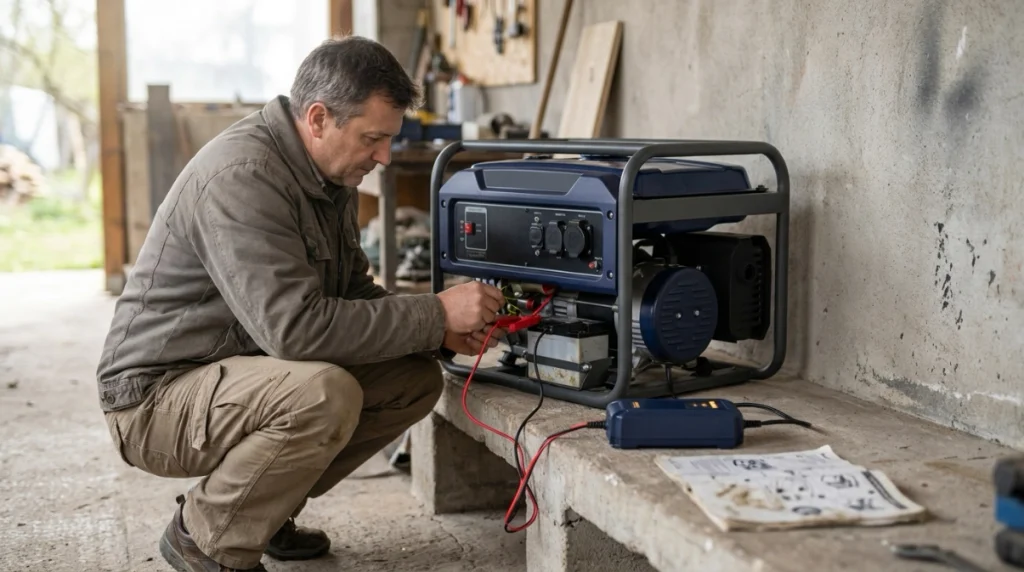
Use the charger and charging rate recommended in your generator manual. A small starter battery usually needs a low-current smart charger rather than an aggressive automotive fast charger.
Some Champion service guidance, for example, specifies a 12V automatic charger with a maximum 2-amp charging rate for certain models. That number should not be treated as universal.
- Turn the generator off. Let the engine cool before working near the battery or fuel system.
- Read the battery label. Confirm voltage and chemistry before selecting charger mode.
- Inspect the battery. Don’t charge a swollen, cracked, leaking, or visibly damaged battery.
- Check the manual. Confirm whether the battery can remain connected during charging.
- Connect the charger correctly. Match positive to positive and negative to negative.
- Select the proper mode. Use AGM, standard lead-acid, or lithium mode only when it matches the battery.
- Allow the smart charger to finish. Avoid repeatedly interrupting the charging cycle.
- Disconnect safely. Follow the charger’s instructions before removing the leads.
Champion Power Equipment’s battery guidance is also worth checking when you own one of its electric-start models.
How Do You Test a Portable Generator Battery With a Multimeter?
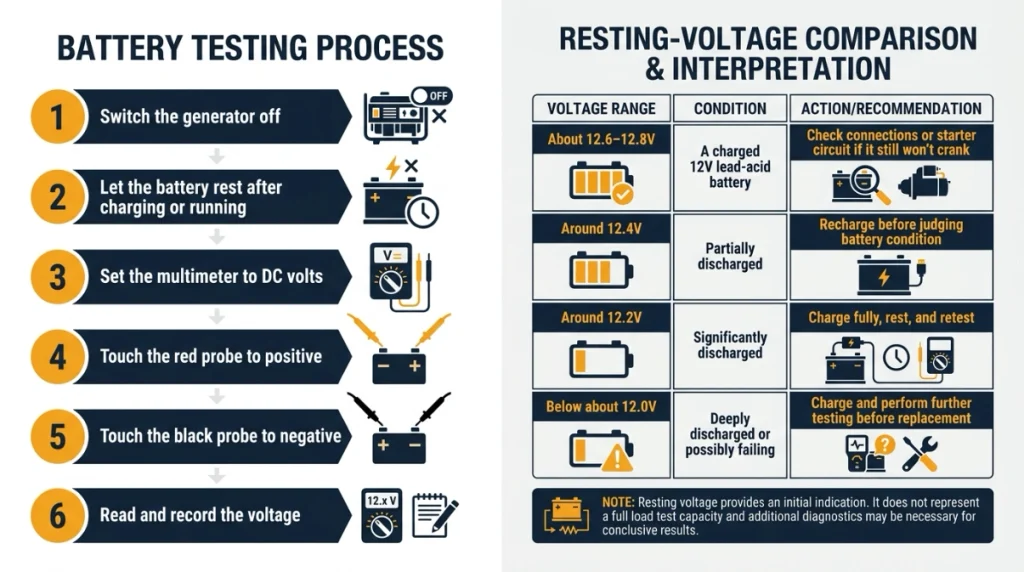
A resting-voltage test is the fastest first check when an electric-start generator clicks or cranks slowly. It tells you whether the battery is charged, although it doesn’t replace a proper load test.
I keep a basic digital multimeter with my generator tools because it turns a vague “won’t start” complaint into useful information within a minute.
- Switch the generator off.
- Let the battery rest after charging or running.
- Set the multimeter to DC volts.
- Touch the red probe to positive.
- Touch the black probe to negative.
- Read and record the voltage.
| Resting Voltage | What It Suggests | Next Step |
|---|---|---|
| About 12.6–12.8V | A charged 12V lead-acid battery | Check connections or starter circuit if it still won’t crank |
| Around 12.4V | Partially discharged | Recharge before judging battery condition |
| Around 12.2V | Significantly discharged | Charge fully, rest, and retest |
| Below about 12.0V | Deeply discharged or possibly failing | Charge and perform further testing before replacement |
Voltage alone doesn’t prove that a battery can deliver enough current under starter load. A weak battery can show acceptable resting voltage and still collapse when you press the start button.
Why Does My Portable Generator Battery Keep Dying?
A generator battery usually keeps going dead because it isn’t being fully recharged, it has a parasitic load, or its capacity has deteriorated. Loose terminals and a faulty charging circuit can create similar symptoms.
| Symptom | Likely Cause | What to Check |
|---|---|---|
| Starter only clicks | Low battery voltage or poor connection | Voltage, terminal tightness, corrosion |
| Cranks slowly | Weak battery or resistance in cables | Charge battery and inspect cable ends |
| Battery dies during storage | Self-discharge or small electrical draw | Storage instructions and maintainer use |
| Battery is charged but generator won’t start | Fuel, ignition, low-oil sensor, fuse, or starter issue | Move beyond the battery and diagnose the starting system |
| New battery repeatedly goes flat | Charging-system or parasitic-draw problem | Test charging behavior before buying another battery |
Replacing the battery without finding the cause can waste money. If the second battery develops the same problem, stop blaming the battery and diagnose the generator.
How Long Does a Portable Generator Battery Last?
A small lead-acid generator battery commonly lasts a few years, but storage conditions often matter more than calendar age. Heat, deep discharge, long periods without charging, and repeated hard starting can shorten its useful life.
I prefer condition-based replacement over blindly changing batteries on a fixed date. If a fully charged battery repeatedly loses voltage or cranking strength, replacement makes more sense than another charging cycle.
Signs Replacement Is Getting Close
- The starter turns noticeably slower than before.
- The battery needs charging after short storage periods.
- Voltage falls quickly after a full charge.
- Terminal corrosion keeps returning despite cleaning.
- The case is swollen, cracked, or leaking.
- The battery fails a proper load or conductance test.
Don’t keep charging a physically damaged battery. Replace it and investigate why the damage occurred.
How Should You Maintain a Generator Battery During Storage?
The goal during storage is to prevent the battery from sitting deeply discharged. A compatible smart maintainer is often the easiest solution when the generator sits unused for long periods.
My own routine is simple: I check starting-battery voltage as part of the same pre-season inspection that covers oil, fuel, air filter, spark plug, and electrical connections.
- Before storage: Fully charge the battery according to the manual.
- Monthly: Check battery condition if the generator remains unused.
- During long storage: Use an approved automatic maintainer when recommended.
- At the terminals: Keep connections clean, tight, and dry.
- Before storm season: Confirm electric start works before you depend on it.
If your owner’s manual says to disconnect a battery lead during long storage, follow that procedure. Remote-start electronics can create different storage requirements from a basic key-start generator.
Can You Start a Generator With a Dead Battery?
Many electric-start portable generators also include a recoil starter, so a dead battery may not stop you from running the engine. The generator still needs healthy fuel, ignition, oil level, and engine condition.
A recoil backup is especially useful during an outage. It lets you get the engine running while you diagnose or recharge the electric-start battery.
Don’t automatically connect a powerful automotive jump starter unless the generator manufacturer allows it. Sensitive starting electronics, battery size, and connection procedures vary among models.
Portable Generator Battery Safety Matters Too
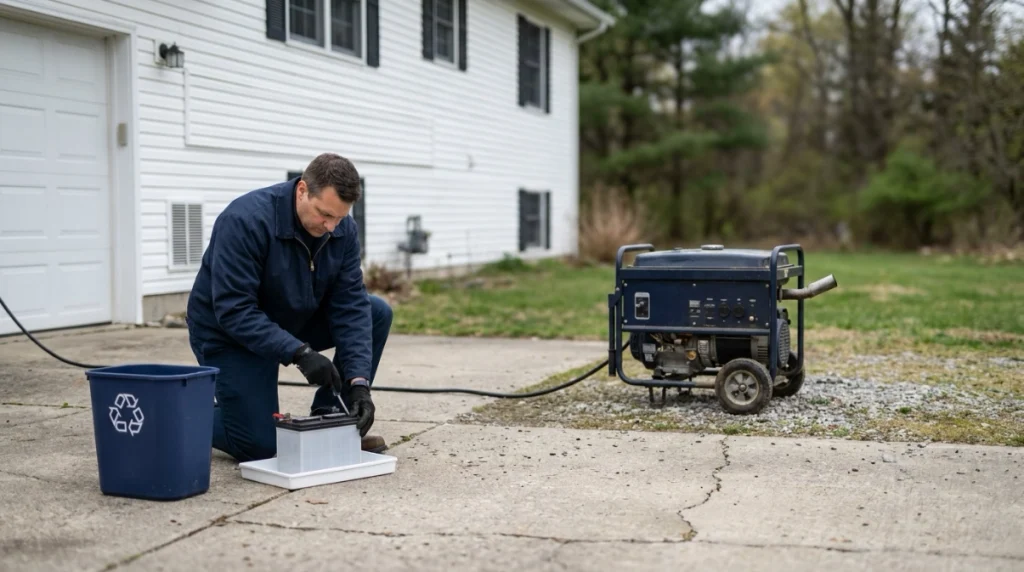
Stop the engine and keep flames, cigarettes, and sparks away while servicing a lead-acid battery. Charging batteries can create hazardous conditions, especially when damaged or improperly connected.
The generator itself creates a separate carbon-monoxide hazard. The U.S. Consumer Product Safety Commission recommends operating portable generators outdoors at least 20 feet from the home, with exhaust directed away from openings.
- Never run a generator inside a home.
- Never run one inside a garage, even with the door open.
- Keep the generator away from windows, doors, and vents.
- Use working carbon-monoxide alarms inside the home.
When a lead-acid battery reaches the end of its life, don’t place it in household trash. The EPA’s used battery guidance recommends returning lead-acid batteries to an appropriate retailer or collection program.
Portable Generator Battery Tools I Recommend
If you’re maintaining an electric-start generator yourself, these are the types of tools I find most useful. Always confirm your battery chemistry and charging specifications first.
🏆 Best all-around charger
NOCO GENIUS1 1-Amp Smart Battery Charger
★★★★★
The GENIUS1 supports 6V and 12V batteries and includes modes for common lead-acid, AGM, and compatible lithium batteries. I like its flexibility when several pieces of small-engine equipment share the same workbench.
🔋 Best for long storage
Battery Tender Junior 12V 750mA
★★★★☆
This 12V automatic charger and maintainer is designed for small lead-acid, AGM, gel, and sealed batteries, with Battery Tender listing a 3Ah to 30Ah range. It’s the one I’d consider when maintaining a compatible small generator battery through seasonal storage.
🧰 Best diagnostic tool
Klein Tools MM325 Digital Multimeter
★★★★☆
The MM325 measures AC/DC voltage up to 600V and also checks resistance, continuity, batteries, and diodes. For generator work, I mainly value it because a voltage reading can quickly tell me whether to investigate the battery or keep moving through the starting circuit.
Frequently Asked Questions
What size battery does a portable generator use?
There is no single portable generator battery size. Many electric-start generators use a small 12V lead-acid or AGM battery, but the amp-hour rating, dimensions, terminal layout, and starting requirements vary. Check the generator’s model-specific manual before buying a replacement.
Can I use a car battery in a portable generator?
A car battery may supply enough voltage to crank some 12V systems, but that doesn’t make it the correct permanent replacement. The physical size, terminals, charging system, capacity, and manufacturer requirements may differ. Use the specified generator battery whenever possible.
Can I leave a battery maintainer connected to my generator?
You can leave a compatible automatic maintainer connected when both the battery and charger manufacturers permit long-term maintenance. Confirm the battery chemistry first. A smart maintainer that switches to float mode is different from a basic charger that continuously supplies current.
Why does my generator only click when I press the start button?
A clicking starter often points to a discharged battery, corroded terminals, loose cables, or insufficient current reaching the starter. Measure battery voltage and clean the connections first. If the battery tests well, inspect the fuse, starter solenoid, wiring, and starter motor.
Will running my generator recharge a dead starting battery?
It depends on the generator. Some portable generators have a charging circuit that recharges the starter battery while running, while others use an external charger. Check the owner’s manual rather than assuming that running the engine will restore the battery.
Keep the Battery Ready Before the Outage
The best time to discover a weak portable generator battery isn’t when the utility power has already failed. Check it before storm season, keep the terminals clean, and follow the manufacturer’s storage and charging instructions.
Most battery problems are straightforward once you separate charging, battery condition, wiring, and starter issues. A manual, a multimeter, and a compatible smart charger cover most of the diagnosis I would do first.
If electric start suddenly stops working, begin with battery voltage and connections. Work through the system in order, and you’ll avoid replacing good parts just because the start button stayed silent.

Hi, I’m Michael Turner. I own a generator workshop in the United States and founded HomeGeneratorBlog to share practical, hands-on guidance about generator installation, maintenance, troubleshooting, safety, and backup power solutions. My goal is to help homeowners make smarter, more confident decisions through clear and reliable information