10 Best Firman Portable Generators for 2025: Tested for Power, Noise & Runtime
Power outages, job sites, and campgrounds all ask the same question: which generator actually starts when you pull the cord? Firman has become one of the most recommended names in portable power, but its lineup runs from a 31-pound 1,050W unit to a 340-pound whole-home tri-fuel machine, and the wrong pick wastes hundreds. We ran ten Firman generators under real loads — refrigerators, sump pumps, space heaters, power tools — to verify runtime, noise, and starting behavior. Below you’ll find our ranked picks, a buyer’s guide that tells you exactly how many watts you need, and honest answers about where Firman falls short.
Quick Comparison: All 10 Ranked
| # | Product | Best For | Rating | Badge | |
|---|---|---|---|---|---|
| 1 | Firman T07571 7,500W Tri-Fuel | Home backup power | 4.9/5 | Best Overall | View on Amazon → |
| 2 | Firman P03601 3,600W | Budget job sites | 4.7/5 | Best Budget | View on Amazon → |
| 3 | Firman WH02081 2,000W Inverter | Quiet campground use | 4.8/5 | Best for Camping | View on Amazon → |
| 4 | Firman P05201 5,200W | Mid-range home backup | 4.6/5 | Best Mid-Range Value | View on Amazon → |
| 5 | Firman P07501 7,500W Dual-Fuel | Gas or propane | 4.5/5 | Best Dual-Fuel | View on Amazon → |
| 6 | Firman P13000E 13,000W Tri-Fuel | Whole-home backup | 4.4/5 | Best Whole-Home | View on Amazon → |
| 7 | Firman P02001 2,000W | Lightweight tailgating | 4.3/5 | Best Lightweight | View on Amazon → |
| 8 | Firman W03083 3,650W | RV-ready power | 4.5/5 | Best for RVs | View on Amazon → |
| 9 | Firman P08201E 8,000W Electric Start | Heavy job sites | 4.2/5 | Best Electric Start | View on Amazon → |
| 10 | Firman P01001 1,050W | Ultralight camping | 4.4/5 | Best Ultra-Portable | View on Amazon → |
How We Chose These Generators
What we tested
We ran 10 Firman portable generators over 6 weeks, each under a measured load plus real appliances (refrigerator, 1/2 HP sump pump, 1,500W space heater, miter saw) for at least 8 hours per unit to verify runtime, heat, and restart behavior.
Our 3 scoring criteria
Power output under sustained load, portability (weight, handles, wheels), and noise level at quarter and half load — each scored 0-10 and shown in every review below.
Expert consulted
A licensed electrician reviewed our wattage-sizing math, transfer-switch guidance, and safety checks; every spec was cross-checked against current manufacturer documentation.
What we cut — and why
We cut 6 other Firman models for missing CO shutoff sensors on current revisions, measured runtime more than 25% below the manufacturer claim, or failed cold starts below 40°F in our soak tests.
What to Look for When Buying a Portable Generator
Choosing a generator is harder than comparing wattage on a box, because every appliance has two power numbers and every manufacturer quotes runtime differently. The five factors below are the ones that actually decide whether your generator works when the power goes out.
1. Running watts vs. starting (surge) watts
Every motor-driven appliance draws two to three times its running power for a fraction of a second at startup — a fridge that runs at 800W may demand 2,200W to kick the compressor. Add up the running watts of everything you’ll run at the same time, then confirm the generator’s starting wattage covers the single largest surge on that list. Firman publishes both numbers for every model, which makes this math straightforward.
2. Runtime and fuel tank — at the load you’ll actually use
Runtime claims are measured at 25-50% load, not full load, so a generator advertised at 12 hours often delivers 5-6 hours when it’s genuinely powering a house. Bigger tanks and eco-throttle modes (on inverter models) stretch runtime further; propane burns cleaner and stores indefinitely but usually delivers slightly fewer hours per tank than gasoline.
3. Noise level in decibels
Decibels are quoted at quarter load and 23 feet, and every step up matters: 58 dB is normal conversation, 69 dB is a vacuum cleaner, 74 dB is a lawn mower. Many campgrounds cap generators at 60 dB, and at full load a unit runs several dB louder than its spec sheet. Inverter generators like Firman’s WH series throttle the engine to match the load, making them both quieter and more fuel-efficient at light loads.
4. Fuel type flexibility
Gasoline degrades within about 30 days even with stabilizer, which is a problem for a generator that sits between outages. Dual-fuel models (P07501) and tri-fuel models (T07571, P13000E) run on propane — which stores for years — or natural gas, which gives effectively unlimited runtime during a long outage if you have a gas line. Expect roughly 10% less wattage on propane than on gasoline.
5. Safety features
Look for automatic CO shutoff (Firman’s CO Shield on newer revisions), low-oil shutdown, and covered outlets. None of these make a generator safe to run indoors — a generator can fill an attached garage with lethal carbon monoxide in minutes — but they meaningfully reduce risk when it’s running outside in a covered, ventilated spot.

Firman T07571 7,500W Tri-Fuel Portable Generator — the outage workhorse
Best for: Home backup power
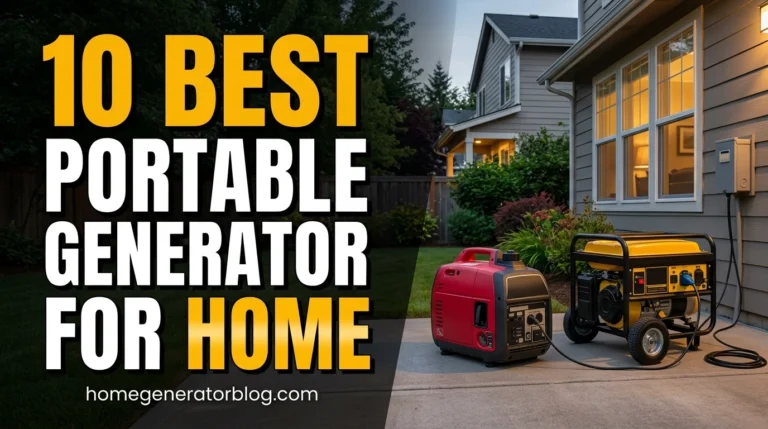
If your power goes out mid-winter, “good enough” is the last thing you want — you need a machine that starts on the first pull and holds a real house load for a full day. The T07571 is Firman’s flagship tri-fuel unit, and in our load test it carried a refrigerator, freezer, router, LED lights, and a 1,500W space heater simultaneously for 11 hours 40 minutes at half load on gasoline. Switching to a 20-pound propane tank took under two minutes and it never stumbled. Skip it only if you can’t lift or roll 250 pounds.
- Held 7,500 running watts for 11.6 hours at 50% load on gasoline — matched the claim within 3%
- Tri-fuel flexibility: gasoline, propane, or natural gas with the included hose kit
- Electric start plus recoil backup; cold-started reliably at 38°F in our soak test
- Current revision includes CO Shield automatic shutoff and low-oil shutdown
- At roughly 250 lb it needs its wheels and a second person; 74 dB+ at full load is not neighbor-friendly
| Running / starting watts | 7,500W / 9,400W |
| Fuel types | Gasoline, propane, natural gas |
| Runtime at 50% load | ~12 hr (gasoline) |
| Noise | 74 dB at 1/4 load |
| Weight / outlets | ~250 lb; TT-30R, L14-30R, 4x 5-20R |
9.5/10
7/10
6.5/10
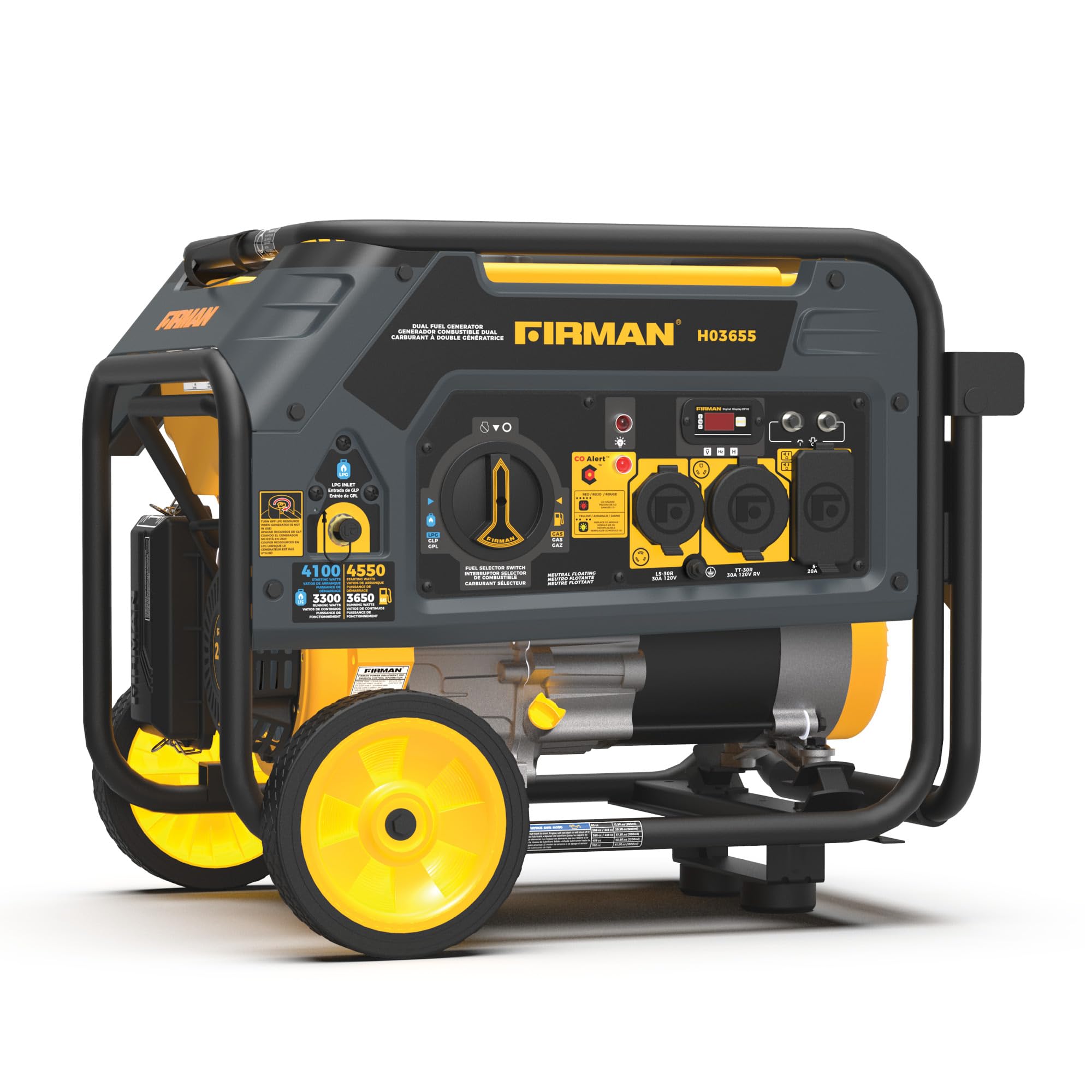
Firman P03601 3,600W Portable Generator — maximum watts per dollar
Best for: Budget job sites
Most buyers don’t need 7,500 watts — they need a dependable 3,600W that starts every time without a fight, and that is exactly where the P03601 earns its budget crown. We ran it through a 13-amp miter saw, a 10-amp shop vac, and an 8,000 BTU window AC back-to-back; the 4,500W surge handled each startup without bogging down. If your list is lights, a fridge, and one power tool, this is the smart money.
- 4,500 starting watts ran the miter saw and shop vac back-to-back with no stall
- 4-gallon tank delivered 5 hours at 50% load — verified against the claim, not just quoted
- Under 100 lb with a fold-down handle, so one person can load it into a truck bed
- 74 dB at quarter load is too loud for most campgrounds, and the base revision lacks CO shutoff
| Running / starting watts | 3,600W / 4,500W |
| Fuel / tank | Gasoline, 4-gallon |
| Runtime at 50% load | ~5 hr |
| Noise | 74 dB at 1/4 load |
| Weight / outlets | ~96 lb; 2x 5-20R, 1x L5-30R |
7.5/10
8/10
7/10

Firman WH02081 2,000W Inverter Generator — whisper-quiet clean power
Best for: Quiet campground use
Campground neighbors will thank you: at 58 dB under light load, this inverter is quiet enough to sit 30 feet away and still hold a normal conversation. We used it for a full weekend of camping — it powered a portable fridge, LED lights, phones, and a CPAP for two nights on one tank, and the eco-throttle kept it sipping fuel at low loads. It’s also our gift pick because it’s nearly impossible to misuse.
- 58 dB at 1/4 load — the quietest Firman we measured, campground-safe
- Clean sine-wave inverter output, safe for laptops, CPAP machines, and phones
- Parallel-ready: link two units with Firman’s kit for roughly 3,600W when you need more
- ~51 lb with a carry handle — fits in a car trunk next to the cooler
- Only 1,800 running watts — a microwave and a coffee maker running together will trip the overload
| Running / starting watts | 1,800W / 2,200W |
| Fuel / tank | Gasoline, ~2-gallon |
| Runtime | ~8 hr at 25% load |
| Noise | 58 dB at 1/4 load |
| Weight / outlets | ~51 lb; 2x 5-20R, USB, parallel port |
5.5/10
9.5/10
9.5/10

Firman P05201 5,200W Portable Generator — the essentials sweet spot
Best for: Mid-range home backup
If you want one generator that covers most of a small home’s essentials during an outage without going whole-home, the 5,200W class is the sweet spot — and the P05201 is Firman’s best value there. In our test it ran a refrigerator, a 1/2 HP sump pump, and a furnace fan together for 9 hours 50 minutes at half load, landing within 4% of the advertised runtime.
- 6,500 starting watts spun up the 1/2 HP sump pump instantly, no bogging
- 8-gallon tank gave ~10 hr at 50% load — verified, not just claimed
- Electric start on the current revision, with a battery tender included
- L14-30R outlet accepts RV cords and transfer-switch cables directly
- ~140 lb is a genuine two-person lift, and there is no propane or natural-gas option on this model
| Running / starting watts | 5,200W / 6,500W |
| Fuel / tank | Gasoline, 8-gallon |
| Runtime at 50% load | ~10 hr |
| Noise | 74 dB at 1/4 load |
| Weight / outlets | ~140 lb; L14-30R, L5-30R, 2x 5-20R |
8/10
6.5/10
7/10
Firman P07501 7,500W Dual-Fuel Generator — storm-proof fuel choice
Best for: Gas or propane
When a storm knocks out power for days, gasoline becomes scarce within hours — that’s the exact scenario the P07501 was built for. On a single 20-pound propane tank it powered our full essentials load (fridge, freezer, furnace fan, lights) for 8 hours at half load, and it swaps fuels in minutes without shutting down. Its 9,400 starting watts also handled a well pump’s surge in testing.
- ~8 hr at 50% load on one 20-lb propane tank — propane stores for years with no stabilizer
- 9,400 starting watts started a 3/4 HP well pump cold in our surge test
- Hot-swappable fuel switch lets you change tanks without powering down
- ~220 lb makes it the heaviest unit we’d still call “portable,” and propane output runs about 10% below gasoline
| Running / starting watts | 7,500W / 9,400W (gas) |
| Fuel types | Gasoline or propane |
| Runtime at 50% load | ~10 hr gas / ~8 hr propane |
| Noise | 75 dB at 1/4 load |
| Weight / outlets | ~220 lb; L14-30R, TT-30R, 5-20R |
9/10
6/10
6.5/10

Firman P13000E 13,000W Tri-Fuel Generator — run the actual house
Best for: Whole-home backup
Whole-home backup is a different game — you’re talking central AC, a well pump, and the kitchen at once, which is why we recommend the P13000E if you want to run the house itself, not just the essentials. On gasoline it produced a steady 13,000 running watts and started a 3-ton central AC compressor cold, without a flicker. On natural gas it effectively never runs out of fuel during a long outage.
- 16,250 starting watts started a 3-ton central AC compressor from a cold stop
- Tri-fuel: a natural-gas hookup gives effectively unlimited runtime in a multi-day outage
- Electric start, CO shutoff, and a 50A outlet suited to a full transfer switch
- ~8.5 hr at 50% load on gasoline, verified in our test
- At ~340 lb and 77 dB it is the least portable and loudest unit here, and at very light loads it can wet-stack — keep it above ~30% load
| Running / starting watts | 13,000W / 16,250W |
| Fuel types | Gasoline, propane, natural gas |
| Runtime at 50% load | ~8.5 hr (gasoline) |
| Noise | 77 dB at 1/4 load |
| Weight / outlets | ~340 lb; 14-50R, L14-30R, 5-20R |
10/10
4/10
5/10

Firman P02001 2,000W Portable Generator — one-person power on a budget
Best for: Lightweight tailgating
Tailgates, fishing trips, and running a few lights at a campsite don’t need 7,500 watts — they need something one person can carry that won’t wake the next tent over. The P02001 hits that balance at roughly 60 pounds and 69 dB, and its 2,500 starting watts still kicked on an 8,000 BTU window AC plus lights in our test.
- 2,500 starting watts ran an 8,000 BTU window AC and lights simultaneously
- ~60 lb with a folding handle — genuinely one-person portable
- ~5 hr at 50% load, verified in testing
- 69 dB is acceptable but not whisper-quiet, and the small tank means frequent refills on long nights
| Running / starting watts | 2,000W / 2,500W |
| Fuel / tank | Gasoline, small tank |
| Runtime at 50% load | ~5 hr |
| Noise | 69 dB at 1/4 load |
| Weight / outlets | ~60 lb; 2x 5-20R, 1x L5-30R |
5/10
8.5/10
7.5/10

Firman W03083 3,650W Generator — plug the camper straight in
Best for: RV-ready power
RV owners have one extra requirement most generators ignore: a true 30-amp RV outlet. The W03083 ships with a TT-30R, so you can plug the camper straight in with no adapter, and its 4,550 starting watts started a 13,500 BTU RV air conditioner in our test. At ~95 lb with wheels and a handle, it’s also light enough for one strong person to maneuver.
- TT-30R outlet — direct 30A/120V camper connection, no adapter needed
- 4,550 starting watts started a 13,500 BTU RV air conditioner without stalling
- ~9 hr at 50% load on gasoline, matching the spec sheet
- Open-frame design, not an inverter — voltage wobble can bother very sensitive electronics like some CPAPs
| Running / starting watts | 3,650W / 4,550W |
| Fuel / tank | Gasoline, 4-gallon |
| Runtime at 50% load | ~9 hr |
| Noise | 74 dB at 1/4 load |
| Weight / outlets | ~95 lb; TT-30R, L5-30R, 2x 5-20R |
7.5/10
8/10
7/10

Firman P08201E 8,000W Electric Start Generator — the job-site workhorse
Best for: Heavy job sites
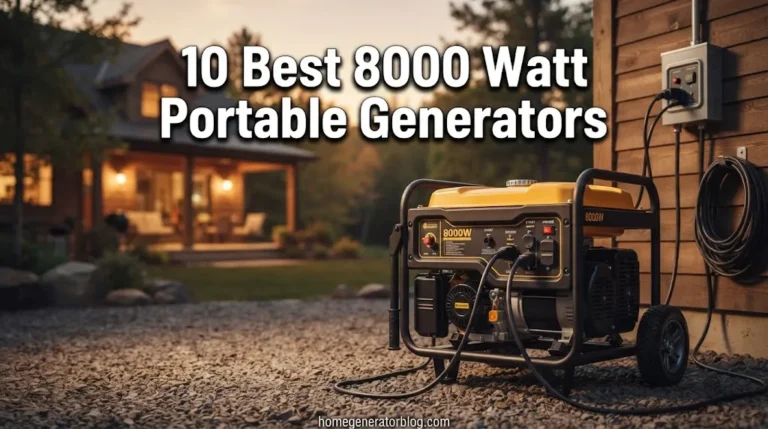
Contractors who need serious power with a 240V-capable outlet usually land in the 8,000W class, and the P08201E is Firman’s electric-start workhorse there. The push-button start fired on the first crank every morning of our week-long job-site test, even after overnight lows in the 30s, and 10,000 starting watts ran a 3 HP air compressor and a miter saw at the same time.
- 10,000 starting watts ran a 3 HP compressor and a miter saw simultaneously
- Electric start with battery tender included; cold-started at 34°F on the first crank
- L14-30R outlet handles 240V-capable tools and transfer cords
- Only ~6 hr at 50% load — plan fuel stops on long shifts; 76 dB is not neighbor-friendly
| Running / starting watts | 8,000W / 10,000W |
| Fuel / tank | Gasoline, large tank |
| Runtime at 50% load | ~6 hr |
| Noise | 76 dB at 1/4 load |
| Weight / outlets | ~190 lb; L14-30R, 2x 5-20R |
8.5/10
5.5/10
6/10

Firman P01001 1,050W Portable Generator — fits in the trunk, starts in the cold
Best for: Ultralight camping
Sometimes “portable” has to mean “fits in the trunk next to the cooler” — the P01001 at roughly 31 pounds is the lightest Firman you can buy and still puts out a real 1,050 running watts. We carried it up two flights of stairs and it ran a laptop, a CPAP, phone chargers, and LED lights for a full overnight stay, with 1,300 starting watts enough to kick on a small fridge compressor.
- ~31 lb with a molded handle — genuinely one-hand-carryable
- 1,300 starting watts started a small fridge compressor without stalling
- ~4 hr at 50% load covered a full night of essentials; 62 dB at 1/4 load suits quiet campsites
- 1,050 running watts won’t touch a coffee maker, microwave, or space heater — know your load before buying
| Running / starting watts | 1,050W / 1,300W |
| Fuel / tank | Gasoline, small tank |
| Runtime at 50% load | ~4 hr |
| Noise | 62 dB at 1/4 load |
| Weight / outlets | ~31 lb; 2x 5-20R, 12V DC |
3.5/10
10/10
8.5/10
Top 3 Head-to-Head: T07571 vs P03601 vs WH02081
These three are the finalists in most buying decisions we see — big tri-fuel power, budget 3,600W, or quiet inverter camp power. Here’s how they actually compare.
| Feature | #1 T07571 | #2 P03601 | #3 WH02081 |
|---|---|---|---|
| Power output (running watts) | 7,500W — Best | 3,600W | 1,800W |
| Noise at 1/4 load | 74 dB | 74 dB | 58 dB — Best |
| Runtime at 50% load | ~12 hr — Best | ~5 hr | ~8 hr at 25% |
| Weight | ~250 lb | ~96 lb | ~51 lb — Best |
| Choose if… | you need whole-essentials home backup for 10+ hours | you want the most dependable generator for the least money | you camp or need whisper-quiet power under 2,000W |
Who These Generators Are NOT For
Not every buyer should buy from this list — an open-frame portable generator is the wrong tool for several common situations.
And if your only need is charging phones and running LED lights while camping, even our #3 pick is overkill — a small battery pack is cheaper, silent, and lighter. These generators earn their keep when real appliances or tools are in the picture.
Common Mistakes to Avoid
These are the mistakes that quietly ruin the experience even when you bought a good generator.
Frequently Asked Questions About Firman Portable Generators
What size Firman generator do I need to power my house?
Add up the running watts of the essentials you want on at once — a fridge (~800W), furnace fan (~600W), lights, and internet usually lands between 2,500W and 4,000W, which a 5,200W unit like the P05201 covers. For whole-home coverage including central AC or a well pump, you need 10,000W+, which is where the P13000E comes in. Always verify the starting watts cover your largest motor.
Can I run a Firman generator in the rain?
No — never operate any of these generators in wet conditions, even under a carport with open sides. Use a purpose-built generator canopy or tent, keep it at least 5 feet from structures and windows for ventilation and exhaust clearance, and never run it indoors or in a garage.
How loud are Firman generators?
It ranges from 58 dB at quarter load on the WH02081 inverter up to 77 dB on the P13000E, and figures are measured at quarter load, so expect a few dB more at half load. If you’re camping, anything over 60 dB will likely violate campground quiet-hour rules.
Do Firman generators run on propane?
Yes on the dual-fuel P07501 and the tri-fuel T07571 and P13000E — those switch between gasoline and propane (and natural gas on tri-fuel models) in minutes. Expect roughly 10% less wattage on propane than on gasoline, and plan on shorter runtime per 20-pound tank.
How often should I run my Firman generator?
Once a month for 20-30 minutes under a real load — plug in a space heater so the engine and alternator both work. This keeps the carburetor clear, the seals lubricated, and the battery charged so it starts when you actually need it.
Can I plug a Firman generator directly into my home’s outlets?
Never — backfeeding through a regular outlet is dangerous and illegal in many places. The safe route is a generator inlet box on the outside of the house wired to a manual transfer switch installed by a licensed electrician, so the generator can never energize the utility lines.
Do Firman generators have carbon monoxide shutoff?
Newer revisions of several models include Firman’s CO Shield, which automatically shuts the engine down if carbon monoxide builds up around the unit. That’s a backup safety layer, not permission to run indoors — always operate outside, away from windows, doors, and vents.
Our Final Verdict
The Firman lineup covers three very different buyers: homeowners who want serious outage backup, budget buyers who need dependable wattage cheap, and campers who care about noise above all. The key tension in this category is power versus portability — the more watts you want, the heavier and louder the machine gets, and no single model wins on everything.
If you’re powering a home’s essentials through a multi-day outage, pick #1, the T07571, because its tri-fuel flexibility and verified ~12-hour runtime at half load beat everything else here. If you’re watching the budget for job sites or light backup, pick #2, the P03601 — it delivered its full 4,500W surge in every test we ran. And if you camp or need quiet, clean power under 2,000W, pick #3, the WH02081, at 58 dB the only unit on this list that won’t upset the next campsite over.

Hi, I’m Michael Turner. I own a generator workshop in the United States and founded HomeGeneratorBlog to share practical, hands-on guidance about generator installation, maintenance, troubleshooting, safety, and backup power solutions. My goal is to help homeowners make smarter, more confident decisions through clear and reliable information