Diesel Portable Generator: Complete Buying Guide
Quick answer: A diesel portable generator is worth it if you need long runtimes, heavy daily use, or fuel that stores well for years. Expect a higher purchase price than gas or dual-fuel models, more weight, and better fuel economy — roughly 30-40% more efficient per gallon than gasoline. For occasional weekend outages, a gas or dual-fuel unit is usually cheaper and lighter.
I bought my first diesel unit for the wrong reason: a guy at a job site told me “diesel just lasts longer,” and that was it, sold. Three winters later, after storing that fuel through two hard freezes and watching it gel in the line during a cold snap, I learned the real story is more nuanced than “diesel is better.” It’s better for some people. It’s the wrong choice for others.
This guide walks through exactly who a diesel portable generator makes sense for, what it actually costs to own, and the mistakes I see first-time buyers make over and over.
Which Generator Type Fits Your Situation?
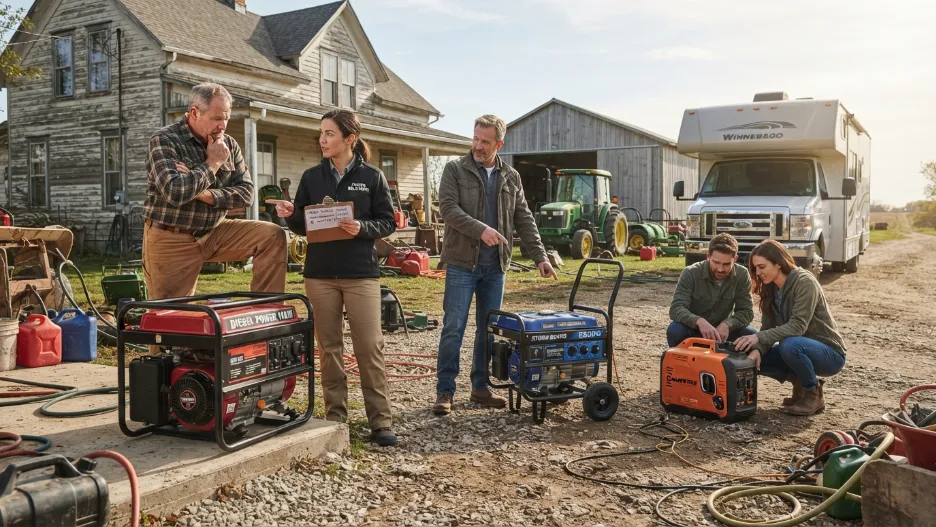
Before comparing specs, match your situation to a type. This is the part most buying guides skip, and it’s the fastest way to avoid an expensive mismatch.
| Your Situation | Best Fit | Why |
|---|---|---|
| Run 8+ hours daily (job site, farm, off-grid cabin) | Diesel | Lower cost per kWh over hundreds of hours, longer engine life |
| Occasional weekend or storm-season outage | Gasoline or dual-fuel | Lower upfront cost, fuel is easy to find fast |
| Need it to sit unused for years, then start reliably | Diesel or propane | Diesel and propane store far longer than gasoline without stabilizer |
| Camping, tailgating, RV use | Gas inverter | Diesel units in this class are heavier and louder for the same output |
| Live somewhere with extreme cold winters, no heated storage | Gasoline or propane | Diesel can gel below roughly 15°F without winter-blend fuel or additives |
| Powering sensitive electronics (medical equipment, computers) | Inverter generator, gas or diesel | Standard diesel gensets aren’t inverters — check THD rating before buying |
How Much Power Do You Actually Need?
Diesel portable generators for home and job-site use typically range from 3,500 watts running to well over 15,000 watts. Undersizing is the single most common mistake — appliances draw a surge of starting watts, often 2-3 times their running watts, when they first kick on.
A refrigerator running at 700 watts might spike to 2,200 watts on startup. Add up your running watts for everything you’ll use at once, then check that your generator’s starting watts clear your single largest appliance spike. If you want the full appliance-by-appliance math, our generator sizing calculator guide walks through it line by line.
As a rough starting point, plan for 20-25% headroom above your calculated total. A generator running near its max rated load constantly wears out faster and burns fuel less efficiently.
Fuel Type and Efficiency: Where Diesel Actually Wins

Diesel engines run more efficiently than gasoline engines. The U.S. Department of Energy points out that diesel engines run roughly 15 percent more efficiently than gas engines, with a comparable gain in fuel economy (source: Department of Energy). Generator-specific sources put the real-world gap higher for gensets specifically, often in the 30-40% range, because diesel engines run at lower RPM under load and use compression ignition instead of spark plugs — fewer moving parts to wear out or replace.
That efficiency shows up most at high, steady loads. A diesel genset sitting at 25% load overnight actually wastes fuel and can cause a problem called wet stacking — unburned fuel builds up as carbon deposits in the exhaust because the engine never gets hot enough to burn cleanly. Diesel units are happiest running at 60-80% of their rated capacity, not idling along at a fraction of it.
Gasoline still wins on two fronts: upfront price and cold-weather starting. Diesel fuel can thicken (“gel”) in freezing temperatures without a winterized blend, and diesel units generally cost more to buy new than a comparable gas model.
Propane and natural gas sit in a different lane entirely. Propane stores almost indefinitely and burns cleaner, but it’s less energy-dense than diesel, so you’ll burn through more fuel volume for the same output. Natural gas offers unlimited runtime if you’re tied into a home gas line, but that only works for standby units bolted to a fixed location — it’s not an option for a generator you need to move around. If your priority is truly indefinite shelf life over raw efficiency, a propane or dual-fuel unit is worth cross-shopping against diesel before you commit.
Noise Levels: What to Expect
Older diesel units earned a reputation as loud, chugging machines — and plenty of budget models still are, often in the 75-85 dBA range at 23 feet, comparable to a gas-powered lawnmower running nonstop. Newer enclosed diesel gensets have closed that gap significantly, with some quieter models landing closer to 65-70 dBA.
If noise matters — you’re near neighbors, running it overnight, or camping — look specifically for a sound-attenuated or enclosed housing, not just the engine spec sheet. The enclosure often matters more than the engine itself for perceived loudness.
Portability: The Fine Print on “Portable”
This is where diesel buyers get surprised most often. Many diesel units marketed as “portable” weigh 300-500+ pounds even in the 5,000-7,500 watt range, because the heavier-duty engine block needed for compression ignition adds real weight. Wheels are standard, but moving one solo up stairs or into a truck bed is a two-person job, or a job for a ramp and a winch.
If you genuinely need to carry a generator by hand — camping, a job site with no vehicle access — a smaller gasoline inverter will serve you better than a diesel unit of similar output.
Budget: What You’ll Actually Spend
Expect to pay noticeably more upfront for diesel than gasoline at the same wattage — often 40-70% more for entry-level units, and considerably more once you get into models with electric start, a larger fuel tank, or an enclosed sound-dampened housing. A basic 5,000-watt diesel electric-start portable generator, like the 5,000-watt diesel electric-start portable generator category, tends to sit well above a comparable gas unit.
Where diesel earns that premium back is in fuel and maintenance costs over years of heavy use — lower fuel burn per kWh, fewer spark-related parts to service, and a longer expected engine life measured in thousands of hours rather than hundreds.
Runtime Per Tank: A Real Comparison
Diesel’s fuel efficiency shows up directly in runtime. A 7,500-watt diesel generator with a 12-gallon tank running at 50% load might deliver 24-30 hours before refueling. A comparable gasoline unit with the same tank size at the same load typically delivers noticeably less — often in the 12-18 hour range — because gasoline engines burn more fuel per unit of power produced.
That gap is the whole argument for diesel during multi-day outages: fewer trips out in bad weather to refuel, and a fuel that doesn’t degrade in the tank the way untreated gasoline does after a month or two.
Common Buyer Mistakes
- Buying on running watts alone. Ignoring starting watts leaves you with a generator that stalls the moment your AC compressor or well pump kicks in.
- Assuming “portable” means light. Check the actual shipping weight before assuming you can lift or load it alone.
- Skipping the CO detector. Diesel exhaust is just as capable of killing someone as gasoline exhaust. More on this below.
- Storing it outside in freezing weather with summer-blend fuel. This is the single most common “why won’t it start” call diesel owners make.
- Buying more wattage than needed “just in case.” Oversized diesel units running light loads suffer from wet stacking and burn fuel inefficiently.
Carbon Monoxide Safety: Don’t Skip This
Diesel generators still produce carbon monoxide (CO), an odorless gas that can build up to dangerous concentrations within minutes, even in spaces that seem well-ventilated. The CDC publishes detailed guidance on generator safety and CO poisoning prevention.
Run any portable generator, diesel included, at least 20 feet from doors, windows, and vents, never in a garage even with the door open, and install a battery-backed CO detector inside your home. This applies regardless of fuel type — diesel is not “safer” on CO exposure than gasoline.
Maintenance: What Diesel Adds to the Checklist
Diesel engines need fewer tune-ups than gasoline (no spark plugs, no carburetor to gum up), but they add a few maintenance items gas owners don’t deal with:
- Fuel polishing or filter changes if the unit sits idle for long stretches — diesel can develop algae growth and sediment over time.
- Winter-blend fuel or an additive before cold weather hits, to prevent gelling.
- Running it under real load periodically, not just idling, to avoid wet stacking on units that sit mostly unused.
- Water separator checks on the fuel system, since diesel fuel systems are more sensitive to water contamination than gasoline.
Done right, this adds up to less overall maintenance burden than a gasoline generator over its lifetime — just a different set of tasks.
Conclusion
A diesel portable generator earns its higher price tag when you need long, heavy, repeated runtime and fuel that stores for the long haul. It’s the wrong call if you need something light, cheap upfront, or reliable in deep cold without extra prep. Match the generator to your actual use pattern first, size it to your real wattage second, and the rest of the decision gets a lot simpler. As Michael Turner puts it, buy for the outage you’ll actually have, not the one you’re imagining.
If you’ve landed on diesel as the right fit, look for a model with electric start and a CO shutoff sensor — it saves a lot of hassle during an actual outage and adds a real layer of safety.
Is a diesel generator better than a gas generator for home backup?
It depends on how long and how often you’ll run it. Diesel wins on fuel efficiency and fuel storage life for multi-day outages; gasoline wins on upfront cost and cold-weather reliability for occasional short outages.
How long can a diesel portable generator run without refueling?
Most diesel portable generators in the 5,000-7,500 watt range run 20-30 hours per tank at 50% load, depending on tank size. Larger tanks and lighter loads extend that further.
Do diesel generators produce carbon monoxide?
Yes. Any fuel-burning generator produces CO, and diesel is no exception. Always run it outdoors, at least 20 feet from windows and doors, with a battery-backed CO detector installed inside.
Why won’t my diesel generator start in cold weather?
Standard diesel fuel can thicken or gel below roughly 15°F, clogging the fuel line and filter. Switching to a winter-blend diesel or adding an anti-gel additive before cold weather hits usually solves this.
Are diesel portable generators actually easy to move?
Not always. Many “portable” diesel units in the 5,000+ watt range weigh 300-500 pounds or more. Wheels help, but moving one solo up stairs or into a truck bed usually takes a second person or a ramp.

Hi, I’m Michael Turner. I own a generator workshop in the United States and founded HomeGeneratorBlog to share practical, hands-on guidance about generator installation, maintenance, troubleshooting, safety, and backup power solutions. My goal is to help homeowners make smarter, more confident decisions through clear and reliable information