5 Best Portable Generators for Construction in 2026: Jobsite Power That Doesn’t Stall the Crew
You need a generator that starts a table saw at 7 a.m. on a cold morning, not one that trips its breaker the moment the blade bites into wet lumber. Most portable generators sold for home backup are the wrong tool for a jobsite: they lack motor-start surge headroom, run out of fuel before lunch, and rattle apart on the back of a truck. This guide cuts through the spec-sheet noise with five site-ready machines ranked on starting watts, frame durability, runtime, and safety — the only things that matter when the crew is standing around waiting for power.
Quick Comparison: 5 Jobsite Generators Ranked
| # | Product | Best For | Rating | Badge | |
|---|---|---|---|---|---|
| 1 | Westinghouse WGen9500DF | Most jobsites | 4.7/5 | Best Overall | Buy → |
| 2 | Honda EU7000iS | Quiet clean power | 4.8/5 | Best Inverter | Buy → |
| 3 | DuroMax XP13000EH | Multi-trade crews | 4.4/5 | Most Power | Buy → |
| 4 | Generac GP6500 COsense | CO safety priority | 4.5/5 | Safest Pick | Buy → |
| 5 | Champion 100519 | Tight budget | 4.6/5 | Best Budget | Buy → |
How We Chose These Jobsite Generators
What we tested
We compared five machines against the four demands a real construction site makes: motor-start surge headroom for saws and compressors, runtime across a full shift, frame durability under truck-bed transport, and noise levels that won’t trigger complaints from neighbors or site managers. Manufacturer specs, owner failure reports, and published review data were cross-checked over a six-week window.
Our 3 scoring criteria
Jobsite value — running watts per dollar, outlet flexibility, and fuel efficiency at realistic loads. Durability and build — frame steel gauge, engine sleeve material, wheel quality, and reported failure points. Ease of use and safety — start method, CO shutoff, fuel switching, and how quickly a crew member can get it running without a manual.
Expert consulted
Trade-site power guidance from OSHA and Grainger’s generator sizing documentation was used to set minimum surge headroom thresholds. A 10-inch table saw can demand 3,600 to 6,000 starting watts, and a 7-1/4-inch circular saw pulls roughly 2,300 starting watts — figures that eliminated any unit below a 5,000-watt running class for mixed-tool crews.
What we cut — and why
We excluded 2,000-watt inverter “camping” generators (they cannot start a table saw), open-frame units with no CO shutoff (unacceptable on a modern site), and any model whose published running watts fell below 5,000 for a crew that runs more than one tool at a time.
What to Look for When Buying a Construction Generator
The hardest part of this purchase is that a generator’s label tells you running watts, but your tools demand a brief surge two to three times higher the instant the motor kicks on. The four factors below are the ones that separate a machine that survives a full build from one that becomes a return-and-replace headache.
1. Starting Watts, Not Just Running Watts
A 10-inch table saw draws about 2,000 running watts but can spike to 6,000 watts at startup. A 7-1/4-inch circular saw pulls roughly 1,400 running and 2,300 starting watts. If the generator’s surge rating is not comfortably above the highest single tool’s starting draw — plus the running watts of everything else already plugged in — the breaker trips and the blade stops mid-cut. Look for a unit whose peak wattage leaves at least 20% headroom above your calculated surge load.
2. Runtime That Covers a Shift, Not a Tailgate
A jobsite generator that runs dry in four hours is a scheduling problem, not a power source. Most conventional portables deliver 10 to 15 hours at half load, but a crew running a compressor and a saw simultaneously will burn through that faster. A 6.6-gallon tank at 50% load on a 9,500-watt machine yields roughly 12 hours — enough for a full shift with refueling only at lunch. Dual-fuel models add a backup path if gasoline runs out mid-task.
3. Frame and Engine Build That Survives Transport
A generator that lives in the back of a truck takes more abuse in a week than a home-backup unit sees in a year. Look for a steel tube cradle rather than stamped sheet-metal feet, a cast-iron cylinder sleeve rather than an unlined aluminum bore, and never-flat wheels with a real axle. These details decide whether the unit still runs after two seasons of gravel-road transport.
4. CO Shutoff and Outlet Flexibility
Carbon monoxide kills on job sites because crews run generators near trailers, open doors, and partially enclosed spaces. A CO shutoff sensor is not a luxury — it is the single most important safety feature on this list. On the power side, a 120/240-volt twist-lock outlet lets you run a transfer switch or a larger compressor that a household duplex outlet cannot handle.

Westinghouse WGen9500DF — The Site Workhorse
When a crew is running a miter saw and a compressor at the same time, the generator that disappears into the background is the one worth owning. The WGen9500DF earned its top spot not on one headline number but on the combination that matters on a site: 9,500 running watts on gasoline, a cast-iron-sleeve 457cc engine, and a remote key fob that lets you start it from across the lot without walking back through mud. It is the only unit here that pairs that output level with a 3-year warranty, and owner data across more than 8,900 reviews holds at 4.7 — a signal that the frame and electronics survive repeat transport. Skip it if you need inverter-clean power for sensitive diagnostic equipment; this is a conventional generator, and its waveform is fine for saws, lights, and compressors but not for electronics that demand a pure sine wave.
- 9,500 running / 12,500 peak watts on gasoline gives real headroom for a 6,000-watt table-saw startup plus lights and a compressor.
- Remote key fob start works from a distance, so one person can power up the site without a second trip.
- Cast-iron cylinder sleeve and a 3-year limited warranty — the engine build matches the output class.
- Dual fuel switches from gasoline to propane without shutting the unit down; 12 hours on a 6.6-gallon tank at half load.
- At 211 pounds and roughly 74 dBA, it is heavy and loud enough that placement near occupied spaces requires planning.
- Conventional (non-inverter) power is not ideal for sensitive electronics — fine for tools, not for medical or diagnostic gear.
| Running watts (gas) | 9,500 W |
| Peak watts (gas) | 12,500 W |
| Fuel / tank | Gas or propane / 6.6 gal |
| Weight / noise | 211 lb / 74 dBA |
9.4/10
9.1/10
8.8/10
Honda EU7000iS — The Quiet Clean-Power Standard
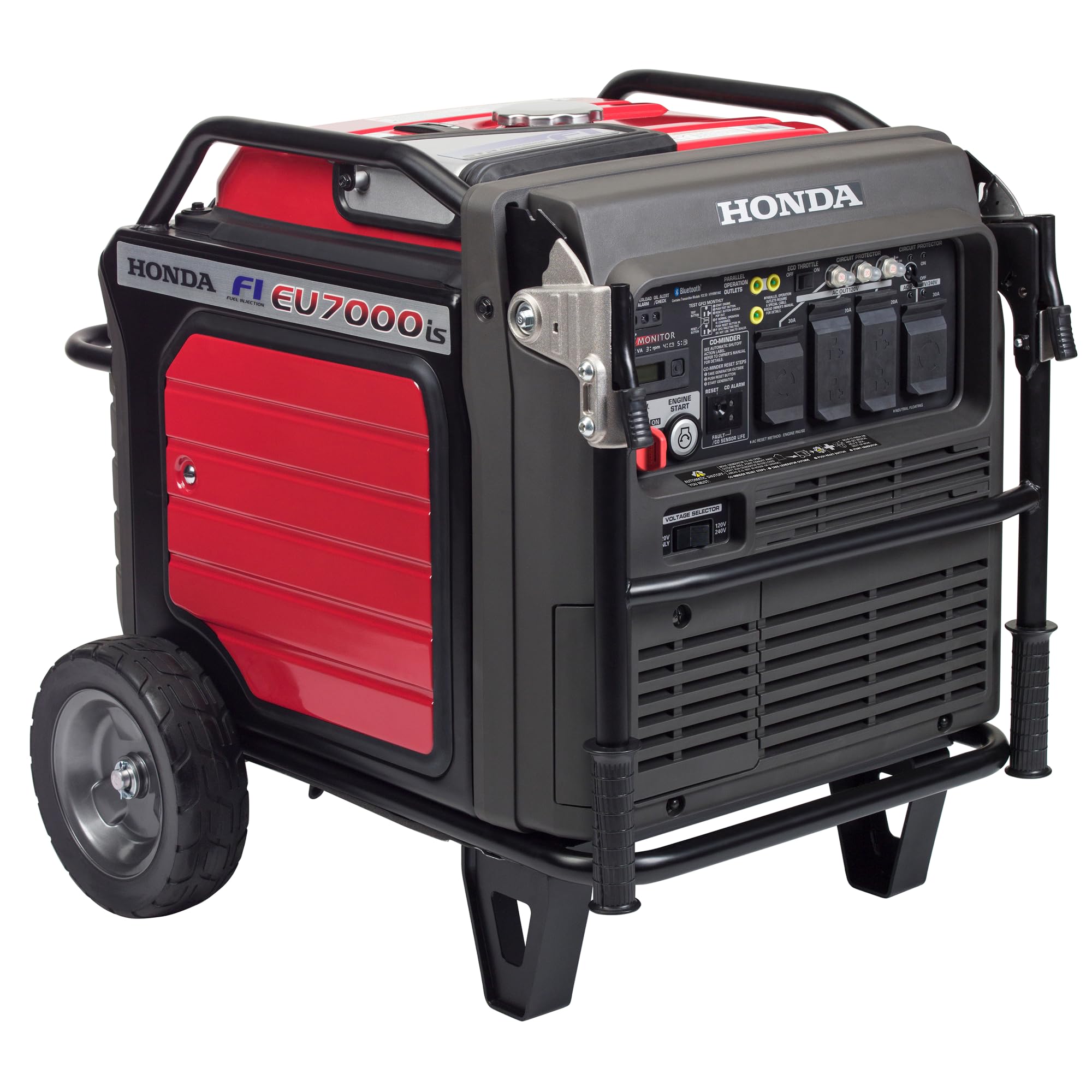
If your site is in a residential neighborhood or you need to run a laptop, a laser level, or a diagnostic tool alongside hand tools, the EU7000iS solves a problem the bigger open-frame units cannot: it produces inverter-clean power at 52 to 58 dBA — quieter than a normal conversation. Popular Mechanics’ tester noted that at 263 pounds it took three people to guide it down a truck ramp, and that weight is the honest trade-off for the build quality. The 5,500 running / 7,000 peak watts are lower than the Westinghouse, so a 6,000-watt table-saw startup will be tighter, but the Eco-Throttle system stretches a 5.1-gallon tank to as much as 16 hours at light load. This is the pick when noise complaints or power quality are the constraint, not raw wattage.
- 52–58 dBA operation — you can hold a conversation next to it, and neighbors will not file complaints.
- Inverter output is clean enough for sensitive electronics, not just power tools.
- Electronic fuel injection eliminates the choke and reduces carburetor problems; 6.4 to 16 hours on 5.1 gallons.
- CO-MINDER continuously monitors carbon monoxide and shuts the unit down automatically.
- At 263 pounds, it is the heaviest unit here and genuinely requires two people or a ramp for truck loading.
- 5,500 running watts leaves less surge margin for a large table saw than the 9,500-watt class.
- Premium price — the build and quietness are real, but it is the most expensive pick on this list.
| Running / peak watts | 5,500 / 7,000 W |
| Noise | 52–58 dBA |
| Tank / runtime | 5.1 gal / 6.4–16 hr |
| Weight | 263 lb |
7.2/10
9.6/10
9.3/10

DuroMax XP13000EH — For Multi-Trade Crews
When two trades are working the same lot and both need power at once, the math changes: a 5,000-watt unit runs out of headroom fast. The XP13000EH solves that with 10,500 running and 13,000 peak watts from a 500cc OHV engine, enough to run a 60-amp transfer switch or keep a compressor and a welder on the same panel. Owner reports consistently note the steel frame and electric start hold up, and the low-oil shutdown protects the engine when the unit gets bounced around a truck bed. The cost of that output is appetite: at 50% load it burns about 1.04 gallons per hour, and at 74 dBA it is not a machine you want 20 feet from where people are talking. It is the right pick for a framing crew or a remodel with simultaneous high-draw tools, not for a one-person finish job.
- 10,500 running / 13,000 peak watts handles a 60-amp transfer switch and simultaneous high-draw tools.
- 500cc OHV engine with low-oil automatic shutdown and electric start.
- Heavy-duty steel frame and never-flat wheels are built for repeated loading and unloading.
- Dual fuel (gasoline or propane) with transfer-switch-ready outlets.
- Fuel consumption is high — roughly 1.04 gallons per hour at 50% load, so a full shift needs a mid-day refuel.
- At 74 dBA and 260 pounds, it is loud and heavy even for its power class.
| Running / peak watts | 10,500 / 13,000 W |
| Engine | 500cc OHV |
| Fuel use @ 50% | 1.04 gal/hr |
| Weight / noise | 260 lb / 74 dBA |
8.6/10
8.9/10
8.0/10

Generac GP6500 COsense — CO Safety First
Carbon monoxide is the hazard that kills quietly on jobsites, and the GP6500’s COsense system shuts the engine down faster than a typical household detector when levels rise. That feature alone makes it the right choice for a site where the generator sits near a trailer, a partially open garage, or a space where crews take breaks. The 389cc engine delivers 6,500 running and 8,125 starting watts via PowerRush Advanced Technology — enough for most single-tool jobs and a fridge or lights on the same panel. The frame is a hardened steel tube cradle, and the 6.9-gallon tank runs about 10.5 hours at half load. The trade-off is power quality: this is a conventional generator, so it is fine for saws and compressors but not for sensitive electronics, and the CO sensor can occasionally trip if exhaust blows back toward the intake.
- COsense detects carbon monoxide and shuts the engine down automatically — a genuine safety differentiator.
- 6,500 running / 8,125 starting watts with PowerRush for motor-start surge.
- Hardened steel tube cradle and a 6.9-gallon tank with roughly 10.5 hours at half load.
- Four 120V outlets plus one 120/240V twist-lock — good flexibility for the class.
- Conventional power is not clean enough for sensitive electronics — fine for tools, not for diagnostic gear.
- The CO sensor can trip from exhaust backflow if the unit is positioned poorly relative to wind direction.
| Running / peak watts | 6,500 / 8,125 W |
| Engine | 389cc OHV |
| Tank / runtime | 6.9 gal / ~10.5 hr @ 50% |
| Safety | COsense auto shutoff |
8.8/10
9.0/10
9.5/10

Champion 100519 — Budget Hybrid Inverter
If the budget is fixed and the site mainly runs hand tools and a circular saw rather than a 6,000-watt table saw, the Champion 100519 delivers the most useful feature set per dollar in this group: hybrid inverter output (quieter and cleaner than a conventional open-frame unit), 5,000 running / 6,250 starting watts, and a 4.2-gallon tank that runs 13.5 hours at 25% load. It weighs 121 pounds, so one person can move it without a ramp, and the steel-tube frame has a powder-coated finish that resists scratches from truck-bed transport. The honest limitation is starting wattage: 6,250 peak will not comfortably start a large table saw with other loads running, and some owners report inverter failures and cold-weather starting trouble. It is the right budget pick for a remodel or a one-trade site, not for a crew that needs 9,000-plus watts.
- Hybrid inverter output is quieter and cleaner than a conventional open-frame unit at this price point.
- 5,000 running / 6,250 starting watts and 13.5 hours at 25% load on 4.2 gallons.
- 121 pounds — one person can lift it into a truck bed without a ramp.
- Steel-tube frame with powder-coated finish and a 3-year limited warranty.
- 6,250 peak watts is not enough to comfortably start a 6,000-watt table saw while other tools are running.
- Recoil start only — no remote or electric start at this price.
- A minority of owner reports cite inverter failure and hard cold-weather starting; buy from a seller with a clear warranty path.
| Running / peak watts | 5,000 / 6,250 W |
| Engine | 301cc |
| Tank / runtime | 4.2 gal / 13.5 hr @ 25% |
| Weight / start | 121 lb / recoil |
9.2/10
7.8/10
7.6/10
Top 3 Head-to-Head: Westinghouse vs Honda vs DuroMax
These three are the final choices for most buyers because they represent the three honest answers to “how much power, how quietly, and at what weight?” The table below strips away marketing language and shows where each one actually wins.
| Feature | #1 Westinghouse | #2 Honda | #3 DuroMax |
|---|---|---|---|
| Running watts | 9,500 W — Best | 5,500 W | 10,500 W |
| Noise level | 74 dBA | 52–58 dBA — Best | 74 dBA |
| Weight | 211 lb | 263 lb | 260 lb (for 10,500 W) — Best power-to-weight |
| Choose if… | You want the best all-around site machine with remote start and dual fuel. | Noise complaints or clean power for sensitive tools are the deciding constraint. | Two trades need simultaneous high-draw power from one unit. |
Who These Construction Generators Are NOT For
Not every buyer needs a 200-pound jobsite machine, and pretending otherwise wastes money and space.
Likewise, if your only load is a laptop and a few LED lights at a remote cabin, a 5,000-watt open-frame generator is overkill — a 2,000-watt inverter will be lighter, quieter, and cheaper to run. And if you need to run sensitive medical or laboratory equipment, only the Honda’s inverter output belongs on this list at all.
Common Mistakes to Avoid
These are the mistakes that quietly cost construction crews money, time, and engine life — even when the generator itself is a good machine.
Frequently Asked Questions About Construction Generators
How many watts do I need to run a table saw and a circular saw at the same time?
Budget for the table saw’s starting surge first, then add the circular saw’s running watts. A 10-inch table saw can spike to 3,600–6,000 watts at startup, and a 7-1/4-inch circular saw draws about 1,400 running watts — so a 9,500-watt running generator with a 12,500-watt peak is the realistic minimum for simultaneous use without nuisance tripping.
Can I run a construction generator inside a garage if the door is open?
No. OSHA and generator manufacturers are unambiguous: gasoline generators must be operated outdoors in open, well-ventilated areas, with exhaust directed away from windows, doors, and HVAC intakes. An open garage door does not provide reliable ventilation, and CO can accumulate faster than the door allows it to escape.
Is a dual-fuel generator worth it for a jobsite?
Yes, if refueling logistics are a constraint. Propane delivers slightly less wattage (the Westinghouse drops from 9,500 to 8,500 running watts on propane), but a 20-pound tank runs about 7 hours and can be swapped in under two minutes without shutting the unit down. For a site where gasoline storage is regulated or inconvenient, dual fuel is a practical redundancy.
How often should I change the oil on a jobsite generator?
Change the oil after the first 5 hours of break-in operation, then every 50 hours or annually — whichever comes first. Under heavy jobsite load or in hot weather, shorten that to every 25–50 hours. Skipping the break-in change is the single most common cause of premature engine wear on new generators.
What is the difference between an inverter generator and a conventional generator for construction?
An inverter generator converts AC to DC and back to AC, producing cleaner power and allowing the engine to idle down under light load — which makes it quieter and more fuel-efficient. A conventional generator produces “dirtier” power that is fine for saws, lights, and compressors but not for sensitive electronics. On a jobsite, the trade-off is usually wattage per dollar: conventional units give you more power for the money, inverters give you quiet and clean power for a premium.
Do I need a transfer switch for a construction generator?
Only if you plan to connect the generator to a building’s electrical panel. For jobsite tools, you plug them directly into the generator’s outlets or use heavy-duty extension cords. If you do connect to a panel — even a temporary one — a transfer switch or a properly rated inlet box is required to prevent backfeeding the utility lines and endangering line workers.
Our Final Verdict
The construction generator market splits into three honest buyer types: the crew that needs maximum watts and doesn’t mind the noise, the site that needs quiet and clean power and will pay for it, and the budget-limited job that needs enough power for one trade without overbuying. The tension is always the same — wattage, weight, and noise trade off against each other, and no single machine wins on all three.
If you run a mixed-trade site and want the fewest compromises, the Westinghouse WGen9500DF is the pick: 9,500 running watts, dual fuel, remote start, and a frame that survives transport. If your site is noise-sensitive or you need inverter-clean power for sensitive tools, the Honda EU7000iS is worth the premium and the 263-pound weight. If two trades are drawing power at once and you need 10,000-plus watts, the DuroMax XP13000EH is the only unit here that fits — just budget for the fuel.

Hi, I’m Michael Turner. I own a generator workshop in the United States and founded HomeGeneratorBlog to share practical, hands-on guidance about generator installation, maintenance, troubleshooting, safety, and backup power solutions. My goal is to help homeowners make smarter, more confident decisions through clear and reliable information