
Is It Cheaper to Run Propane or Gas in a Generator?
Quick Answer
Gasoline is often cheaper if you buy propane in small cylinders or exchanges, but bulk propane can cost less. The real winner depends on your local fuel price, generator fuel consumption, and electrical load. If you want more background first, see this portable generator fuel system guide.
Propane vs. gas at a glance
- Energy content: One gallon of propane contains about 74% of the energy represented by one gasoline gallon equivalent.
- Gasoline advantage: Gas usually provides more generator output from the same engine.
- Propane advantage: Bulk propane can be inexpensive enough to overcome its lower energy density.
- Small cylinders: Propane exchanges can make propane considerably more expensive than bulk delivery.
- Storage: Propane is easier to keep ready for long periods because it does not degrade like stored gasoline.
My practical rule
- Compare cost per hour using your generator’s actual gasoline and propane consumption rates instead of comparing gallon prices alone.
When people ask me whether propane or gasoline is cheaper in a generator, I never compare the pump prices alone. A gallon of each fuel doesn’t contain the same amount of usable energy.
Fuel source matters too. Bulk propane delivered to a large tank can produce a completely different answer from propane bought through a 20-pound cylinder exchange.
Is Propane or Gas Cheaper to Run in a Generator in 2026?

Either fuel can be cheaper, depending on how you buy propane. Current U.S. price benchmarks show why a simple propane-versus-gas answer can be misleading.
The U.S. Energy Information Administration reported a U.S. regular gasoline average of about $4.071 per gallon for August 31, 2026. You can check current figures through the EIA gasoline and diesel fuel update.
| Fuel benchmark | Approx. price | Energy factor | Approx. cost per GGE | Likely cost winner |
|---|---|---|---|---|
| Regular gasoline | $4.071/gal | 1.00 GGE | $4.07 | Baseline |
| Residential bulk propane | $2.674/gal | 0.74 GGE | About $3.61 | Propane |
| AFDC retail propane benchmark | $3.59/gal | 0.74 GGE | About $4.85 | Gasoline |
The EIA’s latest residential heating-season propane benchmark was about $2.674 per gallon on March 30, 2026, excluding taxes. EIA pauses its weekly residential propane collection outside the heating season, so check its propane price data when making your own comparison.
The Department of Energy’s Alternative Fuels Data Center reported an April 2026 retail propane benchmark of $3.59 per gallon. That source represents a different retail market, which helps explain why propane pricing varies so much.
- Bulk propane: May beat gasoline when you have an economical home delivery price.
- Retail propane: Can become more expensive after adjusting for lower energy content.
- Cylinder exchange: Often carries convenience costs that make propane less attractive for extended generator use.
Why Can Propane Cost Less per Gallon but More to Run?
Propane contains less energy per gallon than gasoline. The Department of Energy lists one gallon of LPG at about 0.74 gasoline gallon equivalent.
You can review the underlying comparison through the DOE Alternative Fuels Data Center fuel properties chart. In simple terms, you generally need more propane volume to supply the same amount of fuel energy.
- One gallon gasoline: Roughly one gasoline gallon equivalent.
- One gallon propane: Roughly 0.74 gasoline gallon equivalent.
- Equivalent energy: Roughly 1.35 gallons of propane represents the energy in one gasoline gallon equivalent.
That gives you a useful break-even shortcut. If gasoline costs $4.07 per gallon, propane would need to cost roughly $3.01 per gallon or less to match gasoline on a simple fuel-energy basis.
Generator efficiency can shift the final number. That’s why the manufacturer’s gallons-per-hour or runtime specification remains more useful than energy content alone.
Does a Generator Produce Less Power on Propane?
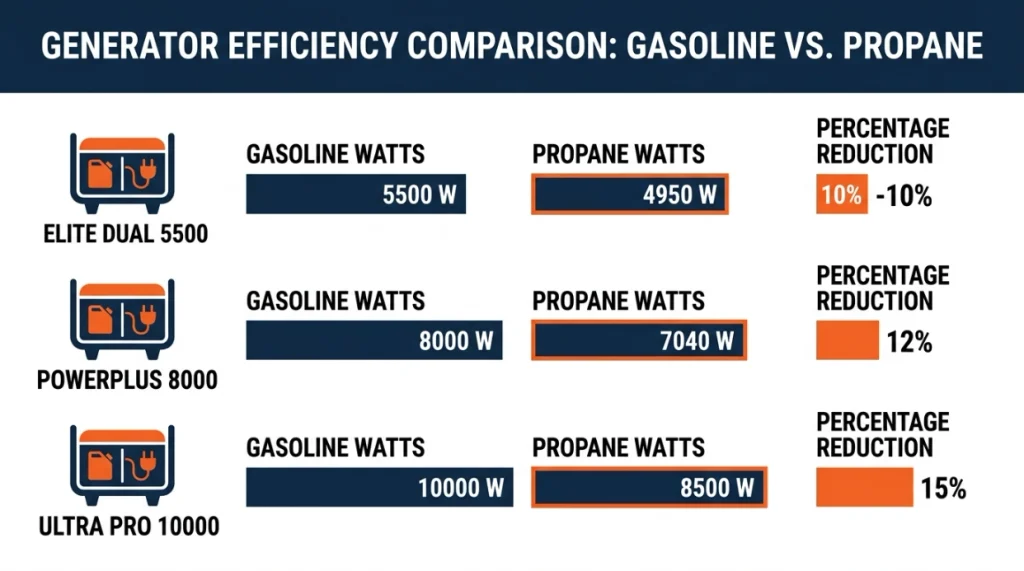
Most dual-fuel generators produce somewhat less rated wattage on propane. The size of the reduction depends on the engine, fuel system, and manufacturer.
I prefer looking at real specifications instead of using one percentage for every machine. These three current dual-fuel examples show the variation.
| Generator | Gas running watts | Propane running watts | Approx. reduction |
|---|---|---|---|
| Westinghouse WGen9500DF | 9,500W | 8,500W | About 10.5% |
| Champion 201281 | 7,500W | 6,750W | 10% |
| DuroMax XP13000EH | 10,500W | 9,975W | 5% |
This lower output doesn’t automatically mean propane costs more per hour. Your generator may still be economical on propane if your local propane price is low enough.
If propane will be your main fuel, my preference is to size the generator using its propane rating. Our propane portable generator guide covers that choice in more detail.
How Do You Calculate Gas vs. Propane Generator Cost?

The most accurate calculation uses your generator’s actual fuel consumption. You need the local price per gallon and the amount burned each hour at your expected load.
- Find gasoline consumption: Check the manual for gallons per hour or divide tank capacity by stated runtime.
- Find propane consumption: Use the manufacturer’s propane runtime at the same approximate load.
- Check local prices: Compare gasoline with the price you actually pay for propane.
- Calculate hourly cost: Multiply gallons burned per hour by price per gallon.
- Compare useful output: Divide hourly fuel cost by the actual kilowatts your generator is supplying.
The first formula is simple: fuel cost per hour = gallons used per hour × price per gallon. This works well when you’re comparing the same generator under the same household load.
For a better comparison, calculate cost per kilowatt-hour = hourly fuel cost ÷ average electrical output in kilowatts. That accounts for generators producing different power on gasoline and propane.
A quick break-even example
Using $4.071 gasoline and DOE’s 0.74 propane energy factor, propane’s simple energy-price break-even point is about $3.01 per gallon. Propane below that level has a fuel-energy cost advantage before generator-specific efficiency is considered.
At $3.59 per gallon, propane works out to roughly $4.85 per gasoline gallon equivalent. That makes $4.071 gasoline cheaper on this specific energy-normalized comparison.
When Is Propane Cheaper for a Generator?
Propane becomes attractive when you can buy it cheaply in bulk. A large stationary tank can change the economics compared with repeated grill-cylinder exchanges.
- Low delivered price: Your propane price falls below the local break-even point.
- Large storage tank: You avoid small-cylinder exchange premiums.
- Long storage periods: You don’t throw away degraded fuel after quiet storm seasons.
- Lower fuel-system maintenance: Propane avoids the stale liquid gasoline left in carburetor bowls.
- Preparedness value: Stored propane remains available when local gas stations lose power or develop long lines.
That last point matters more to me than a few cents per hour during emergencies. The cheapest generator fuel isn’t useful when you can’t get it.
When Is Gasoline Cheaper for a Generator?
Gasoline usually wins when propane comes from expensive small cylinders. It also gives most dual-fuel generators their highest rated wattage.
- Short outages: A few gallons from the pump may be all you need.
- High electrical loads: Gasoline normally provides the generator’s maximum output.
- Cheap local gasoline: Regional pump prices can make the cost gap substantial.
- Small propane cylinders: Exchange pricing can erase propane’s potential bulk-fuel advantage.
If gasoline will be your main fuel, check our gasoline portable generator guide. I would still avoid leaving untreated gasoline sitting in a carburetor for months.
Which Fuel Is Better During a Long Power Outage?
A dual-fuel strategy gives you the most flexibility. You can choose whichever fuel is available, cheaper, or better suited to the load at that moment.
- Use gasoline for maximum output: Helpful when starting well pumps, air conditioners, or other heavy loads.
- Use propane for stored backup: Helpful when gasoline supply becomes difficult.
- Keep both available: One fuel shortage doesn’t leave your generator useless.
- Watch your load: Reducing unnecessary appliances stretches either fuel supply.
That’s the main reason I like a dual-fuel portable generator for emergency home use. You’re buying fuel flexibility, not just another engine feature.
What Other Costs Should You Consider?
Fuel price is only one part of generator ownership. Storage, maintenance, wasted fuel, tank equipment, and available wattage all affect the real cost.
- Fuel stabilizer: Gasoline stored for emergencies may need treatment according to the generator and stabilizer instructions.
- Propane tanks: Larger cylinders or stationary tanks require more upfront equipment.
- Refill convenience: Gasoline can often be purchased faster during normal conditions.
- Fuel waste: Old gasoline may become a maintenance problem if stored improperly.
- Generator sizing: Lower propane wattage may require buying a slightly larger generator.
For current nationwide alternative-fuel benchmarks, the Alternative Fuels Data Center fuel price report is useful. Your local propane supplier and gas stations still give you the numbers that matter most.
Does Propane Make a Generator Safer Indoors?
No portable fuel-burning generator is safe to operate indoors. Propane generators still produce carbon monoxide and require the same serious exhaust precautions.
Generator safety reminder
The U.S. Consumer Product Safety Commission says portable generators should be used outside, at least 20 feet from the home, with exhaust directed away from buildings. See the CPSC carbon monoxide safety guidance before operating any portable generator.
Never run one in a garage, basement, shed, enclosed porch, or near open doors and windows. Install working carbon monoxide alarms inside the home as an additional layer of protection.
If you’re ready to pick a dual-fuel model, these are three options I’d put on a practical comparison list:
🏆 Best Overall
Westinghouse WGen9500DF
★★★★½ 4.6/5
Rated at 9,500 running watts on gasoline and 8,500 on propane, with electric and remote start. I like it for home backup because the fuel difference is easy to compare and the 120/240V output gives you useful flexibility.
💰 Best Mid-Size Pick
Champion 201281
★★★★☆ 4.4/5
This model delivers 7,500 running watts on gasoline and 6,750 on propane, plus Champion’s CO Shield system. I’d consider it when you need solid home-backup capacity without stepping into the largest open-frame machines.
🚛 Best High Output
DuroMax XP13000EH
★★★★½ 4.5/5
The XP13000EH is rated for 10,500 running watts on gasoline and 9,975 on propane. I like this one when heavier home loads matter because its propane output stays relatively close to its gasoline rating.
Frequently Asked Questions
Is propane cheaper than gasoline for running a generator?
Propane can be cheaper when bought in bulk at a low delivered price. Gasoline can be cheaper when propane comes from higher-priced retail cylinders or exchanges, so compare your generator’s hourly fuel consumption using actual local prices.
How much propane equals one gallon of gasoline?
DOE fuel-property data puts one gallon of propane at about 0.74 gasoline gallon equivalent. On an energy basis, that means roughly 1.35 gallons of propane represents about the same fuel energy as one gasoline gallon equivalent.
Do generators run longer on gasoline or propane?
There is no universal answer because gasoline tanks and propane cylinders have different capacities. On the same dual-fuel generator, gasoline has greater energy per gallon, but a large external propane tank can provide far longer uninterrupted operation than the generator’s built-in gasoline tank.
Does a generator lose power when running on propane?
Most dual-fuel generators have a lower propane wattage rating. In the real models compared above, the reduction ranges from about 5% to 10.5%, so always size your generator using the rating for the fuel you expect to use.
Which fuel is best for an emergency generator?
Gasoline is useful for maximum output and easy everyday refueling, while propane is excellent for long-term stored fuel. For many homeowners, a dual-fuel generator offers the best emergency setup because either fuel can keep the power running.
So, Is It Cheaper to Run Propane or Gas in a Generator?
Gasoline isn’t automatically cheaper, and neither is propane. Bulk propane below roughly 74% of your gasoline price has a strong chance of winning on fuel-energy cost, while expensive cylinder propane usually pushes the advantage back toward gasoline.
My approach is simple: get your local prices, check the generator’s fuel consumption at the same load, and calculate cost per hour. If outage reliability matters as much as pennies per hour, keeping both fuels available through a dual-fuel generator is often the most practical answer.

Hi, I’m Michael Turner. I own a generator workshop in the United States and founded HomeGeneratorBlog to share practical, hands-on guidance about generator installation, maintenance, troubleshooting, safety, and backup power solutions. My goal is to help homeowners make smarter, more confident decisions through clear and reliable information

2 Comments