How Do You Connect Two Compatible Inverter Generators in Parallel? Step-by-Step Kit, Start Order & Safety Guide
Quick Answer
How do you connect two compatible inverter generators in parallel? Turn both units off, connect the parallel kit cables to the matching parallel ports on each generator, connect the ground wires, plug your load into the kit outlet, then start one generator, start the second, and add loads slowly — which is how you safely run multiple appliances at once without overloading either unit.
The exact connection order
- Both off first: Switches off, Eco mode off, and no load plugged in.
- Kit cables next: Push each parallel cable firmly into the matching port.
- Ground wires on: Connect the kit ground to both frame ground terminals.
- Load into kit: Plug the RV or extension cord into the parallel kit, not a generator.
- Start in order: Start generator one, wait, then start generator two.
- Add loads last: Turn loads on one at a time and watch for overload lights.
Before you start
- Use only a kit made for your brand and models, and check your owner’s manual first.
I’ve paralleled two small inverters at a campsite and at home during an outage.
The job looks simple, but the order matters more than most people expect.
This guide walks through compatibility, kit types, and the exact start and shutdown sequence.
You’ll also learn what power you really get, and what to do when it does not sync.
In This Guide
- What does parallel mean for inverter generators?
- Are your two generators actually compatible?
- What parallel kit do you need?
- How do you connect two compatible inverter generators in parallel, step by step?
- How much power do you actually get in parallel?
- Starting, stopping, and adding loads safely
- Common mistakes and troubleshooting
- FAQ
What does parallel mean for inverter generators?
Parallel operation links two inverter generators so they act as one power source.
Their inverter boards sync voltage and frequency before they share the load.
A parallel-capable inverter generator is a generator with dedicated parallel ports and electronics that can sync with another unit through a parallel kit.
That sync is the key difference.
Conventional generators cannot do this safely with a simple cable.
Why two small units instead of one big unit?
Two small units are easier to lift and store.
You can run one alone for light loads and save fuel.
- Light load days: Run one unit for a fridge, lights, and chargers.
- Heavy load days: Parallel both for an RV air conditioner or microwave.
- Backup value: If one unit fails, you still have some power.
I learned this on a hot weekend trip.
One 2,200-watt unit would not start the RV AC alone, but the pair started it cleanly every time.
Section Takeaway: Parallel does not just add cables. It adds synced, shared power you can scale up or down.
Are your two generators actually compatible?
Compatibility means same brand family, parallel-capable models, and a kit rated for them.
Check the manual before you assume two similar-looking units will work together.
Some brands allow different sizes to pair.
Others require matching models only.
How do you check compatibility in 2 minutes?
- Parallel ports: Look for two covered parallel ports on the front panel.
- Manual language: Search for “parallel capable” and the approved kit number.
- Voltage match: Both units must be 120V models for a standard 120V kit.
- Kit rating: The kit outlet and breaker must handle your combined load.
Do not mix brands unless the maker explicitly approves it.
Sync signals differ, and a mismatch can trip overloads or damage the inverter board.
Safety note: Never force a parallel cable, modify a kit, or use a homemade “suicide cord” to link generators. If the manual does not list the pairing, do not run it.
That rule has saved me from guessing.
When I was unsure about an older unit, I checked the spec sheet first and skipped the pairing.
Section Takeaway: Ports alone are not proof. The manual and the approved kit number are your compatibility check.
What parallel kit do you need?
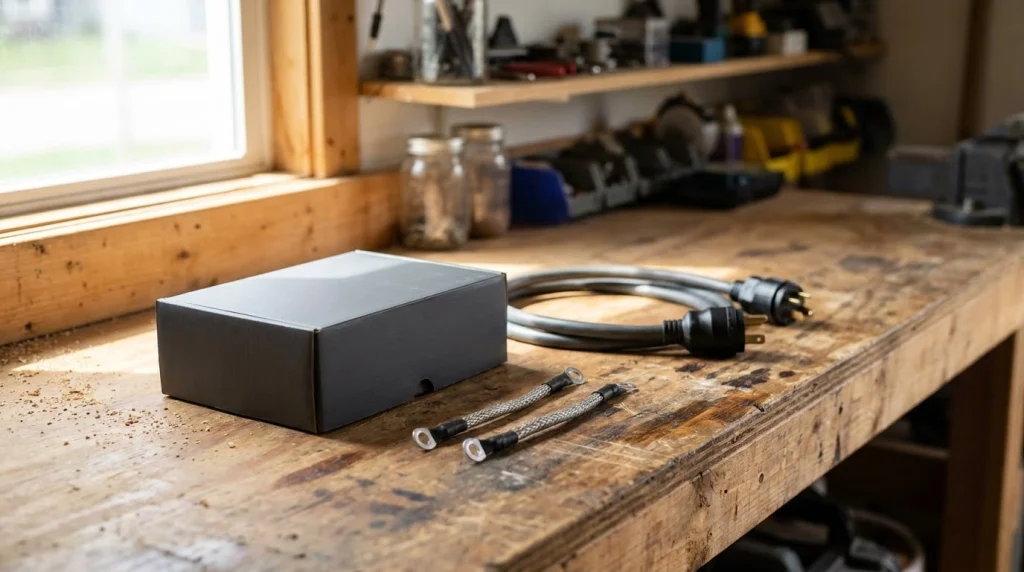
You need the kit that matches your outlet need: standard 120V, RV TT-30, or a larger twist-lock outlet.
The kit is not just cables, it also holds the shared outlet and breaker.
| Kit type | Outlet on kit | Best for | Watch out for |
|---|---|---|---|
| Standard parallel kit | 120V duplex or single 20-30A | Home essentials, tools, chargers | Do not exceed the kit breaker rating |
| RV parallel kit | TT-30R, 120V 30A | 30-amp RVs and travel trailers | Still 120V only, not 240V |
| High-output kit / box | L14-30 or larger outlet, brand-specific | Larger paired units, transfer switch use | Only if the maker rates it for 240V |
Most paired 120V inverters still give 120V only.
Do not assume parallel creates 240V, and check our guide on whether an inverter can provide 240V power for household circuits before planning for a well pump or dryer.
What comes in the box?
- Two parallel cables: One set for each generator’s ports.
- Ground wires: Short wires for the frame ground terminals.
- Outlet box: The shared outlet you actually plug loads into.
Keep the kit dry and off the ground.
A damp kit caused nuisance trips for me once, and drying and elevating it fixed the problem.
How do you connect two compatible inverter generators in parallel, step by step?
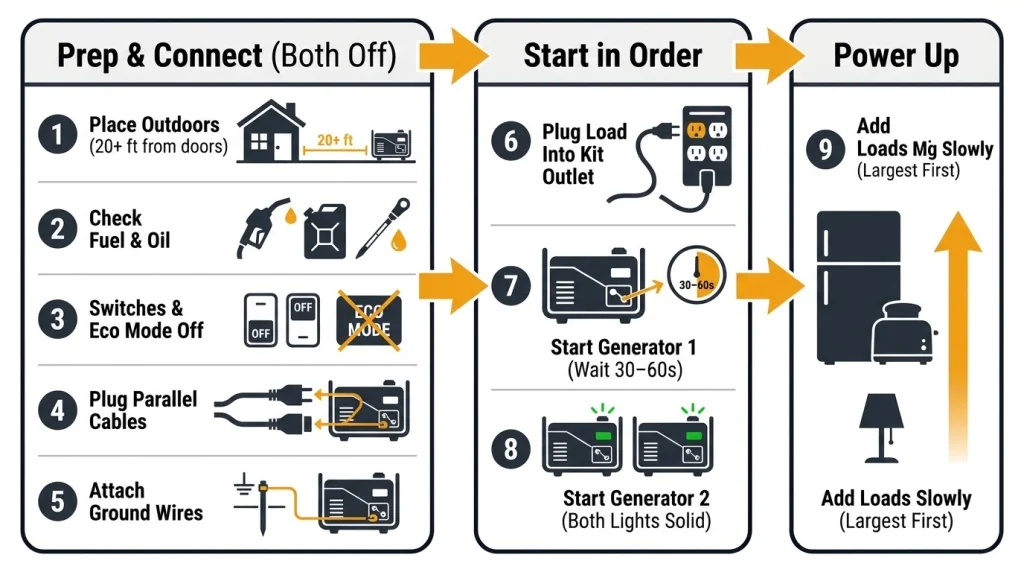
Connect everything with both generators off, then start them one at a time.
Never connect or disconnect parallel cables while a unit is running.
- Place both units safely: Set them outdoors on flat, dry ground, at least 20 feet from doors and windows, exhausts pointing away.
- Check fuel and oil: Fill both before starting, so you do not shut one down mid-run to refuel.
- Turn everything off: Engine switches off, Eco mode off, breakers as the manual directs, and no loads plugged in.
- Connect parallel cables: Plug one cable set into generator A and the other into generator B, matching colors or labels.
- Connect ground wires: Attach the kit ground leads to each generator’s ground terminal and tighten by hand.
- Plug in your load cord: Put the RV cord or extension cord into the parallel kit outlet only.
- Start generator one: Start it, let it stabilize for 30 to 60 seconds, and check for a steady output light.
- Start generator two: Start the second unit and wait for both output lights to stay solid.
- Add loads slowly: Turn on the largest load first, then add smaller loads one at a time.
Safety note: Run generators outdoors only. Carbon monoxide can build up fast, and guidance from the EPA and other safety authorities stresses outdoor placement and distance from the home.
Keep cords untangled and visible.
You want to see a loose plug before it becomes a shutdown.
Section Takeaway: Cables first, engines second, loads last. Reversing that order is where most parallel problems start.
How much power do you actually get in parallel?
You get close to the combined running watts, limited by the kit outlet and breaker.
Starting watts add too, but only for short motor starts.
| Pair example | Combined running watts* | Typical use |
|---|---|---|
| Two 1,800 running-watt units | About 3,600 watts, or kit limit if lower | RV AC plus fridge and lights |
| Two 2,000 running-watt units | About 4,000 watts, or kit limit if lower | RV AC, microwave in short bursts |
| One 1,800 + one 2,200-watt unit, if approved | Use the maker’s paired rating | Mixed loads, check manual first |
*Check your owner’s manual or the kit spec sheet for the exact paired rating. A 30-amp kit outlet caps you at 3,600 watts at 120V, even if the math says more.
That cap surprises many owners.
It is why sizing matters before you buy the second unit, especially if you are checking what size inverter generator can run an RV air conditioner on hot days.
For home loads, compare your list with what appliances a 3,000-watt inverter generator can run to avoid stacking too much at once.
Independent testing notes from Consumer Reports also remind buyers to plan on running watts, not peak watts, for steady loads.
Section Takeaway: Add the running watts, then respect the lowest limit — the kit, the outlet, or the breaker.
Starting, stopping, and adding loads safely
Start with Eco mode off, add loads, then turn Eco on only if the manual allows it under load.
Shutdown is the reverse of startup.
How do you shut down a parallel pair?
- Turn loads off: Switch off the AC, microwave, and other loads first.
- Unplug the load cord: Remove it from the parallel kit outlet.
- Stop both engines: Turn both engine switches off and let them stop fully.
- Disconnect cables last: Remove ground wires, then parallel cables, once everything is off.
Never unplug parallel cables to “drop” one generator while running.
That can cause an overload on the remaining unit instantly.
Using the pair for an RV or at home
For RV use, plug the trailer into the kit’s TT-30 outlet.
That setup is a favorite in roundups of the best portable generators for RV camping because you carry two light units instead of one heavy one.
For home backup, use extension cords to individual appliances.
If you want panel power, follow the safe methods in our guide on how to safely connect an inverter generator to a house with a transfer switch or interlock.
Safety note: Never backfeed a house panel through a dryer outlet or a homemade cord. Use a listed transfer switch or interlock and follow local code.
Section Takeaway: Startup and shutdown are mirror images. Loads come on last and go off first, every time.
Common mistakes and troubleshooting
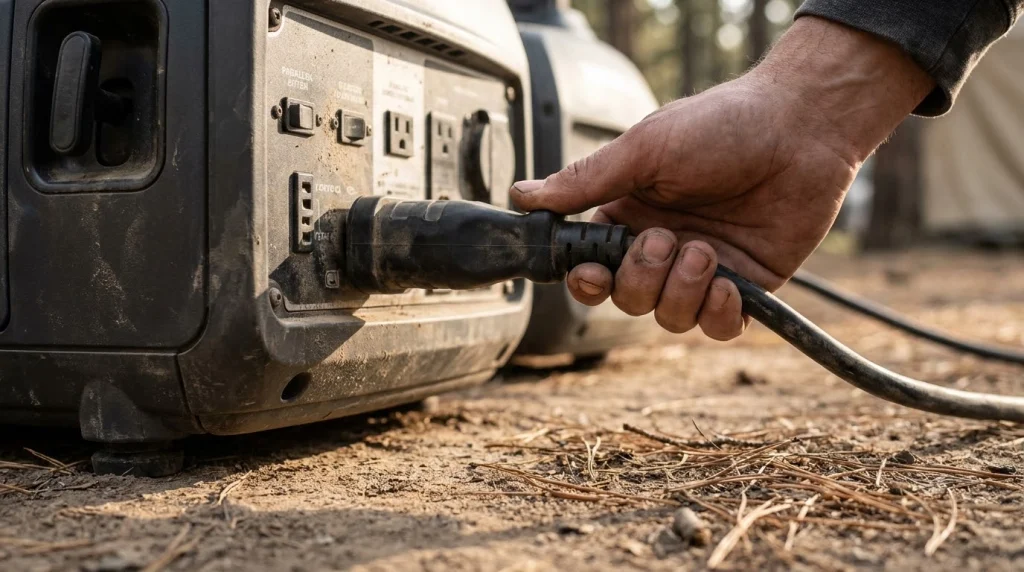
Most parallel failures come from loose cables, Eco mode, or overloading the kit.
Work through the simple checks before you assume a unit is broken.
- Overload light on: Turn loads off, stop both units, restart, and add loads more slowly.
- Second unit will not sync: Stop both, reseat every parallel plug, and restart in order.
- AC will not start: Turn Eco off on both units and start the AC before other loads.
- Breaker on kit trips: Your load exceeds the kit outlet rating, even if total watts look fine.
- One unit runs rough: Check fuel, oil, and air filter on that unit alone first.
I once chased a sync fault for twenty minutes.
The cause was one parallel plug backed out by a quarter inch.
Push, check, and restart fixed it.
As of 2026, most new parallel-capable models still use this same cable-first logic.
The kits change shape, but the sequence does not.
Section Takeaway: Reseat, restart in order, and reduce the load. That solves most parallel issues in the field.
FAQ
Can you parallel two different brands of inverter generator?
Generally no, unless both makers explicitly approve that exact pairing and kit. Sync signals, ports, and protection logic differ by brand. Mixing brands risks overload trips, unstable voltage, and voided warranties, so stick to one brand family.
Can you parallel two different size inverter generators?
Sometimes yes, if the brand allows mixed sizes in the manual. The pair will share load within the maker’s paired rating, not always evenly. Check the approved combinations and kit rating before you buy a second, larger or smaller unit.
Do you plug loads into the generator or the parallel kit?
Plug loads into the parallel kit outlet when running in parallel. That outlet is rated for the combined power and holds the shared breaker. Plugging a large load into one generator alone can overload that single unit.
Can you connect parallel cables while the generators are running?
No. Always connect and disconnect parallel cables with both generators fully off. Hot-connecting can cause arcing, overload faults, and inverter damage. Stop both units, reseat the cables, then restart in the correct order.
Does paralleling two generators give you 240 volts?
Usually no. Most 120V inverter pairs in parallel still output 120V only, just at higher amps through the kit. Only specific larger models and kits rated for 240V provide it, so check the kit outlet and manual.
How long can you run two generators in parallel?
You can run them as long as fuel, oil, and cooling allow, with breaks for refueling with both units off and cool. Runtime is limited by the smaller tank in practice. Check oil levels and let units cool before refueling.
What if only one generator starts in parallel?
Turn the running unit off, remove loads, and troubleshoot the dead unit alone. Check fuel, oil, choke, and spark issues per its manual. Do not run a large load on one unit through a kit rated for the pair.
Paralleling is one of the best reasons to own small inverters.
Follow the cable-first, loads-last order, and the pair will feel like one clean, quiet generator.
Start with a test run at home, note your start order on the kit case, and you’ll be ready when you actually need the extra watts.

Hi, I’m Michael Turner. I own a generator workshop in the United States and founded HomeGeneratorBlog to share practical, hands-on guidance about generator installation, maintenance, troubleshooting, safety, and backup power solutions. My goal is to help homeowners make smarter, more confident decisions through clear and reliable information