Are Inverter Generators Quieter Than Conventional Generators?
Quick Answer
Yes. A typical small inverter generator runs about 50 to 60 decibels at quarter load, while a similar-size conventional generator runs about 70 to 80 decibels under the same conditions. That 10 to 20 decibel gap sounds roughly two to three times as loud to the human ear. If quiet matters most, start with the quietest portable generators.
Why the gap is so big
- Variable speed: The engine slows down under light loads instead of holding full speed all day.
- Enclosed case: Most suitcase inverters hide the engine inside a sound-dampening shell.
- Better muffling: Larger mufflers and tuned exhausts cut the sharp edge off the sound.
- Smaller engine: The inverter electronics handle frequency, so the engine can run slower.
- Eco mode: A switch that lets the engine idle down when demand drops.
Check before you buy
- Compare ratings at the same load and distance, usually 25% load at 23 feet.
- Check the full-load figure too, since every generator gets louder at full load.
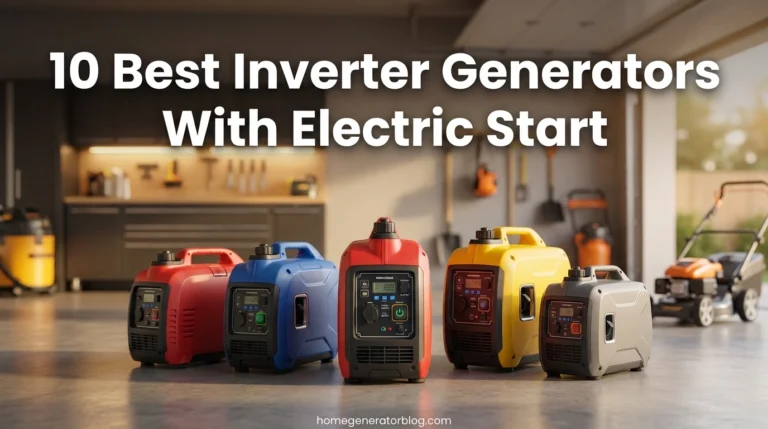
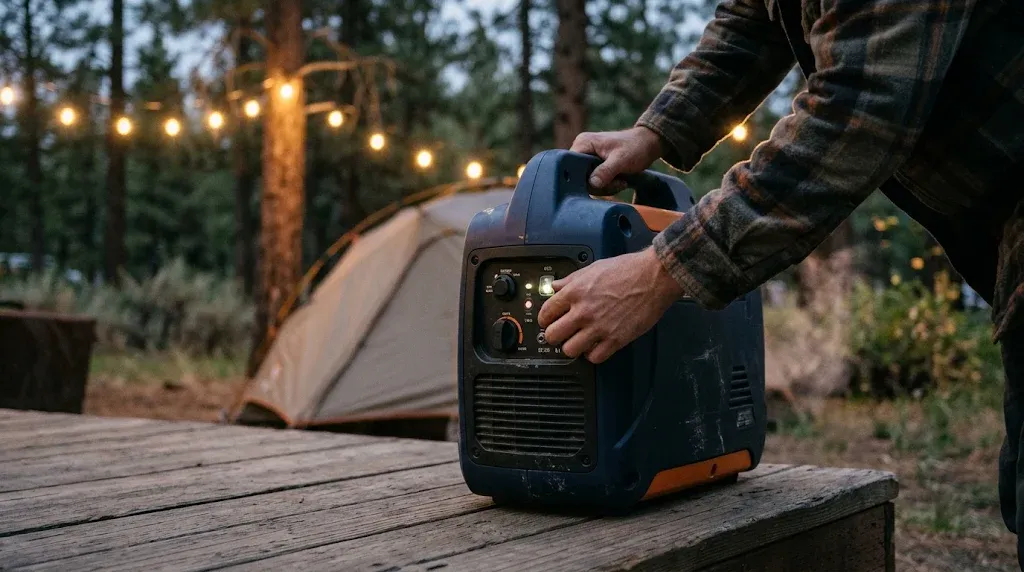
I’ve run a suitcase inverter generator beside a tent and listened to a neighbour’s open-frame unit rattle through a tailgate from two sites away.
For most portable power jobs around a home, campsite, or RV, noise is the first thing your neighbours notice.
This guide explains why inverter generators run quieter, how much quieter they really are, and how to read the numbers before you buy.
In This Guide
- What Does “Quieter” Actually Mean in Decibels?
- Why Are Inverter Generators Quieter Than Conventional Generators?
- How Much Quieter Are Inverter Generators?
- What Makes Some Inverter Generators Louder Than Others?
- How to Read a Generator Noise Rating Before You Buy
- How Far Away Should You Place a Generator to Keep Noise Down?
- How Can You Make Any Generator Quieter?
- When Is a Conventional Generator Still the Right Choice?
- Conclusion
- Frequently Asked Questions
What Does “Quieter” Actually Mean in Decibels?
“Quieter” is easy to feel and hard to compare, because decibels do not work like inches or pounds.
A decibel scale is logarithmic, so each 10-decibel step sounds about twice as loud to the human ear.
A 3-decibel rise doubles the sound energy, even though your ear hears it as only a small step up.
That is why a 10 to 20 decibel gap between two generators is a large real-world difference, not a rounding error.
Why distance changes everything
Sound fades fast as you move away from the source.
In open air, doubling the distance cuts the level by about 6 decibels.
A generator rated at 60 decibels from 23 feet will read about 54 decibels from 46 feet.
Always check the load and distance printed next to a rating, since brands do not all test the same way.
Section takeaway: A 10-decibel gap sounds about twice as loud, and the load and distance behind a rating matter as much as the number itself.
Why Are Inverter Generators Quieter Than Conventional Generators?
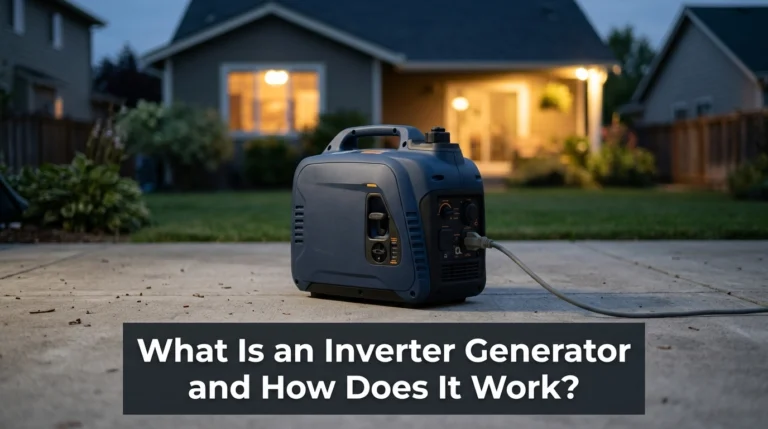
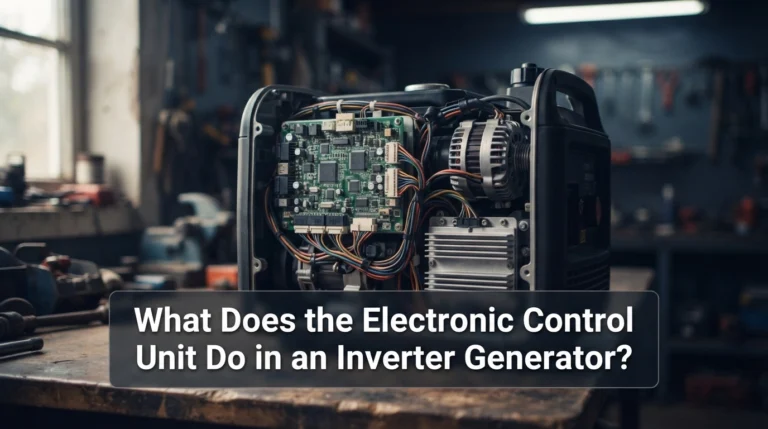
An inverter generator is a portable generator that makes raw AC power, converts it to DC, then rebuilds it as clean, stable AC through an inverter module.
That extra step frees the engine from holding one fixed speed, and that freedom is the main reason it runs quieter.
A conventional generator must hold about 3,600 RPM to keep its output at 60 Hz.
Its engine roars at full speed even when you only charge a phone.
I explain the full three-stage process in my guide to how an inverter generator works.
The engine slows down when the load drops
An inverter generator can idle down to match a light load, then speed up only when you add a fridge or a power tool.
At night, with lights and a CPAP running, mine drops to a low hum I can talk over.
This variable speed is called eco mode or economy mode on most models.
The case works like a muffler
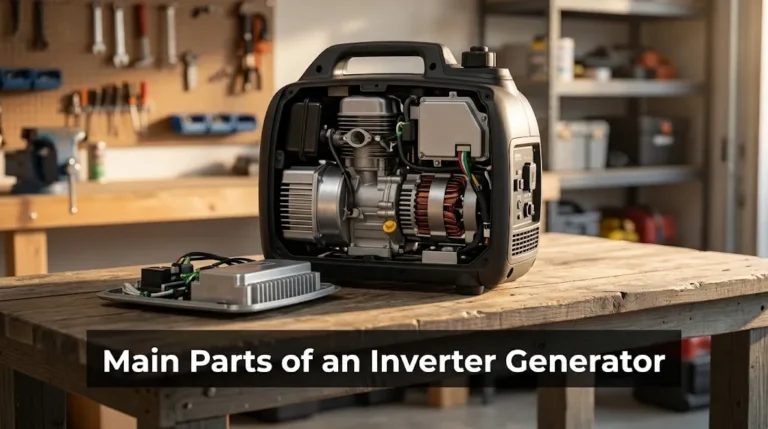
Most suitcase inverter generators enclose the engine in a plastic shell lined with sound-absorbing material.
The shell traps much of the mechanical clatter before it reaches your ears.
Conventional open-frame generators have no shell at all.
Their engine, alternator, and exhaust sit in the open air, so every vibration escapes.
The exhaust is tuned for quiet, not just flow
Inverter models usually carry larger mufflers relative to their engine size.
Clean power is a bonus here, not the noise trick itself.
Inverter output holds total harmonic distortion, or THD, under 3 percent, while conventional output often runs 10 to 25 percent, which is why sensitive electronics prefer inverters.
Section takeaway: The inverter lets the engine slow down, the shell traps the clatter, and the muffler softens the exhaust, so all three work together to cut noise.
How Much Quieter Are Inverter Generators?
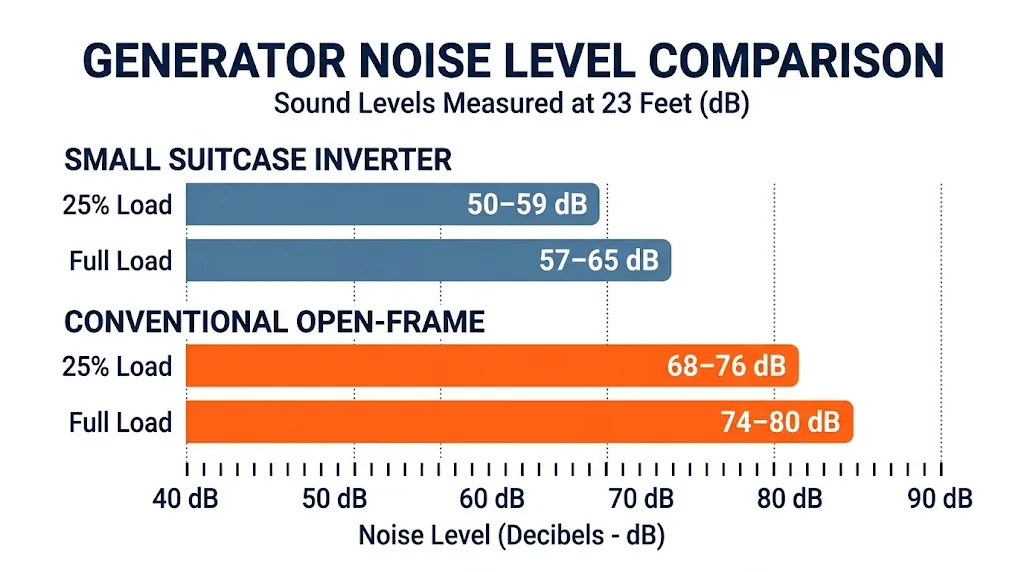
At comparable size and load, expect a gap of roughly 10 to 20 decibels.
A small suitcase inverter at quarter load often sits near 50 to 59 decibels, while a similar-size conventional unit sits near 68 to 76 decibels.
That gap sounds roughly two to three times as loud to the ear.
| Generator type | Typical noise at 25% load, 23 feet | Typical noise at full load | Where it fits best |
|---|---|---|---|
| Small suitcase inverter (1,000–2,200 running watts) | 50–59 dB | 57–65 dB | Camping, tailgating, light charging |
| Mid-size inverter (3,000–4,500 running watts) | 52–62 dB | 60–68 dB | RV, fridge and lights in an outage |
| Large open-frame inverter (5,000+ running watts) | 58–66 dB | 64–72 dB | Home backup, larger RV loads |
| Conventional open-frame (3,500–5,000 running watts) | 68–76 dB | 74–80 dB | Job sites, budget backup |
| Large conventional (7,500+ running watts) | 72–80 dB | 78–84 dB | Heavy tools, whole-home loads |
Typical ranges only, not guarantees for any one model.
A real-world example from a campsite
On one camping trip, I ran a 2,200-watt suitcase inverter in eco mode to charge phones and run a small fan.
Two sites over, a conventional unit ran a similar load at a steady roar.
We could hear it clearly over dinner, and the owners switched it off an hour earlier than they planned.
For the full trade-off beyond noise, see my guide on inverter vs generator: which is better for each job.
Section takeaway: Expect a 10 to 20 decibel gap at the same load, and remember the table shows typical ranges, so always confirm your exact model.
What Makes Some Inverter Generators Louder Than Others?
Not every inverter generator is quiet, and size is the first clue.
A 5,000-watt open-frame inverter will always be louder than a 2,000-watt suitcase model, even with the same technology inside.
- Load: A generator at full load is several decibels louder than the same unit at quarter load.
- Eco mode off: With eco mode off, the engine holds high speed even for a phone charger.
- Open frame vs enclosed: Open-frame inverters trade the sound shell for airflow and lower cost.
- Age and care: A loose panel, worn muffler, or dirty air filter can add rattles and roar.
- Hard ground: Concrete and bare dirt reflect sound, while grass and a rubber mat soften it.
Eco mode also stretches a tank, which I cover in my guide to the most fuel-efficient portable generators.
Does fuel type change the noise?
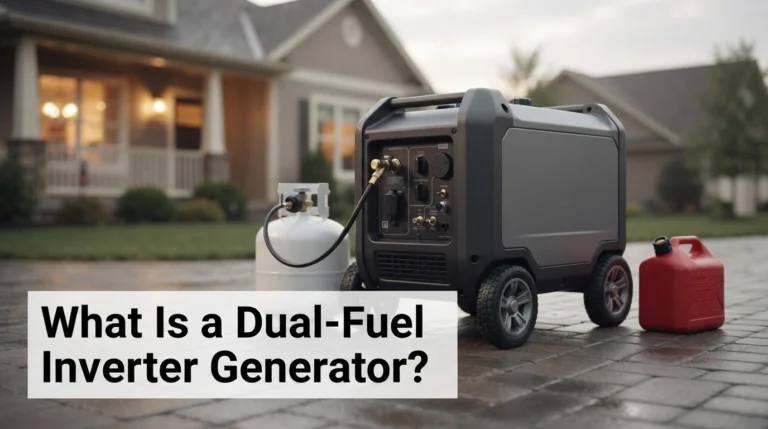
Gasoline is the baseline most ratings use, and propane usually runs a touch smoother on the same unit.
Propane also delivers about 10 percent less power than gasoline on dual-fuel models, so the engine may work slightly harder for the same load.
The fuel difference is small next to load and enclosure.
Section takeaway: Size, load, eco mode, and the shell decide how loud an inverter runs, while fuel type barely moves the needle.
How to Read a Generator Noise Rating Before You Buy
A noise rating is only useful if you know how it was measured.
Start with the two numbers that sit next to it: the load and the distance.
- Find the load: Most brands quote 25 percent load, so a “58 dB” label usually means quarter load, not full load.
- Find the distance: 23 feet, or 7 metres, is the common test distance, so use it as your baseline.
- Find the full-load figure: If the brand only prints quarter-load noise, assume full load adds roughly 5 to 8 decibels.
- Compare like with like: Only rank models whose ratings share the same load and distance.
No single test standard forces every brand to measure the same way, so two close ratings may not mean two equally quiet machines.
For electronics, check THD on the same spec sheet.
Look for under 3 percent, and confirm it on the manufacturer’s own page rather than a retailer listing.
Consumer Reports also publishes independent generator test results, including noise measurements, when you want a second opinion.
Section takeaway: A rating without a load and a distance is a slogan, so compare only ratings measured the same way.
How Far Away Should You Place a Generator to Keep Noise Down?
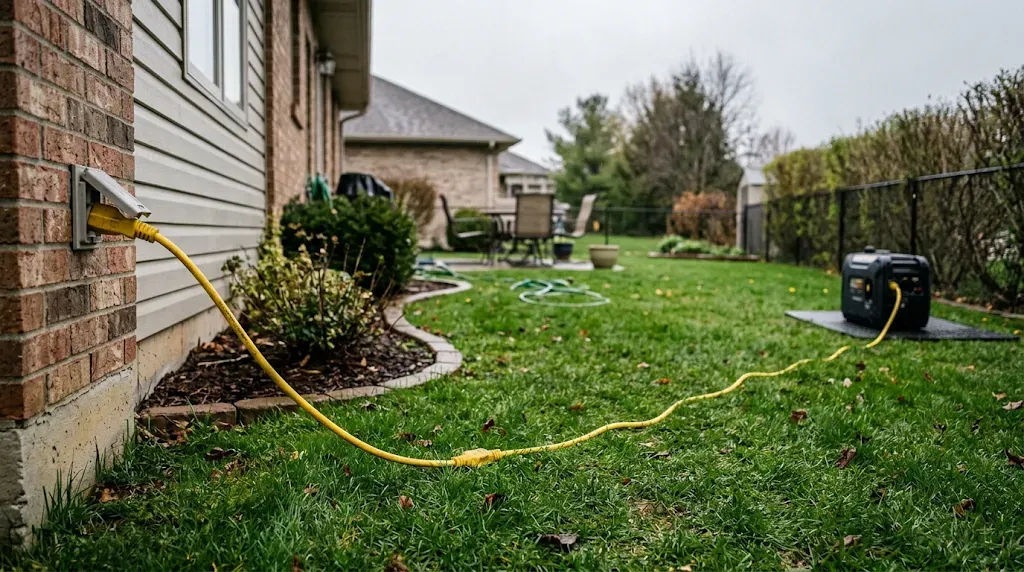
Distance is the cheapest noise control you own, and the math is friendly.
Every time you double the distance, the level drops by about 6 decibels in open air.
A unit rated at 60 decibels from 23 feet reads about 54 from 46 feet and about 48 from 92 feet.
What about campsites and neighbours?
Campsites rarely give you 90 feet, so aim for the farthest legal spot and point the exhaust away from tents.
Most campgrounds also set quiet hours, often 10 p.m. to 6 a.m., so plan heavy loads for the daytime.
At home, a long cord lets you push the unit toward the far corner of the yard.
Keep the cord rated for the load, and never run it through a doorway or window gap that invites exhaust inside.
Safety note: run generators outdoors at least 20 feet from doors, windows, and vents, with exhaust pointed away from the house, and never run one indoors or in a garage.
Follow CDC guidance on carbon monoxide and CPSC generator safety guidance before you set up.
For campsite-ready models, see my roundup of the best portable inverter generators for camping.
Section takeaway: Doubling the distance cuts about 6 decibels, so a long cord and the far corner of the yard are your best free tools.
How Can You Make Any Generator Quieter?
You cannot turn a conventional open-frame unit into a whisper-quiet suitcase model.
You can still shave several decibels off any generator with placement and care.
- Switch eco mode on: Let the engine slow down whenever the load allows it.
- Right-size the load: Run one heavy load at a time instead of stacking a fridge, microwave, and power tool together.
- Set it on soft ground: Grass, dirt, or a rubber mat absorbs vibration better than concrete.
- Point the exhaust away: Aim the tailpipe at open space, not at a wall, fence, or seating area.
- Keep it maintained: Fresh fuel, clean air filters, and the oil changes in your manual keep the engine from labouring.
- Use a barrier, not a box: A fence panel or plywood sheet angled between the unit and listeners can deflect sound.
Safety note: never cover or enclose a running generator to muffle it, since trapped exhaust can cause carbon monoxide poisoning and trapped heat can cause a fire.
I walk through the full set of options in my guide on how to reduce generator noise.
Section takeaway: Eco mode, lighter loads, soft ground, and distance help every generator, but never enclose a running unit to muffle it.
When Is a Conventional Generator Still the Right Choice?
Quiet is not the only thing that matters, and conventional generators still win on price per watt.
If you need 7,500 watts for a job site or whole-home backup on a tight budget, a conventional unit costs far less for the same output.
Who should still buy an inverter?
Campers, RVers, and anyone with close neighbours should pay the inverter premium.
If you run sensitive electronics, the choice is clearer still.
Inverter output under 3 percent THD suits laptops, phones, and CPAP machines, while conventional output at 10 to 25 percent is a poorer match.
The U.S. Department of Energy explains how to size backup power for a home before you shop.
Section takeaway: Buy conventional when watts per dollar matters most and nobody will hear it, and buy an inverter when people, campsites, or sensitive electronics are nearby.
Conclusion
Yes, inverter generators are quieter than conventional generators, usually by 10 to 20 decibels at the same load.
Variable speed, an enclosed case, and a tuned exhaust do the work, and eco mode keeps the engine slow when the load is light.
As of 2026, my rule is simple: if people will hear it, buy the inverter.
Check the rating at the same load and distance, place the unit as far as your cord allows, and I am Michael Turner, and the noise check is still one of the first I run before I recommend any portable unit.
If you want quiet, clean power for camping, RV use, or home backup, a quiet inverter generator is a solid option to compare. Look for low THD, eco mode, and a noise rating measured at 25% load and 23 feet, not just the biggest wattage number.
Frequently Asked Questions
How many decibels quieter is an inverter generator?
A typical small inverter generator runs about 10 to 20 decibels quieter than a similar-size conventional generator at the same load. That gap sounds roughly two to three times as loud to the ear, so compare ratings measured the same way.
What is the quietest type of generator?
A small enclosed suitcase inverter generator is usually the quietest fuel-powered option, often near 50 to 59 decibels at quarter load. Battery power stations are quieter still, since they have no engine, but they store far less energy.
Does eco mode make a generator quieter?
Yes. Eco mode lets the engine slow down under light loads instead of holding full speed, which cuts both noise and fuel use. The effect is biggest with small loads like lights and phone charging.
How far away should I put my generator?
Place it outdoors at least 20 feet from doors, windows, and vents, with exhaust pointed away from the house. For noise, farther is better: doubling the distance cuts about 6 decibels in open air.
Can I make a conventional generator as quiet as an inverter?
No. You can cut a few decibels with lighter loads, soft ground, distance, and a sound barrier, but the open frame and fixed 3,600 RPM engine set a floor. An enclosed inverter starts quieter by design, so it stays ahead.
Are inverter generators quiet enough for camping?
Most small inverter generators are quiet enough for campgrounds, especially in eco mode, but rules vary by site. Check the campground’s noise rules and quiet hours before you go, and place the unit as far from neighbouring tents as your cord allows.

Hi, I’m Michael Turner. I own a generator workshop in the United States and founded HomeGeneratorBlog to share practical, hands-on guidance about generator installation, maintenance, troubleshooting, safety, and backup power solutions. My goal is to help homeowners make smarter, more confident decisions through clear and reliable information