What Does the Electronic Control Unit Do in an Inverter Generator?
Quick Answer
The electronic control unit (ECU) is the brain of an inverter generator. It reads engine speed, load, voltage, and temperature many times a second, then tells the engine how fast to run and tells the inverter how to rebuild clean power. In short, it keeps the output at a steady 120 volts and 60 hertz while using only as much fuel and noise as the load needs. If you are still choosing a unit, start with this inverter generator buying guide before you compare watts and prices.
What the ECU does, at a glance
- Matches engine speed: It speeds the engine up when you add load and slows it down when the load drops.
- Steadies the power: It works with the inverter to hold voltage and frequency steady, even as engine speed changes.
- Protects the unit: It triggers overload shutdown, low-oil shutdown, and over-temperature protection before damage spreads.
- Runs eco mode: It manages the low-speed, fuel-saving mode most owners use for light loads at camp or at home.
- Handles starting and stopping: On many models it controls the choke, fuel valve, ignition timing, and shut-off sequence.
If the power looks wrong
- Check the load first, then the breakers, oil level, and vents. A healthy ECU cannot fix an overloaded unit or a blocked air intake.
An inverter generator is a small power plant with a brain, and that brain is the electronic control unit. I have run one through a multi-day outage with a fridge, a CPAP machine, and a handful of phone chargers, and the difference between a good unit and a rough one usually comes down to how well that brain does its job.
This guide goes deeper than a one-line definition. You will learn what the ECU senses, what it controls, how it differs from the inverter module and the alternator, what it does when something goes wrong, and how to keep it healthy for years.
In This Guide
- What Is the Electronic Control Unit in an Inverter Generator?
- How Does the ECU Work, Step by Step?
- What Does the ECU Control During Normal Running?
- ECU vs Inverter Module vs Alternator: What’s the Difference?
- How Does the ECU Protect Your Generator and Your Appliances?
- What Happens When the ECU Fails?
- How to Keep the ECU Healthy
- Conclusion
- Frequently Asked Questions
What Is the Electronic Control Unit in an Inverter Generator?
An electronic control unit, or ECU, is a small circuit board with a microprocessor that manages the generator’s engine and electrical output. Think of it as the control centre that sits between the engine, the alternator, and the inverter.
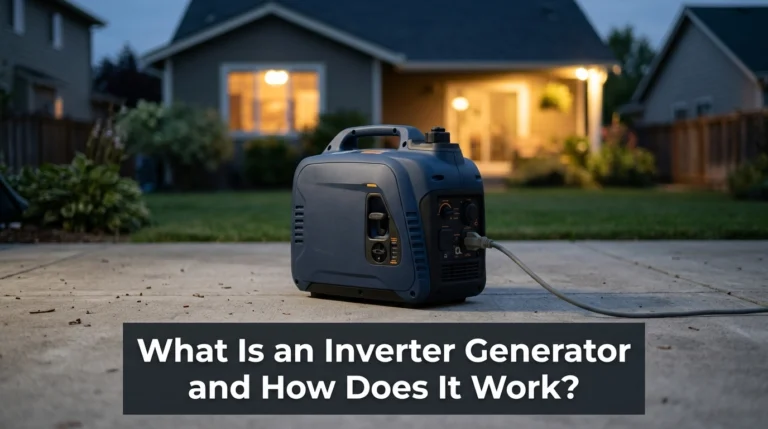
An inverter generator is a portable power source that makes raw power, converts it to DC, then rebuilds it as clean AC. The ECU is the part that decides how that process should run from moment to moment, based on what you plug in.
Manufacturers use different names for the same idea. You may see it called an engine control unit, an inverter control unit, a control board, or a control module in a manual or parts list.
Those names can overlap, and that causes confusion. On some models the ECU and the inverter module share one board. On others they are separate boards that talk to each other through wiring and sensors.
The name matters less than the job. If a board reads sensors and changes engine speed or output in response, it is doing ECU work, whatever the label says.
Here is a worked example from my own use. During an outage I ran a fridge, two phone chargers, and a lamp on a 2,000-watt inverter unit. The ECU held the engine at a low, quiet idle because the load was light.
When the fridge compressor kicked in, the load jumped for a few seconds. The ECU sensed the surge, opened the throttle, and then eased the engine back down once the compressor settled. I did not touch a thing.
Section takeaway: The ECU is the microprocessor board that senses load and conditions, then adjusts the engine and the inverter so the power stays clean and steady.
How Does the ECU Work, Step by Step?
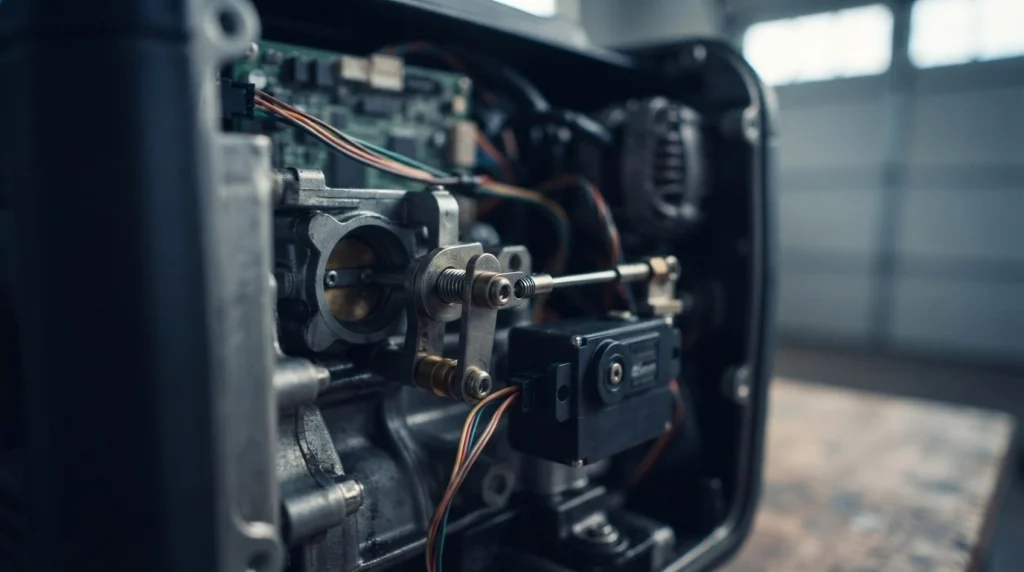
The ECU works in a fast loop: sense, decide, act, then sense again. That loop runs many times a second while the generator is running.
First, sensors feed it information. Those sensors track engine speed, output load, output voltage, temperature, and oil level. Some models also add a carbon monoxide (CO) sensor and a fuel-level sensor.
Next, the microprocessor compares those readings with its target values. It wants a steady 120 volts at 60 hertz in North America, with a clean sine wave and low total harmonic distortion, or THD. THD is a measure of how distorted the power waveform is, and lower is cleaner.
Then it acts on the difference. If the load rises, it opens the throttle to raise engine speed. If the load falls, it closes the throttle to save fuel and cut noise.
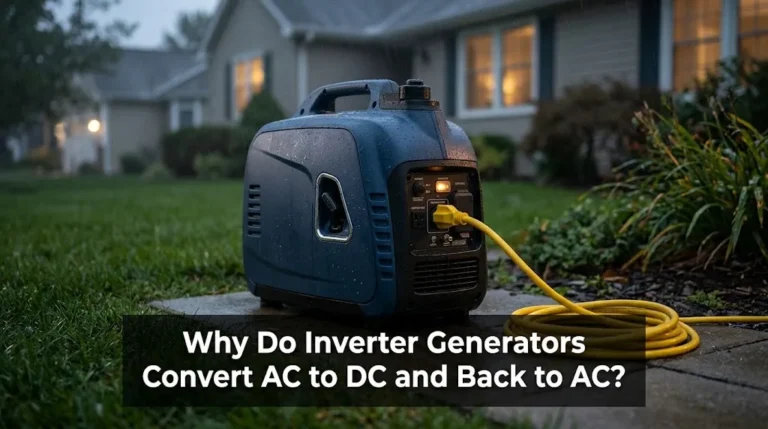
At the same time, it tells the inverter how to rebuild the output. The alternator makes raw, high-frequency AC that changes with engine speed. The inverter turns that power into DC, then rebuilds it as stable AC.
That split is the key to the whole design. The engine speed can vary, because the inverter, guided by the ECU, rebuilds the frequency electronically instead of relying on a fixed engine speed. Honda describes the same idea in its inverter generator advantages guide, where the alternator output is converted to DC and then back to clean AC under microprocessor control.
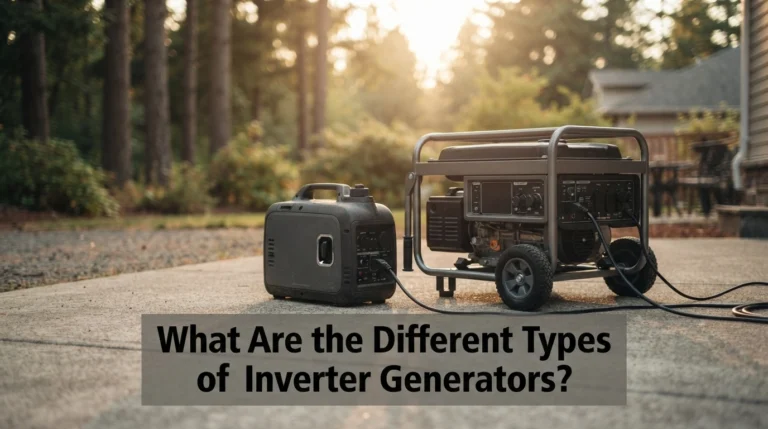
A conventional generator works the other way. It must hold about 3,600 RPM to make 60-hertz power directly, even when the load is light. That is why it burns more fuel and makes more noise at low load.
Here is the sequence in order:
- Sense the load: The ECU measures how much current your appliances are drawing right now.
- Check the output: It compares voltage and frequency with its target values.
- Adjust the throttle: It moves a small stepper motor or servo to open or close the throttle.
- Guide the inverter: It keeps the rebuilt sine wave steady as engine speed changes.
- Watch for danger: It checks oil, temperature, and overload limits on every pass through the loop.
- Repeat: The loop runs again, many times a second, for as long as the unit runs.
Safety note: Never open the control housing or bypass a sensor to keep a generator running. A bypassed low-oil or CO sensor can let a small fault turn into engine damage or a serious safety risk.
Section takeaway: The ECU senses load and output, adjusts the throttle, and guides the inverter in a loop that repeats many times a second.
What Does the ECU Control During Normal Running?
What does the ECU control when everything is working well? More than most owners realise, and most of it happens without any input from you.
How does the ECU manage engine speed and eco mode?
Engine speed is the ECU’s most visible job. In normal mode it raises speed as load rises, so a fridge start or a power tool gets the power it needs without a long voltage dip.
In eco mode, also called economy mode or eco-throttle, the ECU lets the engine idle much lower under light load. That saves fuel, cuts noise, and reduces wear. As of 2026, eco mode is standard on most inverter generators, and it is the mode I use for overnight fridge and CPAP runs.
Turn eco mode off for a large motor start, such as a window AC or a well pump. The engine then holds a higher speed, so the surge does not drag the voltage down first.
How does the ECU keep voltage and frequency steady?
The ECU and the inverter share this job. The ECU sets engine speed, and the inverter rebuilds the waveform at a steady 60 hertz. Together they hold voltage close to 120 volts, even when the load changes.
That steadiness is what protects sensitive electronics. Laptops, phones, routers, and medical devices such as a CPAP machine prefer a clean sine wave with low THD. Quality inverter generators typically hold THD under 3%, while a conventional generator typically runs 10 to 25%. Check the spec sheet for your model, because the exact figure varies.
For a deeper look at the other half of this job, see the guide to generator frequency and how a stable 60-hertz output is maintained.
Does the ECU control fuel, ignition, and starting?
On many modern models, yes. The ECU can manage the choke during a cold start, set ignition timing, and control the fuel valve on units with an electric fuel shut-off.
On electric-start models it also manages the start sequence. It cranks the engine, checks for a successful start, and then takes over throttle control. On pull-start models the ECU still takes over once the engine is running.
Some ECUs also manage parallel operation. When two compatible units are linked with a parallel kit, their ECUs sync the output so the two units share the load. That is a job a simple governor cannot do alone.
Section takeaway: During normal running the ECU controls engine speed, eco mode, voltage and frequency stability, starting, and, on many models, parallel sync.
ECU vs Inverter Module vs Alternator: What’s the Difference?
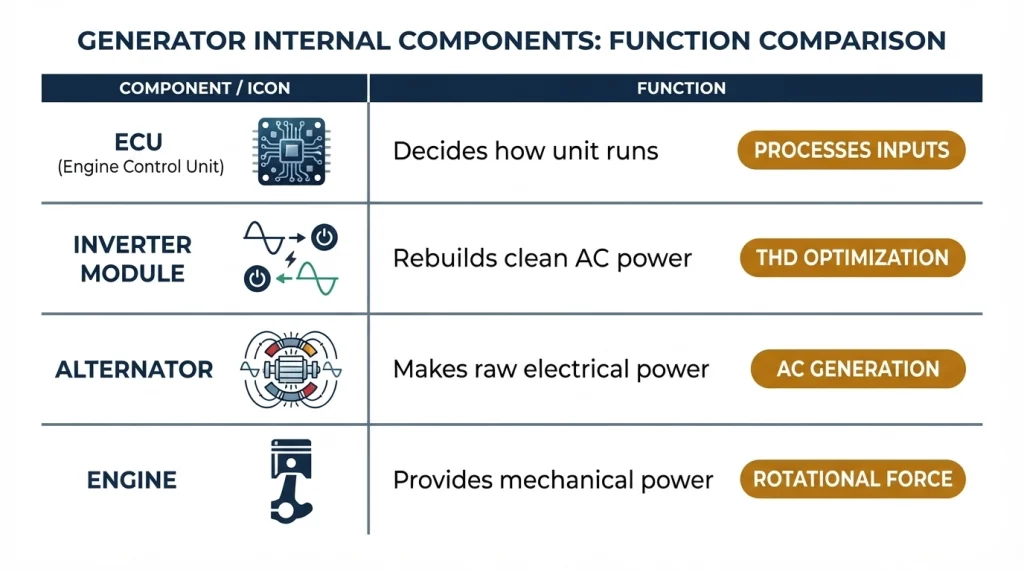
These three parts work as a team, and mixing them up leads to wrong diagnoses. The alternator makes the raw power, the inverter module rebuilds it, and the ECU tells both of them what to do.
The alternator is the spinning electrical part driven by the engine. It turns mechanical energy into raw, high-frequency AC. Its output rises and falls with engine speed.
The inverter module is the power electronics that convert that raw AC into DC, then switch it back into clean 120-volt AC. It uses fast-switching transistors, usually IGBTs or MOSFETs, under microprocessor control.
The ECU is the decision-maker. It reads sensors, sets the throttle, and coordinates the inverter. On some units the ECU and inverter module live on the same board, which is why parts lists sometimes blur the two.
| Component | Main job | What it controls | If it fails |
|---|---|---|---|
| ECU | Decides how the unit should run | Throttle, eco mode, starting, protection shutdowns | Erratic speed, no start, false shutdowns, or no output |
| Inverter module | Rebuilds clean AC power | Voltage, frequency, waveform, THD | Engine runs, but outlets give no power or unstable power |
| Alternator | Makes raw electrical power | Raw AC output, which rises with engine speed | Low or no raw power, so the inverter has nothing to rebuild |
| Engine and governor | Provides mechanical power | Engine speed, under ECU direction on inverter units | Surging, stalling, or failure to start at all |
That table explains a common troubleshooting trap. An engine that runs fine with no power at the outlets often points to the inverter module or its breakers, not the ECU. An engine that surges, hunts for speed, or shuts down for no clear reason points more toward the ECU, its sensors, or the throttle motor.
Section takeaway: The alternator makes raw power, the inverter module rebuilds it clean, and the ECU decides how both should behave.
How Does the ECU Protect Your Generator and Your Appliances?
Protection is the ECU’s quietest job, and it is the one that saves you money. It watches for conditions that would damage the generator or the things plugged into it, then acts before the damage happens.
What happens during an overload?
When you draw more watts than the unit can supply, the ECU sees the current rise past its limit. It first tries to raise engine speed to meet the demand. If the load stays too high, it trips the overload protection and cuts output.
That shutdown is not a fault. It is the unit refusing to cook its own windings or feed sagging voltage to your fridge and laptop. Unplug the heaviest load, reset the overload, and restart with a smaller load.
How does low-oil shutdown work?
A low-oil sensor sends its reading to the ECU. When oil drops below a safe level, the ECU stops the engine or refuses to start it. That protects the engine from running dry and seizing.
Check oil on a level surface, with the engine cool, and follow the level in your owner’s manual. A unit that will not start after storage often has low oil, stale fuel, or a clogged air filter, not a dead ECU.
What about heat and carbon monoxide?
Many ECUs also watch temperature. If vents are blocked or the unit runs in hot, still air, the ECU can shut it down before heat damages the inverter board. Keep the vents clear and the unit out of direct, trapped heat.
Some newer models add a CO sensor that talks to the ECU. If carbon monoxide builds up around the unit, the ECU shuts the engine down. That feature helps, but it does not replace safe placement.
Safety note: Run the generator outdoors, at least 20 feet from doors, windows, and vents, with the exhaust pointing away from the house. The CDC gives the same 20-foot guidance for portable generators, and a CO alarm inside the home is still worth having.
For the full safety picture, the CDC carbon monoxide guidance and the Consumer Product Safety Commission both cover generator placement and CO alarms. If you want cleaner power for sensitive gear, the roundup of portable generators with low THD shows which models are built for that job.
Section takeaway: The ECU protects the unit with overload, low-oil, over-temperature, and, on some models, CO shutdowns, but safe placement still comes first.
What Happens When the ECU Fails?
ECU failure is rare, and it is often blamed for faults that belong elsewhere. I once opened a small inverter unit after a storm, expecting a dead board, and found a clogged air filter and a near-empty tank instead. The ECU was fine. The fuel and air were not.
Still, ECUs do fail. Heat, moisture, vibration, voltage spikes, and age can damage a board. A lightning strike nearby or a short in the wiring can do it too. Sealed boards are hard to repair at home, and most are replaced as a unit by a technician.
Watch for these signs, and check the simple causes first:
- Engine surges or hunts: Speed rises and falls with a steady load. Check fuel quality, the air filter, and the spark plug before you blame the board.
- No output, engine runs: Check breakers and the overload reset first. A failed inverter module is also a common cause here.
- False shutdowns: The unit stops with no overload and good oil. Check vents, temperature, and the CO sensor area for exhaust blowing back.
- Will not start at all: Check oil level, fuel, the fuel valve, and the battery on electric-start models. A dead ECU is possible, but it is not the first suspect.
- Eco mode stops working: The engine stays at high speed under a light load. Check the eco switch and the throttle linkage for sticking or dirt.
Can you reset an ECU? Some models reset when you turn the unit off, unplug all loads, and restart it. Others need a fault code cleared by a dealer. Your owner’s manual is the only safe source for the reset steps on your model.
Do not buy a replacement board on a guess. A technician can test the sensors, the throttle motor, and the inverter output, then confirm whether the board is the fault. That test costs less than a wrong part.
Section takeaway: ECU failure is possible but uncommon, so check fuel, oil, air, breakers, and vents first, and let a technician confirm a board fault.
How to Keep the ECU Healthy

An ECU lasts longest when it stays cool, dry, and clean. Most of the care it needs is the same care the whole generator needs, done on schedule.
Start with fuel. Stale gasoline gums up the carburettor and makes the engine surge, which forces the ECU to chase a moving target. Use fresh fuel, add stabiliser for storage if your manual allows it, and run the carburettor dry before a long lay-up.
Keep the air filter and vents clean. A starved engine runs rough, and a hot inverter board ages faster. I check the filter after dusty camping trips and before storm season, not after the unit starts surging.
Change oil on the schedule in your manual. Low or dirty oil can trigger shutdowns, and it shortens engine life whether the ECU notices or not. Check the level before each long run.
Store the unit dry and under cover. Rain, damp storage, and rodent damage to wiring are all hard on control boards. A generator cover helps, but it is not a substitute for a dry shed or garage bay.
Do not overload the unit to “test” the ECU. Repeated overload trips stress the inverter and the engine. Size the load first, using running watts and the largest starting surge, then stay inside the rating.
For a practical next step, read the parallel kit guide before you link two units together. Two synced ECUs share a load well, but only when the kit and the models are compatible.
Safety note: Let the engine cool before you refuel, and never refuel a hot or running generator. Wipe up spills, keep fuel away from the exhaust, and store fuel in an approved container away from living spaces.
Section takeaway: Fresh fuel, clean air and vents, scheduled oil changes, dry storage, and loads inside the rating keep the ECU, and the whole unit, healthy.
Conclusion
The electronic control unit is the brain that lets an inverter generator be quiet, fuel-efficient, and safe for sensitive electronics. It senses load, voltage, temperature, and oil, adjusts the throttle, guides the inverter, and shuts the unit down when a limit is crossed.
That is why two units with similar watt ratings can feel so different in use. The better the control, the steadier the power, the lower the fuel use at light load, and the fewer surprises during an outage. I am Michael Turner, and the ECU is the first system I think about when a unit surges, shuts down for no clear reason, or refuses to settle into eco mode.
If you run laptops, a fridge, or a CPAP machine during an outage, a quiet inverter generator with a clean sine wave and a well-managed eco mode gives you the steady power those devices need, without running the engine flat out all night. → Check Price on Amazon
Frequently Asked Questions
Is the ECU the same as the inverter module?
No. The ECU is the control board that senses load and decides how the engine and inverter should respond. The inverter module is the power electronics that convert raw AC to DC and rebuild it as clean AC. Some models combine them on one board, but their jobs are different.
Can an inverter generator run without an ECU?
No, not as an inverter generator. Without the ECU, the engine cannot adjust speed to load and the inverter cannot be coordinated with the engine. A conventional generator uses a mechanical governor instead, which is why it must hold a fixed speed.
Does the ECU control fuel use?
Yes, indirectly. It controls engine speed through the throttle, and engine speed sets fuel use. In eco mode it lets the engine idle low under light load, which is why a lightly loaded inverter generator can run much longer on a tank than a conventional unit at full speed.
How do I reset the ECU on my inverter generator?
On many models, turn the unit off, unplug all loads, wait a minute, and restart it. That clears a simple overload or protection trip. For a fault code or a repeated shutdown, follow the reset steps in your owner’s manual or ask a dealer, because the steps vary by brand and model.
Can I replace an ECU myself?
You can on some models, if you can get the exact part and follow the manual, but it is rarely a first repair. The board is often sealed, model-specific, and costly. Check fuel, oil, air, breakers, and sensors first, and let a technician confirm the board is faulty before you order one.
Does the ECU drain the battery on electric-start models?
Only a tiny amount when the unit is off, if it has a standby circuit, and most models draw nothing meaningful in storage. If the battery goes flat over weeks, check the battery itself and the charging circuit first. Disconnect the battery for long storage if your manual recommends it.

Hi, I’m Michael Turner. I own a generator workshop in the United States and founded HomeGeneratorBlog to share practical, hands-on guidance about generator installation, maintenance, troubleshooting, safety, and backup power solutions. My goal is to help homeowners make smarter, more confident decisions through clear and reliable information