Can You Use an Inverter Generator With a Transfer Switch? Safe Setup, Sizing & 240V Limits
Quick Answer
Can you use an inverter generator with a transfer switch? Yes, most inverter generators work well with a manual transfer switch when the generator is sized correctly, the switch matches its voltage and amperage, and it connects through a proper outdoor inlet box. That setup is far safer than using a generator without a transfer switch or backfeeding through a dryer outlet.
What makes it work
- Manual switch first: A manual transfer switch is the best match for a portable inverter generator.
- Right voltage: A 120V-only generator can feed 120V circuits, but it cannot power 240V loads.
- Right size: Add running watts for your chosen circuits, then add the largest starting watts.
- Proper inlet: Use an outdoor inlet box and a generator cord rated for the switch amperage.
- Licensed install: Have a licensed electrician install the switch, inlet, and wiring.
Before you buy
- Check your generator outlet type, its running watts, and whether it has a 120/240V outlet.
- Pick only the circuits you truly need during an outage.
- Never use a suicide cord or plug a generator into a wall outlet.
I have run a fridge, a few lights, and a CPAP through a multi-day outage with a small inverter generator. The setup worked because I planned the loads first and kept the power path simple.
A transfer switch makes that plan safer and much easier to use. This guide explains how it works, which inverter generators fit, how to size one, and what to avoid in 2026.
In This Guide
- What Is a Transfer Switch and How Does It Work?
- Will Your Inverter Generator Work With a Transfer Switch?
- Manual vs Automatic Transfer Switch: Which One Fits an Inverter Generator?
- What Size Inverter Generator Do You Need for a Transfer Switch?
- How to Connect an Inverter Generator to a Transfer Switch
- Transfer Switch vs Interlock Kit vs Extension Cords: Which Is Best?
- Common Mistakes and Safety Rules to Follow
- Frequently Asked Questions
What Is a Transfer Switch and How Does It Work?
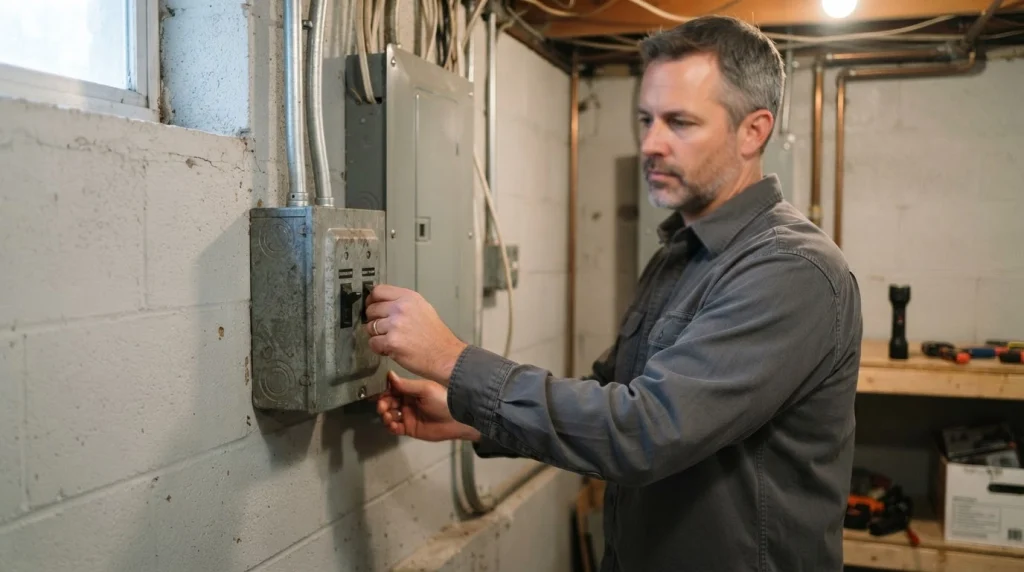
A transfer switch is a device that lets your home safely switch between grid power and generator power. It stops both sources from feeding the same circuits at the same time.
That break-before-make action is the key safety feature. It protects line workers, your generator, and your home wiring from backfeed.
An inverter generator is a portable generator with clean, stable power
An inverter generator is a portable generator that creates raw AC power, converts it to DC, then inverts it back to clean AC power. That process produces a stable sine wave with low total harmonic distortion, or THD.
Low THD matters for phones, laptops, routers, and modern furnace controls. It also helps the generator adjust engine speed to the load, which saves fuel and cuts noise.
How a manual transfer switch moves power
A manual transfer switch sits between your main panel and a set of chosen circuits. You flip it to generator power after the outage starts, then flip it back when grid power returns.
Most home kits cover 6 to 10 circuits. Common picks are the fridge, freezer, furnace blower, sump pump, well pump, lights, and a few outlets.
- Grid mode: Circuits run from the utility as normal.
- Generator mode: Circuits run only from the generator through the switch.
- Isolation: The switch blocks power from flowing back to the grid.
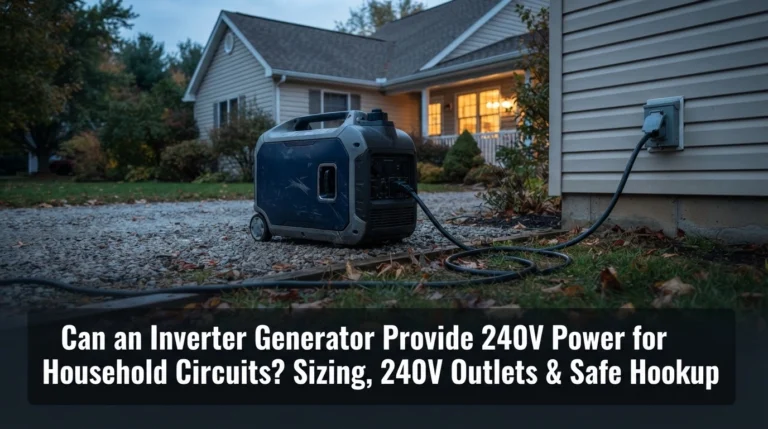
An inlet box on the outside wall is where the generator cord plugs in. That cord runs from the generator to the inlet, then inside wiring carries power to the switch.
Safety note: Run generators outdoors and well away from windows, doors, and vents. Use a transfer switch or interlock installed by a licensed electrician, and check your owner’s manual before use.
Section Takeaway: A transfer switch safely isolates generator power from grid power, and an inlet box gives you one clean plug-in point outside.
Will Your Inverter Generator Work With a Transfer Switch?
Yes, in most cases it will work. The match depends on voltage, amperage, outlet type, and total watts, not on the inverter design alone.
I have seen small 2,000-watt models run a fridge and lights through a 30-amp switch with no trouble. I have also seen a larger home setup fail because the owner tried to feed 240V circuits from a 120V-only unit.
Check voltage first: 120V vs 120/240V
Most small inverter generators are 120V only. They can feed 120V circuits through a transfer switch, but they cannot run a 240V well pump, electric water heater, or central AC.
Larger inverter generators often have a 120/240V outlet, usually a 30-amp twist-lock or a 50-amp outlet. Those models can feed both 120V and 240V circuits when the switch is wired for it.
- 120V only: Best for fridge, lights, outlets, CPAP, and a furnace blower on a 120V circuit.
- 120/240V: Needed for 240V loads like a well pump or electric range.
- Check the label: Read the outlet panel and spec sheet before you buy a switch.
Check amperage, outlets, and grounding
Match the switch and inlet to the generator outlet. A 30-amp switch needs a 30-amp inlet and a 30-amp cord, while a 50-amp setup needs 50-amp parts throughout.
Do not use adapters to force a larger plug into a smaller outlet. That shortcut can overheat the cord and trip the generator under load.
Grounding and neutral bonding also matter here. Some inverter generators have a floating neutral, while others are bonded, so your electrician should check the manual and local code before wiring.
Learn the difference between running watts and starting watts before you size the switch. Starting watts decide whether a motor load will start at all.
Section Takeaway: Most inverter generators work with a transfer switch, but only when voltage, amperage, and watts all match the switch and the circuits you pick.
Manual vs Automatic Transfer Switch: Which One Fits an Inverter Generator?
A manual transfer switch fits almost every portable inverter generator. An automatic transfer switch usually does not, unless the generator is built for it.
The difference comes down to starting. A manual switch waits for you, while an automatic switch expects the generator to start itself.
Manual transfer switch: the practical choice
You start the generator, plug in the cord, then flip the switch. That simple sequence gives you control over warm-up, load order, and fuel checks.
Manual switches also cost less and suit smaller loads. A 30-amp, 6-circuit kit is a common fit for a 3,000- to 5,000-watt inverter generator.
- Pros: Lower cost, simple install, full control over loads.
- Cons: You must be home to start it and flip the switch.
- Best for: Home backup, outages, and portable inverter generators.
Automatic transfer switch: why it rarely fits a portable inverter
An automatic switch senses an outage, starts the generator, waits for stable power, then transfers the load. That design suits standby generators with electric start, auto-choke, and a fixed fuel line.
Most portable inverter generators lack that auto-start system. Some larger models offer remote start, but that is not the same as a true automatic transfer setup.
Do not wire a portable unit to an automatic switch unless the maker states it is supported. A wrong setup can crank a cold engine, drain the battery, or leave the switch hunting for power.
The U.S. Department of Energy offers general guidance on home backup power and safe generator use. Check its home energy pages before you plan a whole-home setup.
Section Takeaway: Choose a manual transfer switch for a portable inverter generator, and save an automatic switch for a standby generator built for it.
What Size Inverter Generator Do You Need for a Transfer Switch?
Size the generator to the circuits on the switch, not to the whole house. A transfer switch does not make a small generator bigger.
Start with a short list of must-run loads. Then add running watts, add the largest starting watts once, and leave a 20% margin if you can.
How do I calculate watts for a transfer switch?
List each circuit, note its running watts, and note the starting watts for motor loads. Fridges, freezers, sump pumps, and furnace blowers all surge at startup.
Use this simple math as a guide. Add all running watts, then add the highest single starting surge from your list.
- Fridge: About 150-200 running watts, with 800-1,200 starting watts.
- Freezer: About 100-200 running watts, with 800-1,200 starting watts.
- Furnace blower: About 500-1,200 running watts, with 1,200-2,200 starting watts.
- Sump pump: About 800-1,500 running watts, with 1,500-3,000 starting watts.
- Lights and outlets: About 200-600 running watts for a few rooms.
Those are typical ranges, not specs for a single model. Check the label on each appliance and the spec sheet for your generator.
If you want a step-by-step method, see how to calculate the generator wattage you need for your exact load list. It walks through the same math with more examples.
What size fits common home backup plans?
A 2,000-watt inverter generator can cover a fridge, lights, phones, and a CPAP. It will struggle with a sump pump and a fridge starting at the same time.
A 3,500- to 5,000-watt model covers more circuits with room to spare. That range suits many 30-amp manual switches and a 120/240V outlet.
Use our guide on what size inverter generator you need to match watts to your home, RV, or job-site plan. It helps you avoid buying too small or far too large.
Parallel capability can help when one unit is too small. Two matched inverter generators with a parallel kit can share the load, but both must support parallel operation.
Section Takeaway: Add running watts, add the largest starting surge once, and pick a generator with headroom for the circuits on your switch.
How to Connect an Inverter Generator to a Transfer Switch
The connection path is simple on paper: generator to cord, cord to inlet, inlet to switch, switch to circuits. The install work behind it must be done right.
Have a licensed electrician install the switch and inlet. That step keeps the wiring code-compliant and protects your warranty and insurance.
What parts do you need?
- Manual transfer switch: Sized for 30 amps or 50 amps to match your generator.
- Power inlet box: Mounted outside, wired to the switch.
- Generator cord: Rated for the same amperage, with the right plug ends.
- Breakers and wiring: Sized by your electrician for the switch and circuits.
Keep the cord as short as practical and keep it off walkways. A long, thin cord drops voltage and can starve motor loads at startup.
How do you run it during an outage?
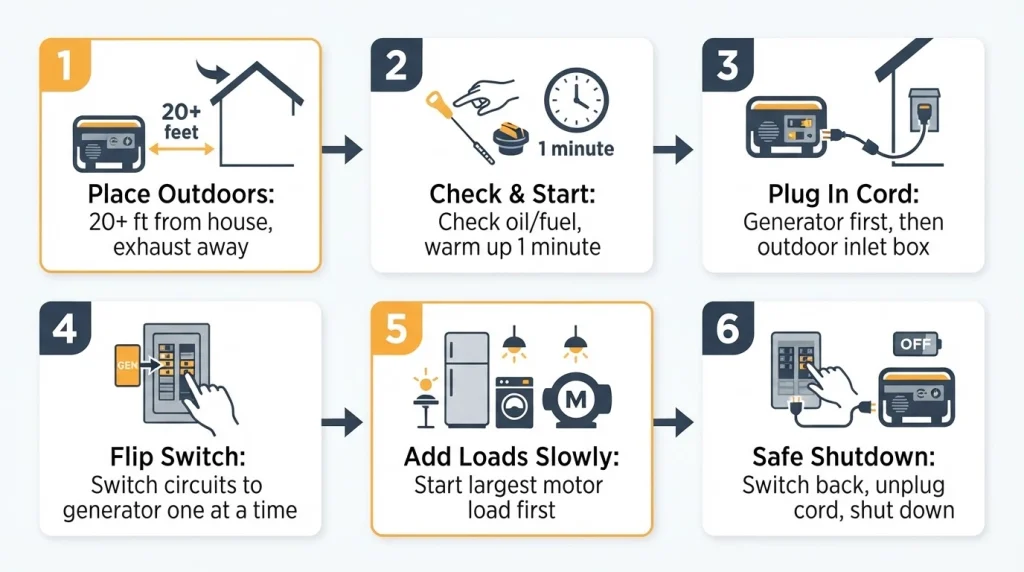
- Place the generator outdoors, at least 20 feet from the house, with exhaust pointed away.
- Check oil and fuel, then start the generator and let it warm up for a minute.
- Plug the cord into the generator first, then into the inlet box.
- Flip the transfer switch to generator power, one circuit at a time.
- Add loads slowly, starting with the largest motor load first.
- When grid power returns, switch back, unplug the cord, and shut down the generator.
That slow load order matters. I once flipped a fridge and a sump pump on together, and the generator tripped on overload in seconds.
If you need 240V power, look for a model with the right outlet before you buy. See our picks for the best portable generator with a 240V outlet to compare sizes and outlet types.
Safety note: Never run a generator in a garage, basement, or enclosed porch, even with a door open. Carbon monoxide can build up fast, so keep the unit outdoors and use a CO alarm inside.
Section Takeaway: Start the generator outdoors, plug in, flip circuits one at a time, and reverse the steps when grid power returns.
Transfer Switch vs Interlock Kit vs Extension Cords: Which Is Best?
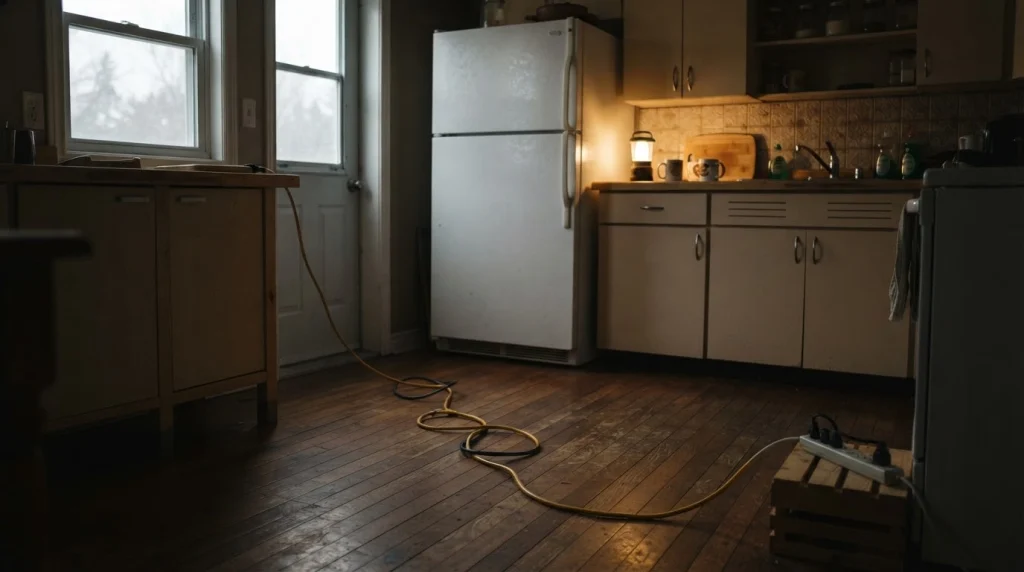
All three methods can power a home during an outage. Only two of them connect safely to your panel, and only one gives you a dedicated switch for each circuit.
Your choice depends on budget, panel space, and how many circuits you want to run. A transfer switch is the clearest option for most homeowners.
| Method | How It Works | Best For | Limits |
|---|---|---|---|
| Manual transfer switch | Dedicated switch moves 6-10 chosen circuits to generator power | Fridge, furnace, sump pump, lights | Higher cost, fixed circuit list |
| Interlock kit | A plate on the main panel blocks grid and generator breakers from being on together | Flexible circuit choice, lower cost | Needs panel space, easy to overload if you pick too many circuits |
| Extension cords | Cords run from the generator straight to appliances | One or two items, short outages | No hardwired loads, trip and weather risk |
| Backfeed / suicide cord | Generator plugs into a wall or dryer outlet | Never safe, never recommended | Can kill line workers and damage the home |
An interlock kit is a solid middle option when your panel supports it. It lets you pick circuits on the day, but you must watch total watts closely.
Extension cords work for a fridge and a phone charger. They cannot run a hardwired furnace, sump pump, or well pump.
The Consumer Product Safety Commission warns against backfeeding and unsafe generator hookups. Its generator safety pages are a good check before any home install.
Section Takeaway: A transfer switch gives the clearest, safest circuit control, an interlock adds flexibility, and extension cords suit only a few plug-in loads.
Common Mistakes and Safety Rules to Follow
Most transfer-switch problems come from sizing, not from the switch itself. A small mistake at setup can trip the generator or leave a key circuit dark.
I keep a short checklist taped inside my generator cover. It saves me from guessing when the power is out and the house is dark.
Mistakes that trip or damage a setup
- Too many circuits: Picking every circuit at once will overload a small inverter generator.
- Wrong voltage: Feeding 240V loads from a 120V-only generator will not work.
- Thin cord: An undersized cord drops voltage and can overheat.
- Stale fuel: Old gas can clog the carburetor and cause surging or hard starts.
- No test run: A switch you never tested is a guess, not a plan.
Safety rules that never change
Run the generator outdoors, at least 20 feet from the house. Keep exhaust away from windows, doors, and vents, and install battery-powered CO alarms inside.
The Centers for Disease Control and Prevention stresses outdoor placement and CO alarms for generator safety. Follow its guidance every time you run a unit.
Let the generator cool before refueling, and store fuel in an approved container away from living space. Check oil, air filter, and spark plug on the schedule in your manual.
If you are still planning load size, read our guide on generator size for a power outage before you pick circuits. It helps you match watts to the outage plan.
The National Fire Protection Association also covers electrical safety and code topics that apply to home generator installs. Ask your electrician how local code applies to your panel.
Safety note: Use a transfer switch or interlock installed by a licensed electrician. Never backfeed a home, and check your owner’s manual before use.
Section Takeaway: Size first, test before an outage, run outdoors, and let a licensed electrician handle the panel work.
Frequently Asked Questions
Can a 2000-watt inverter generator use a transfer switch?
Yes, a 2,000-watt inverter generator can use a 30-amp manual transfer switch for a few 120V circuits. Pick a fridge, lights, and small outlets, and leave motor-heavy loads off the list.
Can you use an inverter generator with an automatic transfer switch?
Usually no, because most portable inverter generators lack auto-start and auto-choke. An automatic switch suits a standby generator built for that job, so use a manual switch for a portable unit.
Do I need a 240V inverter generator for a transfer switch?
You need 120/240V only if you plan to run 240V loads like a well pump or central AC. A 120V-only generator works fine for 120V circuits through a matching switch.
What size transfer switch do I need for an inverter generator?
Match the switch to the generator outlet and your load plan. A 30-amp switch fits most 3,000- to 5,000-watt models, while a 50-amp switch fits larger 120/240V units.
Can two inverter generators in parallel feed a transfer switch?
Yes, two matched inverter generators with a parallel kit can feed a switch when both support parallel operation. Use the kit and outlet the maker specifies, and size the switch for the combined output.
Is a transfer switch better than an interlock kit?
A transfer switch is clearer and easier to use because each circuit has its own switch. An interlock kit is cheaper and more flexible, but it needs more care to avoid overload.
Do I need an electrician to install a transfer switch?
Yes, hire a licensed electrician for the switch, inlet, and panel wiring. That install keeps the work code-compliant and safe for your home and line workers.
Yes, you can use an inverter generator with a transfer switch, and a manual switch is the best fit for most homes. Size the generator to your chosen circuits, match voltage and amperage, and have the install done by a licensed electrician.
Test the setup before the next outage. Start the generator outdoors, flip one circuit at a time, and note what runs well together in 2026.

Hi, I’m Michael Turner. I own a generator workshop in the United States and founded HomeGeneratorBlog to share practical, hands-on guidance about generator installation, maintenance, troubleshooting, safety, and backup power solutions. My goal is to help homeowners make smarter, more confident decisions through clear and reliable information