How Do You Calculate the Generator Wattage You Need? A Simple 5-Step Formula That Prevents Overloads
Quick Answer
Add up the running watts for everything you’ll run at the same time, then add the extra surge from your largest motor. That total, plus 20% headroom, tells you the size to buy, and this approach works for home backup, RV trips, and camping. Start with a clear list of must-run loads, not every appliance you own, and check your plan against generator size for a power outage before you shop.
The 5-step wattage formula
- List loads: Write down only the items you’ll run together during a typical outage or trip.
- Add running watts: Sum the steady power each item draws while it runs normally.
- Add one surge: Add the extra starting watts for your single largest motor, not every motor.
- Add headroom: Multiply your running total by 1.2 to leave room for cycling loads and hot days.
- Match both ratings: Pick a generator whose running watts and starting watts both meet or beat your numbers.
If your math lands between sizes
- Size up one step, stagger motor starts, or plan to rotate heavy loads like a microwave and an air conditioner.
- Never size down and hope eco mode, a soft start, or luck will cover a motor surge.
I’ve run a fridge, a freezer, and a CPAP through a multi-day outage, and I’ve also tripped an overload trying to start a window air conditioner on a hot afternoon. An inverter generator can feel perfect for phones and lights, then stall the moment a compressor kicks on.
This guide shows you the exact math I use before I buy, borrow, or pack a generator for portable power. You’ll learn the difference between running watts and starting watts, how to find real numbers for your appliances, and how to test your total before you need it.
In This Guide
- What Do Running Watts and Starting Watts Actually Mean?
- What Is the Simple Formula to Calculate Generator Wattage?
- How Do You Find the Wattage for Each Appliance?
- How Many Watts Do Common Appliances Really Use?
- What Size Generator Do You Need for Home, RV, and Camping?
- What Can Throw Off Your Wattage Calculation?
- How Do You Test Your Wattage Math Before an Outage?
- Frequently Asked Questions
- Final Takeaway: Do the Math Once, Then Buy With Confidence
What Do Running Watts and Starting Watts Actually Mean?
Running watts measure the steady power an appliance draws while it runs. Starting watts measure the short surge a motor needs for a few seconds when it starts.
An inverter generator is a portable generator that makes power, converts it to direct current, then rebuilds it as a clean sine wave through an inverter. A clean sine wave means smooth, stable power that suits phones, laptops, medical devices, and modern electronics.
That clean output comes with a trade-off you must respect in your math. Most inverter generators are smaller than open-frame conventional generators, so a motor surge eats a larger share of their capacity.
What are running watts?
Running watts, also called rated watts, are the watts an appliance uses after it settles into normal operation. A fridge might run at 150 to 200 watts once its compressor is already turning.
Your generator must supply the sum of all running watts for loads that run at the same time. If that sum tops the running rating, the generator will overload even without a new motor start.
- Steady loads: Lights, chargers, fans, TVs, and routers draw a fairly flat load.
- Cycling loads: Fridges, freezers, and air conditioners cycle on and off, so plan for the moment they overlap.
- Heating loads: Microwaves, kettles, toasters, and space heaters draw high, steady watts with little or no surge.
What are starting watts?
Starting watts, also called surge watts or peak watts, are the brief spike a motor draws to get moving from a dead stop. A fridge compressor can pull three to six times its running watts for one to three seconds.
That spike is short, but it is real. I once watched a small inverter handle a fridge fine at idle, then shut down the instant the compressor and a freezer compressor cycled together.
- High-surge items: Refrigerators, freezers, well pumps, sump pumps, furnace blowers, and air conditioners.
- Low-surge items: LED lights, electronics, CPAP machines, and resistive heaters show little extra draw at start.
- Tool surge: Circular saws, compressors, and drills can surge hard under load, so check the tool plate.
Why do both ratings matter for an inverter generator?
You need two wins, not one. The running rating must cover your steady total, and the starting rating must cover that total plus the largest extra surge.
Shoppers often buy by the big number on the box. That big number is usually starting watts, and the smaller running watts number decides what you can run all evening.
Learn to read both numbers on the spec sheet before you compare models. If you want help decoding those labels, read how inverter generator ratings help you choose the right size and features for your use.
Power quality matters too, especially for sensitive electronics. THD, or total harmonic distortion, describes how clean the power waveform is, and lower THD is generally cleaner.
Section takeaway: Running watts decide what you can run for hours, starting watts decide whether motors can start at all, and you must satisfy both numbers before you buy.
What Is the Simple Formula to Calculate Generator Wattage?

Use this formula: total running watts plus the largest extra surge, with 20% headroom on the running total. It takes five minutes, and it beats guessing by size, brand, or a neighbor’s setup.
As of 2026, most makers still list running and starting watts on the spec sheet, not just on the box. Use those spec-sheet numbers, and treat any single headline watt number with care.
How do you run the 5-step calculation?
Work through these steps in order, and write each number down. A phone note works fine, and a paper list on the fridge works even better during an outage.
- List what runs together. Include the fridge, lights, CPAP, router, and any fan or pump that must run at the same time.
- Find running watts for each item. Use the label, manual, or the estimates in the table below as a starting point.
- Add the running watts. This sum is your steady load, before any motor starts.
- Add the largest extra surge. Take the largest motor’s starting watts, subtract its running watts, and add only that extra amount.
- Add 20% headroom and match both ratings. Multiply the running sum by 1.2, then choose a generator that meets the running need and the starting need.
Here is the formula in plain form. Starting need equals total running watts plus the largest extra surge, and running need equals total running watts times 1.2.
What does a home-essentials example look like?
Picture a quiet outage evening with a fridge, a freezer, a gas furnace blower, a CPAP, lights, and a laptop. Those are the loads that keep food cold, heat moving, and sleep safe.
- Fridge: 180 running watts, 1,000 starting watts.
- Freezer: 150 running watts, 900 starting watts.
- Furnace blower: 600 running watts, 1,800 starting watts.
- CPAP, lights, and laptop: 200 running watts combined, with no meaningful surge.
Add the running watts: 180 plus 150 plus 600 plus 200 equals 1,130 watts. The largest extra surge comes from the furnace blower: 1,800 minus 600 equals 1,200 extra watts.
Your starting need is 1,130 plus 1,200, or 2,330 watts. Your running need with headroom is 1,130 times 1.2, or 1,356 watts.
A generator rated near 1,800 running watts and 2,400 starting watts would clear both bars in this example. A unit rated only 1,600 running watts might start the blower once, then struggle when the fridge cycles on a hot night.
Why add only the largest surge, not every surge?
Motors rarely start at the exact same second, and you can stagger them on purpose. Adding every surge at once would push you toward a far larger, louder, and thirstier generator than you need.
Staggering is a skill, not luck. Start the largest motor first, let it settle for 20 to 30 seconds, then add the next load.
If two large motors must start together, change the math. Add both extra surges, or plan to unplug one load until the other is running.
Why add 20% headroom?
Headroom covers cycling overlap, warm weather, altitude, and loads you forgot. It also keeps the generator out of its overload zone, where voltage can sag and the engine works hardest.
Think of headroom as breathing room. A generator running near 95% load has no margin when a compressor kicks on.
For help turning this math into a shortlist, review what to look for in an inverter generator, including outlets, parallel capability, and fuel type. The U.S. Department of Energy also offers general guidance on estimating home energy loads at Energy.gov.
Section takeaway: Add running watts, add only the largest extra surge, add 20% headroom, and buy a generator that clears both the running and starting totals.
How Do You Find the Wattage for Each Appliance?
Start with the label on the appliance, then the manual, then a plug-in meter for a real reading. Estimates work for planning, but labels beat guesses when a motor surge is involved.
I keep a short list taped inside a kitchen cabinet. It took one afternoon to build, and it has saved me from overload guesswork in every outage since.
Where do you find watts, amps, and volts on a label?
Check the back, bottom, or side of the appliance for a rating plate. Many plates list watts directly, while others list amps and volts instead.
Use this simple math when only amps and volts appear: watts equal amps times volts. A device rated 5 amps at 120 volts draws about 600 watts.
- Look for running watts first. Some plates list input watts, which is close enough for planning.
- Check for locked-rotor amps. Motors may list a higher start current, which hints at a larger surge.
- Read the manual for surge data. Manuals sometimes list starting watts for pumps, compressors, and air conditioners.
Do not trust a single online estimate for a well pump, sump pump, or central air system. Those loads vary by horsepower, age, and head pressure, so check your own plate or manual.
Should you use a plug-in watt meter?
A plug-in meter gives you a real running-watts reading for 120-volt plug-in loads. Plug the appliance into the meter, run it normally, and note the steady watts.
Meters miss most short surges, so they understate starting watts. Use the meter for running watts, and use label or manual data for surge planning.
For hardwired loads like a furnace blower or well pump, do not improvise with a meter. Check the nameplate, manual, or a licensed electrician’s load notes instead.
What if you cannot find a number at all?
Use the table in the next section as a planning range, then size with extra headroom. Pick the high end of the range for older motors, larger units, and hot climates.
Older fridges and window units often draw more than new, efficient models. When in doubt, round up and test the load before you depend on it.
Section takeaway: Labels and manuals beat online guesses, a plug-in meter confirms running watts, and surge data matters most for motors, pumps, and compressors.
How Many Watts Do Common Appliances Really Use?
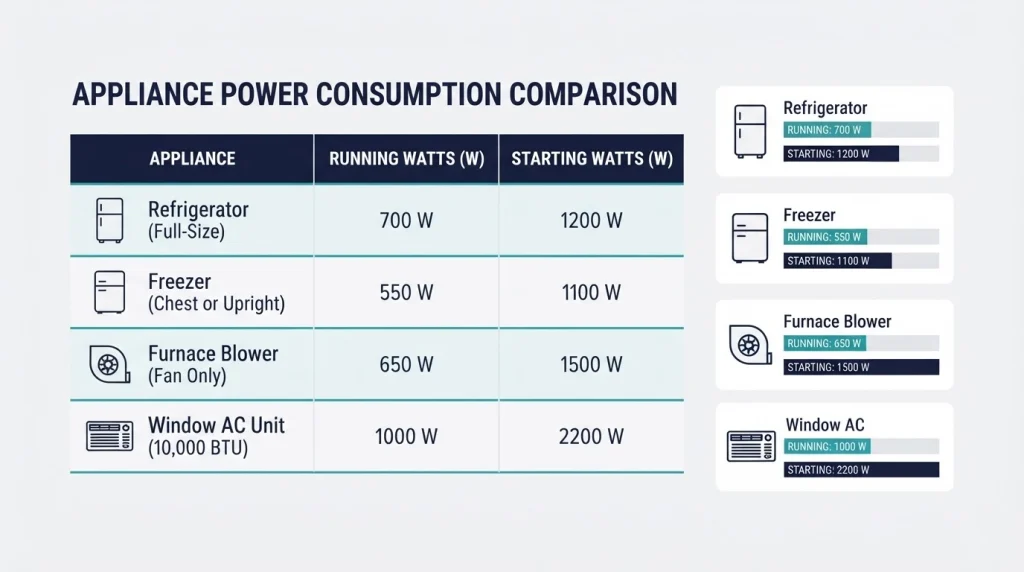
Use this table to build a first draft, then replace estimates with your own label numbers. Ranges are typical for common household sizes, and your model may sit outside the range.
Check the spec sheet for your exact appliance before you buy. A larger fridge, a deeper well, or a bigger air conditioner can shift your total by hundreds of watts.
| Appliance | Running watts | Starting watts | Notes |
|---|---|---|---|
| Refrigerator, full-size | 150–200 | 800–1,200 | Cycles on and off all day |
| Chest freezer | 100–200 | 800–1,000 | Stagger starts with the fridge |
| Gas furnace blower | 400–800 | 1,200–2,400 | Varies by blower size |
| Sump pump, 1/3 HP | 800–1,000 | 1,600–2,400 | Surge repeats with each cycle |
| Window AC, 10,000 BTU | 900–1,200 | 2,200–3,000 | Hard start on hot days |
| RV AC, 13,500 BTU | 1,200–1,500 | 2,800–3,500 | Often the largest RV load |
| Microwave | 1,000–1,200 | 1,000–1,200 | High steady load, little surge |
| Well pump, 1/2 HP | 1,000 | 2,000–3,000 | May need 240 volts |
| CPAP machine | 30–60 | 30–60 | Heated humidifier adds watts |
| Laptop, phones, and router | 100–200 | 100–200 | Small, steady, and easy to run |
| Five LED lights | 40–60 | 40–60 | LEDs beat old bulbs by a wide margin |
| Corded power drill | 600–800 | 1,200–1,800 | Load varies with the bit and material |
Notice how small the light and electronics loads look next to a single motor. That gap explains why a generator can feel roomy at night, then trip when a pump cycles at dawn.
Heating appliances deserve a separate warning. A space heater can draw 1,500 watts all on its own, and an electric water heater can draw far more.
Leave electric ranges, electric dryers, and central air off a small portable plan unless your math and outlets support them. Those loads often need a larger portable unit, a standby system, or a transfer switch plan from an electrician.
If cold food is your top priority, start your list with the fridge and freezer first. For model and sizing context, see the guide to the best portable generator for a refrigerator and how fridge surge shapes the choice.
Section takeaway: Motors drive the surge math, heaters drive the steady math, and lights and electronics rarely decide the generator size on their own.
What Size Generator Do You Need for Home, RV, and Camping?
Your use case sets the load list, and the load list sets the size. A camping setup and a home backup setup can differ by thousands of watts, even with the same generator type.
Use the ranges below as a starting point, then run your own five-step math. Your fridge, air conditioner, and pump sizes will move you up or down a class.
| Use case | Typical running watts | Starting need | Common size range |
|---|---|---|---|
| Camping essentials | 500–1,000 | 1,000–1,500 | 2,000-watt class |
| RV without air conditioning | 800–1,400 | 1,500–2,000 | 2,000–3,000 watts |
| RV with 13,500 BTU AC | 1,800–2,500 | 3,000–3,500 | 3,500–4,500 watts, or parallel pair |
| Home essentials | 1,500–2,500 | 3,000–4,500 | 3,500–5,000 watts |
| Home plus window AC or sump pump | 2,500–4,000 | 4,500–6,500 | 5,000–7,500 watts |
| Job-site power tools | 2,000–3,500 | 4,000–6,000 | 5,000 watts or more |
What size works for home backup during an outage?
Most home-essentials plans land in the 3,500 to 5,000-watt class, once you include a fridge, a furnace blower or sump pump, lights, and devices. Add a window air conditioner, and you often need the next size up.
Rotate heavy loads to stay inside a smaller size. Run the microwave for three minutes, then turn it off before you run a hair dryer or a coffee maker.
A transfer switch, inlet box, or interlock kit changes how you connect, not how much power you need. A transfer switch is a device that safely connects a generator to selected home circuits, and it should be installed by a licensed electrician.
Safety note: Run generators outdoors and well away from windows, doors, and vents, and never backfeed a home through a wall outlet. Use a transfer switch or interlock installed by a licensed electrician, and check your owner’s manual before use.
What size works for an RV air conditioner?
An RV air conditioner often decides the whole RV calculation. A 13,500 BTU unit can need 2,800 to 3,500 starting watts, even though it runs near 1,200 to 1,500 watts.
Add the converter, fridge on AC power, lights, and a microwave, and the running total climbs fast. Many RVers size up, use a parallel pair, or add a soft-start device to lower the AC surge.
Check your AC nameplate and your RV outlet type before you buy. For sizing context, see the guide to the best generator for an RV air conditioner and how starting watts shape that choice.
What size works for camping and tailgating?
Camping loads are usually light: phones, lights, a fan, a small cooler, and maybe a coffee maker. A 2,000-watt-class inverter generator often covers that list with room to spare.
Noise and weight matter as much as watts at a campsite. A quiet generator with eco-throttle can sip fuel at light loads, while a large open-frame unit can annoy the whole loop.
Watch the coffee maker and electric griddle. Those heaters can draw 1,000 to 1,500 watts each, and they can push a small unit into overload if they run together.
Section takeaway: Home backup usually needs more surge capacity than camping, RV air conditioning often sets the size, and your own load list beats any generic size chart.
What Can Throw Off Your Wattage Calculation?
Most sizing errors come from the same few habits. People use the box number, forget a cycling motor, or assume every load runs at once in a perfect, steady line.
I made the classic error early on: I added running watts, ignored surge, and bought too small. The generator ran my lights beautifully and failed the first time the fridge compressor kicked on.
What mistakes should you avoid?
Check your math against this list before you shop. One fix here can save you a return, a parallel kit, or a dark night.
- Using peak watts as running watts: The big box number is starting watts, so compare the smaller running rating to your steady total.
- Forgetting cycling loads: Fridges, freezers, pumps, and AC units cycle, so plan for overlap, not for a single quiet moment.
- Adding every surge at once: Add only the largest extra surge, unless two motors must start together.
- Ignoring 240-volt loads: Some well pumps and larger tools need 240 volts, and many small inverters offer only 120 volts.
- Skipping headroom: A generator at full load has no margin for heat, altitude, or a forgotten charger.
- Trusting a memory estimate: Check labels for motors and heaters, since a wrong guess can miss by 500 watts or more.
How do parallel kits change the math?
A parallel kit links two compatible inverter generators so they share the load. Parallel capability means the generator is built to pair safely with a matching unit through a kit.
Two 2,000-watt-class units in parallel can offer far more running and starting capacity than one alone. Check the kit and manual for the combined rating, since the total is not always a simple doubling.
Parallel pairs suit RV owners who want light weight for solo trips and more power for air conditioning. For options and limits, see the guide to the best portable generator with parallel capability.
Does eco mode change your wattage calculation?
Eco mode, also called eco-throttle or economy mode, lets the engine slow down at light loads to save fuel and cut noise. It does not raise the generator’s watt rating.
Turn eco mode off when you start a large motor. The engine needs time to ramp up, and a sudden surge can trip the overload before it catches up.
Use eco mode for steady light loads like lights and chargers. Switch it off for air conditioners, pumps, saws, and other surge-heavy starts.
How do propane, altitude, and heat affect output?
Fuel type and altitude can lower real output below the gasoline rating on the spec sheet. Dual fuel generators often produce fewer watts on propane than on gasoline, so check both ratings.
High altitude also cuts engine power, since thinner air holds less oxygen. Makers often note a derate per 1,000 feet, and some offer a high-altitude jet kit.
Heat, humidity, and a dirty air filter can add drag too. If you camp above 5,000 feet or run in extreme heat, add extra headroom and check the manual.
Safety note: Store fuel outdoors in approved containers, away from heat and living spaces, and let the generator cool before refueling. Check your owner’s manual for fuel type, oil checks, and break-in guidance.
Section takeaway: Parallel kits, eco mode, propane, and altitude change real capacity, so read both fuel ratings, turn eco mode off for motor starts, and keep headroom for tough conditions.
How Do You Test Your Wattage Math Before an Outage?
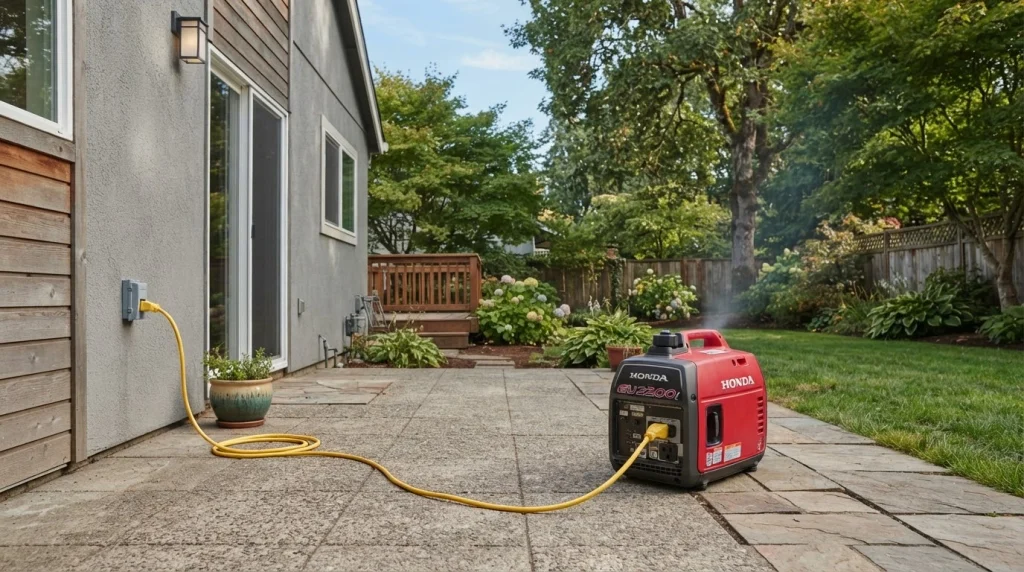
Test on a calm day, not during a storm. A 20-minute load test will show overloads, weak starts, and cord problems while you still have time to fix them.
I test mine twice a year: once before storm season, and once before a long RV trip. The test takes less time than a grocery run, and it builds real confidence.
What is a simple load test you can run at home?
Start with the generator outdoors, on level ground, away from the house. Add loads one at a time, largest motor first, and watch for overload lights, sagging lights, or engine strain.
- Start the generator with no load. Let it warm up for two to three minutes, with eco mode off.
- Add the largest motor first. Plug in the fridge, pump, or air conditioner and let it settle.
- Add the next loads one by one. Pause 20 to 30 seconds between each load, and note any strain.
- Run the full list for 15 minutes. Listen for surging, watch for overload warnings, and check cord warmth.
- Try a restart test. Unplug the largest motor, wait a minute, then restart it while the other loads run.
If the generator overloads during the restart test, your plan is too tight. Drop a load, stagger starts, or size up before you depend on the setup.
How should you manage loads during a real outage?
Keep a short priority list: must-run, nice-to-have, and rotate-only. Must-run loads stay on, nice-to-have loads run in turns, and rotate-only loads never run together.
- Must-run: Fridge, freezer, furnace blower or sump pump, CPAP, and a few lights.
- Rotate-only: Microwave, coffee maker, toaster, hair dryer, and window AC on a hot day.
- Delay: Laundry, dishwashers, and battery charging for tools can often wait until the storm passes.
Use heavy-duty, outdoor-rated extension cords rated for the load and length. Long, thin cords cause voltage drop, which strains motors and can trip overloads.
For authoritative safety guidance, review generator safety information from the U.S. Consumer Product Safety Commission and carbon monoxide guidance from the Centers for Disease Control and Prevention. For independent buying context, Consumer Reports offers general generator guidance and safety notes.
Safety note: Run generators outdoors only, at least 20 feet from the house when possible, with exhaust pointed away from windows and doors. Install battery-powered carbon monoxide alarms, and check your owner’s manual before use.
Section takeaway: A short load test on a calm day proves your math, and a simple priority list keeps you inside your watt budget during a real outage.
Frequently Asked Questions
How do you calculate generator wattage for a house?
List the circuits and plug-in loads you’ll run together, add their running watts, add the largest extra motor surge, and add 20% headroom. Then match both the running and starting totals to a generator rating, and use a transfer switch plan for hardwired circuits.
Do you add starting watts for every appliance?
No, add starting watts for only the largest motor, and use its extra surge above its running watts. Adding every surge at once overstates the need, unless two large motors must start at the same time.
What size inverter generator will run a refrigerator and freezer?
A fridge and freezer together often need about 250 to 400 running watts and 1,600 to 2,200 starting watts, depending on size and age. A 2,000-watt-class inverter can work for that pair alone, but add lights, a furnace blower, or a pump and you’ll likely need a larger size.
Can a 2000-watt inverter generator run an RV air conditioner?
Usually not on its own, since a 13,500 BTU RV air conditioner can need 2,800 to 3,500 starting watts. A parallel pair, a larger inverter, or a soft-start device often works better, so check your AC nameplate before you buy.
What happens if your generator is too small?
It may trip its overload protection, stall, or sag in voltage when a motor starts. Repeated overloads can stress the generator and connected loads, so size up, stagger starts, or rotate heavy appliances instead of forcing the unit to cope.
How much headroom should you leave on a generator?
Leave about 20% headroom above your total running watts for most home, RV, and camping plans. Leave more headroom for high altitude, extreme heat, propane fuel, older motors, or loads that cycle at the same time.
Final Takeaway: Do the Math Once, Then Buy With Confidence
Wattage math feels technical until you run it once with your own appliances. After that, it becomes a short list, two totals, and a clear yes or no on any generator you compare.
Write your list today, test it on a calm day, and keep it with the generator. That small habit turns a stressful outage into a calm routine, with cold food, safe sleep, and power you can trust.
Start with running watts, respect the largest surge, and leave room to breathe. Your future self, standing in a dark kitchen during the next outage, will thank you for the five minutes you spent on the math.

Hi, I’m Michael Turner. I own a generator workshop in the United States and founded HomeGeneratorBlog to share practical, hands-on guidance about generator installation, maintenance, troubleshooting, safety, and backup power solutions. My goal is to help homeowners make smarter, more confident decisions through clear and reliable information