How Do Inverter Generator Ratings and Reviews Help You Choose?
Quick Answer
Inverter generator ratings and reviews help you choose by turning spec sheets into real-world proof. Ratings show what a generator can do on paper, while reviews show what it does in a campsite, an RV, or a home outage. Together, they help you match watts, noise, runtime, and clean power to your loads before you buy. Start with the spec sheet, then check it against owner experience and an inverter vs conventional generator comparison.
Use ratings and reviews in this order
- Match the watts: Add up running watts for your loads, then check starting watts for motors.
- Check clean power: Look for low THD if you run laptops, phones, or medical gear.
- Test the noise claim: Compare dB ratings at the same load and distance.
- Read the patterns: Trust repeated owner complaints over one angry review.
- Confirm the fit: Pick the model that fits your main use, not the biggest one.
One habit that saves buyers
- Write down your three must-run loads before you read a single review.
I’ve bought inverter generators for home backup, RV trips, and campsites. The spec sheet looked simple each time.
Then the real questions started. Would it start my fridge? Would it stay quiet at night? Would it last through a long outage?
This guide shows how ratings and reviews answer those questions together. You’ll learn what each number means, which review signals to trust, and how to shortlist with confidence in 2026.
In This Guide
- What Do Inverter Generator Ratings Actually Mean?
- How to Read Running Watts, Starting Watts, and THD
- What Do Noise, Runtime, and Fuel Ratings Tell You?
- How to Read Reviews Without Getting Misled
- Which Review Signals Matter Most for Your Use?
- Ratings vs Reviews: What Each One Proves
- A Simple 5-Step Checklist to Choose With Confidence
- Frequently Asked Questions
What Do Inverter Generator Ratings Actually Mean?
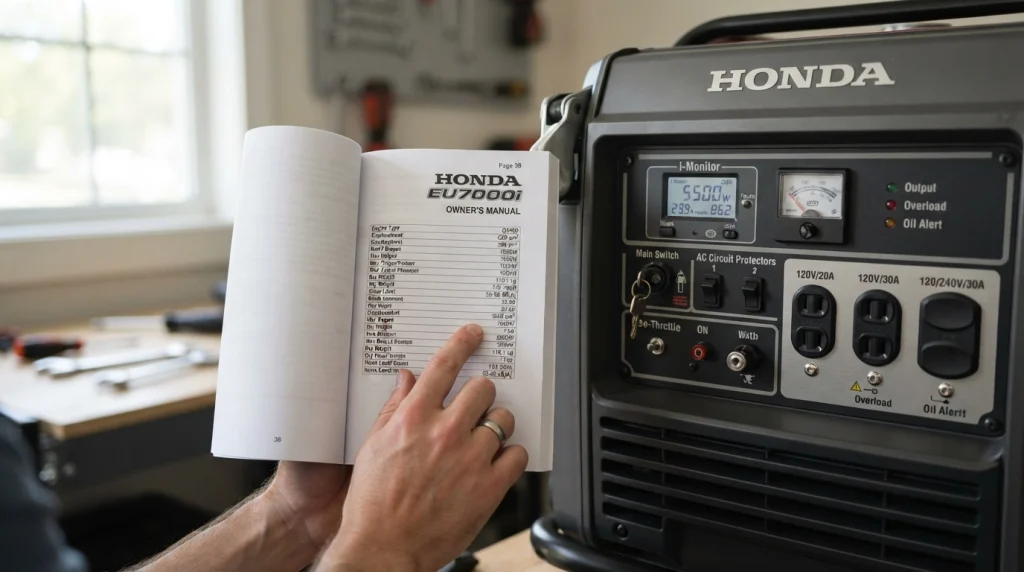
An inverter generator rating is a tested claim about one part of performance. It tells you watts, noise, runtime, or power quality under set conditions.
An inverter generator is a portable generator that makes clean, stable power for sensitive electronics. It converts raw engine power into a smooth sine wave, so laptops and phones run safely.
Ratings help you compare models on the same terms. Reviews help you check whether those terms hold up in daily use.
Why ratings alone can mislead you
A high wattage rating sounds reassuring. It means little if your fridge needs a big starting surge at the same moment.
That gap is why buyers need both sides. Ratings set the shortlist, and reviews test the shortlist.
The four ratings that matter first
- Running watts: the steady power a generator can supply without strain.
- Starting watts: the short surge it can supply when a motor starts.
- THD: total harmonic distortion, a measure of how clean the power is.
- Noise and runtime: how loud it runs, and how long it runs on one tank.
Start with these four.
Section Takeaway: Ratings give you a fair comparison, but only reviews show whether those numbers survive real loads, real noise, and real weather.
How to Read Running Watts, Starting Watts, and THD
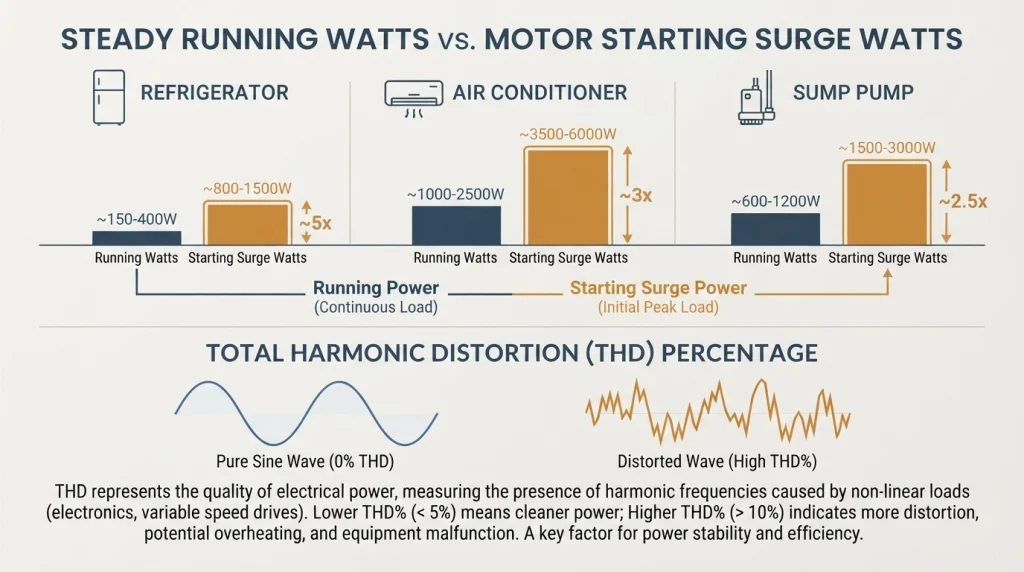
Running watts and starting watts answer different questions. Mix them up, and a generator that looks strong on paper can trip under load.
Running watts, also called rated watts, cover steady loads like lights, a fan, or a laptop charger. Starting watts, also called surge watts, cover the brief spike when a motor starts.
How do you do the wattage math?
List every load you must run at the same time. Add their running watts together first.
Then add the largest starting surge once. That total is the minimum running capacity you need, with a little headroom.
- Fridge: steady draw is modest, but the compressor surge is much higher.
- Window AC: needs a strong surge at startup, then settles to a lower draw.
- Sump pump: surges hard each time it kicks on, so size for the surge.
- CPAP machine: draws little power, but needs clean, steady power all night.
- Power tools: saws and drills surge at startup, then run at a lower level.
I learned this during a multi-day outage. My fridge and CPAP ran fine together, but adding a window AC tripped the overload.
The spec sheet had warned me. I had read the running watts and skipped the surge.
What is THD, and why does it matter?
THD stands for total harmonic distortion. It measures how far the power waveform strays from a pure sine wave.
Low THD means clean sine wave power. That matters for laptops, phones, routers, and medical devices like a CPAP.
Most inverter generators advertise low THD, often under 3 percent. Check the spec sheet for the exact figure, and treat a missing figure as a warning sign.
Section Takeaway: Add running watts, add the biggest surge once, and check THD before you plug in anything with a circuit board.
What Do Noise, Runtime, and Fuel Ratings Tell You?
Read them together. A quiet generator with a tiny tank may still wake you up for a refuel at 2 a.m.
How do you compare noise ratings fairly?
Noise is rated in decibels, written as dB. A small change in dB means a clear change in how loud it sounds.
Compare ratings at the same load and the same distance. A rating at quarter load and 23 feet is not the same as one at full load and 7 feet.
- Check the load: look for the load level, often 25 percent or 50 percent.
- Check the distance: look for the test distance in feet or metres.
- Check real reviews: owners report noise at night, near tents, and beside RVs.
Reviews caught what the rating missed. The noise rose and fell with the load.
What does runtime really mean?
Runtime is usually quoted at 25 percent or 50 percent load. A generator runs much longer at light load than at full load.
Tank size matters here too. A larger tank stretches runtime, but it also adds weight and bulk.
Eco mode helps at light loads by slowing the engine. It helps less when you run a heavy load all day.
What about fuel type and efficiency?
Most inverter generators run on gasoline. Dual fuel models also run on propane, which stores longer and burns cleaner.
Propane usually gives slightly less power than gasoline on the same model. Check the spec sheet for both fuel ratings before you decide.
Fuel efficiency shows up in runtime per tank, not in a single number. Compare runtime at the same load across models.
Safety note: Run generators outdoors and well away from windows, doors, and vents. Never run one in a garage, even with the door open.
Section Takeaway: Compare noise and runtime at the same load, and let owner reviews tell you what happens when the load changes.
How to Read Reviews Without Getting Misled
Reviews turn numbers into stories. A good review tells you what the generator did, what it powered, and what went wrong.
A weak review tells you only that the buyer loved it or hated it. Skip the feeling, and look for the facts.
What makes a review useful?
- Specific loads: the reviewer names the fridge, AC, or tools they ran.
- Real conditions: the reviewer mentions heat, rain, altitude, or long run times.
- Time in use: the reviewer used it for weeks or months, not one afternoon.
- Problems and fixes: the reviewer says what failed, and whether support helped.
- Balanced tone: the reviewer lists both strengths and limits.
One detailed review beats ten short ones. Look for the reviewer who sounds like you, with the same loads and the same use.
Which review red flags should you watch for?
Watch for reviews that praise everything and explain nothing. Watch for reviews that blame the generator for a clear sizing mistake.
Watch for the same complaint across many reviews. A repeated hard-starting problem, a clogged carburetor, or an overload trip is a pattern, not bad luck.
Check the review date as well. A model can change over time, and older reviews may describe an older version.
How many reviews are enough?
Read at least 20 to 30 reviews for a shortlisted model. Skim the top praise, then read the lowest ratings in full.
Then check an independent source. Consumer Reports tests generators in a lab, while owner reviews test them in real life.
Section Takeaway: Trust patterns over single reviews, details over praise, and recent experience over old ratings.
Which Review Signals Matter Most for Your Use?

Your use decides which review signals matter. A camper and a homeowner read the same reviews and need different answers.
Start with your main use. Then read reviews through that lens, and ignore praise for features you will never use.
What should home backup buyers look for?
- Long-run reliability: owners who ran it for days, not hours.
- Fuel and refuelling: how often it needed fuel, and how easy refuelling was.
- Transfer switch use: owners who connected it through a transfer switch or inlet.
- Overload behaviour: whether it shut down cleanly or tripped under a surge.
A transfer switch is a panel device that lets you connect a generator to home circuits safely. It needs a licensed electrician to install.
Safety note: Use a transfer switch or interlock installed by a licensed electrician. Never plug a generator into a wall outlet.
What should RV and camping buyers look for?
- Night noise: owners who ran it near tents or in RV parks.
- RV air conditioner: owners who started a rooftop AC without tripping.
- Weight and carry: owners who lifted it in and out of a truck bed.
- Parallel capability: owners who paired two units for more power.
Parallel capability lets you link two inverter generators for double the watts. It suits RV air conditioners and larger loads.
See which type of inverter generator fits different applications before you shortlist by size.
What should job site buyers look for?
- Tool surges: owners who ran saws, compressors, or drills.
- Dust and weather: owners who used it outdoors in heat, dust, or rain.
- GFCI outlets: owners who used ground-fault outlets for tool safety.
Check OSHA job-site safety rules before you run tools on site.
Section Takeaway: Read reviews for your use first, and let the other uses stay in the background.
Ratings vs Reviews: What Each One Proves
Ratings prove what a generator can do in a test. Reviews prove what it does in a home, a campsite, or a job site.
Neither one works alone. Ratings without reviews can hide real flaws, and reviews without ratings can hide sizing mistakes.
| What you check | What ratings prove | What reviews prove |
|---|---|---|
| Power | Running and starting watts on paper | Whether it starts a fridge or AC in practice |
| Clean power | THD figure from the spec sheet | Whether laptops and CPAPs ran without faults |
| Noise | dB at a set load and distance | How it sounds at night beside a tent |
| Runtime | Hours per tank at 25 or 50 percent load | How often owners refuelled in real outages |
| Reliability | Warranty length and stated features | Hard starts, stale-fuel clogs, and support quality |
| Safety | CO shutoff and low-oil shutdown listed | Whether those shutoffs worked when needed |
Use the table as a check, not a score. A model can win on ratings and still lose on reliability.
The CPSC and the CDC both warn that generator exhaust can kill, so placement matters more than any feature.
Safety note: Keep the generator at least 20 feet from your home, with exhaust pointing away. Check your owner’s manual before use.
Section Takeaway: Ratings show the promise, reviews show the proof, and the table above shows where each one counts.
A Simple 5-Step Checklist to Choose With Confidence
Work through them once. Then buy the model that passes all five, not the one with the loudest praise.
Step 1: List your loads
Write down the three loads you must run together. Add running watts, then add the biggest surge once.
This list stops impulse buys. It also stops you from buying far more power than you need.
Step 2: Shortlist by ratings
Pick two or three models that meet your watts, THD, noise, and runtime needs. Check the spec sheet for each one, not a retailer summary.
Drop any model with a missing THD figure or a vague noise rating. Clear specs are a sign of a serious maker.
Step 3: Read reviews for your use
Note repeated complaints first. Then note repeated praise, and check whether it matches your use.
Step 4: Check noise, weight, and fuel in real terms
Ask three plain questions. Can I lift it? Can I run it all night? Can I fuel it safely?
Noise ratings help here, and so do owner notes on weight and tank size. A quiet generator that you cannot lift is still the wrong buy.
For a fuller view of value, see whether inverter generators are worth buying for your use before you commit.
Step 5: Confirm safety, support, and the manual
Check for CO shutoff, low-oil shutdown, and clear manual guidance. Check warranty terms and parts availability too.
Section Takeaway: List loads, shortlist by ratings, test by reviews, check the practical fit, then confirm safety before you buy.
Frequently Asked Questions
Should I trust star ratings or written reviews more?
Trust written reviews more. Stars show a mood, while written reviews show loads, conditions, and outcomes you can check against your own needs.
How do I know if a review is fake?
Look for detail. Fake reviews often lack load names, use dates, and real problems, while genuine reviews name what they ran and what went wrong.
What THD should I look for in an inverter generator?
Look for low THD, often under 3 percent, for laptops, phones, and medical gear. Check the spec sheet for the exact figure, and avoid models that hide it.
Do noise ratings tell the whole story?
No, they tell part of it. A dB rating needs a load level and a distance to mean anything, and owner reviews show how noise changes as loads change.
Can reviews help me pick the right size?
Yes, when reviewers name their loads. A reviewer who ran a fridge, a CPAP, and lights tells you more than a wattage chart alone.
Are expensive inverter generators always better?
No, the best model is the one that fits your loads, noise limits, and runtime needs. Check our guide to the best inverter generators to compare shortlisted models by use.
Ratings and reviews work best as a pair. Ratings narrow the field, reviews test the field, and your load list keeps the choice honest.
If you take one habit from this guide, make it this one. Write down your loads first, then let ratings and reviews prove which generator can carry them.

Hi, I’m Michael Turner. I own a generator workshop in the United States and founded HomeGeneratorBlog to share practical, hands-on guidance about generator installation, maintenance, troubleshooting, safety, and backup power solutions. My goal is to help homeowners make smarter, more confident decisions through clear and reliable information