Are Inverter Generators Worth Buying? Honest Guide
Quick Answer
Yes, for most campers, RV owners, and homeowners who need clean, quiet power for phones, laptops, a fridge, or a CPAP, an inverter generator is worth buying. You pay more up front, but you get stable power, lower noise, and better fuel use at light loads. Learn how an inverter generator works before you size one for your home.
Worth it when:
- Clean power matters: You run laptops, phones, TVs, or medical gear that needs stable voltage.
- Noise matters: You camp, tailgate, or run power near neighbors and want a quieter machine.
- Fuel matters: You run light loads for hours and want eco-mode to stretch a tank.
- Portability matters: You carry power to a campsite, job site, or RV without a truck.
- Small loads fit: Your must-run list stays under about 2,000 to 4,500 running watts.
Skip it when:
- You need to run a whole house, central AC, or an electric water heater.
- You want the lowest cost per watt and noise is not a concern.
- You need long, heavy-load runtime without refueling often.
I’ve run inverter generators through multi-day outages, quiet campgrounds, and noisy job sites.
Some buyers love them from day one. Others wish they had bought a bigger conventional unit instead.
This guide goes deeper than a price tag. You’ll get real wattage math, honest trade-offs, and a clear buy-or-skip call for your situation.
In This Guide
- What Is an Inverter Generator?
- Are Inverter Generators Worth the Extra Cost?
- Inverter vs. Conventional vs. Dual Fuel Generator: Which Wins?
- What Can an Inverter Generator Run?
- How Much Do Inverter Generators Cost in 2026?
- Who Should Buy One, and Who Should Skip It?
- How Do You Choose the Right Size Inverter Generator?
- What Are the Downsides, Maintenance Needs, and Safety Rules?
- Frequently Asked Questions
What Is an Inverter Generator?

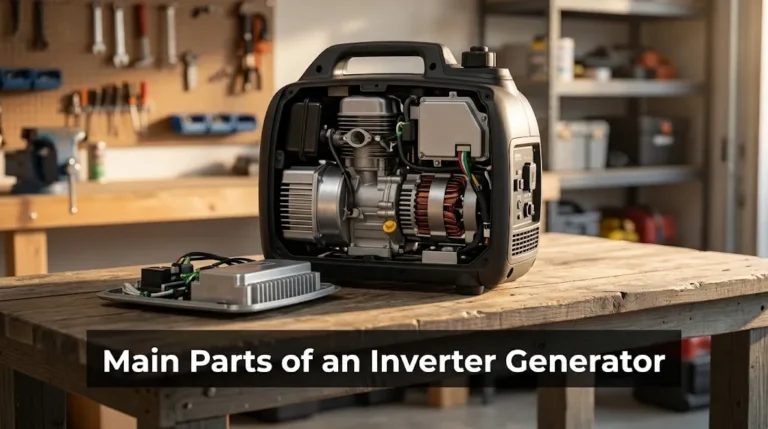
An inverter generator is a portable generator that makes clean, stable power for sensitive electronics.
It creates AC power, turns it into DC power, then rebuilds it as a pure sine wave.
That extra step is the whole point. It keeps voltage and frequency steady when loads change.
What does clean power mean?
Clean power means a smooth sine wave with low total harmonic distortion, often called THD.
THD measures how much the power wave wobbles from a perfect shape.
Most inverter generators keep THD under 3%. That level suits laptops, phones, CPAP machines, and modern fridge controls.
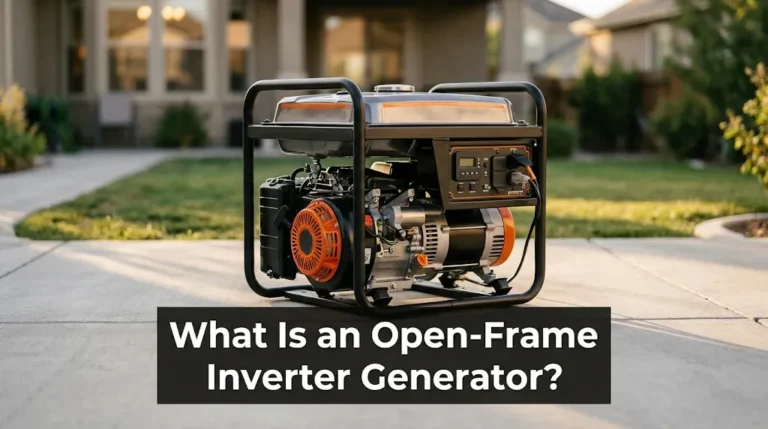
Conventional open-frame generators can run higher THD. They still work fine for many tools and heaters.
They just carry more risk for delicate circuit boards.
How is it different from a conventional generator?
A conventional generator runs its engine at one fixed speed, usually 3,600 rpm.
It holds that speed even when you only charge a phone.
An inverter generator uses eco-throttle, also called economy mode. It slows the engine when demand drops.
That saves fuel and cuts noise. It also makes the unit lighter and easier to carry.
I’ve camped next to both types. The difference at night is hard to miss.
Section Takeaway: An inverter generator trades raw size for stable, quiet, fuel-smart power, and that trade is ideal for electronics and light loads.
Are Inverter Generators Worth the Extra Cost?
Yes, if you value quiet power and clean output more than raw watts per dollar.
No, if you only need cheap bulk power for tools or heat.
The premium buys three things: lower noise, cleaner power, and better fuel use at part load.
What do you actually get for the premium?
- Quieter operation: Many small inverters run around 50 to 60 dB at quarter load, measured at about 23 feet. Check the spec sheet for the exact rating.
- Clean sine wave: Stable power protects laptops, routers, and CPAP machines from flicker and damage.
- Eco-mode savings: The engine slows at light load, so a small tank can last 8 to 12 hours or more at 25% load.
- Light weight: A 2,000-watt inverter often weighs 45 to 55 pounds. A similar conventional unit can weigh far more.
- Parallel capability: Many models link two units with a parallel kit for double the power.
When does the premium pay off?
It pays off fast for campers and RV owners. Quiet hours matter, and neighbors notice loud generators.
It also pays off for home backup with a short must-run list. A fridge, a few lights, phones, and a CPAP fit well.
It pays off less for a job site. Tools want brute power, and noise rules are looser there.
During a three-day outage, I ran a fridge and CPAP on a 2,200-watt inverter. Eco-mode stretched each tank through the night.
A louder open-frame unit would have worked too. It just would have burned more fuel and annoyed the whole street.
Section Takeaway: The extra cost is worth it when quiet, clean power solves a real problem for you, not when you just need maximum watts.
Inverter vs. Conventional vs. Dual Fuel Generator: Which Wins?
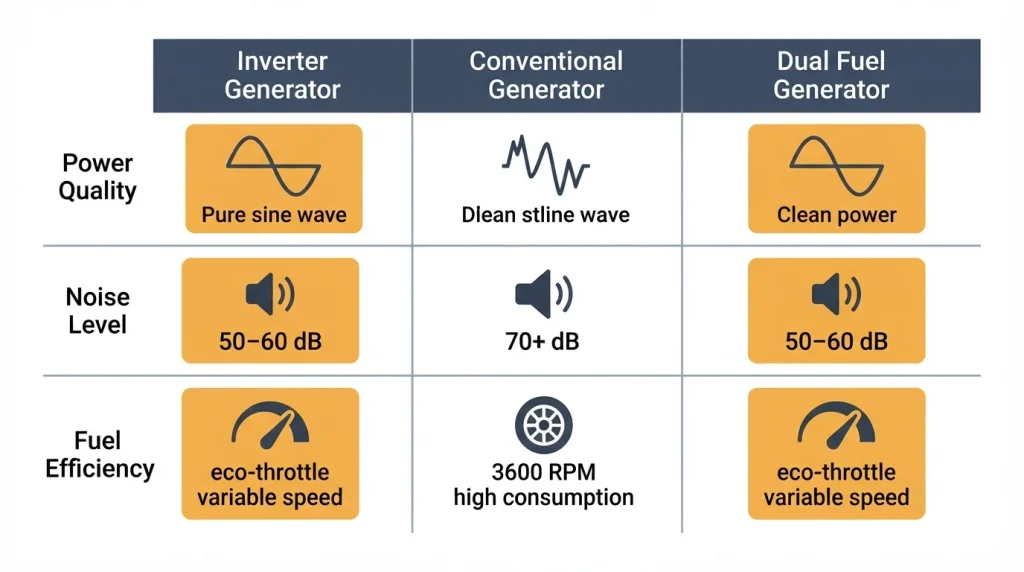
There is no single winner. The right type depends on your loads, your noise limits, and your fuel plan.
Use this table to compare the trade-offs side by side.
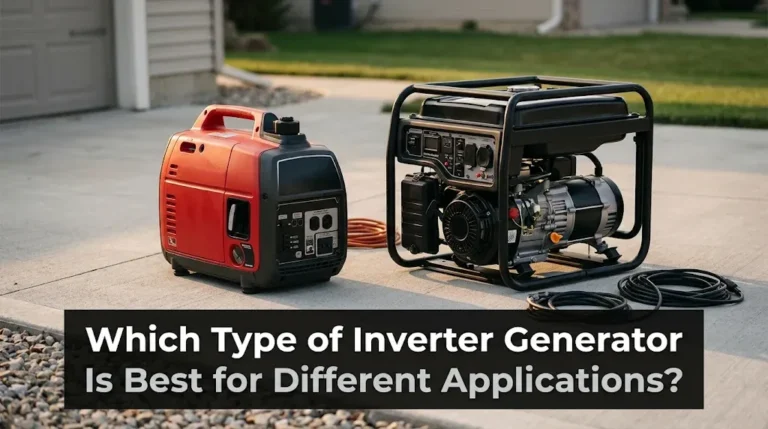
| Feature | Inverter Generator | Conventional Generator | Dual Fuel Generator |
|---|---|---|---|
| Power quality | Clean sine wave, low THD | Rougher output, higher THD | Varies by model, often inverter or conventional |
| Noise | Quietest, often 50-60 dB | Loudest, often 70 dB or more | Mid to loud, depends on design |
| Fuel use | Best at light loads with eco-mode | Fixed speed, uses more fuel at light loads | Propane stores longer, gasoline gives more watts |
| Size range | About 1,000 to 7,500 running watts | About 2,000 to 12,000+ running watts | About 2,000 to 10,000+ running watts |
| Best for | Camping, RVs, electronics, light home backup | Job sites, heavy tools, whole-house backup | Outages, fuel flexibility, longer storage |
| Cost | Highest cost per watt | Lowest cost per watt | Mid to high, plus propane tank cost |
Should you choose a dual fuel inverter instead?
A dual fuel inverter gives you two fuel choices in one clean-power machine.
Gasoline usually gives you more watts. Propane stores for years without going stale.
That mix helps in a long outage. You can start on gas, then switch to propane when gas runs low.
Read the dual fuel inverter generator guide if you want that flexibility without giving up clean power.
Safety note: Run generators outdoors and well away from windows, doors, and vents. Never run one in a garage, even with the door open.
Section Takeaway: Pick an inverter for quiet, clean power, a conventional unit for cheap bulk watts, and a dual fuel model when fuel choice matters most.
What Can an Inverter Generator Run?
It depends on running watts and starting watts. Running watts keep a device going.
Starting watts, also called surge watts, cover the brief spike when a motor starts.
A fridge may need 600 running watts but 1,200 starting watts. A window AC needs far more to start than to run.
Typical loads for common sizes
- 1,000-2,000 watts: Phones, laptops, lights, TV, fan, CPAP, small fridge.
- 2,000-3,500 watts: Full-size fridge, freezer, microwave in short bursts, sump pump, furnace blower.
- 3,500-4,500 watts: RV air conditioner with a soft start, window AC, well pump in some cases, more lights and outlets.
- 4,500-7,500 watts: Larger RV AC, multiple fridges, power tools, partial home backup.
Always check the spec sheet for your exact appliances. Nameplate watts beat guesswork every time.
What will it struggle with?
Central AC, electric water heaters, electric stoves, and large well pumps often need too much surge power.
Space heaters also eat watts fast. One 1,500-watt heater can use most of a small inverter’s capacity.
I once tried a window AC on a 2,000-watt unit without a soft start. It surged, tripped the overload, and shut down.
A larger unit or a soft-start kit would have fixed that. Size the surge load first, not just the running load.
For sensitive gear, see the best portable generator for sensitive electronics picks to compare clean-power options.
Section Takeaway: Add up starting watts first, then running watts, and leave a 20% safety margin so motors start cleanly.
How Much Do Inverter Generators Cost in 2026?
As of 2026, small inverter generators often cost about $400 to $1,000.
Mid-size models often run $800 to $2,000. Large models can reach $2,500 to $4,500 or more.
Brand, wattage, fuel type, and features drive the price. Honda and Yamaha often cost more than Champion, Westinghouse, WEN, or Predator.
What else should you budget for?
- Fuel and storage: Gas cans, fuel stabilizer, and propane tanks add cost fast.
- Parallel kit: Expect $50 to $150 if you plan to link two units later.
- Transfer switch or inlet: A safe home hookup needs a transfer switch or interlock installed by a licensed electrician.
- Maintenance: Oil, filters, spark plugs, and a spare air filter keep the unit ready.
- Cover and cords: A weather cover and heavy-duty extension cords protect your gear.
Total cost matters more than the sticker price. A cheap unit that needs constant repairs costs more over time.
If budget is tight, compare the best affordable inverter generator options before you buy on price alone.
Safety note: Use a transfer switch or interlock installed by a licensed electrician for home hookups. Never backfeed power through a wall outlet.
Section Takeaway: Budget for fuel, cords, and a safe hookup, not just the generator, and the true cost becomes clear before you buy.
Who Should Buy One, and Who Should Skip It?
Buy one if you camp, RV, tailgate, or need quiet backup for electronics.
Skip it if you need whole-house power or the lowest cost per watt.
Your use case decides the value, not the marketing.
Best fits
- Campers: Quiet power respects quiet hours and nearby tents.
- RV owners: Clean power runs AC, fridge, and laptops without fuss.
- Homeowners: Short outages need a fridge, lights, phones, and a CPAP, not a whole house.
- Tailgaters: Light, quiet power runs a TV and small grill gear.
- Remote workers: Stable power keeps laptops and routers safe during outages.
Poor fits
- Whole-house backup: You need a standby generator or a large conventional unit.
- Heavy job sites: Large saws, compressors, and welders want brute watts.
- Long heavy loads: Small tanks mean frequent refueling at high load.
- Tight budgets: A conventional unit gives you more watts for the same money.
If you want a shortlist, start with the best portable inverter generator guide and match the size to your must-run list.
Section Takeaway: Buy an inverter when quiet, clean, portable power fits your life, and skip it when size or price matters more.
How Do You Choose the Right Size Inverter Generator?
Start with your must-run list, not the biggest model on the shelf.
List every device you need at the same time. Add running watts, then add the largest starting watts.
Do the wattage math in four steps
- List must-run items: Fridge, lights, phones, CPAP, sump pump, and furnace blower are common picks.
- Add running watts: Use nameplate watts or your owner’s manual for each item.
- Add surge watts: Add the highest starting watts for one motor at a time, not every motor at once.
- Add a margin: Add 20% headroom so the generator does not run at full load all day.
Example: A fridge at 600 running watts plus 1,200 starting watts, lights at 100 watts, and a CPAP at 100 watts needs about 2,000 watts at startup.
A 2,200-watt inverter handles that with care. A 3,500-watt unit handles it with room to spare.
What size fits common needs?
- 2,000 watts: Camping, charging, lights, small fridge, CPAP.
- 3,500 watts: RV AC, fridge and freezer, sump pump, furnace blower.
- 4,500 watts: Larger RV AC, window AC, more home circuits, tools.
- Parallel pair: Two 2,000-watt units give you flexible power and easy transport.
For home backup, also read the best generator to buy for home guide to compare inverter and whole-house options.
Section Takeaway: Size by surge watts plus a 20% margin, and you will avoid overload trips and short generator life.
What Are the Downsides, Maintenance Needs, and Safety Rules?
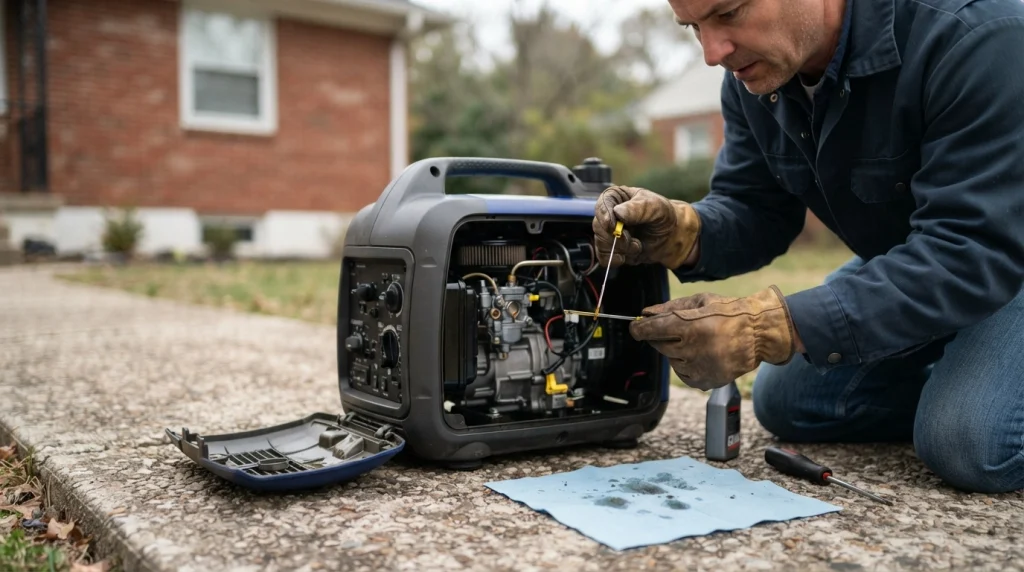
Inverter generators are not perfect. They cost more, hold less fuel, and need care to start when you need them.
Know the downsides before you buy. They are easier to manage than to fix later.
Real downsides to plan for
- Higher price: You pay more per watt than a conventional generator.
- Smaller tanks: Expect more refueling at high loads, even with eco-mode.
- Repair costs: Inverter modules and control boards cost more to replace than simple AVR parts.
- Stale fuel: Gas goes bad in weeks. It clogs carburetors and causes hard starts.
- Overload trips: Small units shut down fast when you add one load too many.
How do you keep one ready?
Run it monthly for 20 to 30 minutes under a light load. That keeps fuel moving and parts oiled.
Change oil per your owner’s manual, often after the first 20 to 30 hours, then on a regular schedule.
Use fuel stabilizer if gas sits for more than a month. Or drain the fuel for long storage.
Check the air filter, spark plug, and oil level before each outage season. Store it dry, clean, and covered.
For safety basics, the Consumer Product Safety Commission shares generator safety guidance, and the CDC explains carbon monoxide risks from portable generators.
The EPA also covers small-engine emissions and fuel care. Energy.gov offers home backup-power planning help, and Consumer Reports tests generators for noise and performance.
Safety note: Run generators outdoors and well away from windows, doors, and vents. Use battery CO alarms indoors and check your owner’s manual before use.
Section Takeaway: Monthly runs, fresh fuel, and safe outdoor placement keep an inverter generator ready and protect your family.
Frequently Asked Questions
Are inverter generators worth it for home backup?
Yes, for light backup like a fridge, lights, phones, and a CPAP. They give clean, quiet power for essential loads.
They are not ideal for whole-house backup, central AC, or electric heat. Those loads need a larger or standby unit.
Do inverter generators use less fuel?
Yes, at light loads. Eco-mode slows the engine when demand drops, so fuel lasts longer.
At full load, the advantage shrinks. A conventional unit can match it when both run near maximum.
Are inverter generators quieter than conventional generators?
Yes, in most cases. Many small inverters run around 50 to 60 dB at quarter load.
Conventional open-frame units often run 70 dB or more. Always check the spec sheet for the test distance.
Can an inverter generator run a refrigerator?
Yes, most full-size fridges run fine on a 2,000-watt inverter. You need enough starting watts for the compressor.
Add a 20% margin and avoid starting a microwave at the same time. That keeps the overload from tripping.
How long do inverter generators last?
With regular oil changes and clean fuel, many last 1,000 to 2,000 hours or more. Quality and care matter more than brand alone.
Follow your manual for break-in, oil, and storage. A neglected unit fails far sooner.
Is a 2000-watt inverter generator enough?
Yes, for camping and light backup. It runs phones, laptops, lights, a small fridge, and a CPAP.
It struggles with RV AC, window AC, and large motors. Size up or add a parallel kit for those loads.
Should I buy a dual fuel inverter generator?
Yes, if you want fuel flexibility in an outage. Propane stores longer, and gasoline gives more watts.
It costs more and adds tank storage. It is worth it when gas supply is uncertain.
If quiet, clean power fits your life, buy the right size and keep it maintained. If you need whole-house power or the cheapest watts, choose a bigger conventional or standby unit instead.
Start with your must-run list, add surge watts, and pick the smallest inverter that covers it with margin. That simple step turns a good purchase into a great one.

Hi, I’m Michael Turner. I own a generator workshop in the United States and founded HomeGeneratorBlog to share practical, hands-on guidance about generator installation, maintenance, troubleshooting, safety, and backup power solutions. My goal is to help homeowners make smarter, more confident decisions through clear and reliable information