Inverter Generator vs. Solar Generator: Which Is Better?
Quick Answer
Neither one wins outright. An inverter generator is better for high watts, long runtime, and motors such as a fridge or an air conditioner, while a solar generator is better for quiet, fume-free power indoors for phones, laptops, and lights. Start with our inverter portable generator guide if you want the fuel-powered side explained first.
Choose an inverter generator when
- High starting watts: Motors need a surge to start, and a fuel engine can meet that surge far more often than a battery can.
- Long outages: You can refuel in minutes, while a battery needs hours of sun or a wall outlet to recharge.
- Heavy loads: Air conditioners, sump pumps, and power tools sit in inverter-generator territory.
- Bad weather: An inverter generator runs in rain and cloud, with a safe shelter, while solar charging slows or stops.
Choose a solar generator when
- Indoor use: It makes no exhaust, so you can run it in a living room, a tent, or an apartment.
- Silence matters: It runs with no engine noise, which suits campsites, night use, and close neighbours.
- Light loads: Phones, laptops, lights, and a small fan are a natural fit for stored battery power.
- Low upkeep: No fuel, no oil changes, and no stale-gas carburetor trouble.
I have run both kinds of power through real outages, RV trips, and campsite nights. I have also watched people buy the wrong one, then learn that watts and watt-hours are not the same thing.
In This Guide
- What Is an Inverter Generator?
- What Is a Solar Generator?
- Inverter Generator vs. Solar Generator: Side-by-Side Comparison
- Which One Powers More? Wattage, Starting Watts, and Real Loads
- How Long Can Each One Run? Runtime, Fuel, and Recharging
- Noise, Safety, and Where You Can Use Each One
- Cost, Maintenance, and Which One Fits Your Situation
- The Bottom Line: Which One Should You Buy?
- Frequently Asked Questions
What Is an Inverter Generator?
An inverter generator is a fuel-powered generator that rebuilds its power before it reaches your appliances. It burns gasoline or propane, makes rough AC power, turns it into DC, then rebuilds it as clean AC power.
That rebuild step gives you a smooth, stable sine wave that suits laptops, phones, TVs, and modern furnace controls. The engine can also slow down at light loads, because it does not need to spin at one fixed speed.
What does THD mean for an inverter generator?
Total harmonic distortion, or THD, measures how far a power waveform strays from a smooth sine wave. A low THD number means cleaner power, while a high number means a rougher waveform.
Many inverter generators keep THD under 3 percent. Conventional open-frame generators often run much higher, typically 10 to 25 percent, although some sources list 6 to 25 percent for conventional models.
- Fuel: Gasoline is most common, with dual-fuel models adding propane at about 10 percent less power than gasoline.
- Size: Common portable sizes run from about 1,000 to 4,500 running watts, with larger models above that.
- Eco mode: Eco-throttle, or economy mode, lets the engine slow down at light loads to save fuel.
- Parallel capability: Many models can pair with a second matching unit through a parallel kit for more watts.
Section Takeaway: An inverter generator burns fuel and rebuilds the power into a clean sine wave under 3% THD, so it suits sensitive electronics and hard-starting motors.
What Is a Solar Generator?
A solar generator is not a generator in the engine sense. It is a portable power station: a large battery, an inverter, and a charge controller in one box, often sold with foldable solar panels.
You charge the battery from a wall outlet, a car outlet, or solar panels. The built-in inverter then turns the stored DC power into household AC power, with no engine running and no exhaust.
What do watts and watt-hours mean here?
Watts tell you how much power it can give at one moment. Watt-hours tell you how much energy the battery holds in total.
A 1,000-watt station with a 1,000-watt-hour battery can run a 100-watt load for about 10 hours in theory. Real use runs shorter, because the inverter loses some energy as heat and the battery keeps a reserve.
- Capacity: Small stations hold about 300 to 500 watt-hours, while mid-size models hold about 1,000 to 2,000 watt-hours.
- Output: Many mid-size stations offer about 1,000 to 2,000 running watts, with a short surge rating above that.
- Recharge: Wall charging takes a few hours, car charging takes longer, and solar charging depends on sun, panel size, and cloud cover.
For model ideas, see our best portable battery generator roundup.
Section Takeaway: A solar generator is a battery and inverter in one box, charged by sun, wall, or car power, and it gives silent, fume-free power until the battery runs down.
Inverter Generator vs. Solar Generator: Side-by-Side Comparison

The table below puts the two side by side on the points that decide most purchases. Read it as a trade-off list, not a scorecard, because each side wins a different set of rows.
| Feature | Inverter generator | Solar generator |
|---|---|---|
| Power source | Gasoline or propane, burned in an engine | Stored battery power, charged by sun, wall, or car |
| Typical running watts | About 1,000 to 4,500 watts for portable models | About 300 to 2,000 watts for common stations |
| Energy limit | Fuel in the tank, plus fuel you store | Battery watt-hours, then recharge time |
| Runtime | Hours per tank, refuel in minutes | Hours per charge, recharge in hours |
| Starting watts | Strong surge rating for motors | Limited surge, often too low for large motors |
| Noise | Engine noise, quieter than open-frame models | Silent, apart from a small cooling fan |
| Indoor use | Never, exhaust holds carbon monoxide | Yes, no exhaust at all |
| Power quality | Clean sine wave, often under 3% THD | Clean sine wave on most quality stations |
| Maintenance | Oil, fuel, air filter, spark plug, per your manual | Very little, keep the battery charged and cool |
| Weather dependence | Runs in cloud and rain, with safe shelter | Solar charging slows in cloud and stops at night |
Section Takeaway: An inverter generator wins on watts, surge, and runtime, while a solar generator wins on silence, indoor use, and upkeep.
Which One Powers More? Wattage, Starting Watts, and Real Loads
An inverter generator powers more, in most cases. It offers higher running watts and a stronger surge rating, so it can start motors that a battery station cannot.
That gap shows up fast with air conditioners. A window unit may draw about 1,000 running watts and need about 2,000 starting watts, which sits inside a 3,500-watt inverter generator and outside most portable power stations.
How do running watts and starting watts work?
Running watts are the steady watts a load draws once it runs. Starting watts, or surge watts, are the short spike a motor needs to start spinning.
A fridge may draw about 120 running watts and need about 500 starting watts. A sump pump may draw about 800 running watts and need about 1,500 starting watts.
Add the running watts first, then add the largest starting spike once. That total is the size you need, plus a safety margin for the next load that starts.
A worked example: a window air conditioner, a fridge, and a freezer
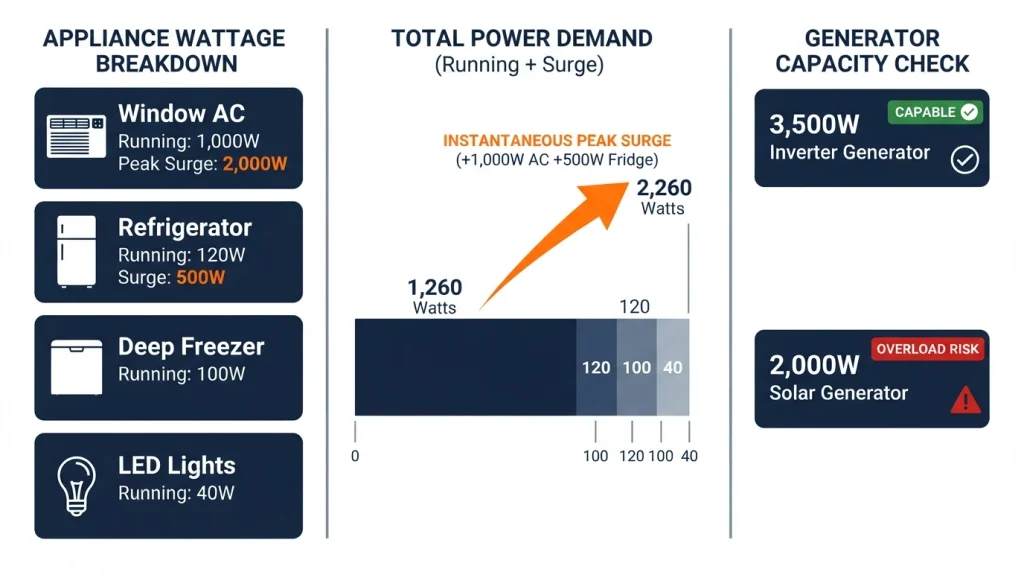
Picture a hot outage afternoon. You want a window air conditioner at 1,000 running watts, a fridge at 120 running watts, a freezer at 100 running watts, and lights at 40 running watts.
The running total is 1,260 watts. The air conditioner start adds about 1,000 watts above its running draw, so the peak hits about 2,260 watts for a few seconds.
A 3,500-watt inverter generator can meet that peak, if you start the air conditioner first and add the fridge and freezer after it settles. A 2,000-watt solar generator cannot, because its surge limit trips first, even with a full battery.
Now flip the load to phones, a laptop, and LED lights at about 80 watts together, with no motor start at all. That light load is where a solar generator shines, running all evening in silence while an inverter generator would burn fuel for a load that barely taxes it.
Section Takeaway: Size the choice on starting watts, not on the battery size alone, because a motor start is the load that separates the two options.
How Long Can Each One Run? Runtime, Fuel, and Recharging
An inverter generator runs longer, as long as you have fuel. A solar generator runs until its battery empties, then it needs hours to recharge.
That difference matters most in a multi-day outage. Fuel is energy you can carry in a can, while sunlight is energy you must wait for.
How long does an inverter generator run on a tank?
Runtime depends on tank size, load, and eco mode. A small inverter generator may run about 8 to 10 hours at 25 percent load on one tank, while a larger model may run less at a heavy load.
Refuelling takes minutes, once the engine has cooled. Store spare fuel in an approved container away from living space, and refuel outdoors.
Safety note: Run any generator outdoors, at least 20 feet from your home, windows, doors, and vents, with the exhaust pointed away from people and buildings. Let it cool before you refuel, and check your owner’s manual before use.
How long does a solar generator last on a charge?
Divide the battery watt-hours by the load watts for a rough guide, then cut the result by about 15 to 20 percent for inverter loss. A 1,000-watt-hour battery at a 200-watt load gives about 4 hours of useful power, not 5.
Recharging takes far longer than refuelling. A wall outlet may refill a mid-size station in a few hours, while a 200-watt solar panel in good sun may need most of a day.
Cloud, shade, panel angle, and short winter days all cut solar input. For longer off-grid stays, see our best portable generator for off-grid living guide.
Section Takeaway: Fuel gives an inverter generator days of runtime with minute-long refuels, while a solar generator gives hours per charge and needs sun or a wall outlet to recover.
Noise, Safety, and Where You Can Use Each One

A solar generator is silent and safe indoors. An inverter generator is quiet for an engine, but it still makes noise and exhaust, so it must stay outdoors.
That split decides many purchases on its own. An apartment, a tent, or a bedroom cannot host a fuel engine, no matter how small it is.
How loud is each option?
Many small inverter generators list about 50 to 60 decibels at 25 percent load, measured at a stated distance. That is close to normal conversation, and far quieter than an open-frame generator at full speed.
Check the spec sheet for the distance and the load behind any noise figure. A number with no distance or load tells you almost nothing, so compare like with like.
What are the safety rules for an inverter generator?
Carbon monoxide is the main risk. It has no smell and no colour, and it can build up fast in a garage, a tent, or a room with an open window.
Run the generator outdoors, at least 20 feet from your home, windows, doors, and vents. Point the exhaust away from people and buildings, and keep a battery CO detector inside the home.
Use a transfer switch or an interlock kit, installed by a licensed electrician, for any home connection. Never backfeed through a household outlet, and never run a generator in rain without a safe, ventilated shelter that keeps water off the outlets.
Safety note: Run generators outdoors and well away from windows, doors, and vents. Use a transfer switch or interlock installed by a licensed electrician, and check your owner’s manual before use.
Read our carbon monoxide safety guide before your first outage run. It covers placement, detectors, and what to do if an alarm sounds.
The CDC and the CPSC both publish generator CO safety guidance.
The U.S. Department of Energy also covers backup-power planning, and those sources agree on the outdoor rule.
What are the safety rules for a solar generator?
A solar generator has no exhaust, no fuel, and no hot engine. Its main risks are overload, heat, and a damaged battery.
Stay inside the running-watts and surge limits, keep vents clear, and keep the unit dry and out of direct heat. Do not use a swollen, cracked, or wet battery, and follow the maker guide for storage charge.
Section Takeaway: A solar generator is the only one of the two you can use indoors, while an inverter generator must stay outdoors at 20 feet, with a CO detector inside.
Cost, Maintenance, and Which One Fits Your Situation
An inverter generator costs less per watt, but it keeps asking for fuel and care. A solar generator costs more per watt, but it asks for almost nothing after you buy it.
Small inverter generators often cost less than a mid-size solar generator with panels, for far more watts. Fuel is the running cost on the inverter side, while a solar generator recharges for free in good sun.
What maintenance does each option need?
An inverter generator needs oil changes, air-filter checks, spark-plug care, and fresh fuel, per your manual. Stale gasoline can clog a carburetor, so run it dry or use stabiliser for storage.
A solar generator needs very little care. Keep it charged, store it cool and dry, clean the panel surface, and check cables and vents before a trip.
Which one fits your situation?
- Home outage, fridge and heat: Inverter generator, sized on running plus starting watts.
- RV air conditioner: Inverter generator, or two paralleled units, with a soft-start kit if your manual allows it.
- Apartment or indoor backup: Solar generator, because fuel engines cannot run indoors.
- Quiet camping, phones and lights: Solar generator, with panels for a multi-day trip.
- Job site or power tools: Inverter generator, for surge watts and all-day runtime.
If solar panels are part of your plan, compare them with our best portable generator with solar panels roundup.
Section Takeaway: An inverter generator is cheaper per watt and needs regular care, while a solar generator costs more per watt and needs almost no care.
The Bottom Line: Which One Should You Buy?
Buy an inverter generator if you need real watts for real motors. It starts air conditioners, runs fridges and pumps through long outages, and refuels in minutes.
Buy a solar generator if you need quiet, indoor power for light loads. It charges phones and laptops, lights a room, and runs with no fumes, no noise, and no fuel to store.
As of 2026, that split still holds. Batteries keep getting larger and cheaper, but fuel still wins on surge watts and multi-day runtime, while batteries still win on silence and indoor use.
List your must-run loads, add the largest starting spike once, and check the spec sheet before you buy. I am Michael Turner, and that wattage check is still the first one I do.
Section Takeaway: Choose on loads and location, not on the name, because watts, runtime, and indoor safety decide the winner for your situation.
Frequently Asked Questions
Can a solar generator run a refrigerator?
A large station can run a modern fridge for a few hours, if it meets the starting watts and holds enough watt-hours. A small station will trip or drain fast, so check the fridge nameplate and the station surge rating first.
Can a solar generator run an air conditioner?
Most portable stations cannot start a full-size RV or window air conditioner. The starting spike is too high, and the battery would drain in an hour or two even if it did start.
Can an inverter generator run indoors?
No, never run an inverter generator indoors, in a garage, or in a tent. The exhaust holds carbon monoxide, which has no smell or colour, so run it outdoors at least 20 feet from your home.
Can I charge a solar generator while I use it?
Yes, most stations support pass-through charging from solar or wall power while they run light loads. Heavy loads may still drain the battery faster than it charges, so check your manual first.
Which is better for camping?
A solar generator is better for quiet camping with phones, lights, and laptops. An inverter generator is better if you need an RV air conditioner, a microwave, or power tools at camp.

Hi, I’m Michael Turner. I own a generator workshop in the United States and founded HomeGeneratorBlog to share practical, hands-on guidance about generator installation, maintenance, troubleshooting, safety, and backup power solutions. My goal is to help homeowners make smarter, more confident decisions through clear and reliable information