Are Inverter Generators More Powerful Than Conventional Generators?
Quick Answer
No, inverter generators are usually not more powerful than conventional generators. A conventional open-frame generator often gives more running watts for the same money, while an inverter generator gives cleaner, steadier power at a lower wattage. For the clean-power side of that trade-off, see what an inverter generator is and how it works.
The short version
- Peak watts favour conventional: Large open-frame models often reach 7,500 to 12,000 running watts or more.
- Most inverters stay smaller: Common portable inverter models run from about 1,000 to 4,500 running watts.
- Clean power favours inverter: Inverter output often holds total harmonic distortion under 3%, while conventional output often runs 10 to 25%.
- Usable power is the real test: A smaller inverter can still run your fridge, lights, and laptop if its running watts cover them.
- Parallel kits close the gap: Two matched inverters can share a larger load, though they still cost more per watt.
Before you buy, do this first
- Add up running watts for your must-run loads, then add the largest motor start.
- Compare that total with running watts, not with the bigger starting-watts number on the box.
- Pick the smallest unit that covers that total with about a 20% margin.
I have run both types side by side, and the difference shows up fast. The big open-frame unit started everything at once, and the small inverter ran the quiet, steady loads all night.
This guide explains where each type wins on power, where each one falls short, and how to match the watts to your home, RV, or job site as of 2026.
In This Guide
- What Does “More Powerful” Actually Mean?
- Are Inverter Generators More Powerful Than Conventional Generators?
- How Much Power Can an Inverter Generator Make?
- How Much Power Can a Conventional Generator Make?
- Inverter vs Conventional Generator: Power Comparison
- Why Do Conventional Generators Usually Offer More Watts?
- Can Two Inverter Generators Match a Big Conventional Generator?
- Which Type Should You Choose for Your Loads?
- Conclusion
- FAQ
What Does “More Powerful” Actually Mean?

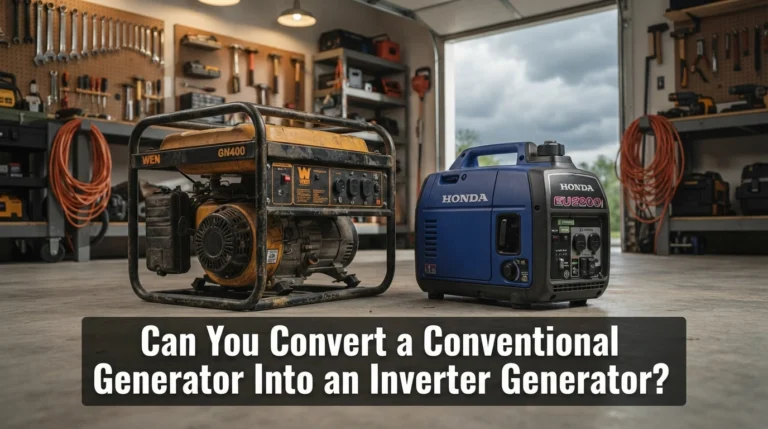
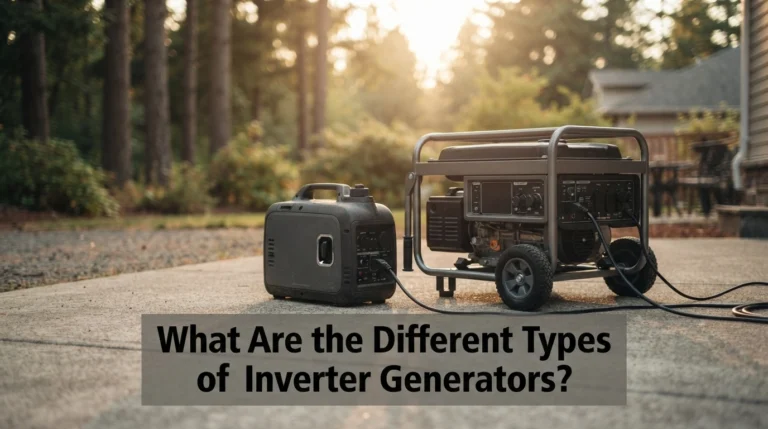
An inverter generator is a portable generator that converts raw power to DC, then rebuilds it as a clean, stable sine wave. A conventional generator, often called an open-frame generator, makes AC power straight from the engine and alternator, with engine speed tied to output frequency.
“More powerful” usually means more watts, but watts alone can mislead you. A generator has two watt ratings, and they measure different things.
Running watts, also called rated watts, are the power a generator can sustain for hours. Starting watts, also called surge watts, are the brief extra push it can give for a few seconds when a motor starts.
A fridge may run on 150 watts and need 600 to 800 watts to start its compressor. A window air conditioner may run on 700 to 900 watts and need 1,800 to 2,200 watts to start.
Those starting spikes decide whether a unit trips, even when the running load looks small.
Power quality is a second meaning of “powerful,” and it matters for electronics. Clean power means steady voltage, steady frequency, and a smooth sine wave.
The usual measure is total harmonic distortion, or THD. THD describes how far the wave strays from a perfect sine shape, and lower is cleaner.
Many quality inverter generators hold THD under 3%. Conventional open-frame generators often run much higher, commonly in the 10 to 25 percent range, depending on load and design.
Some sources list 6 to 25 percent for conventional models, so the range varies by model and source.
For the watt terms in full, see the portable generator watts guide. It covers running watts, starting watts, and how to read a spec sheet.
Section Takeaway: “More powerful” can mean more running watts, more starting watts, or cleaner power, so check all three before you compare two models.
Are Inverter Generators More Powerful Than Conventional Generators?
No, not on raw watts. A conventional generator of the same price usually gives you more running watts than an inverter generator.
That answer flips if you mean clean power. An inverter generator gives steadier voltage and frequency, and much lower distortion, than a conventional generator at the same load.
Think of it as two different strengths. Conventional wins on size, and inverter wins on quality.
A typical portable inverter in the 2,000 to 3,500 running-watt range can run a fridge, lights, a router, a laptop, and a furnace blower. It will struggle with a large well pump, a central air conditioner, or several big motors at once.
A typical open-frame conventional unit in the 7,500 to 10,000 running-watt range can run those bigger loads. It can also run a whole panel of home circuits through a transfer switch, if the house wiring allows it.
The price gap tells the same story. Inverter parts, including the inverter module and the microprocessor that controls it, cost more to build than a simple open-frame alternator.
So you pay more per watt for an inverter, and you get quieter running, lower fuel use at light load, and safer power for sensitive electronics in return. That trade is worth it for many owners, and it is the wrong trade for others.
Safety note: Run generators outdoors only, at least 20 feet from the house, with exhaust pointed away from doors, windows, and vents. Never run one in a garage, even with the door open.
Section Takeaway: Conventional generators are more powerful on watts, while inverter generators are more powerful on clean, steady power.
How Much Power Can an Inverter Generator Make?
Most portable inverter generators fall in the 1,000 to 4,500 running-watt range as of 2026. Small suitcase models sit near the bottom of that range, and larger wheeled inverter models sit near the top.
A 1,000 to 2,000 running-watt inverter suits camping, tailgating, and light charging. It can run LED lights, phones, a laptop, a small fan, and a CPAP machine without a heated humidifier.
A 2,000 to 3,500 running-watt inverter suits a light home outage or an RV without a large air conditioner. It can add a fridge, a router, a furnace blower, and a microwave in turns.
A 3,500 to 4,500 running-watt inverter suits a heavier outage list or a small RV air conditioner. It can start a window air conditioner or a 13,500 BTU RV air conditioner, if you start that motor first and keep other large loads off.
Large inverter models above 5,000 running watts exist, and some reach 7,000 to 7,500 running watts. They are heavy, costly, and far less common than the small and mid-size models.
Fuel changes the number too. A dual-fuel inverter often gives about 10% less power on propane than on gasoline, so check the spec sheet for both ratings.
Size on the propane figure if propane will be your main fuel.
Eco mode also changes what the unit can do at the moment you need it most. Eco mode slows the engine at light load to save fuel and cut noise.
That slow idle can stumble when a large motor starts. Turn eco mode off before you start a fridge compressor, a sump pump, or an air conditioner, then turn it back on once the motor is running.
For a buying shortlist in this size range, the inverter portable generator buying guide covers sizes, outlets, and features to check before you buy.
Section Takeaway: Most portable inverters make 1,000 to 4,500 running watts, which covers home essentials and RV camping, but not a whole house at once.
How Much Power Can a Conventional Generator Make?
Conventional portable generators start where most inverters stop. Common open-frame models run from about 5,000 to 12,000 running watts, and larger models reach higher still.
A 5,000 to 7,500 running-watt conventional unit suits a home outage with several large loads. It can run a fridge, a furnace blower, a sump pump, lights, and a window air conditioner, with room for a microwave in turns.
A 7,500 to 10,000 running-watt unit suits a larger outage list or a job site. It can run power tools, a well pump, and more than one large motor, if you stagger the starts.
A 10,000 to 12,000 running-watt unit, and larger, suits a near whole-house load through a transfer switch. It can cover central air conditioning in some homes, though you still need to check the starting watts and the panel wiring.
Conventional units make those watts with a simple design. The engine holds about 3,600 revolutions per minute to make 60-hertz power, even when only a lamp is plugged in.
That fixed speed is why they stay loud and thirsty at light load. The engine cannot idle down the way an inverter engine can, so fuel use and noise stay high all day.
It is also why their power is rougher. Voltage can sag when a large motor starts, and the wave carries more distortion than an inverter wave.
Sensitive electronics, furnace boards, and some medical devices may not like that roughness.
For the capacity side in more depth, the generator power capacity guide explains how capacity, load, and runtime fit together.
Safety note: Use a transfer switch or interlock installed by a licensed electrician for house circuits. Never plug a generator into a wall outlet to backfeed a panel, because that can injure utility workers.
Section Takeaway: Conventional generators commonly make 5,000 to 12,000 running watts, which covers bigger motors and more circuits, at the cost of noise, fuel, and rougher power.
Inverter vs Conventional Generator: Power Comparison
The table below compares the two types on the power points that matter most. Use it to see the trade-off at a glance, then read the sections after it for the reasons behind the numbers.
| Factor | Inverter generator | Conventional generator |
|---|---|---|
| Typical running watts | 1,000 to 4,500, larger models to about 7,500 | 5,000 to 12,000, larger models higher |
| Power quality (THD) | Often under 3% | Often 10 to 25% |
| Voltage and frequency | Steady, set by the inverter | Can sag under a motor start |
| Engine speed | Varies with load | Fixed near 3,600 rpm |
| Noise at light load | Usually quieter | Usually louder |
| Fuel use at light load | Lower, engine idles down | Higher, engine stays fast |
| Cost per watt | Higher | Lower |
| Best for | Electronics, RV, camping, home essentials | Heavy tools, large motors, high load |
One row deserves a second look: power quality. A conventional unit can outrun an inverter on watts and still be the wrong choice for a laptop, a router, or a modern furnace board.
Check the spec sheet for THD on both types, not just the wattage. A low-THD conventional model exists, but it is the exception, not the rule.
For low-distortion options, the best portable generator with low THD guide lists models built for cleaner output.
Section Takeaway: The table shows the real trade, more watts and lower cost per watt on the conventional side, cleaner and steadier power on the inverter side.
Why Do Conventional Generators Usually Offer More Watts?
The answer is design, not effort. A conventional generator has fewer parts between the engine and the outlet.
Its alternator makes AC power straight from the spinning engine. No inverter module sits in the middle, so no module limits the current or adds cost.
An inverter generator adds a rectifier and an inverter module to that path. Those parts rebuild the power into a clean sine wave, but they also set a ceiling on how much power can pass through them.
That ceiling rises with bigger, costlier parts. A 7,500 running-watt inverter needs a much larger inverter module, a larger engine, and better cooling than a 2,000-watt model.
Weight and size follow the same curve. A large inverter is heavy and costly, so most buyers choose a smaller inverter or a larger conventional unit instead.
Cooling is a second limit. Inverter electronics make heat, and heat needs airflow and space.
An open-frame conventional unit dumps heat straight into the air, while an enclosed inverter must manage it inside a smaller case.
Market demand is the third reason. Most inverter buyers want a quiet, portable unit for camping, RV use, or a light outage.
Most buyers who need 10,000 watts want a job-site or whole-house tool, and they accept the noise.
Manufacturers build for those buyers. That is why the inverter shelf tops out near 4,500 running watts for most models, while the conventional shelf runs far higher.
Section Takeaway: Conventional units offer more watts because their simpler design has no inverter module to limit current, cool, or pay for.
Can Two Inverter Generators Match a Big Conventional Generator?
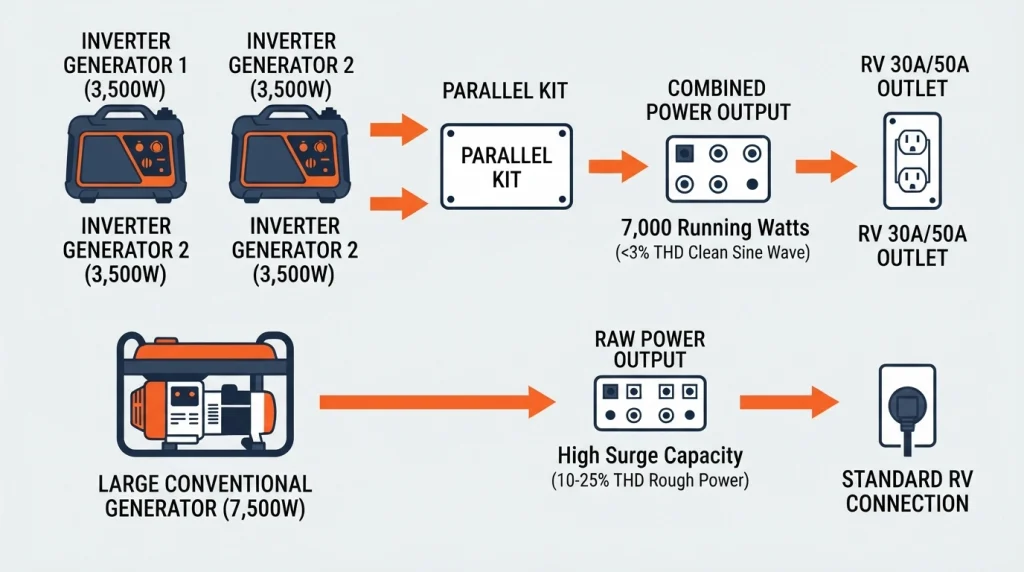
Yes, in many cases, through parallel operation. Two matched inverter generators can link with a parallel kit and share a larger load.
Two 3,500 running-watt inverters in parallel can give about 7,000 running watts together. That matches a mid-size conventional unit on watts, while keeping the clean power of an inverter.
Parallel kits work only with compatible models, usually two units of the same model or a matched pair from the same brand. Check compatibility first, because not every inverter pairs with another, even from the same maker.
The kit links the outputs and keeps the two units in sync. It also gives you a larger outlet, often a 30-amp or 50-amp RV outlet, so you can plug in a heavier load.
Parallel power still costs more per watt than a single conventional unit. You buy two engines, two inverter modules, and a kit, instead of one open-frame engine.
It also doubles the fuel and maintenance work. You fill two tanks, change oil in two engines, and store two units instead of one.
Where parallel shines is flexibility. Run one unit for a light night, and link the second only when the air conditioner or a large tool needs it.
A single big conventional unit cannot split itself that way.
I used that split on an RV trip with a 13,500 BTU air conditioner. One 3,500 running-watt inverter started the unit with eco mode off, and it held the fridge and lights too.
The microwave tripped it when I added it at the same time. I linked a second matched inverter the next day, and the pair ran the air conditioner and the microwave in turns without a trip.
A single 7,500 running-watt conventional unit would have run both at once, louder, and with rougher power for the laptop.
Safety note: Use only the parallel kit made for your models, and follow the manual for the link order. Never join two generators with a home-made cable.
Section Takeaway: Two matched inverters in parallel can match a mid-size conventional unit on watts, with cleaner power and more cost, fuel, and upkeep.
Which Type Should You Choose for Your Loads?

Choose by your largest motor, not by the biggest number on the box. List your must-run loads, add their running watts, then add the starting watts for the largest motor only.
Here is a worked example from an RV trip, different from a home outage list. A 13,500 BTU RV air conditioner runs at about 1,500 watts and needs about 2,800 watts to start.
A fridge adds 150 watts, LED lights add 40 watts, and a laptop charger adds 65 watts.
The running total is 1,755 watts. For the brief start peak, swap the air conditioner running figure for its starting figure: 2,800 watts for the start, plus 150 for the fridge, 40 for lights, and 65 for the laptop, which comes to about 3,055 watts.
A single 2,000 running-watt inverter, with about 2,200 starting watts, would fall short of that peak. A single 3,500 running-watt inverter, with about 4,000 starting watts, could start it, if eco mode is off and no other large load runs at the same time.
A pair of matched 3,500 running-watt inverters would cover it with room to spare, and could add a microwave in turns. A single 7,500 running-watt conventional unit would cover it easily, and could add a microwave too.
That math points to a simple rule. Pick an inverter if your list fits under about 4,500 running watts and clean power matters.
Pick a conventional unit if your list runs past that, or if you need 240 volts for a well pump or central air.
Pick parallel inverters if you want clean power at a higher total, and you are willing to pay for two units. Pick a single large conventional unit if you want the most watts for the money and you can live with the noise.
For the sizing steps in full, the what size generator for home guide walks through the same math for a house list. The U.S. Department of Energy also publishes general guidance on home energy use at energy.gov.
Carbon monoxide safety still decides where the unit sits, whatever type you choose. The CDC and the U.S. Consumer Product Safety Commission both warn against running fuel generators indoors or in a garage.
Keep the unit at least 20 feet from the house, and use a battery carbon monoxide alarm inside.
Section Takeaway: Add running watts, add the largest motor start, then choose inverter under about 4,500 watts, parallel inverters for clean power above that, or conventional for the most watts per dollar.
Conclusion
Inverter generators are not more powerful than conventional generators on raw watts. Conventional open-frame models give you more running watts for the money, and they cover larger motors and more circuits.
Inverter generators win on clean, steady power, quiet running, and fuel use at light load. That win matters most for electronics, RV use, camping, and a light home outage.
Size by your must-run list, add the largest motor start, and leave about a 20% margin. I am Michael Turner, and that load list, not the headline watts, is still the first check I do.
If you need clean, quiet backup for home essentials or RV use, an inverter generator is a solid place to start. Size it to your must-run list, not to the biggest number on the box.
FAQ
Are inverter generators more powerful than regular generators?
No, on raw watts a regular conventional generator is usually more powerful. Most portable inverters make 1,000 to 4,500 running watts, while common conventional models make 5,000 to 12,000 running watts.
Inverters win instead on clean, steady power.
Can an inverter generator run a refrigerator and an air conditioner?
Yes, if its running watts cover both loads and its starting watts cover the air conditioner start. A fridge runs at about 150 watts, while a small window air conditioner may need 1,800 to 2,200 watts to start.
Start the air conditioner first, with eco mode off, then add smaller loads.
What is the most powerful inverter generator?
Most portable inverter models top out near 4,500 running watts, and larger models reach about 7,000 to 7,500 running watts. Check the spec sheet for running watts, not just the headline starting watts.
Two matched inverters in parallel can give more power than one large inverter alone.
Do inverter generators have enough power for a whole house?
Usually not, on their own. A single portable inverter can run home essentials such as a fridge, lights, a furnace blower, and a laptop.
A whole house with central air, an electric range, and a large well pump usually needs a larger conventional unit or a standby generator.
Is a conventional generator better for power tools?
Often yes, because power tools need high starting watts and steady current under load. A conventional unit gives more watts per dollar and handles several large motors at once.
An inverter can still run smaller tools, and it gives cleaner power for chargers and sensitive tool electronics.
Does parallel capability make an inverter as powerful as a conventional generator?
It can, on watts. Two matched 3,500 running-watt inverters in parallel give about 7,000 running watts, which matches a mid-size conventional unit.
The pair still costs more per watt, and you maintain two engines instead of one.
Which is better, inverter or conventional, for home backup?
It depends on your load list. Choose an inverter for home essentials, sensitive electronics, and quiet running.
Choose a conventional unit for larger motors, more circuits, and the most watts for the money. Size either one by running watts plus the largest motor start, with about a 20% margin.
If you need clean backup for home essentials or RV use, start with your must-run list, then choose the smallest inverter that covers it with a margin. That list, not the headline watts, is the right buying guide.

Hi, I’m Michael Turner. I own a generator workshop in the United States and founded HomeGeneratorBlog to share practical, hands-on guidance about generator installation, maintenance, troubleshooting, safety, and backup power solutions. My goal is to help homeowners make smarter, more confident decisions through clear and reliable information