Portable Generator Parallel Kit: Complete 2026 Guide
Quick Answer
A portable generator parallel kit connects two compatible inverter generators so they can supply more usable power through one protected outlet panel. The generators and kit must be approved for parallel operation, so check the manufacturer’s compatibility information, such as Honda’s generator parallel capability guide, before connecting anything.
Before You Connect Two Generators
- Confirm compatibility: Use only a generator combination and parallel kit approved by the manufacturer.
- Check output limits: The kit’s breaker and outlet rating can limit the power available from the pair.
- Expect the same voltage: Most common RV-style kits increase available current, not voltage.
- Connect while off: Shut down both generators and disconnect loads before installing the parallel equipment.
- Operate outdoors: Keep fuel-powered generators well away from occupied buildings, doors, windows, and vents.
- Avoid backfeeding: Never use a wall outlet or male-to-male cord to feed generator power into a house.
My Rule
- If the exact generator combination isn’t listed as compatible, I don’t connect it.
A parallel kit is one of the easiest ways to get more power without buying one huge generator. It lets you keep the portability and fuel flexibility of smaller inverter units.
There’s one catch. Parallel compatibility matters more than matching plug shapes, wattage numbers, or brand colors.
As of 2026, manufacturers offer everything from simple parallel cables to 30-amp and 50-amp RV-ready boxes. This guide explains how to choose and use one without guessing.
What Is a Portable Generator Parallel Kit?
A portable generator parallel kit is an accessory designed to combine the AC output of two compatible generators. It usually includes connection cables, overload protection, and one or more higher-capacity receptacles.
The generators remain separate engines and alternator systems. Compatible inverter electronics allow their electrical output to work together correctly.
Definition: Generator paralleling means operating two manufacturer-approved generators together so compatible electrical output can be shared through an approved parallel connection system.
This is different from plugging two ordinary generators into the same circuit. Conventional generators should never be tied together unless their manufacturer specifically provides a synchronization system.
What does a parallel kit actually increase?
In most portable inverter setups, paralleling increases available current and wattage. It does not automatically turn two 120-volt generators into a 240-volt power source.
For example, Champion’s 100740 kit provides 120V 30A outlets, while FIRMAN describes its 50A kit as 120V-only. Always read the kit specifications instead of assuming a 50A receptacle means 240V.
How Does a Generator Parallel Kit Work?
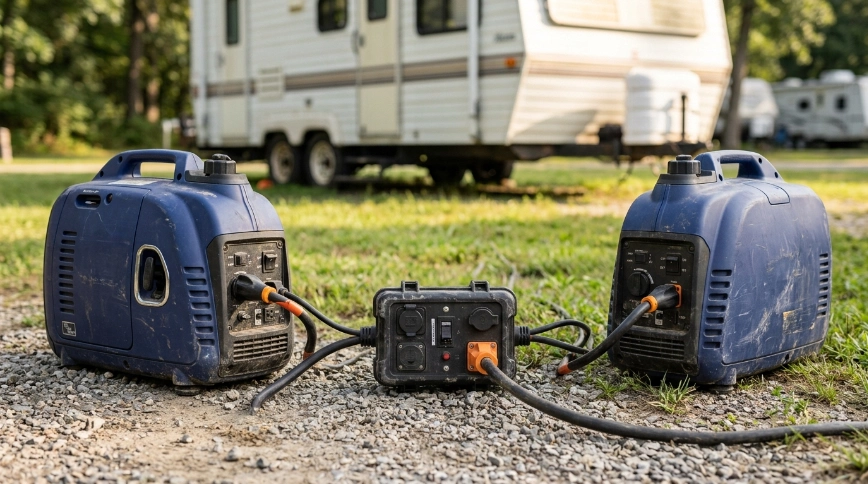
Compatible inverter generators electronically control their AC output. The approved parallel connection allows the units to supply a shared load while remaining synchronized.
The parallel box then gives you a convenient connection point for an RV cord, locking plug, or other supported load.
- Generator one supplies part of the load.
- Generator two contributes additional available output.
- Parallel cables create the manufacturer-designed connection between the machines.
- Circuit breakers limit excessive current through the parallel kit.
- Kit receptacles provide the usable combined-power connection.
The combined wattage is not always the simple sum printed in huge numbers on both generator cases. Starting watts, running watts, outlet ratings, breaker capacity, temperature, and the connected load all matter.
How much power can two generators make?
I use one simple planning rule: start with running watts, then check the parallel kit’s maximum output. Whichever limit is lower controls your realistic continuous-power plan.
Imagine two inverters rated at 1,800 running watts each. Their combined running rating is 3,600 watts before considering any additional manufacturer limits.
A 120V 30A connection also represents 3,600 watts by basic electrical math: 120 volts × 30 amps = 3,600 watts. You still need extra headroom for motor-starting surges.
| Feature | 120V 30A Kit | 120V 50A Kit |
|---|---|---|
| Electrical ceiling by V × A | 3,600 watts | 6,000 watts |
| Common use | RV, camping, moderate backup loads | Larger RV or equipment loads |
| Typical receptacle examples | TT-30R or L5-30R | 14-50R plus other manufacturer-selected outlets |
| Does it automatically provide 240V? | No | No — verify the exact kit |
| Main limiting factor | Generator ratings and kit breaker | Generator ratings and kit breaker |
Important: Those watt figures describe simple 120V × amperage limits. Your manufacturer’s rated output always takes priority.
Can You Parallel Two Different Generators?
Sometimes you can parallel different generator models. You can only do it when the manufacturer approves that exact combination or family of generators.
Champion, for example, allows certain ParaLINK-ready inverter models to be mixed within specified ranges. Its 100740 ParaLINK kit is designed for compatible 2,000- to 3,000-watt Champion inverters.
Can you parallel different-size generators?
Yes, in some product families. Generator size alone doesn’t determine compatibility.
Don’t assume a 2,000-watt inverter can connect to a 3,000-watt inverter because both have parallel ports. Check the kit selector, compatibility chart, or both generator manuals first.
Can you parallel generators from different brands?
I wouldn’t connect different brands unless the manufacturers explicitly approve the exact pairing. Similar-looking parallel ports are not proof of electrical compatibility.
Different products can use different control systems, neutral arrangements, cables, or connection procedures. An aftermarket claim should never override the generator manufacturer’s instructions.
How Do You Connect Two Generators With a Parallel Kit?
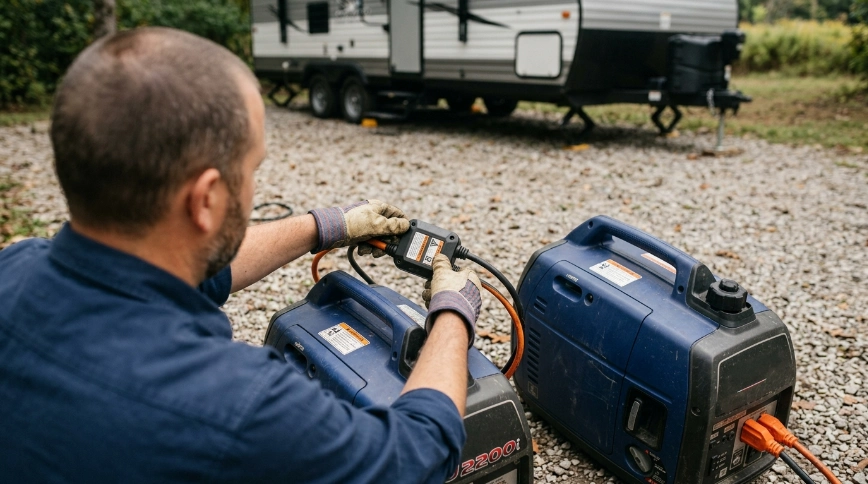
The exact sequence depends on the generator manufacturer. However, the safe preparation steps are similar across most consumer inverter systems.
- Read both generator manuals. Confirm that both models support parallel operation and identify the approved kit.
- Turn both generators off. Remove connected electrical loads before installing the parallel equipment.
- Position the generators safely. Put them outdoors with adequate cooling space and direct exhaust away from occupied buildings.
- Install the parallel cables. Connect every power and grounding lead exactly where the kit instructions specify.
- Start the generators. Follow the manufacturer’s starting sequence and operating-mode instructions.
- Confirm normal operation. Check warning lights, overload indicators, and the kit’s power indicator if fitted.
- Connect your load. Use the receptacle on the parallel kit and add loads gradually.
- Shut down correctly. Disconnect loads first, stop the generators, and remove the kit only after the units are off.
Champion’s 100740 operator instructions specifically tell users to have both inverters off and loads disconnected before installing the kit. That’s a good habit even when another system looks straightforward.
What Can You Run With Two Generators in Parallel?
The answer depends on the pair’s combined rated output and each appliance’s starting demand. Motors and compressors often need a brief surge above their normal running watts.
Common parallel-generator applications include:
- RV air conditioners
- Refrigerators and freezers
- Microwaves and small cooking appliances
- Battery chargers
- Lighting
- Power tools
- Selected home essentials through properly installed transfer equipment
An RV air conditioner is one reason these kits are popular. Champion states that its 30A 100740 setup can provide enough output with suitable generators to start and run most 15,000 BTU RV air conditioners.
I still check the air conditioner’s actual data label. Compressor condition, elevation, temperature, other loads, and soft-start equipment can change the result.
Can a parallel generator setup power a house?
It can supply selected home circuits when the generator system has enough output and the house uses properly installed transfer equipment. A parallel kit by itself does not make a generator safe for direct connection to household wiring.
Never plug a generator into a wall receptacle. OSHA advises using a properly installed transfer switch when a generator supplies a structure’s electrical system.
What Are the Most Important Parallel Generator Safety Rules?
More available wattage also means more current is available at the parallel box. Treat the combined setup like serious electrical equipment.
- Never operate indoors: Gasoline, propane, and other combustion generators produce carbon monoxide.
- Keep generators away from buildings: The CDC’s carbon monoxide guidance says generators should operate outside more than 20 feet from windows, doors, and vents.
- Keep equipment dry: Follow the manufacturer regarding weather protection and never let water collect around electrical connections.
- Don’t exceed the kit rating: A larger pair of generators cannot force extra safe capacity through a smaller breaker or receptacle.
- Never backfeed a house: Use an inlet and transfer equipment installed for generator service.
- Use proper cords: Cords must be grounded, undamaged, outdoor-rated where required, and sized for the connected load.
- Allow cooling space: Don’t position generators so one unit’s exhaust and heat blow directly into the other.
For structural connections, review OSHA’s portable generator safety guidance. Local electrical codes and the manufacturer’s instructions still control your installation.
30-Amp vs 50-Amp Parallel Kit: Which Should You Buy?
A 30A kit is usually the simpler choice when your compatible generator pair and intended loads stay within a 30A, 120V setup. That’s common for smaller RVs and moderate portable loads.
A 50A kit makes sense when the manufacturer supports a larger inverter pair and you need more available current. It does not automatically mean the kit supplies 240V split-phase power.
Choose a 30A kit when:
- Your generators are specifically approved for the 30A kit.
- Your RV uses a TT-30 connection.
- Your combined running demand stays within the system’s rating.
- Portability matters more than maximum output.
Choose a 50A kit when:
- Your generator manufacturer approves a 50A parallel box.
- Your pair can supply enough wattage to benefit from the larger connection.
- You have larger RV loads or several simultaneous appliances.
- You have confirmed the kit’s actual voltage and receptacle configuration.
Don’t buy by amperage alone. Compatibility comes first, load requirement second, receptacle type third.
Common Generator Parallel Kit Mistakes
Most paralleling problems start before either generator is running. The wrong kit or unrealistic wattage expectations cause more trouble than the connection process itself.
- Buying by plug shape: Matching connectors don’t prove that two generators are compatible.
- Adding starting watts: Continuous loads should be planned around running output and the kit’s limits.
- Assuming 50A means 240V: Several portable parallel systems use 50A receptacles while supplying 120V only.
- Ignoring surge loads: Air conditioners, refrigerators, pumps, and tools may pull extra current while starting.
- Connecting while loaded: Remove electrical loads before installing or removing the parallel system.
- Using homemade backfeed cords: Male-to-male generator cords create severe shock and fire hazards.
If a setup trips its breaker, I remove loads instead of repeatedly resetting it. A breaker that keeps opening is telling you to find the overload or fault.
If you’re ready to pick one, here’s what I’d recommend based on manufacturer compatibility and connection features:
🏆 Best for 30A RV Use
Champion 100740 30A ParaLINK Parallel Kit
★★★★★
Designed for compatible 2,000- to 3,000-watt ParaLINK-ready Champion inverters, with 120V TT-30R and L5-30R outlets plus a 30A breaker. I like this option when a standard 30A RV connection is the main goal.
🚐 Best for Higher-Output RV Setups
FIRMAN 1201 50A Portable Generator Parallel Kit
★★★★☆
FIRMAN specifies this 120V kit for combining two FIRMAN inverter generators. It includes a 50A 14-50R receptacle, 30A L5-30R outlet, breakers, cable storage, and outlet lighting.
🔌 Best for PowerSmart Owners
Briggs & Stratton 6278 Parallel Box Kit
★★★★☆
Made for compatible Briggs & Stratton PowerSmart Series inverter generators, this kit uses long connector leads and protected 120V outlets. It’s the option I’d check first if I already owned compatible PowerSmart units.
Frequently Asked Questions
Can I use a parallel kit on any inverter generator?
No. A generator needs manufacturer-supported parallel capability, and the kit must match the approved generator models. Never assume that two machines are compatible just because both have ports labeled for parallel operation.
Can I parallel a 2,000-watt generator with a 3,000-watt generator?
Sometimes. Certain manufacturers allow different-size inverter models within specific parallel families, while others specify exact model combinations. Check the compatibility chart and both generator manuals before connecting them.
Does connecting two generators in parallel give me 240 volts?
Not automatically. Many portable parallel systems remain 120V and simply provide more available amperage. Check the kit’s voltage specification because even some units with 50A-style receptacles are designed for 120V output.
Is a portable generator parallel kit safe for an RV air conditioner?
It can be when the generator pair, kit, and RV load are correctly matched. Compare the air conditioner’s running and starting requirements with the generators’ rated output, and leave enough capacity for other appliances operating at the same time.
What happens if one generator shuts down while running in parallel?
Don’t assume the remaining generator can safely carry the entire load. Disconnect or reduce loads, shut the system down if necessary, and follow the manufacturer’s troubleshooting procedure before restarting parallel operation.
Final Takeaway
A portable generator parallel kit is a practical way to get more usable power while keeping two smaller inverter generators easy to transport. The best setup is the one your generator manufacturer explicitly approves.
Check model compatibility first, then compare running watts, breaker capacity, outlet type, and voltage. Never choose a kit just because the connectors appear to fit.
Finally, keep both generators outdoors, manage starting loads carefully, and use proper transfer equipment for any connection to household wiring. Those steps matter more than squeezing out every last watt.
Hi, I’m Michael Turner. I own a generator workshop in the United States and founded HomeGeneratorBlog to share practical, hands-on guidance about generator installation, maintenance, troubleshooting, safety, and backup power solutions. My goal is to help homeowners make smarter, more confident decisions through clear and reliable information