Cummins Onan P9500DF Review: Is It Worth It?
The Cummins Onan P9500DF portable generator is a dual-fuel, open-frame generator designed for substantial backup loads. It supplies temporary electricity for essential home circuits, demanding outdoor work, and equipment during outages.
This Cummins Onan portable generator targets homeowners who prioritize usable wattage and fuel flexibility over quiet operation. It is not an inverter generator, and its 9,500-watt headline describes peak gasoline output rather than continuous power.
🏆 My Quick Verdict
💡 Best For: Homeowners wanting gasoline-or-propane backup for selected household circuits.
⚡ Key Specs:
7,500 running / 9,500 peak watts on gasoline; 6,750 running / 8,550 peak watts on propane; 120/240 V; 194 lb dry.
✅ Bottom Line: Strong backup capability and convenient starting make this a practical outage machine. Consider its weight, noise, and conventional-generator power quality before buying.
At a Glance
- Dual-fuel operation provides a second fuel option when gasoline supplies become inconvenient.
- Continuous output drops from 7,500 watts on gasoline to 6,750 watts on propane.
- A 120/240-volt twist-lock outlet supports compatible professionally installed backup connections.
- Electric, remote, and recoil starting offer three ways to start the engine.
- The 194-pound dry weight makes wheels essential for most owners.
- This conventional generator is louder than many enclosed inverter alternatives.
Cummins Onan P9500DF Specifications
| Specification | Manufacturer data |
|---|---|
| Fuel | Unleaded gasoline or propane |
| Gasoline output | 7,500 running / 9,500 peak watts |
| Propane output | 6,750 running / 8,550 peak watts |
| Engine | 420 cc four-stroke OHV |
| Electrical output | 120/240 V, 60 Hz |
| Gasoline tank | 6.6 gallons |
| Gasoline runtime | 12 hours at 25% load, EPA-model sheet |
| Noise | As low as 74 dBA |
| Dry weight | 194 pounds |
| Dimensions | 27.3 × 26.3 × 26.3 inches |
| Residential warranty | Three-year limited |
Design & Build Quality
The P9500DF uses an exposed tubular frame rather than a sound-insulated enclosure. That layout makes the engine and service areas accessible, but it offers little acoustic shielding.
Its substantial 420 cc engine and 6.6-gallon gasoline tank suit longer backup sessions. A top-mounted fuel gauge provides an immediate visual check before an outage.
At roughly 27 inches in each main direction, it demands dedicated storage space. Its 194-pound dry weight also rules out casual lifting by one person.
- The included wheel kit helps across reasonably firm, level ground.
- A foam-grip handle makes deliberate repositioning more manageable.
- Outlet covers help protect unused receptacles from dirt during storage.
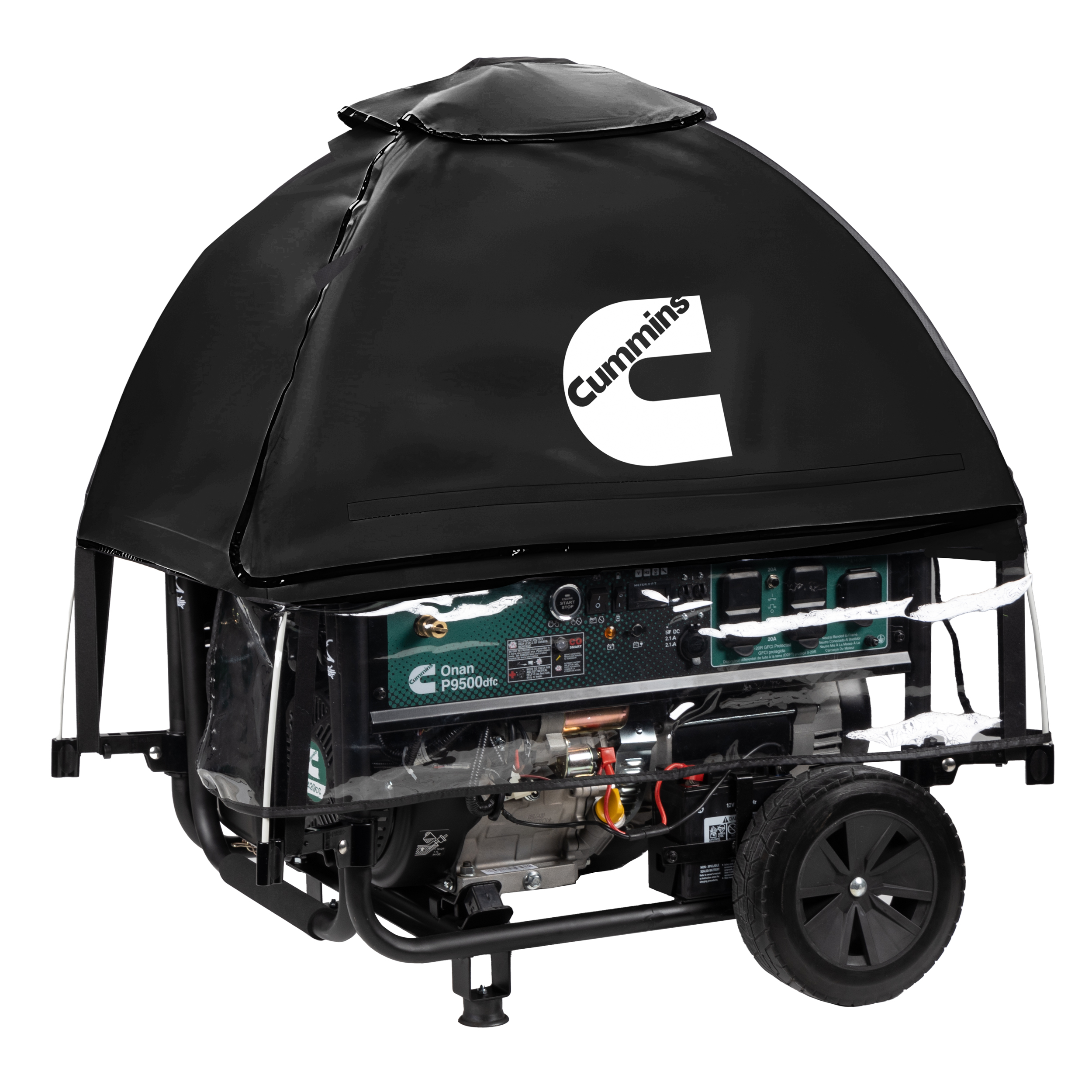
The supplied product photograph shows a fitted protective cover over the generator. Confirm separately whether that accessory is included with a specific seller’s listing.
Setup, Installation & Ease of Use
- Inspect the delivered unit for shipping damage before assembly.
- Install the included wheel kit according to the owner’s manual.
- Position the generator on stable, level ground outdoors.
- Add the specified engine oil before the first start.
- Connect the starting battery following the manual’s instructions.
- Select gasoline or attach a properly rated propane supply.
- Check that loads are disconnected before starting the generator.
- Use the push-button, remote, or recoil start method as instructed.
- Connect appliances through correctly rated cords and compatible outlets.
- Arrange professionally installed transfer equipment for home-circuit use.
- Cool the engine fully before refueling, covering, or storage.
Core Performance & Feature Breakdown
Running Power Versus Starting Power
The generator’s useful continuous gasoline rating is 7,500 watts. The larger 9,500-watt figure represents temporary starting capacity, not an all-day operating target.
On propane, continuous capability falls to 6,750 watts. This reduction matters if a refrigerator, well pump, and heating equipment may operate together.
Build an appliance schedule around actual nameplate ratings and motor startup demand. For broader sizing context, see this dual-fuel portable generator buying guide.
- Allow startup headroom for compressors and other motor-driven appliances.
- Prioritize essential circuits rather than assuming whole-house coverage.
- A 30-amp connection also imposes its own circuit-level output limits.
Fuel Consumption and Runtime
Cummins’ March 2025 EPA-model sheet specifies 12 hours at quarter load on gasoline. At half load, the same sheet reports eight hours.
The manufacturer also quotes nine hours at half load from a standard 20-pound propane tank. Actual operation varies with demand, environment, and fuel condition.
Expert Insight
Published P9500DF runtime figures vary across document revisions. Match the exact unit and regional specification sheet before planning overnight fuel reserves.
Noise and Power Quality
Cummins specifies sound as low as 74 dBA, which is noticeable outdoors. Site layout and load will influence what nearby residents hear.
This model has an automatic voltage regulator but no built-in inverter. Its published harmonic distortion ceiling is far higher than a typical low-distortion inverter model.
Buyers prioritizing delicate electronics should evaluate power-quality requirements carefully. The site’s inverter portable generator guide explains that distinction.
Key Features Explained
Dual-Fuel Selector
The selector gives owners gasoline and propane operating choices without purchasing a conversion kit. It adds flexibility during emergencies, although output is lower on propane.
Three Starting Methods
Push-button and remote starting reduce repeated pulling in routine use. Recoil starting offers a fallback when electronic starting is unavailable.
VFT Data Center
The display reports voltage, frequency, runtime information, maintenance reminders, and lifetime hours. These readings help owners monitor use without separate diagnostic equipment.
Transfer-Switch-Ready Outlet
A 120/240-volt L14-30R outlet supports compatible manual-transfer arrangements. Professional installation remains essential; the generator must never backfeed a household receptacle.
Real-World Usability & Maintenance
The most practical ownership advantage is keeping both approved fuel sources available. That redundancy becomes useful when prolonged outages complicate access to gasoline.
Service still requires oil checks, scheduled changes, air-filter care, and appropriate fuel storage. Follow the exact maintenance intervals in the supplied owner manual.
Operate outdoors at least 20 feet from windows, doors, and vents, with exhaust directed away. Use functioning carbon monoxide alarms indoors; a cover never makes enclosed operation safe.
Pros & Cons
Pros
- Two fuel options improve backup planning flexibility.
- Substantial running output supports selected essential circuits.
- Remote, electric, and recoil starting offer useful redundancy.
- A 120/240-volt outlet suits compatible transfer equipment.
Cons
- Its 194-pound dry weight complicates stairs and transport.
- The open-frame design is unsuitable for quiet campgrounds.
- Conventional power quality may not suit sensitive electronics.
Common Issues & Fixes
- Engine will not start: Check fuel selection, oil level, battery connection, and the manual’s starting sequence.
- Breaker trips under load: Disconnect equipment and recalculate continuous wattage plus motor startup demands.
- Unexpectedly short runtime: Measure the connected load and compare it against the matching fuel-specific runtime chart.
What to Know Before You Buy
Confirm whether the listing describes the original P9500DF or the different P9500DF EFI variant. Their published equipment and maintenance requirements are not identical.
The P9500DF is not factory equipped with an RV-specific TT-30 outlet. Check the exact receptacles on your RV and use only approved electrical arrangements.
Also confirm emissions compliance for your jurisdiction; Cummins’ March 2025 EPA sheet identifies a version not sold in California. Retail listings and regional variants can differ.
- Budget for approved heavy-gauge cords and a professional transfer installation.
- Verify whether a pictured protective cover is sold separately.
- Check warranty eligibility and local Cummins service support before purchase.
- Remember that the Amazon buttons open search results, not a verified listing.
Some Cummins documents report different runtimes for earlier versions. Ask the seller for the exact model documentation rather than combining figures from multiple revisions.
Who Should Buy It / Who Should Skip It
✅ Who Should Buy It
- Homeowners preparing for extended outages affecting essential circuits.
- Buyers who value gasoline and propane flexibility.
- Property owners with a suitable outdoor operating area.
✗ Who Should Skip It
- Campers needing a compact and particularly quiet generator.
- Shoppers whose priority is low-distortion inverter output.
- Anyone unable to provide safe outdoor placement and storage.
Alternatives to Consider
Westinghouse WGen9500DF
Best For: Buyers needing greater continuous backup output.
Main Advantage: Higher running wattage and a 50-amp outlet.
Trade-off: Heavier than the Onan and still an open-frame machine.
Key Spec: 9,500 running watts on gasoline; 8,500 on propane.
DuroMax XP12000EH
Best For: Owners comparing higher-output dual-fuel options.
Main Advantage: More gasoline running and surge capacity.
Trade-off: Larger power class may be unnecessary for smaller loads.
Key Spec: 9,500 running and 12,000 peak watts on gasoline.
Is It Worth It?
The P9500DF is worth considering when backup power matters more than portability or refined acoustics. The value proposition rests on useful continuous wattage, dual-fuel convenience, and accessible controls.
Its suitability depends on your required appliances and the total installation cost. A smaller inverter generator may be preferable when loads are modest and noise matters.
Final Verdict
The Cummins Onan P9500DF is a capable conventional backup generator for buyers who understand its electrical limits. Choose it for essential circuit support and fuel flexibility, not quiet recreation or inverter-grade output.
Frequently Asked Questions
Can the Cummins Onan P9500DF power an entire house?
It can power selected circuits, not necessarily every household load. Total demand, starting surges, and the 30-amp outlet determine what can run simultaneously.
Is the P9500DF an inverter generator?
No, it is a conventional open-frame generator. Cummins specifies an automatic voltage regulator but no built-in inverter.
What size transfer connection does it use?
It provides a 120/240-volt, 30-amp L14-30R outlet. Have a qualified electrician confirm connection compatibility and install approved transfer equipment.
How long is the Cummins Onan P9500DF warranty?
Cummins lists a three-year limited residential warranty. Its EPA-model specification also lists one year of commercial coverage; review the applicable warranty terms.
What maintenance does the P9500DF require?
It needs routine engine oil, air-filter, spark-plug, and fuel-system care. Use the owner’s manual for correct intervals and storage procedures.
Is the P9500DF suitable for an RV?
Not as a direct plug-and-play TT-30 RV generator. Cummins does not list an RV-ready outlet, so verify electrical compatibility before considering adapters.
Affiliate disclosure: HomeGeneratorBlog earns a small commission when you purchase through links on this page — at no extra cost to you. Our editorial process is independent: affiliate relationships never influence which products we recommend or how we rank them.

Hi, I’m Michael Turner. I own a generator workshop in the United States and founded HomeGeneratorBlog to share practical, hands-on guidance about generator installation, maintenance, troubleshooting, safety, and backup power solutions. My goal is to help homeowners make smarter, more confident decisions through clear and reliable information