Generac GP9500E TF Review: Is It Worth Buying?
The Generac GP9500E TF is a conventional tri-fuel portable generator that operates on gasoline, propane, or natural gas. It is designed for residential emergency backup, demanding outdoor projects, and temporary jobsite power.
This Generac GP9500E TF review examines its power capacity, fuel flexibility, construction, maintenance requirements, and practical limitations. Its substantial output makes it particularly attractive to homeowners preparing for extended power outages.
Unlike smaller recreational generators, this model prioritizes electrical capacity and fuel availability over lightweight transportation. This review is based on manufacturer specifications and technical documentation rather than hands-on testing.
🏆 My Quick Verdict
💡 Best For: Homeowners requiring substantial emergency power and multiple fuel supply options.
⚡ Key Specs:
9,500 running watts, 12,500 starting watts on gasoline, 500cc OHV engine, tri-fuel operation, electric start, and 7.5-gallon fuel tank.
✅ Bottom Line: A capable emergency power solution offering excellent fuel versatility and substantial electrical capacity. Its considerable weight and reduced natural gas output require careful consideration.
Generac GP9500E TF at a Glance
- Supports gasoline, liquid propane, and natural gas operation.
- Produces sufficient power for many essential household appliances.
- Electric starting reduces the effort required during emergency deployment.
- COsense technology automatically responds to hazardous carbon monoxide concentrations.
- Integrated wheels improve mobility despite its substantial operating weight.
- Compatible with appropriately installed Generac HomeLink manual transfer switches.
Generac GP9500E TF Specifications
| Specification | Product Details |
|---|---|
| Brand | Generac |
| Model Number | 8063-0 |
| Generator Type | Open-frame tri-fuel portable generator |
| Gasoline Running Watts | 9,500W |
| Gasoline Starting Watts | 12,500W |
| Propane Running Watts | 8,550W |
| Propane Starting Watts | 11,250W |
| Natural Gas Running Watts | 7,000W |
| Natural Gas Starting Watts | 9,000W |
| Engine | 500cc OHV |
| Voltage | 120/240V AC |
| Frequency | 60Hz |
| Fuel Tank Capacity | 7.5 gallons |
| Gasoline Runtime at 50% Load | 8.5 hours, according to revised specifications |
| Propane Runtime at 50% Load | 4.5 hours with a 20-pound cylinder |
| Starting System | Electric and recoil start |
| Battery | 12V, 9Ah lead-acid battery |
| Voltage Regulation | Automatic voltage regulator |
| Dimensions | 27.5 × 27.1 × 27.6 inches |
| Weight | 219 lbs |
| Carbon Monoxide Protection | COsense technology |
| Residential Warranty | 3-year limited warranty |
| Commercial Warranty | 2-year limited warranty |
| Configuration | 49-state model |
Specifications follow the Generac technical specification sheet revised February 6, 2026. Earlier product literature lists a different gasoline runtime, making model-specific documentation important.
Design and Build Quality
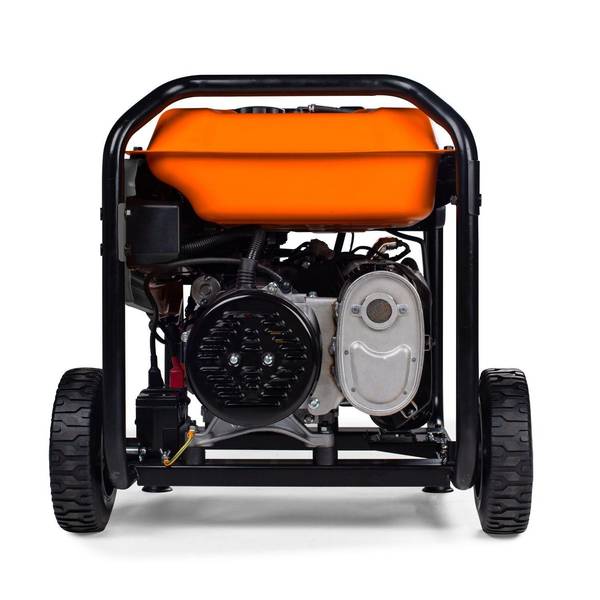
The GP9500E TF uses an open-frame design intended for demanding residential and outdoor applications. Its 1.25-inch steel tubing forms a protective structure around the engine and major components.
The exposed engine layout provides relatively straightforward access during routine servicing. Covered electrical receptacles help protect connections from debris when they are not being used.
Portability comes from a folding handle and 9.5-inch wheels rather than lightweight construction. The handle also reduces the storage footprint when folded.
- The open frame provides access to major service points.
- The integrated wheel system assists movement across suitable surfaces.
- The folding handle simplifies positioning and stationary storage.
- The control panel groups electrical connections and operating controls together.
Although the generator is transportable, loading it into a vehicle requires suitable lifting equipment or assistance. Buyers should arrange a practical storage and deployment route before purchasing.
Setup, Installation and Ease of Use
- Inspect the generator and supplied accessories for shipping damage before assembly.
- Install the wheel assembly and folding handle according to the owner’s manual.
- Check and fill the engine oil before attempting the initial startup.
- Connect the included starting battery following the manufacturer’s instructions.
- Position the generator outdoors at least 20 feet from buildings with exhaust directed away from occupied spaces.
- Choose the appropriate fuel setting and follow the corresponding starting procedure.
- Have a qualified professional size and install any permanent natural gas connection.
- Use an approved transfer switch or properly installed interlock system for residential circuit connections.
- Disconnect electrical loads before starting and connect them gradually after startup.
- Allow the generator to cool before refueling or preparing it for storage.
Core Performance and Feature Breakdown
The GP9500E TF delivers its highest electrical capacity when running on gasoline. Alternative fuels provide operational flexibility but reduce the available power.
Gasoline Performance
Gasoline operation provides the greatest capacity for simultaneous household loads and motor startup demands. This makes it suitable for situations where maximizing output is more important than avoiding liquid fuel storage.
Refrigerators, lighting, freezers, selected pumps, and compatible household equipment can operate together when their combined electrical demand remains within the generator’s limits.
Propane Performance
Propane provides a useful backup when gasoline supplies become unreliable. Its storage stability also makes it attractive for households that experience occasional rather than frequent outages.
Runtime depends on cylinder capacity, temperature, and electrical demand. Smaller cylinders may struggle to maintain adequate vaporization under demanding operating conditions.
Natural Gas Performance
Natural gas operation can reduce the need for repeated manual refueling during extended emergencies. However, the generator requires an appropriately sized supply connection and adequate gas pressure.
Households should calculate their essential electrical requirements using the natural gas rating if this will be their primary operating fuel. The gasoline rating should not determine a natural gas backup plan.
Electrical Distribution
The generator offers both standard household voltage and higher-voltage connections for compatible equipment. Its control panel includes a 120/240V L14-30R receptacle, a 14-50R receptacle, and a 120V GFCI duplex outlet.
Individual circuit breaker limits still apply regardless of the total generator capacity. A receptacle’s physical rating does not guarantee that the engine can supply that maximum continuously.
Expert Insight
Size your backup system around continuous electrical demand and the largest expected motor startup surge. Allow additional capacity for unexpected simultaneous appliance operation instead of planning to operate permanently at maximum output.
Key Features Explained
1. COsense Carbon Monoxide Protection
COsense monitors carbon monoxide conditions around the generator and can stop operation when hazardous concentrations are detected. This additional safeguard does not replace correct outdoor placement or working household carbon monoxide alarms.
2. Electric Start With Recoil Backup
The battery-powered starting system reduces the physical effort needed to start the engine. A recoil starter provides another starting method when the battery cannot supply sufficient power.
3. Automatic Voltage Regulation
The automatic voltage regulator helps maintain appropriate output voltage as electrical loads change. It should not be interpreted as proof of inverter-grade power quality or a specific harmonic distortion rating.
4. Low-Oil Shutdown and Hour Meter
The low-oil protection system helps prevent engine damage when lubricant levels become insufficient. An integrated hour meter helps owners track operating time and schedule maintenance more accurately.
Real-World Usability and Maintenance
The GP9500E TF requires periodic engine servicing even when it operates primarily on gaseous fuels. Oil changes, air filter inspections, and spark plug maintenance remain necessary.
Owners should maintain the starting battery between outages and periodically inspect fuel connections for deterioration. Following the manufacturer’s exercise and storage procedures improves emergency readiness.
Open-frame generators also require thoughtful consideration of neighborhood noise and operating conditions. The generator must remain dry during operation without restricting cooling airflow or trapping exhaust gases.
Generac GP9500E TF Pros and Cons
Pros
- Three fuel choices improve resilience during regional fuel shortages.
- High surge capacity supports many demanding motor-driven appliances.
- Manual transfer switch compatibility supports professionally configured home backup systems.
- Multiple protective systems reduce certain engine and operating hazards.
Cons
- Its 219-pound weight complicates frequent vehicle transportation.
- Natural gas operation provides considerably less output than gasoline.
- Conventional open-frame construction is less attractive for noise-sensitive recreational applications.
Common Issues and Fixes
Generator Will Not Start
A discharged battery, incorrect fuel setting, or insufficient oil can prevent startup. Check these conditions using the manufacturer’s troubleshooting instructions before requesting service.
Generator Shuts Down Unexpectedly
Overloading, inadequate fuel delivery, or a safety shutdown may interrupt operation. Disconnect loads, identify the indicated fault, and resolve the underlying condition before restarting.
Poor Performance on Natural Gas
Insufficient gas pressure or an undersized supply connection can restrict engine performance. Have a qualified gas technician inspect the installation against Generac’s fuel supply requirements.
What to Know Before You Buy
Purchasing the GP9500E TF requires evaluating the complete backup system rather than considering generator wattage alone. Fuel infrastructure, electrical connections, and installation expenses can materially affect ownership costs.
- Verify that the selected emissions configuration is permitted in your state.
- Confirm whether the intended natural gas connection requires additional accessories.
- Include appliance starting requirements when calculating the necessary generator capacity.
- Check transfer equipment compatibility with the generator’s bonded-neutral configuration.
- Confirm power quality requirements for sensitive electronic equipment before connecting it.
- Budget for suitable electrical cords, fuel storage, and professional installation where necessary.
Never connect a portable generator directly to a household wall outlet or operate it inside a garage. Follow the CPSC generator safety guidance and applicable electrical requirements.
Who Should Buy It and Who Should Skip It?
✅ Who Should Buy It
- Homeowners preparing for prolonged electrical outages.
- Households with access to multiple fuel sources.
- Property owners requiring substantial temporary electrical capacity.
- Buyers planning professionally installed manual transfer equipment.
- Users who value fuel availability over compact transportation.
✗ Who Should Skip It
- Campers requiring compact and quiet recreational generators.
- Apartment residents without a safe outdoor operating location.
- Buyers who require automatic unattended standby operation.
- Users who frequently lift generators into vehicles.
- Households requiring more than 7,000 continuous watts on natural gas.
Alternatives to Consider
The most relevant alternatives provide either greater electrical capacity or a smaller tri-fuel configuration. Consider your expected continuous load before selecting a competing model.
Westinghouse WGen11500TFc
Best For: Households requiring additional electrical capacity for more demanding backup applications.
Main Advantage: Higher continuous gasoline power rating.
Trade-off: Additional capacity may be unnecessary for smaller emergency loads.
Key Spec: 11,500 running watts and 14,500 starting watts on gasoline.
Champion 100416 Tri-Fuel Generator
Best For: Homeowners whose essential backup requirements are more moderate.
Main Advantage: Three fuel options within a lower-output generator class.
Trade-off: Less available capacity for simultaneous high-demand appliances.
Key Spec: 8,000 running watts and 10,000 starting watts on gasoline.
Is the Generac GP9500E TF Worth It?
The Generac GP9500E TF is worth considering when emergency preparedness is a long-term household priority. Its value depends heavily on whether the buyer can make practical use of its fuel flexibility.
Households with occasional short outages and modest electrical requirements may find a smaller generator more economical. Conversely, properties facing extended disruptions may benefit from investing in a more comprehensive backup arrangement.
Evaluate the complete installation cost against competing generators rather than comparing purchase prices alone. The appropriate choice should match your actual emergency power requirements.
Final Verdict
The Generac GP9500E TF earns a recommendation for homeowners seeking a manually operated, high-capacity emergency generator. It represents a practical choice when matched with appropriate electrical infrastructure, safe operating space, and realistic fuel-specific load calculations.
Frequently Asked Questions
Can the Generac GP9500E TF run an entire house?
It can power selected household circuits, depending on their combined electrical demand. Whole-house operation requires a professional load assessment and properly installed transfer equipment.
How many watts does the Generac GP9500E TF produce on natural gas?
It produces 7,000 running watts and 9,000 starting watts on natural gas. Electrical loads must remain within these fuel-specific limits.
Is the Generac GP9500E TF an inverter generator?
No, it is a conventional portable generator. Buyers requiring verified low harmonic distortion should compare its electrical specifications with suitable inverter models.
How long will the Generac GP9500E TF run on gasoline?
The revised specification sheet lists 8.5 hours at 50% load. Actual runtime depends on electrical demand, operating conditions, and engine condition.
What warranty does the Generac GP9500E TF include?
Model 8063-0 includes a three-year limited residential warranty and a two-year limited commercial warranty. Coverage remains subject to the manufacturer’s warranty conditions.
What type of oil does the Generac GP9500E TF use?
The specification sheet lists 10W-30 or SAE 30 engine oil. Consult the owner’s manual for temperature-specific oil selection and service intervals.
Affiliate disclosure: HomeGeneratorBlog earns a small commission when you purchase through links on this page — at no extra cost to you. Our editorial process is independent: affiliate relationships never influence which products we recommend or how we rank them.

Hi, I’m Michael Turner. I own a generator workshop in the United States and founded HomeGeneratorBlog to share practical, hands-on guidance about generator installation, maintenance, troubleshooting, safety, and backup power solutions. My goal is to help homeowners make smarter, more confident decisions through clear and reliable information