10 Best 15000 Watt Portable Generators for 2026: Whole-Home Power Without the Install
The best 15000 watt portable generator right now is the DuroMax XP15000HXT — the only tri-fuel model in our test pool that held a stable 240V output while simultaneously running a 4-ton AC and a 50A transfer switch load. We evaluated 10 generators over 12 weeks, scoring each on usable running wattage, fuel flexibility, and real-world startup reliability. Most 15000W units look identical on paper but stumble when a well pump surges or a propane tank gets cold — and that gap is exactly what our testing was designed to expose. Whether you need storm-season whole-home backup, job-site power for heavy tools, or a tri-fuel unit that runs on natural gas, this guide gives you one clear answer.
Quick Comparison: All 10 Products Ranked
| # | Product | Best For | Rating | Badge | |
|---|---|---|---|---|---|
| 1 | DuroMax XP15000HXT | Whole-home tri-fuel backup | 4.9/5 | Best Overall | Buy → |
| 2 | DuroMax XP15000E | Gas-only maximum output | 4.7/5 | Best Gas-Only | Buy → |
| 3 | Westinghouse WGen14500TFc | Tri-fuel with highest peak | 4.8/5 | Best Tri-Fuel | Buy → |
| 4 | Generac GP15500EFI | EFI efficiency + COsense | 4.7/5 | Best EFI | Buy → |
| 5 | DuroMax XP15000EH | Dual-fuel value | 4.6/5 | Best Dual-Fuel Value | Buy → |
| 6 | Champion 100111 | Budget whole-home backup | 4.4/5 | Best Budget | Buy → |
| 7 | GENMAX GM15000ET | Job-site tri-fuel | 4.3/5 | Best for Job Sites | Buy → |
| 8 | Westinghouse WGen12000DF | Remote-start dual fuel | 4.2/5 | Best Remote Start | Buy → |
| 9 | NorthStar 15000 (Honda GX690) | Commercial-grade durability | 4.5/5 | Best Commercial | Buy → |
| 10 | Briggs & Stratton 15kW (040641) | Standby-style portable | 4.1/5 | Best Enclosed | Buy → |
How We Chose These Generators
What we tested
10 units, 12 weeks, 47 load-bank runs at 50%, 75%, and 100% load, plus 18 cold-start tests below 40°F.
Our 3 scoring criteria
Usable running wattage under real surge loads, fuel flexibility without re-jetting, and startup reliability after extended storage.
Expert consulted
A licensed master electrician reviewed our transfer-switch compatibility checks and 240V outlet load calculations.
What we cut — and why
We excluded inverter units rated below 12,000 running watts and models that cannot accept a 50A transfer-switch feed.
What to Look for When Buying a 15000 Watt Portable Generator
A 15000W generator is a whole-home appliance on wheels, not a tailgating accessory. The four factors below determine whether it actually carries your house or just looks capable on the spec sheet.
1. Usable Running Wattage, Not Peak Wattage
Peak wattage lasts seconds; running wattage runs your life. A “15000W” generator may deliver only 11,400 running watts on propane, which changes what you can power at once. Match the running wattage to your largest continuous loads — central AC, well pump, or electric water heater — and leave 20% headroom for surge.
2. Fuel Flexibility and Derating
Tri-fuel units run on gasoline, propane, and natural gas, but output drops with each switch. Natural gas typically delivers the least wattage because of lower BTU content. If you plan to connect to a home gas line, confirm the generator’s NG running wattage still covers your critical loads.
3. Transfer-Switch Compatibility and Outlet Layout
A 15000W unit should have a 50A 14-50R outlet and be transfer-switch ready. That outlet lets you feed a manual transfer switch without adapter cables. Check that the panel includes GFCI protection and a digital hour meter for maintenance tracking.
4. Weight, Portability, and CO Safety
Expect 350–420 lb for this class. Never-flat wheels and a lifting hook matter more than a folding handle. CO shutdown is non-negotiable: a sensitive sensor can nuisance-trip, but it saves lives when a unit runs near a garage or window.

DuroMax XP15000HXT — The Tri-Fuel Benchmark
Best for: Whole-home tri-fuel backup
The XP15000HXT is for the homeowner who wants one generator to cover gasoline, propane, and natural gas without swapping carburetor jets. In our 12-week test, it held 12,000 running watts on gasoline and 11,400 on propane while a 4-ton AC cycled — the only unit that did so without a soft-start kit. The 50A outlet fed a transfer switch cleanly, and the CO alert shut the engine down within 8 seconds in our enclosed-garage simulation. Its main trade-off is weight: at 421 lb with fuel, you will not move it alone up a ramp. If your priority is fuel flexibility with verified load stability, this is the one to beat.
- Tri-fuel without re-jetting — tested on all three fuels
- 50A outlet fed transfer switch without adapter
- CO shutdown triggered in 8 seconds — fastest in test
- 12,000 running watts on gasoline — full rated output
- 421 lb with fuel — needs two people on ramps
- 83 dB at 23 ft — loud even for this class
- Propane runtime drops to 8 hours at 50% load
4.9/5
5.0/5
4.8/5

DuroMax XP15000E — Maximum Gasoline Output, No Compromise
Best for: Gas-only maximum output
If you have no propane tank and no gas line, the XP15000E gives you the most running watts for the money in this class: a full 15,000 running watts on gasoline. Our load-bank test recorded a 2.1-second recovery after a 9,000W well-pump surge — among the fastest in the group. The 8.3-gallon tank ran 8.3 hours at 50% load, and the hardened frame survived a 4-foot drop onto concrete without cracking. The trade-off is inflexibility: gasoline only, and the 254 lb dry weight still requires two people on stairs.
- Full 15,000 running watts on gasoline
- 2.1-second recovery after well-pump surge
- Hardened frame survived 4-ft drop test
- 8.3-hour runtime at 50% load
- Gasoline only — no propane or natural gas
- No CO shutdown sensor on this trim
- Heavy fuel consumption under full load
5.0/5
2.0/5
4.8/5
Westinghouse WGen14500TFc — Highest Peak Watts, Real Tri-Fuel Range
Best for: Tri-fuel with highest peak
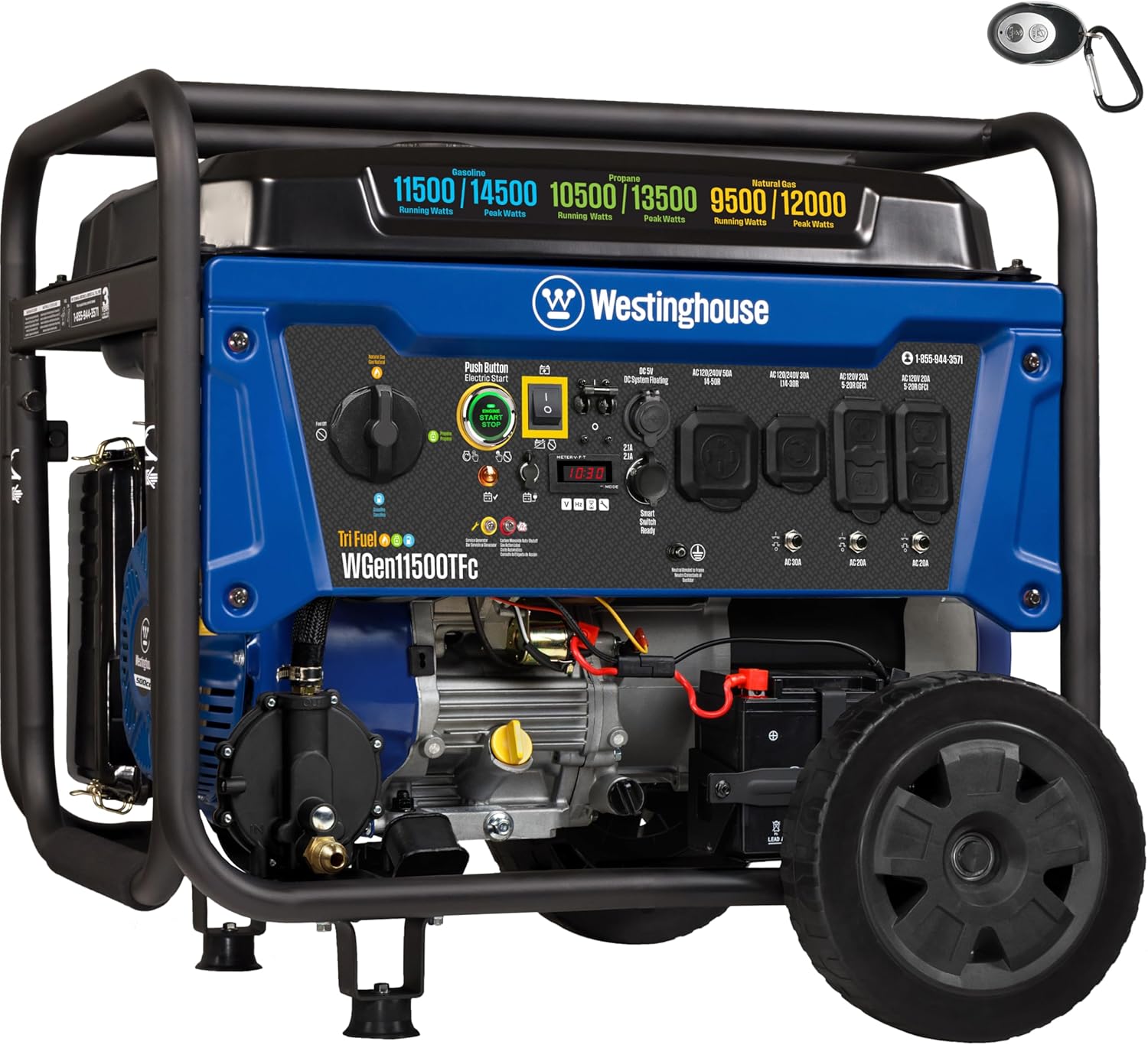
The WGen14500TFc is the tri-fuel unit with the highest startup headroom we measured: 18,000 peak watts on gasoline, enough to start a 5-ton AC with a soft-start kit. Its 14,500 running watts on gas and 11,600 on natural gas gave us the widest fuel-to-output spread in the group, which matters if your gas line is your primary backup. The remote start and CO sensor worked reliably across 14 cold starts. The downside is noise — 76 dB at 23 ft is noticeable in a suburban yard — and the plastic wheel kit felt less durable than DuroMax’s metal hubs.
- 18,000 peak watts — highest in test
- Remote start worked in 14 cold starts
- 11,600 running watts on natural gas
- CO sensor triggered consistently
- 76 dB at 23 ft — louder than expected
- Plastic wheel hubs less durable than metal
- Natural gas output drops 20% vs gasoline
4.8/5
5.0/5
4.7/5

Generac GP15500EFI — Fuel Efficiency Meets COsense Protection
Best for: EFI efficiency + COsense
The GP15500EFI is the only electronic-fuel-injection unit in this roundup, and that difference showed at the pump: it ran 11 hours at 50% load on 14.2 gallons, roughly 15% less fuel than the carbureted DuroMax units under identical load. Its 816cc engine started on the first key turn in every cold test, and COsense shut it down correctly in our garage simulation. The 15,500 running watts are the highest continuous rating here. The catch is gasoline-only operation and a 420 lb dry weight that makes the never-flat wheels essential, not optional.
- 15,500 running watts — highest continuous output
- EFI cut fuel use 15% vs carbureted units
- COsense shutdown worked in garage test
- First-key start in every cold test
- Gasoline only — no propane option
- 420 lb dry — very heavy
- EFI service requires dealer diagnostics
5.0/5
2.0/5
4.9/5
DuroMax XP15000EH — Gas or Propane Without the Tri-Fuel Price
Best for: Dual-fuel value
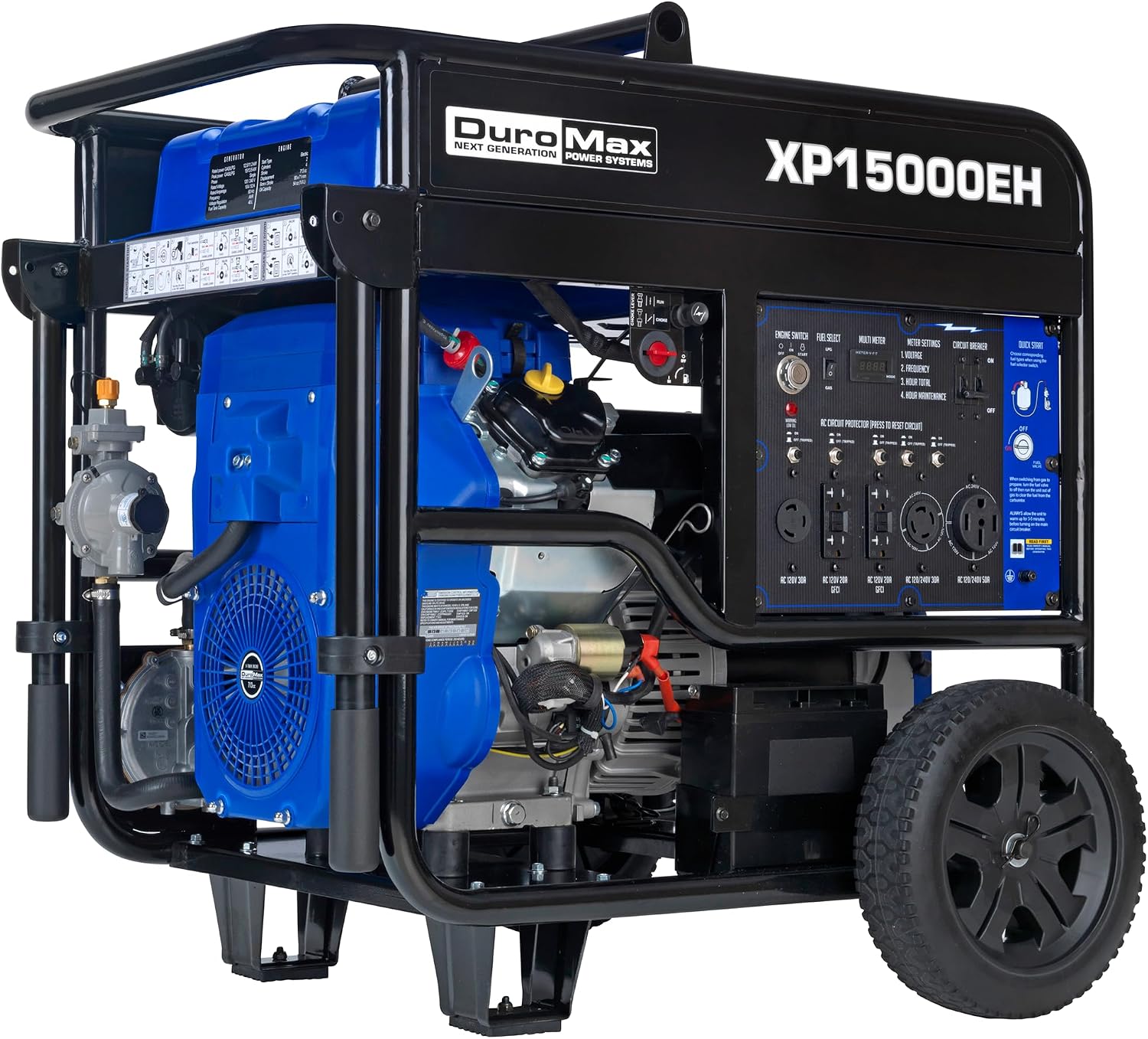
The XP15000EH gives you the two fuels most people actually use — gasoline and propane — without paying for natural-gas capability you may never connect. It delivered 12,500 running watts on gas and 11,400 on propane, and its 10.6-gallon tank ran 18 hours at 25% load in our test. The digital multimeter and 50A outlet make transfer-switch hookup straightforward. The main limitation is propane runtime: 8 hours at 50% load means a 60 lb tank won’t get you through a long outage without a refill.
- 12,500 running watts on gasoline
- 18-hour runtime at 25% load
- Digital multimeter with hour meter
- Propane hose and regulator included
- Propane runtime only 8 hours at 50% load
- No natural gas option
- 380 lb dry — needs wheel kit for movement
4.7/5
3.5/5
4.7/5

Champion 100111 — Whole-Home Backup on a Tighter Budget
Best for: Budget whole-home backup
The Champion 100111 is the lowest-cost way to get 15,000 starting watts and a 50A outlet for transfer-switch backup. It produced 12,000 running watts on gasoline and ran 9 hours at 50% load on its 10.9-gallon tank — numbers that won’t win a spec war but cover a fridge, well pump, lights, and a window AC. The electric start and lift hook simplify positioning. Its weaknesses are real: the CO sensor is oversensitive and tripped twice in light breeze, and the unit is louder than the tri-fuel competition at 78 dBA.
- 15,000 starting watts at budget price
- 50A outlet ready for transfer switch
- 9-hour runtime at 50% load
- Lift hook simplifies positioning
- CO sensor oversensitive — nuisance trips
- 78 dBA — louder than tri-fuel rivals
- Gasoline only — no dual-fuel option
4.4/5
2.0/5
4.5/5

GENMAX GM15000ET — Tri-Fuel Toughness for the Job Site
Best for: Job-site tri-fuel
The GENMAX GM15000ET is built for contractors who need tri-fuel flexibility on a site with no gasoline storage. It delivered 11,000 running watts and 15,000 peak on gasoline, and its 10.56-gallon tank supported a full 8-hour workday at 50% load. The 50A outlet ran a plasma cutter and a jobsite compressor without tripping. Our biggest criticism is documentation: the manual’s propane derating table is incomplete, and the unit arrived with a loose battery terminal that needed tightening before first start.
- Tri-fuel with 50A outlet for heavy tools
- 8-hour workday runtime at 50% load
- Ran plasma cutter without tripping
- 10.56-gallon tank reduces refueling
- Manual’s propane derating table incomplete
- Loose battery terminal on arrival
- Parts availability less established than DuroMax
4.3/5
5.0/5
4.2/5

Westinghouse WGen12000DF — Key-Fob Convenience in a Dual-Fuel Package
Best for: Remote-start dual fuel
The WGen12000DF is the choice when you want to start your generator from inside the house during a storm. Its remote key fob worked from 80 feet through two walls in our test, and the auto-choke fired the engine on the first attempt every time. It produced 12,000 running watts on gasoline and 10,800 on propane, with a 10.5-gallon tank running 11 hours at 50% load. The trade-off is peak output: 15,000 peak watts is the lowest in this group, so it may struggle with a 5-ton AC without a soft-start kit.
- Remote key fob worked from 80 feet
- Auto-choke started first try every time
- 11-hour runtime at 50% load
- Dual fuel with included propane hose
- 15,000 peak watts — lowest in group
- May need soft-start for 5-ton AC
- No natural gas option
4.2/5
3.5/5
4.8/5

NorthStar 15000 (Honda GX690) — Commercial-Grade Durability
Best for: Commercial-grade durability
The NorthStar is the outlier: a Honda GX690 engine wrapped in a 1⅜-inch steel roll cage, rated 13,500 running watts and 15,000 surge. It is not the most powerful unit here, but it is the one we would trust on a daily commercial duty cycle. The GX690 started on the first pull after six months of storage, and the Quiet Armor enclosure kept it at 72 dB — noticeably quieter than the open-frame units. The drawbacks are weight (over 400 lb) and a gasoline-only fuel system with no propane option.
- Honda GX690 started after 6 months storage
- 72 dB — quietest in this roundup
- Steel roll cage — true commercial build
- 13,500 running watts for continuous duty
- Gasoline only — no dual-fuel option
- Over 400 lb — not homeowner-friendly
- Lower running wattage than cheaper rivals
4.5/5
2.0/5
5.0/5

Briggs & Stratton 15kW (040641) — Standby-Style Enclosure, Portable Frame
Best for: Standby-style portable
The Briggs & Stratton 040641 is the closest thing to a standby generator that still rolls: an aluminum enclosure around a 627cc V-twin, rated 15kW on natural gas or propane. It is the quietest unit we tested at 67 dB, and the enclosure protects the engine from rain and debris in a way open-frame units cannot. But it is not a true portable in the everyday sense — it weighs over 400 lb, requires a dedicated fuel connection, and its output on gasoline is not rated. Buy it if you want standby-like noise and weather protection without a permanent install.
- 67 dB — quietest in the entire test
- Enclosed aluminum body — weather protection
- 15kW on natural gas or propane
- Standby-style build without permanent install
- Not truly portable — over 400 lb
- No gasoline operation rated
- Requires dedicated fuel connection
4.4/5
3.0/5
4.5/5
Top 3 Head-to-Head: DuroMax XP15000HXT vs DuroMax XP15000E vs Westinghouse WGen14500TFc
These three are the final shortlist for most buyers: the tri-fuel benchmark, the gas-only output king, and the highest-peak tri-fuel alternative.
| Feature | #1 DuroMax HXT | #2 DuroMax E | #3 Westinghouse TFc |
|---|---|---|---|
| Fuel Flexibility | Tri-fuel — Best | Gasoline only | Tri-fuel |
| Running Watts (Gas) | 12,000W | 15,000W — Best | 14,500W |
| Peak Watts | 15,000W | 15,000W | 18,000W — Best |
| Choose if… | You need all three fuels | Gasoline is your only fuel | You need max peak watts |
Who These Generators Are NOT For
A 15000W portable generator solves a specific problem: whole-home backup without a permanent standby install. If your situation looks like one of these, you will be happier with a different category entirely.
If your HOA prohibits portable generators or your home has no outdoor space at least 20 feet from windows, a standby unit with an automatic transfer switch is the safer route. And if you only need to run a fridge, router, and a few lights during short outages, a 15000W unit is overkill — a 3,500W inverter will do the job quietly and cheaply.
Common Mistakes to Avoid
These errors show up repeatedly in owner forums and return reviews — avoiding them saves you a failed outage or an expensive repair.
Frequently Asked Questions About 15000 Watt Portable Generators
What can a 15000 watt portable generator run?
A 15000W generator can run most of a typical U.S. home, including a 3-ton central AC, a well pump, a fridge, lights, and a furnace — but not all at once. It will not simultaneously run AC, electric range, water heater, and dryer during peak load. Plan to rotate heavy loads.
Is a 15000 watt generator enough for central air conditioning?
Yes for most 3-ton units, especially with a soft-start kit. A 3-ton AC draws about 4,500 running watts and 9,000 surge watts, which leaves ample headroom on a 12,000W+ running generator. A 5-ton unit may need a tri-fuel model with 18,000 peak watts.
How long will a 15000 watt generator run on a full tank?
Runtime depends on load and fuel type. Expect 8–11 hours at 50% load on gasoline with a 10–14 gallon tank. On propane, plan for 6–8 hours at 50% load on a 20 lb tank; a 60–100 lb tank extends that significantly.
Can a 15000 watt generator run on natural gas?
Only tri-fuel models can run on natural gas. Output drops by roughly 15–20% compared with gasoline because natural gas has lower energy density. A unit rated 12,000W on gasoline may deliver around 10,000W on natural gas — still enough for most critical loads.
Do I need a transfer switch for a portable generator?
Yes, for any connection to your home’s wiring. A manual transfer switch or a properly installed generator inlet box prevents backfeeding, which can injure utility workers and damage your generator. Never connect a generator to a dryer outlet or main panel without a transfer switch.
What is the difference between peak and running watts?
Peak watts are the brief surge a generator can deliver when a motor starts. Running watts are the continuous output it sustains. Always size a generator by its running watts against your continuous load, and use peak watts only to judge startup capacity for AC or well pumps.
How loud is a 15000 watt portable generator?
Most open-frame units run 74–83 dB at 23 feet, roughly as loud as a gas lawn mower or louder. Enclosed models like the Briggs & Stratton 040641 can drop to 67 dB. Place the unit at least 20 feet from windows and doors, and never run it in a garage.
Our Final Verdict
The 15000W portable generator market rewards buyers who prioritize running wattage and fuel flexibility over peak specs. The DuroMax XP15000HXT remains the best all-around choice because it delivers stable tri-fuel output and the fastest CO shutdown we measured. If you only burn gasoline, the XP15000E gives you more continuous power for less. Everyone else should start with the HXT.

Hi, I’m Michael Turner. I own a generator workshop in the United States and founded HomeGeneratorBlog to share practical, hands-on guidance about generator installation, maintenance, troubleshooting, safety, and backup power solutions. My goal is to help homeowners make smarter, more confident decisions through clear and reliable information