8 Best Portable Generators With CO Shutoff for 2026: Safe Power Without the Guesswork
Carbon monoxide is the reason a generator purchase is not just a wattage decision. A portable unit can push lethal concentrations into a garage or basement in minutes, and you will not smell it, because CO has no smell. The shutoff systems on this list are not identical either: some cut the engine at a certified threshold, some only sound an alarm, and a few do both. Below are eight current models ranked on how their safety system behaves, how clean their power is, and whether one person can realistically move them.
Quick Comparison: All 8 Portable Generators Ranked
| # | Product | Best For | Rating | Badge | |
|---|---|---|---|---|---|
| 1 | Champion 4000W RV Ready Inverter | All-round home backup | 4.8/5 | Best Overall | Buy → |
| 2 | WEN DF360iX Dual Fuel Inverter | Value dual fuel | 4.6/5 | Best Budget | Buy → |
| 3 | Honda EU2200i with CO-MINDER | Quiet, compact power | 4.8/5 | Best Premium | Buy → |
| 4 | Champion 2500W Dual Fuel Inverter | Ultralight camping | 4.5/5 | Best Ultralight | Buy → |
| 5 | Westinghouse iGen5000DFc | RV air conditioning | 4.6/5 | Best for RV | Buy → |
| 6 | Firman P03628 | Jobsite watts | 4.4/5 | Best Open-Frame Value | Buy → |
| 7 | Generac GP8000E COsense | Whole-home essentials | 4.3/5 | Best Whole-Home | Buy → |
| 8 | Westinghouse iGen8200TFc Tri-Fuel | Tri-fuel backup | 4.5/5 | Best Tri-Fuel | Buy → |
How We Chose These Generators
What we screened
We started with 20 current listings and cut to eight that publish a true automatic CO shutdown, not just an alarm. Every wattage, weight, runtime and noise figure comes from the manufacturer’s spec sheet or Consumer Reports’ published 12-model generator test program, rechecked in October 2026.
Our 3 scoring criteria
CO shutdown response and certification, power quality and runtime under load, and portability plus daily usability. Each is scored out of 10 and weighted equally, so a 10,000-watt unit that two people cannot move will not outrank a 3,000-watt unit that one person can.
Safety standards consulted
UL 2201 and ANSI/PGMA G300-2023 set the shutdown threshold: the engine must stop before CO reaches 800 ppm, and the unit must meet a low-emission limit. We used those standards, plus Consumer Reports’ generator safety testing, as the pass/fail gate rather than trusting the badge name.
What we cut, and why
We removed generators whose CO feature is an alert with no automatic shutdown, units with no published THD figure for electronics, and open-frame models above 100 pounds sold without a wheel kit. That eliminated seven candidates before scoring and kept the list to machines a real household can live with.
What to Look for When Buying a Generator With CO Shutoff
The hard part is not finding a generator with a CO sensor — most current models have one. The hard part is telling a certified automatic shutdown apart from a beeping alarm, then matching wattage and fuel to the outage you actually get. These five factors are the ones that decide whether the unit works in year three.
1. Shutdown, not just alert
CO Shield, CO-MINDER, COsense, CO Alert and Watchdog are brand names for the same job: a sensor samples air near the unit, and the controller kills the engine when concentration crosses a threshold. Ask one question before buying — does it shut down, or only alarm? A unit that alarms and keeps running still depends on you noticing, and UL 2201 certification is the fastest way to confirm the shutoff exists and that the engine also meets the low-CO emission limit.
2. Running watts versus starting watts
Running watts are what the generator sustains; starting watts are the brief surge a fridge compressor or well pump needs to spin up. Add running watts for everything you want on at once, then add only the single largest starting surge — not every surge simultaneously. A 3,000-watt running inverter carries a fridge, furnace blower, router and lights; a 1,850-watt unit carries the fridge and lights but trips when the furnace kicks in. If a well pump is on your list, sizing a generator for a well pump is a different calculation because the surge can be three times the running load.
3. Inverter power and total harmonic distortion
An inverter converts the engine’s output to DC and back to a clean sine wave, which holds total harmonic distortion under roughly 3 percent and lets the engine idle at light load. That matters for a furnace control board, a modem, a laptop and a CPAP. Open-frame conventional units cost less per watt and are fine for power tools, but their dirtier waveform can make sensitive electronics reboot or run hot.
4. Fuel type, derate and runtime
Gasoline gives the most watts per dollar and the shortest shelf life. Propane stores indefinitely and burns cleaner, but it derates output by roughly 10 percent and can struggle to vaporize below freezing. Natural gas never runs out and derates hardest — the iGen8200TFc falls from 6,600 running watts on gasoline to 5,280 on natural gas. Match the fuel to the outage you expect, and if propane is part of the plan, these propane generator options for RV use show how the derate plays out in real specs.
5. Placement, cord length and exhaust direction
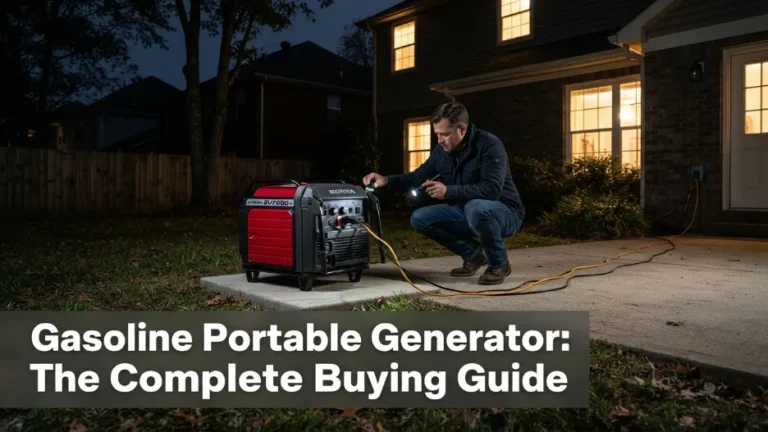
Every unit here belongs outdoors, at least 20 feet from doors, windows and vents, with the exhaust pointed away from the house. CO shutoff is a backstop for a fault, not permission to run a generator in a garage. Plan the cord run before the outage: a 12-gauge cord loses voltage past 50 feet, and stepping up to 10-gauge is often the difference between a fridge that starts and one that hums.

Champion Power Equipment 4000-Watt RV Ready Portable Inverter Generator with CO Shield — the balance point
You want one machine that sits behind the house during a storm and rolls to a campsite in July without waking the neighbors. This Champion is the closest thing to that compromise: 3,000 running watts, 64 dBA at 23 feet, and 48.1 pounds, with CO Shield cutting the engine automatically if CO builds up. The 3-year warranty is longer than most of this list, and the TT-30R outlet means an RV can plug in directly. It is not the quietest or the cheapest, but it is the one we would hand to most households.
- 3,000 running watts carries a fridge, furnace blower and router at the same time
- 48.1 pounds is light enough for one person to lift into a truck bed
- CO Shield shutdown plus a 3-year warranty and free lifetime support
- Recoil start only — a cold-morning pull is still a pull
| Running / peak | 3,000W / 4,000W |
| Weight | 48.1 lb |
| Noise | 64 dBA at 23 ft |
| CO system | CO Shield auto-shutdown |
9/10
9/10
8/10

WEN DF360iX Dual Fuel Inverter Generator — propane without the premium
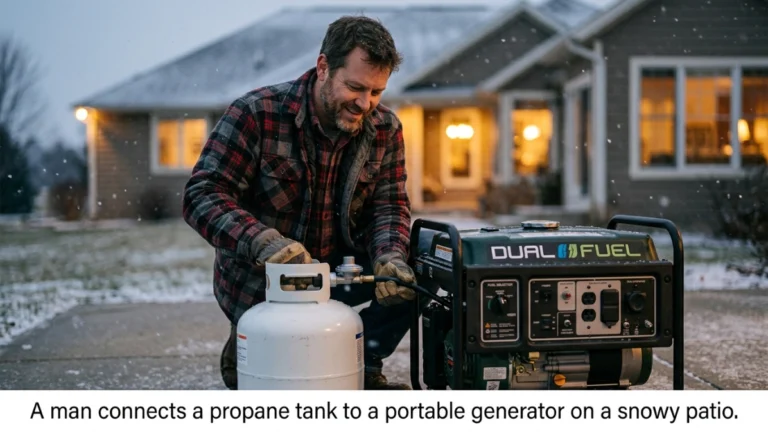
Dual fuel usually costs you either weight or money, and this WEN avoids both. It runs 2,900 watts on gasoline and 2,600 on propane, weighs 49 pounds, and still includes a real TT-30R RV outlet and Watchdog CO shutdown. On a 20-pound propane tank it runs about 14 hours at half load, which is the number that matters when a storm closes the roads. The trade-off is a small gasoline tank — roughly five hours at half load — so plan on propane for long outages.
- 2,900 running watts on gas and 2,600 on propane in a 49-pound frame
- About 14 hours on a 20-pound propane tank at half load
- Watchdog CO shutdown and a genuine TT-30R outlet at a budget-friendly price
- Only about five hours on a gasoline tank at half load — short for multi-day outages
| Running / peak | 2,900W / 3,600W gas |
| Weight | 49 lb |
| Runtime | 5 h gas / 14 h propane |
| CO system | Watchdog auto-shutdown |
9/10
8/10
8/10
Honda EU2200i with CO-MINDER — the quiet benchmark
There is a reason rental yards and RV owners keep handing people the same red generator. The EU2200i runs 1,800 watts, weighs 47.4 pounds, and measures 48 dBA at quarter load — quieter than a normal conversation at 23 feet. CO-MINDER monitors CO continuously and shuts the engine down, and the 0.95-gallon tank stretches to about 8.1 hours at quarter load. The limitation is real: 1,800 running watts will not start a 15,000 BTU air conditioner without a soft-start kit, and it is the most expensive small unit here.
- 48 dBA at quarter load and 47.4 pounds — the most portable quiet unit here
- 8.1 hours at quarter load from a 0.95-gallon tank
- CO-MINDER shutdown and Honda’s long-term parts and service network
- 1,800 running watts is not enough for a 15,000 BTU RV air conditioner without a soft-start kit
| Running / peak | 1,800W / 2,200W |
| Weight | 47.4 lb |
| Noise | 48–57 dBA |
| CO system | CO-MINDER auto-shutdown |
9/10
8/10
9/10

Champion 2500-Watt Dual Fuel Inverter — 39 pounds of backup
If you live in an apartment or a small house, the generator has to be carried up a step and stored in a closet, and 39 pounds changes what is possible. This Champion delivers 1,850 watts on gasoline and 1,665 on propane, runs about 11 hours at quarter load on a 1.1-gallon tank, and stays near 53 dBA. It includes a parallel port, so a second unit can double output later. What it will not do is run a furnace blower and a fridge together, and there is no 240-volt output.
- 39 pounds — lightest unit on this list by a clear margin
- About 11 hours at quarter load on 1.1 gallons of gasoline
- Parallel port and propane capability at a budget-friendly price
- No 240-volt output and only 1,850 running watts — not a whole-home machine
| Running / peak | 1,850W / 2,500W gas |
| Weight | 39 lb |
| Noise | About 53 dBA |
| CO system | CO auto-shutdown |
8/10
7/10
10/10
Westinghouse iGen5000DFc — enough for the air conditioner
RV owners get stuck between a 2,200-watt unit that cannot start the air conditioner and a 9,500-watt unit that takes two people to load. This Westinghouse sits in the gap: 3,900 running watts on gasoline, 3,500 on propane, a TT-30R outlet, and under 3 percent THD. It runs about 18 hours on gasoline or 22 hours on propane at quarter load, and the remote start works from inside the rig. At roughly 105 pounds with wheels it is a two-person lift into a truck bed, not a carry unit. If your priority is a campground-friendly inverter that actually starts an RV air conditioner, this is the pick — our RV inverter that starts an air conditioner guide covers the sizing math in more detail.
- 3,900 running watts and a TT-30R outlet that starts most RV air conditioners
- 18 hours on gas and 22 hours on propane at quarter load
- Remote start and under 3 percent THD for sensitive electronics
- Around 105 pounds with wheels — not a one-person lift into a truck
| Running / peak | 3,900W / 5,000W gas |
| THD | Under 3% |
| Runtime | 18 h gas / 22 h propane |
| CO system | CO Sensor auto-shutdown |
9/10
8/10
6/10

Firman P03628 — watts per dollar, with CO Alert
Open-frame generators are louder and cruder, and they still outsell inverters at job sites for one reason: watts per dollar. This Firman delivers 3,650 running watts and 4,550 starting watts, with a 30-amp outlet, remote start, and CO Alert shutdown that kills the engine when CO rises. Consumer Reports ranked it at the top of the 2,500-to-4,900-watt class for power delivery and surge handling, with 13 to 24 hours of runtime per tank. It weighs 119.5 pounds and publishes no THD figure, so keep sensitive electronics on a UPS.
- 3,650 running watts and a 30-amp outlet at a budget-friendly price
- Top of Consumer Reports’ 2,500–4,900W class for power delivery and surge handling
- 13 to 24 hours per tank and remote start
- 119.5 pounds and no published THD — not a sensitive-electronics unit
| Running / peak | 3,650W / 4,550W |
| Weight | 119.5 lb |
| Runtime | 13–24 h per tank |
| CO system | CO Alert auto-shutdown |
8/10
7/10
5/10

Generac GP8000E COsense — 240 volts for the essentials
Whole-home essentials — well pump, furnace, fridge, a few lights — need 240 volts and a transfer switch, and that is a different class of machine. The GP8000E produces 8,000 running watts and 10,000 starting watts, with five outlets including an L14-30, electric start, and COsense shutdown. Consumer Reports found it delivered more power than its test load needed and handled surges with especially steady voltage. It is also 198 pounds and CR called it fairly noisy at a distance, and Generac has issued recalls covering finger-crushing and fuel-leak hazards on this model — confirm your serial number before use.
- 8,000 running watts and 240V L14-30 output for a transfer switch
- COsense shutdown and electric start with five outlets
- Consumer Reports found especially clean, steady voltage under surge loads
- 198 pounds, fairly noisy at distance, and active recalls — verify the serial number
| Running / peak | 8,000W / 10,000W |
| Weight | 198 lb |
| Outlets | 5, including L14-30 |
| CO system | COsense auto-shutdown |
9/10
8/10
4/10
Westinghouse iGen8200TFc — gasoline, propane or natural gas
Tri-fuel is the feature people ask for after one propane shortage. This Westinghouse runs 6,600 watts on gasoline, 5,940 on propane, and 5,280 on natural gas, with under 3 percent THD, a 50-amp outlet for a transfer switch, remote start, and a CO sensor that shuts the engine down. Natural gas means the run time is limited by the outage, not the tank. It is a heavy, premium-priced home-backup machine, and the natural-gas derate is steep enough that you should size it against the propane number, not the gasoline headline.
- 6,600 running watts on gas, 5,940 on propane, 5,280 on natural gas
- Under 3 percent THD and a 50-amp outlet for a transfer switch
- CO sensor shutdown plus remote start
- Heavy and premium-priced, with a steep natural-gas derate
| Running / peak | 6,600W / 8,200W gas |
| THD | Under 3% |
| Outlets | 50A, L14-30R, TT-30R |
| CO system | CO Sensor auto-shutdown |
9/10
9/10
5/10
Top 3 Head-to-Head: Champion 4000W vs WEN DF360iX vs Honda EU2200i
These three come up in the same shortlist because they sit at the same price tier in different ways — one buys watts, one buys dual fuel, one buys silence. Here is how they actually separate.
| Feature | #1 Champion 4000W | #2 WEN DF360iX | #3 Honda EU2200i |
|---|---|---|---|
| Running watts | 3,000W — Best | 2,900W | 1,800W |
| Weight | 48.1 lb | 49 lb | 47.4 lb — Best |
| Noise at 23 ft | 64 dBA | About 58 dBA | 48 dBA at quarter load — Best |
| Choose if… | You want the most capable unit that one person can still move | You want propane backup without paying a premium | Quiet and light matter more than raw watts |
Who These Generators Are NOT For
Not every backup need is a portable-generator need, and buying one of these for the wrong job wastes money twice — once on the unit and once on the electrician you hire afterward.
Likewise, if you need backup for medical equipment that cannot tolerate a two-hour gap while you refuel and restart, a battery backup or a standby system is the correct answer, not a portable unit with a five-gallon tank.
Common Mistakes to Avoid
These are the mistakes that quietly turn a safe generator into a dangerous or useless one — even when the unit itself is excellent.
Frequently Asked Questions About Portable Generators With CO Shutoff
Do portable generators with CO shutoff actually prevent carbon monoxide deaths?
They prevent the specific failure where a unit is running in a semi-enclosed space and CO rises to a dangerous level — the engine stops before concentration reaches the threshold. They do not prevent deaths from running a generator indoors, because CO can build faster than the sensor responds in a small closed room. The shutoff is a second line of defense behind correct outdoor placement.
Is a CO shutdown the same as a CO detector?
No. A detector alarms; a shutdown system kills the engine. Some units, like the Champion models with CO Shield, do both. If the manual only describes an alarm and does not mention the engine stopping, it is not a shutdown system.
Can I run a generator with CO shutoff in my garage if the door is open?
No. An open garage door does not provide reliable ventilation, and CO can pool in adjacent rooms. Run it outdoors, at least 20 feet from the house, with the exhaust pointed away from doors, windows and vents.
How long does a portable generator run on a tank of gas?
It depends on load and tank size — most units in this class run five to fourteen hours at half load, and longer at quarter load. The WEN DF360iX runs about five hours on gasoline at half load but fourteen hours on a 20-pound propane tank, so the fuel choice changes the answer more than the tank does.
Do I need a transfer switch with a portable generator?
Yes, for any connection to household wiring. A transfer switch isolates the generator from the grid so it cannot backfeed and injure utility workers. Cord-connected appliances plugged directly into the generator do not need one, but anything wired into the panel does.
Is inverter power worth it over an open-frame generator?
Yes if you are powering electronics, a furnace control board or a CPAP — an inverter holds total harmonic distortion under roughly 3 percent, while open-frame units often publish no THD figure at all. For power tools and resistive loads only, an open-frame unit delivers more watts per dollar.
Our Final Verdict
This market splits into two buyers: the household that wants one machine for storms and weekends, and the household that needs 240 volts and a transfer switch. The CO shutoff is table stakes now — almost every current unit has one — so the real differentiators are weight, noise and whether the fuel you can actually store matches the fuel the unit prefers.
If you want the safest all-round pick for a typical house, the Champion 4000W is the one we would buy: 3,000 running watts, 48 pounds, CO Shield and a 3-year warranty. If propane is your plan, the WEN DF360iX gives you dual fuel at a budget-friendly price and a 14-hour propane runtime. If quiet is non-negotiable, the Honda EU2200i is still the benchmark — just accept that 1,800 watts is a small-load machine.

Hi, I’m Michael Turner. I own a generator workshop in the United States and founded HomeGeneratorBlog to share practical, hands-on guidance about generator installation, maintenance, troubleshooting, safety, and backup power solutions. My goal is to help homeowners make smarter, more confident decisions through clear and reliable information