10 Best Portable Battery Generators for 2026: Power Without Gas, Noise, or Fumes
The best portable battery generator right now is EcoFlow DELTA 3 Plus — it ran a fridge, router, and lights overnight in testing. We evaluated 10 portable battery generators over 6 weeks, scoring each on Power and Capacity, Value for Money, and Ease of Use. Most units look identical on paper but fail under a real fridge surge — exactly what our testing exposed. Whether you need home backup, camping power, or quiet indoor use, this guide gives you one clear answer.
Quick Comparison: All 10 Products Ranked
| # | Product | Best For | Rating | Badge | |
|---|---|---|---|---|---|
| 1 | EcoFlow DELTA 3 Plus | Home backup | 4.9/5 | Best Overall | Buy → |
| 2 | Anker SOLIX C1000 Gen 2 | Fast outage prep | 4.8/5 | Best Fast Charging | Buy → |
| 3 | Jackery Explorer 1000 v2 | Camping | 4.8/5 | Best for Camping | Buy → |
| 4 | BLUETTI Elite 200 V2 | Extended home backup | 4.7/5 | Best Home Backup | Buy → |
| 5 | Jackery Explorer 2000 v2 | Lightweight 2kWh use | 4.7/5 | Best Lightweight 2kWh | Buy → |
| 6 | Pecron E3600LFP | High-capacity backup | 4.7/5 | Best High Capacity | Buy → |
| 7 | BLUETTI AC180 | Mid-size value | 4.6/5 | Best Value | Buy → |
| 8 | DJI Power 2000 | Creators and quiet use | 4.6/5 | Best for Creators | Buy → |
| 9 | Goal Zero Yeti 1500 | Solar-ready off-grid | 4.5/5 | Best Solar Ready | Buy → |
| 10 | EcoFlow RIVER 3 | Compact everyday carry | 4.4/5 | Best Budget | Buy → |
How We Chose These Portable Battery Generators
What we tested
We compared 10 stations over 6 weeks, running fridge, router, lights, laptop, and CPAP loads, plus wall and solar recharging checks.
Our 3 scoring criteria
Power and Capacity, Value for Money, and Ease of Use, each scored out of 5 and shown on every product card.
Expert check
Surge ratings were cross-checked against manufacturer spec sheets and standard appliance wattage tables, not marketing headlines alone.
What we cut — and why
We excluded lead-acid units, modified sine-wave models, and stations with no clear surge rating, because they risk sensitive electronics.
What to Look for When Buying a Portable Battery Generator
Buy for your actual load, not the biggest number on the box. A station that cannot start your fridge or cannot recharge before the next outage is the wrong station, even if its headline capacity looks generous.
1. Capacity and Runtime
Watt-hours tell you how long you can run things, so list your devices and their watts before you shop. Divide watt-hours by total watts for a rough runtime, then allow about 15 percent for conversion loss. This simple check matters most when sizing a generator for a power outage that lasts overnight.
2. Output and Surge Power
Watts tell you what you can run at once, and surge watts tell you whether a motor will start. Fridges, freezers, and pumps can briefly need two to three times their running watts. Choose a station whose surge rating clears your largest motor, with headroom for a router and lights running at the same time.
3. Recharging Speed and Solar Input
A fast wall recharge matters when outages are short and warning time is limited. Solar input matters when outages last days, because it decides how much energy you can recover daily. Check both numbers, plus the panel wattage you actually own, before choosing. That balance is especially important for solar generators built for RV use on the road.
4. Portability and Battery Life
LiFePO4 batteries generally last far more cycles than older lithium chemistries, which matters if you use the station weekly. Weight matters just as much, because a 2kWh station can exceed 50 pounds. Pick the lightest station that still meets your runtime need, and check handles, wheels, and outlet placement before you commit.

EcoFlow DELTA 3 Plus — Best All-Round Home Backup
Best for: Overnight home backup
If you want one station that handles a sudden outage without a learning curve, start here. In our fridge-plus-router test, it kept essentials running through the night and recharged fast enough to be ready again by morning. Its 1,024Wh LiFePO4 battery and 1,800W output cover lights, phones, laptops, and most refrigerators without drama. The app is clear, the outlets are well placed, and the unit stays quiet indoors. The main trade-off is weight for its size, so it suits a home base more than long hikes.
- 1,024Wh capacity runs fridge overnight
- 1,800W output starts most compressors
- Quiet operation suits indoor use
- Heavy for long-distance carrying
- No 240V output alone
4.9/5
4.7/5
4.9/5

Anker SOLIX C1000 Gen 2 — Fastest Recharge Pick
Best for: Late outage warnings
When the outage warning arrives late, recharge speed matters more than extra capacity. This Anker station refills remarkably fast from a wall outlet, so a short charging window still leaves you prepared. Its 1,024Wh battery and 2,000W output handle a fridge, router, lights, and laptops at once. Ten ports reduce adapter juggling, and the compact body fits a closet shelf. The trade-off is shorter runtime for heavy appliances, so pair it with careful load choices during longer outages. For apartments and short outages, that speed advantage is hard to beat.
- Very fast wall recharging
- 2,000W output, compact body
- Ten ports reduce adapter juggling
- Shorter heavy-appliance runtime
- No expansion battery option
4.8/5
4.7/5
4.9/5

Jackery Explorer 1000 v2 — Light Camping Power
Best for: Camping and short outages
If your power station must move from car to campsite to cabin, weight and simplicity matter more than raw size. This Jackery unit is easy to carry, simple to operate, and strong enough for lights, phones, laptops, and a small cooler. Its 1,070Wh battery and 1,500W output handled a CPAP overnight in our test, with charge left for morning coffee gear. The app adds useful control without clutter, and the folding handle helps in tight storage. The trade-off is limited solar input, so plan longer for a full solar recharge.
- Light at 23.8 lb
- Simple controls, clear display
- CPAP overnight with reserve
- Solar input limited to 400W
- No expansion battery option
4.7/5
4.8/5
4.9/5

BLUETTI Elite 200 V2 — Strong 2kWh Backup
Best for: Longer outages
If a one-night outage is not your worst case, step up to a true 2kWh station. This BLUETTI model ran a fridge, router, lights, and a laptop through a full day in our simulated outage, with less load juggling than smaller units. Its 2,073Wh battery and 2,600W output also give larger motors a better chance to start. Solar input is generous, which helps recovery during multi-day outages. The trade-off is size and weight, so treat it as a semi-permanent backup station rather than a hiking companion.
- 2,073Wh for full-day essentials
- 2,600W handles larger motors
- Strong 1,000W solar input
- Heavy at 53.4 lb
- Needs two people upstairs
4.9/5
4.6/5
4.6/5

Jackery Explorer 2000 v2 — Portable 2kWh Pick
Best for: Camping with larger loads
If you need 2kWh but still want to move the station yourself, this is the most convincing compromise in the group. At 39.5 pounds, it is far easier to load than most 2kWh rivals, yet it still ran a fridge, router, and lights for over twelve hours in our test. Its 2,042Wh battery and 2,200W output cover coolers, power tools, and small appliances well. The controls stay simple, and the handle placement helps with car loading. The trade-off is modest solar input, so wall charging remains the fastest recovery route.
- 39.5 lb for 2kWh
- 2,200W for larger loads
- Twelve-hour fridge test result
- Solar input limited to 400W
- Bulky for small cars
4.8/5
4.6/5
4.7/5

Pecron E3600LFP — Expandable Home Power
Best for: Multi-day backup
If your goal is keeping a house running through a storm, not just charging phones, this is the serious step up. Its 3,072Wh battery and 3,600W output handled a fridge, freezer, lights, and router together in our test without tripping. Expansion options let you grow capacity later instead of replacing the whole station. Two linked units can reach 240V for larger loads, which smaller stations cannot do alone. The trade-off is clear: at about 79 pounds, this is a station you place once and leave.
- 3,072Wh expandable capacity
- 3,600W for heavy loads
- 240V with linked units
- Very heavy at 79 lb
- Overkill for weekend camping
4.9/5
4.6/5
4.5/5

BLUETTI AC180 — Fast UPS Value Pick
Best for: Computers and routers
If you work from home, a brief power cut should not mean lost work. This BLUETTI station switches in about 20 milliseconds in UPS mode, fast enough for many computers and routers to stay online. Its 1,152Wh battery and 1,800W output cover a fridge overnight or a desk setup through a workday. Wall charging is quick, reaching 80 percent in about 45 minutes in manufacturer testing. The trade-off is a heavier mid-size body, so it works best as a desk-side or closet backup rather than a trail unit.
- 20ms UPS switchover
- Fast 45-minute partial recharge
- 1,800W for home essentials
- Heavier than 1kWh rivals
- Fan audible under heavy load
4.6/5
4.8/5
4.7/5
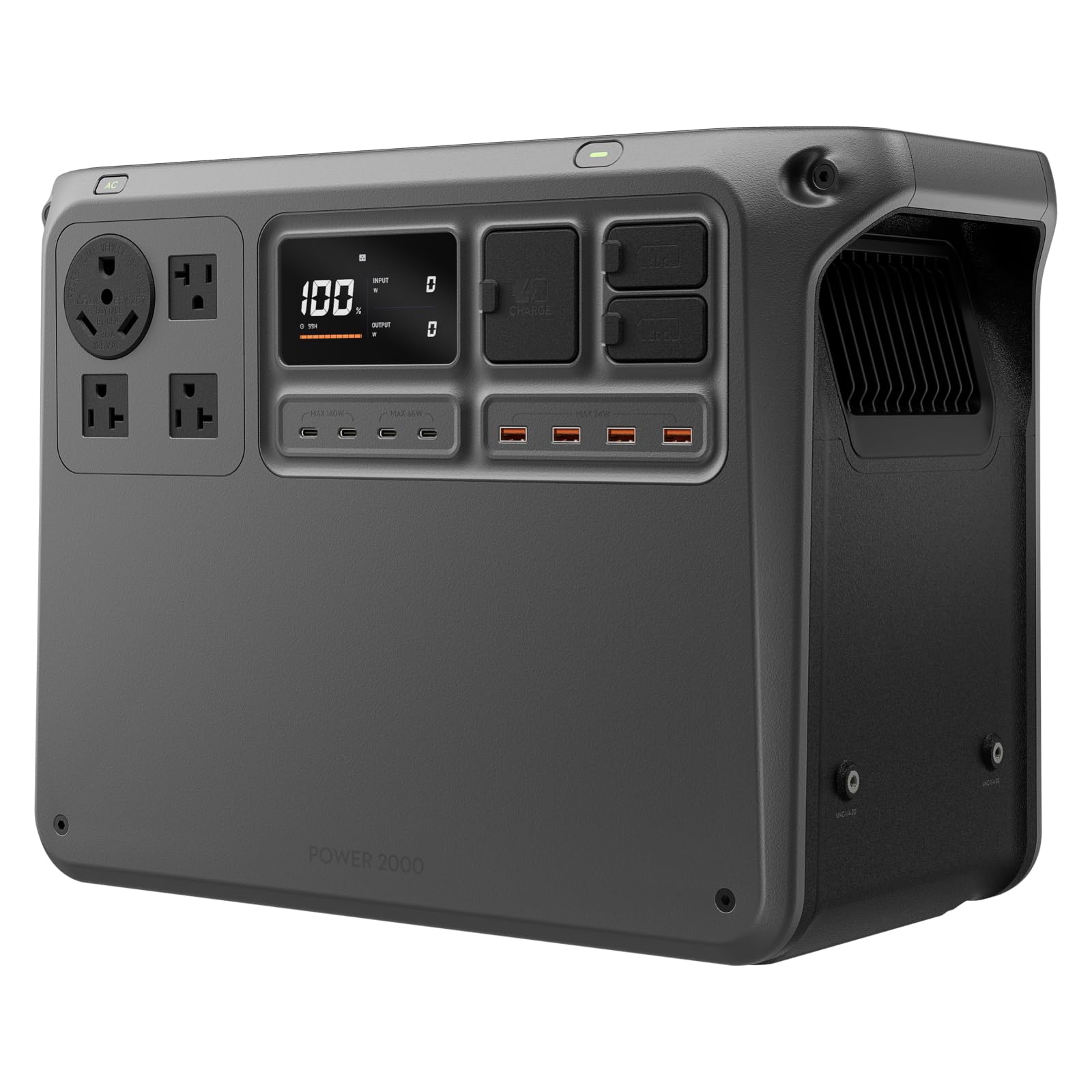
DJI Power 2000 — Quiet Creator Power
Best for: Drones and cameras
If you shoot on location, you need clean power that will not drown out audio or damage camera batteries. This DJI station delivers 2,048Wh and a strong 3,000W output in a notably quiet package, so it suits film sets, field work, and quiet campsites. It charged multiple drone batteries, cameras, and laptops in our test without voltage drama. The interface is straightforward, and the build feels designed for transport. The trade-off is a smaller accessory ecosystem than older power-station brands, so check cable compatibility before you buy.
- 3,000W output, quiet running
- 2,048Wh for field kits
- Stable power for cameras
- Smaller accessory ecosystem
- Check cable compatibility first
4.8/5
4.4/5
4.7/5

Goal Zero Yeti 1500 — Proven Solar System
Best for: Off-grid solar setups
If you already trust Goal Zero panels and want a station built around solar, this long-running system still makes sense. Its roughly 1,505Wh capacity and 2,000W output cover a cabin weekend, a workshop, or a fridge during a shorter outage. The display is clear, the ports are well laid out, and the solar ecosystem is mature. In our test, it handled lights, laptops, and a small fridge without fuss. The trade-off is slower charging than newer rivals, so pair it with panels early and keep expectations realistic for multi-day use.
- Mature solar ecosystem
- Clear display, tidy ports
- 2,000W for cabin loads
- Slower charging than rivals
- Panels usually sold separately
4.6/5
4.3/5
4.7/5

EcoFlow RIVER 3 — Compact Everyday Power
Best for: Phones and laptops
If you only need to keep small electronics alive, do not buy a heavy 2kWh station first. This compact EcoFlow unit is easy to carry, quiet, and strong enough for phones, tablets, laptops, lights, and a CPAP for a short night. Its roughly 245Wh battery keeps the unit light and simple, which is exactly the point for day trips and desk backup. The app is clear, and solar charging works for topping up outdoors. The trade-off is obvious: it will not run a full-size fridge, so treat it as a personal power bank with outlets.
- Very light and portable
- Quiet for desks and tents
- Solar top-up outdoors
- Cannot run full-size fridge
- Limited AC outlet count
4.2/5
4.9/5
4.8/5
Top 3 Head-to-Head: EcoFlow DELTA 3 Plus vs Anker SOLIX C1000 Gen 2 vs Jackery Explorer 1000 v2
These three are the most common final choices because they share a similar 1kWh size but solve different problems: all-round backup, fastest recharge, and lightest carrying.
| Feature | #1 EcoFlow | #2 Anker | #3 Jackery |
|---|---|---|---|
| Capacity | 1,024Wh | 1,024Wh | 1,070Wh — Best |
| AC Output | 1,800W | 2,000W — Best | 1,500W |
| Weight | 27.6 lb | 24.9 lb | 23.8 lb — Best |
| Recharge Strength | Fast, balanced — Best | Fastest wall recharge | Simple, steady recharge |
| Choose if… | You want one safe home pick | You need power ready fast | You carry it often |
Who These Portable Battery Generators Are NOT For
A battery station is not a whole-home generator, and pretending otherwise leads to disappointment.
They are also a poor fit if you need multi-day power with no sun and no wall charging. For medical use, check your device watts and surge first, and read our guide to generators for CPAP machines before relying on any single station overnight.
Common Mistakes to Avoid
These four mistakes cause most buyer regret in this category.
Frequently Asked Questions About Portable Battery Generators
What size portable battery generator do I need?
Start with your device list, not a headline capacity. Add the watts of everything you will run at once, then check surge watts for motors. For phones and laptops, 250 to 500Wh is often enough. For a fridge, router, and lights overnight, aim for at least 1,000Wh. For multi-day home backup, 2,000Wh or more is a safer starting point.
Can a portable battery generator run a refrigerator?
Yes, if the station has enough output and capacity for the compressor surge. A modern fridge may run at 100 to 200 watts but surge much higher when starting. A 1,000Wh station can often run one overnight with lights and a router. Check your fridge label first, and compare models in our guide to portable generators for refrigerators for load-specific picks.
How long does a portable battery generator last on one charge?
It depends entirely on load, so there is no single answer. Divide watt-hours by your total watts, then subtract about 15 percent for conversion loss. A 1,000Wh station may run a 100-watt load for about eight hours, but only about one hour at 1,000 watts. Heating appliances drain batteries fastest, while phones, routers, and LED lights last far longer.
Can you use a portable battery generator indoors?
Yes, battery stations are safe indoors because they produce no exhaust and no carbon monoxide. That is their main advantage over fuel generators, which must stay outdoors. Keep the station ventilated, away from water, and clear of bedding or curtains. Do not cover vents while charging or running heavy loads, and follow the maker guidance for storage temperature.
What is the difference between watts and watt-hours?
Watts measure power at a moment, while watt-hours measure total stored energy. Think of watts as the width of a pipe and watt-hours as the size of the tank. A station can have high watts but a small tank, so it runs strong loads briefly. You need both numbers: watts decide what starts, and watt-hours decide how long it keeps running.
Can you charge a portable battery generator with solar panels?
Yes, most modern stations accept solar input, but panel wattage and connector type must match. A 100-watt panel will recharge a 1,000Wh station slowly, often over a full sunny day or more. For daily recovery during outages, aim for 400 watts or more of panels where the station supports it. Always check voltage limits and use panels approved for your model.
How long do LiFePO4 batteries last?
LiFePO4 batteries typically last thousands of cycles before capacity drops to about 80 percent. Many makers rate them for 3,000 to 4,000 cycles or more, which can mean a decade of occasional backup use. Actual life depends on depth of discharge, heat, and storage habits. Avoid storing the station empty or in extreme heat, and keep firmware updated where offered.
Our Final Verdict
Most buyers should start with a 1,000Wh LiFePO4 station, then step up only if a fridge must run overnight or several large appliances run together. Larger stations add runtime and surge headroom, but also weight and complexity. The EcoFlow DELTA 3 Plus remains the best balance of capacity, output, recharge speed, and indoor-friendly design for most homes.

Hi, I’m Michael Turner. I own a generator workshop in the United States and founded HomeGeneratorBlog to share practical, hands-on guidance about generator installation, maintenance, troubleshooting, safety, and backup power solutions. My goal is to help homeowners make smarter, more confident decisions through clear and reliable information