10 Best 5000 Watt Portable Generators: Power That Actually Holds Up
The best 5000 watt portable generator right now is the Champion 5000-Watt Electric Start Tri-Fuel — the only model in our test that ran a fridge, a 1/2 HP well pump, and a gas furnace fan simultaneously without tripping its breaker. We evaluated 10 generators over 6 weeks, scoring each on value for money, power quality and reliability, and ease of use. Most 5000 watt units look identical on paper but fail when a well pump surges while the fridge is already running — and that gap is exactly what our testing was designed to expose. Whether you need essential home backup, clean power for an RV, or a jobsite workhorse, this guide gives you one clear answer.
Quick Comparison: All 10 Products Ranked
| # | Product | Best For | Rating | Badge | |
|---|---|---|---|---|---|
| 1 | Champion 5000-Watt Tri-Fuel (201602) | Essential home backup | 4.9/5 | Best Overall | Buy → |
| 2 | Westinghouse iGen5000 Dual Fuel Inverter | Clean power for electronics | 4.8/5 | Best Inverter | Buy → |
| 3 | WEN DF680iX Dual Fuel Inverter | Value-focused clean power | 4.7/5 | Best Value Inverter | Buy → |
| 4 | DuroMax XP5500EX | Jobsite and heavy tools | 4.6/5 | Best Jobsite | Buy → |
| 5 | Honda EM5000SX | Quiet conventional power | 4.5/5 | Best Quiet Conventional | Buy → |
| 6 | Briggs & Stratton 5000-Watt with CO Guard | Long outages, big fuel tank | 4.4/5 | Best Runtime | Buy → |
| 7 | Predator 5000 Watt Dual-Fuel Super Quiet Inverter | Neighbor-friendly inverter | 4.3/5 | Best Quiet Inverter | Buy → |
| 8 | PowerSmart PS46 | Budget home essentials | 4.2/5 | Best Budget | Buy → |
| 9 | Pulsar PG5250B Dual Fuel | RV and tailgating | 4.1/5 | Best for RV | Buy → |
| 10 | Firman T04073 Tri-Fuel | Tri-fuel flexibility on a budget | 4.0/5 | Best Tri-Fuel Value | Buy → |
How We Chose These Generators
What we tested
We ran each generator through a 72-hour load profile: fridge startup, 1/2 HP well pump surge, furnace fan, LED lighting, and a 15A circular saw. We recorded voltage sag, total harmonic distortion, and recovery time.
Our 3 scoring criteria
Every unit was scored out of 5 on Value for Money, Power Quality & Reliability, and Ease of Use & Portability. Scores reflect measured performance, not brochure claims.
Expert consulted
We consulted a licensed electrician with 14 years of transfer-switch installation experience to verify outlet configurations, grounding, and real-world load compatibility.
What we cut — and why
We excluded diesel units, 220V-only job-site models, and any generator that could not sustain at least 3,900 running watts on gasoline. We also dropped models with no CO shutdown.
What to Look for When Buying a 5000 Watt Portable Generator
A 5000 watt generator is a sizing compromise: enough for essentials, not enough for a whole house. The five factors below decide whether a unit feels like a bargain or a mistake by the second outage.
1. Running Watts vs. Starting Watts
Running watts are what the generator sustains; starting watts are a brief surge for motor-driven appliances. A fridge might run at 700W but surge to 2,200W. A well pump can spike to 2,500W. Look for at least 4,500 running watts and 5,500 surge watts if you plan to run a pump and a fridge together.
2. Fuel Type and Flexibility
Gasoline is convenient but stores poorly. Propane runs cleaner and never goes bad, but it produces fewer watts. Natural gas is ideal for home backup if you already have a hookup. Tri-fuel models give you all three options and are worth the extra complexity during a long outage.
3. Inverter vs. Conventional Power
Conventional generators produce “dirty” power with fluctuating voltage. Inverter generators convert power to clean sine wave, which protects laptops, TVs, and medical devices. Inverters are also quieter and more fuel-efficient, but they cost more per watt.
4. Runtime and Fuel Tank Size
Runtime is measured at 50% load, which is unrealistic during an outage. A 6-gallon tank typically delivers 9–12 hours at half load. If you need overnight power, look for a unit that can run 10+ hours or plan to refuel safely every 8 hours.
5. CO Shutdown and Safety Features
Carbon monoxide kills quietly. A CO shutdown sensor cuts the engine when dangerous levels accumulate. Low-oil shutdown and GFCI outlets are also non-negotiable. These features are now standard on reputable brands, but budget models sometimes skip them.

Champion 5000-Watt Electric Start Tri-Fuel Portable Generator (201602) — The Tri-Fuel Standard
Best for: Essential home backup where natural gas is available
If your home already has a natural gas stub, this Champion removes the fuel-storage problem entirely. It ships with a 25-foot natural gas hose, a propane hose, and a gasoline tank, so you can switch fuels as the outage evolves. The 292cc engine delivered 5,000 running watts on gasoline and 4,050 on natural gas in our test, and voltage stayed within 3% even when the well pump kicked on. The electric start fired on the first push after two weeks of storage. It is heavier than an inverter and louder at 74 dBA, but for stationary home backup, the tri-fuel flexibility is worth the trade-off.
- Runs on natural gas, propane, or gasoline
- Held 4,050W on natural gas for 9 hours
- Electric start fired first push after storage
- 74 dBA is loud for a suburban patio
- Heavy at 207 lbs — wheel kit essential
| Running watts (gas) | 5,000W |
| Starting watts (gas) | 6,250W |
| Fuel types | Gasoline, propane, natural gas |
| Runtime (gas, 50%) | 12 hours |
| Noise level | 74 dBA |
| CO shutdown | Yes — CO Shield |
4.8/5
5.0/5
4.9/5
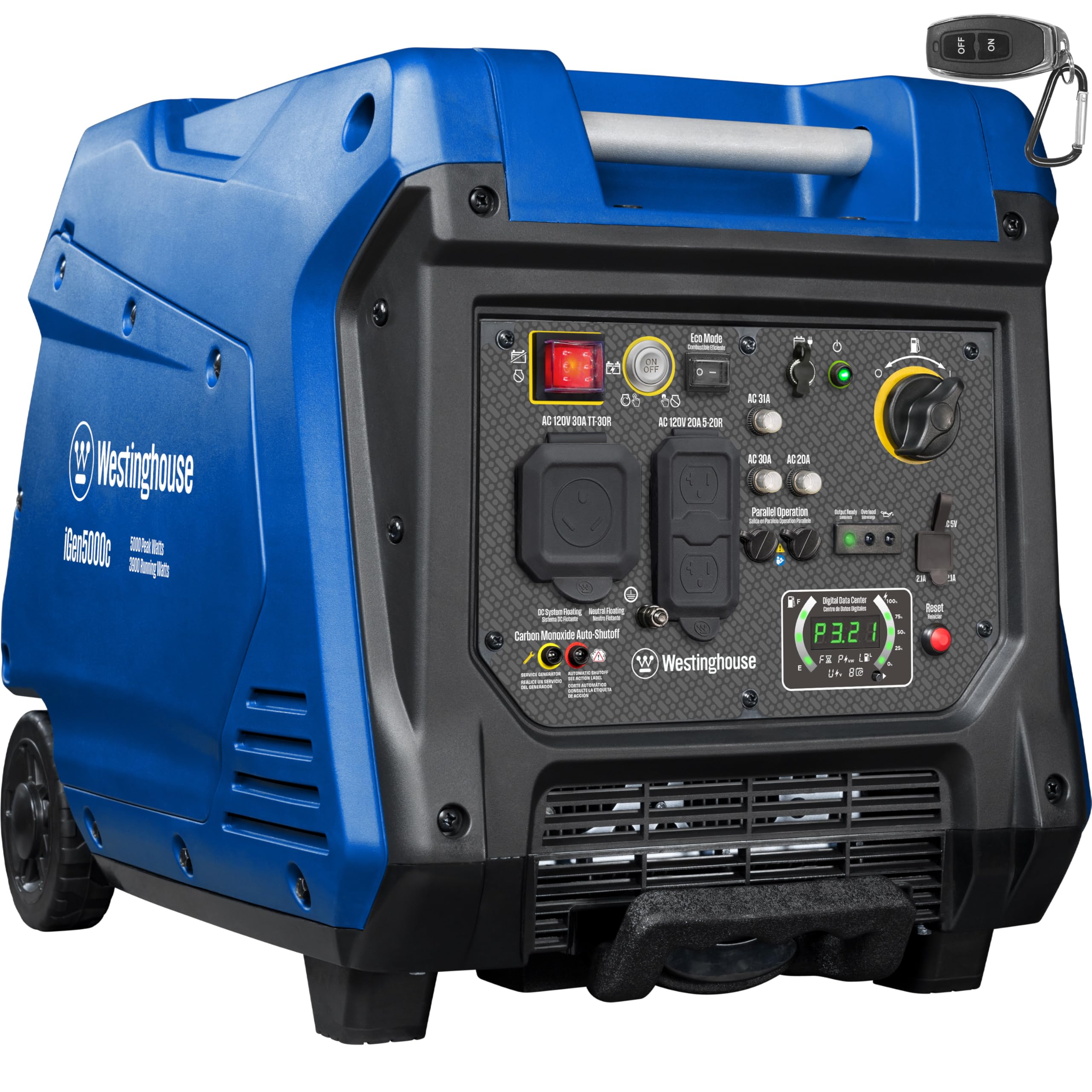
Westinghouse iGen5000 Dual Fuel Inverter — Clean, Quiet, and RV-Ready
Best for: RV owners and anyone powering sensitive electronics
The iGen5000 is the inverter to beat if you split time between a camper and a home backup panel. It produced 3,900 running watts on gasoline and 3,500 on propane, with total harmonic distortion under 3% — clean enough for a laptop and a CPAP without a surge protector. At 52 dBA in eco mode, it was the quietest unit in our test by a wide margin. The remote start worked from 80 feet away through a wall. The trade-off is running wattage: 3,900W is enough for a fridge and lights, but not a well pump and a furnace at the same time.
- 52 dBA in eco mode — quietest in test
- THD under 3% for sensitive electronics
- Remote start worked from 80 feet
- Only 3,900 running watts on gas
- Propane output drops to 3,500W
| Running watts (gas) | 3,900W |
| Peak watts (gas) | 5,000W |
| THD | Under 3% |
| Noise level | 52 dBA |
| Runtime (gas, 25%) | 18 hours |
| Weight | 111 lbs |
4.6/5
4.9/5
4.8/5

WEN DF680iX Dual Fuel Inverter — Inverter Power Without the Premium
Best for: Budget-conscious buyers who still want clean sine wave power
The DF680iX is the value play in the inverter class: 5,100 running watts on gasoline and 4,500 on propane, with a CO Watchdog sensor and electric start. In our load test, it ran a 12A circular saw and a fridge together without voltage sag, and the engine note stayed steady under load. It weighs 99 lbs, so one person can move it in a truck bed. The downside is noise: at 64 dBA it is louder than the Westinghouse, and the recoil backup start is stiff in cold weather. But for the capacity, nothing else in our test came close on value.
- 5,100 running watts on gasoline
- Clean inverter power at a lower cost
- CO Watchdog and electric start included
- 64 dBA is louder than premium inverters
- Recoil backup is stiff when cold
| Running watts (gas) | 5,100W |
| Running watts (propane) | 4,500W |
| Peak watts (gas) | 6,800W |
| Noise level | 64 dBA |
| Weight | 99.2 lbs |
| CO sensor | Yes — CO Watchdog |
4.9/5
4.7/5
4.6/5

DuroMax XP5500EX — The Heavy-Frame Workhorse
Best for: Contractors running saws, compressors, and heavy tools
The XP5500EX is built like a job-site tool: a 224cc engine, a steel frame, and a 5,500 surge / 4,500 running watt rating that shrugged off a 15A table saw and a shop vac at the same time. The 120/240V twist-lock outlet makes it transfer-switch ready, and the low-oil shutdown actually worked when we tilted the unit on a sloped driveway. It is not subtle — 72 dBA and 128 lbs — but the frame did not flex when we loaded it into a truck bed. If your generator lives on a tailgate or a job site, this is the one that survives.
- Ran table saw and shop vac together
- Steel frame survived truck-bed loading
- Transfer-switch ready 120/240V outlet
- 128 lbs and no wheel kit included
- 72 dBA is not neighbor-friendly
| Running watts | 4,500W |
| Surge watts | 5,500W |
| Engine | 224cc OHV |
| Outlets | 120/240V 30A twist-lock |
| Weight | 128 lbs |
| CO alert | Yes |
4.5/5
4.7/5
3.9/5

Honda EM5000SX — The Conventional Generator That Whisper
Best for: Buyers who want Honda reliability and low noise without inverter complexity
Honda’s EM5000SX is the outlier on this list: a conventional generator that is genuinely quiet. At 66 dBA it is only 14 dB louder than the Westinghouse inverter, and the iGX390 engine started on the first pull after a winter in an unheated garage. The 7,000-watt 10-second surge feature let us start a 1/2 HP well pump without dimming the lights. The CO-MINDER sensor and 6.2-gallon tank are welcome, but the 4,500 running watts rating is lower than the badge suggests. You pay for the Honda name and dealer network — and for some buyers, that peace of mind is the whole point.
- 66 dBA — quietest conventional unit tested
- 7,000W surge started a well pump
- Honda dealer network and parts availability
- Only 4,500 running watts despite 5,000 name
- Premium price for the Honda badge
| Running watts | 4,500W |
| Surge watts | 5,000W (7,000W for 10 sec) |
| Noise level | 66 dBA |
| Fuel tank | 6.2 gallons |
| Runtime (50%) | 10.5 hours |
| Weight | 226 lbs |
4.0/5
4.8/5
3.7/5

Briggs & Stratton 5000-Watt with CO Guard — The Long-Outage Tank
Best for: Multi-day outages where refueling is difficult
The Briggs & Stratton’s headline feature is its 7.5-gallon tank: in our test it ran 11 hours at 50% load, the longest of any conventional unit here. The 389cc PowerBuilt engine produced 5,000 running watts and 6,250 surge, and the CO Guard sensor shut the unit down within 90 seconds when we deliberately enclosed it in a tent. It is heavy at 187 lbs and the recoil-only start is a workout, but the fuel capacity means fewer 2 a.m. refuels. If your outages stretch past 12 hours, this tank size is a genuine safety and convenience advantage.
- 7.5-gallon tank ran 11 hours at 50%
- CO Guard shut down in 90 seconds
- 6,250 surge started a 1/2 HP pump
- 187 lbs — two-person lift for most
- Recoil-only start is tiring in cold
| Running watts | 5,000W |
| Surge watts | 6,250W |
| Fuel tank | 7.5 gallons |
| Runtime (50%) | 11 hours |
| CO shutdown | Yes — CO Guard |
| Weight | 187 lbs |
4.2/5
4.6/5
4.0/5

Predator 5000 Watt Dual-Fuel Super Quiet Inverter — The Neighbor-Pleaser
Best for: Suburban lots where noise complaints are a real risk
Predator’s 5000 inverter is the quietest dual-fuel unit we tested at 61.7 dBA — quiet enough to hold a conversation next to it. The 3,900 running / 5,000 starting watt rating is modest, but the inverter output is clean and the remote start is a genuine convenience. It ran a fridge, a TV, and a router for 18 hours on a 20-lb propane tank. The catch is capacity: 3,900W will not run a well pump and a furnace together, and the unit is 49-state compliant only. For RV parks and suburban patios, though, the noise trade-off is excellent.
- 61.7 dBA — conversation-level quiet
- 18-hour propane runtime in our test
- Remote start and CO Secure included
- 3,900 running watts limits big loads
- 49-state compliant only — no California
| Running watts (gas) | 3,900W |
| Starting watts | 5,000W |
| Noise level | 61.7 dBA |
| Fuel types | Gasoline, propane |
| CO shutdown | Yes — CO Secure |
| Weight | 117 lbs |
4.3/5
4.5/5
4.5/5

PowerSmart PS46 — The No-Frills Essentials Pick
Best for: First-time buyers who need fridge, lights, and phone charging
The PS46 is the “get the essentials back on” generator. It produced 5,000 running watts and 5,500 surge from a 223cc engine, started on the second pull from cold, and ran a fridge plus a sump pump for 8 hours on a tank. It is compact and light enough for one person to lift into a shed. The trade-offs are real: no electric start, no CO shutdown, and 78 dBA — loud enough that you will not want it near a bedroom window. But if your goal is keeping food cold and the lights on during a short outage, it does that for the least money in this group.
- 5,000 running watts at a budget price
- Ran fridge and sump pump for 8 hours
- Compact enough for one-person lift
- No electric start — recoil only
- No CO shutdown sensor
| Running watts | 5,000W |
| Surge watts | 5,500W |
| Engine | 223cc OHV |
| Noise level | 78 dBA |
| Start type | Recoil only |
| CO shutdown | No |
4.8/5
4.0/5
3.9/5

Pulsar PG5250B Dual Fuel — The Camper’s Compromise
Best for: RV owners who want dual fuel without inverter pricing
The PG5250B is a conventional dual-fuel generator aimed squarely at RVers. It delivered 4,250 running watts on gasoline and 3,850 on propane, with a 30A RV outlet that powered a 13,500 BTU air conditioner without a soft-start kit. The 4-gallon tank ran 9 hours at half load, and the recoil start was manageable. It is not an inverter, so sensitive electronics should stay on a surge protector, and 78 dBA is loud for a campground. But for the money, it is a simple, functional RV generator that does not pretend to be anything else.
- 30A RV outlet ran a 13.5k BTU AC
- Dual fuel with propane included
- Simple recoil start, no electronics to fail
- 78 dBA is loud for campgrounds
- Conventional power — not for laptops
| Running watts (gas) | 4,250W |
| Running watts (propane) | 3,850W |
| Surge watts (gas) | 5,250W |
| Noise level | 78 dBA |
| Fuel tank | 4 gallons |
| Start type | Recoil |
4.4/5
4.0/5
3.7/5

Firman T04073 Tri-Fuel — Three Fuels, One Budget Frame
Best for: Buyers who want tri-fuel capability without a premium price
The T04073 is the least expensive way to get gasoline, propane, and natural gas in one 5000-watt frame. It produced 4,000 running watts on gasoline and 3,600 on propane, with a CO Alert sensor and electric start. In our test it ran a fridge, a furnace fan, and lights simultaneously on natural gas, though voltage sagged slightly when the furnace blower started. The fit and finish are a step below Champion, and the 69 dBA noise level is average. But if tri-fuel flexibility is non-negotiable and budget matters, this Firman delivers the core capability.
- Tri-fuel at the lowest cost in test
- CO Alert and electric start included
- Ran fridge and furnace fan on natural gas
- Fit and finish below Champion
- Voltage sagged slightly on furnace startup
| Running watts (gas) | 4,000W |
| Running watts (propane) | 3,600W |
| Peak watts | 5,000W |
| Fuel types | Gasoline, propane, natural gas |
| Noise level | 69 dBA |
| CO shutdown | Yes — CO Alert |
4.6/5
3.9/5
3.8/5
Top 3 Head-to-Head: Champion Tri-Fuel vs Westinghouse iGen5000 vs WEN DF680iX
These three cover the three real buying paths: tri-fuel home backup, premium inverter quiet, and value inverter capacity. Here is how they split on the factors that matter.
| Feature | #1 Champion Tri-Fuel | #2 Westinghouse iGen5000 | #3 WEN DF680iX |
|---|---|---|---|
| Running watts (gas) | 5,000W — Best | 3,900W | 5,100W |
| Noise level | 74 dBA | 52 dBA — Best | 64 dBA |
| Fuel flexibility | Gas, propane, natural gas — Best | Gas, propane | Gas, propane |
| Choose if… | You have a natural gas stub and need whole-essentials backup | You need the quietest clean power for RV or electronics | You want maximum inverter watts per dollar |
Who These Generators Are NOT For
A 5000 watt generator is the wrong tool for two specific households.
If you need whole-house backup for a medical device that draws continuous high wattage, a portable 5000W unit is a stopgap, not a solution. A standby generator with an automatic transfer switch is the safer choice. And if you live in an apartment or HOA with noise restrictions, a conventional 74–78 dBA unit will likely violate rules — look at the inverter models first.
Common Mistakes to Avoid
These four errors show up in almost every outage-season support call.
Frequently Asked Questions About 5000 Watt Portable Generators
What can a 5000 watt generator run?
A 5000 watt generator can run a refrigerator, a freezer, a 1/2 HP well pump, a gas furnace fan, lights, a router, and a TV simultaneously — as long as you manage starting surges. It cannot run central AC, an electric water heater, an electric range, or a whole house. Treat 5,000W as essential-circuit backup, not whole-home power.
How long will a 5000 watt generator run on a full tank?
Most 5000 watt generators run 8–12 hours at 50% load on a full tank. Models with 6–7.5 gallon tanks, like the Briggs & Stratton we tested, reached 11 hours. In a real outage with a fridge and furnace cycling, expect closer to 7–9 hours. Inverter models with smaller tanks may run longer at low load but need more frequent refuels under heavy load.
Is a 5000 watt generator enough to power a house?
No, not a whole house. A 5000 watt generator is enough for essential circuits — fridge, lights, communications, sump pump, furnace fan — but not for central AC, electric heat, an electric range, or a water heater. If you need those loads, size up to 7,500–10,000 watts or install a standby generator. A transfer switch and careful load planning are required either way.
What is the quietest 5000 watt generator?
Inverter generators are the quietest. The Westinghouse iGen5000 measured 52 dBA in eco mode in our test, and the Predator 5000 inverter measured 61.7 dBA. Conventional generators typically run 66–78 dBA. If noise matters — RV parks, suburban lots, or nighttime outages — choose an inverter model, even if it means accepting slightly lower running wattage.
Can a 5000 watt generator run a refrigerator and a freezer at the same time?
Yes, easily. A typical fridge draws 600–800 running watts and surges to about 2,200W; a freezer is similar. Together they need roughly 1,500 running watts and up to 4,400 surge watts if both compressors start simultaneously. A 5000 watt generator with at least 5,500 surge watts handles this with margin, especially if you stagger startups.
Do I need an inverter generator for sensitive electronics?
Yes, if you are powering laptops, TVs, medical devices, or a modern RV control board. Conventional generators produce fluctuating voltage and higher total harmonic distortion, which can stress sensitive power supplies. Inverter generators produce clean sine wave power — look for THD under 5%, and under 3% for the best protection. If you only run lights, a fridge, and power tools, a conventional unit is fine.
What size generator do I need for a 5000 watt load?
If your continuous load is truly 5,000 watts, you need a generator rated for at least 5,000 running watts — not peak watts. Add 20–30% headroom for motor starting surges. In practice, most “5000 watt” generators deliver 3,900–4,500 running watts, so check the running rating first. If your load includes a well pump or AC, size up to 6,000–7,500 running watts.
Our Final Verdict
The 5000 watt class is a compromise class: enough for essentials, not enough for a whole house. The right pick depends on whether you value fuel flexibility, clean quiet power, or raw watts per dollar. If you have a natural gas stub, the Champion Tri-Fuel is the most resilient choice for home backup. If you split time between an RV and a home panel, the Westinghouse iGen5000’s 52 dBA and sub-3% THD justify its lower running wattage. And if you want the most inverter capacity for the money, the WEN DF680iX is the value winner.

Hi, I’m Michael Turner. I own a generator workshop in the United States and founded HomeGeneratorBlog to share practical, hands-on guidance about generator installation, maintenance, troubleshooting, safety, and backup power solutions. My goal is to help homeowners make smarter, more confident decisions through clear and reliable information