Generac GP9500E Tri-Fuel Generator Review: Specs, Pros & Cons
The Generac GP9500E Tri-Fuel Portable Generator is a conventional open-frame generator that runs on gasoline, propane, or natural gas. It is designed for home outage backup, demanding outdoor projects, and buyers who want more than one fuel option.
This Generac GP9500E tri fuel portable generator review examines the 49-state 8063-0 model. A 50-state EFI version has different runtime and weight figures.
Strengths include 120/240-volt output and fuel flexibility. Compromises include weight, noise, and lower power on gaseous fuels.
🏆 My Quick Verdict
💡 Best For: Homeowners planning manually managed backup for essential circuits and access to multiple fuel supplies.
⚡ Key Specs:
9,500 gasoline running watts; 8,550 propane running watts; 7,000 natural-gas running watts; 500cc OHV engine; 7.5-gallon gasoline tank (49-state 8063-0).
✅ Bottom Line: A strong backup option when fuel flexibility matters. Confirm your regional variant and safe connection requirements.

At a Glance
- Three fuel choices offer flexibility during prolonged power interruptions.
- Gasoline supplies the model’s highest sustained and starting output.
- Electric and recoil starting provide two starting methods.
- COsense monitors dangerous carbon monoxide conditions near the unit.
- Covered 120/240-volt receptacles support suitable backup connections.
- Its 219-pound listed weight makes wheeled movement important.
Generac GP9500E Tri-Fuel Specifications
| Specification | 49-State GP9500E TF (8063-0) |
|---|---|
| Gasoline output | 9,500 running / 12,500 starting watts |
| Propane output | 8,550 running / 11,250 starting watts |
| Natural gas output | 7,000 running / 9,000 starting watts |
| Electrical output | 120/240 V AC, 60 Hz |
| Engine | 500cc OHV; automatic voltage regulation |
| Gasoline tank | 7.5 gallons |
| Half-load runtime | 8.5 hours gasoline / 4.5 hours on 20-lb propane tank, per 2026 spec revision |
| Starting methods | Electric / recoil |
| Weight and dimensions | 219 lb; 27.5 × 27.1 × 27.6 in |
| Residential warranty | 3-year limited |
Design & Build Quality
The GP9500E TF uses a steel-tube open frame rather than an enclosed inverter-style case. Generac specifies a 1.25-inch cradle, a folding dual-grip handle, and 9.5-inch never-flat wheels.
Its body measures roughly 27 inches each way. The extended handle increases length to 44.9 inches.
Outlet covers resist debris but do not make the generator weatherproof. Expect more sound than from an enclosed inverter.
Setup, Installation & Ease of Use
- Unpack the generator and inspect the frame, receptacles, and fuel fittings for shipping damage.
- Fit and secure the included wheels and folding handle according to the manual.
- Add the specified engine oil before the first start and verify its level.
- Check the included battery connection and use the electric start or recoil backup.
- Choose gasoline, propane, or natural gas using the manufacturer-prescribed fuel procedure.
- Use the supplied propane hose only with a compatible cylinder and regulator arrangement.
- Arrange natural gas connections with a qualified gas professional using approved equipment.
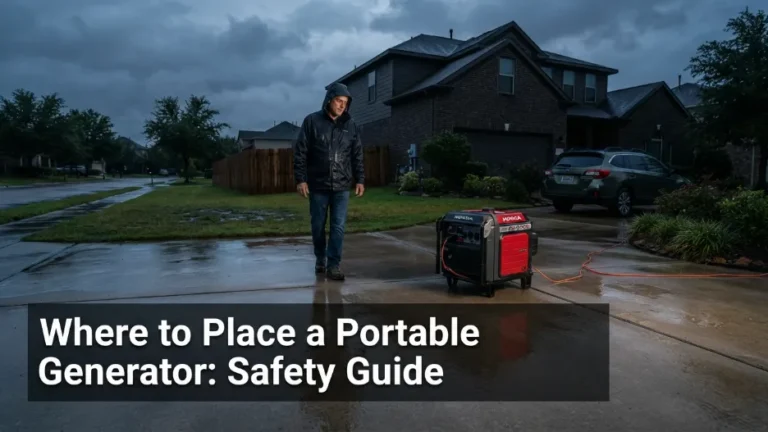
- Place the unit outdoors on level ground, more than 20 feet from building openings.
- Store it dry, secure the handle, and follow the manual’s fuel-storage procedure.
Core Performance & Fuel-Use Breakdown
The GP9500E TF delivers its strongest rated output on gasoline. Its 9,500 running watts can support a substantial collection of selected household loads, provided their combined demand fits the rating.
Starting watts matter when compressors and pumps switch on. The 12,500-watt gasoline surge allowance helps with brief motor startup demands, but it is not continuous capacity.
Propane lowers continuous output to 8,550 watts, while natural gas lowers it to 7,000. That difference becomes crucial if several large appliances start or run together.
- List each appliance’s running wattage and highest startup requirement.
- Build a separate load budget for the fuel you expect to use.
- Stagger motor starts rather than switching on every circuit simultaneously.
Runtime deserves special attention because Generac lists more than one regional and document revision. Its February 2026 specification for the 49-state 8063-0 lists 8.5 hours on gasoline at half load.
The 50-state 8061 model uses electronic fuel injection and is advertised with 10.5 hours on gasoline at half load. Do not apply that EFI model’s runtime or 227-pound weight to the 49-state machine.
Expert Insight
Size the backup system using natural-gas running watts if natural gas will be your primary fuel; gasoline headline figures can overstate the capacity available in that mode.
The generator’s conventional alternator has automatic voltage regulation, not inverter power conversion. Buyers with voltage-sensitive equipment should confirm the devices’ power-quality requirements instead of assuming inverter-grade output.
Key Features Explained
Three-Fuel Operation
A fuel-selection system gives access to gasoline, bottled propane, and a compatible natural-gas supply. It reduces dependence on gas stations, although the usable electrical output changes with the fuel.
COsense Carbon Monoxide Shutoff
COsense detects hazardous carbon monoxide buildup near the generator and can shut down the engine. It is additional protection, never permission to operate indoors, in a garage, or near occupied spaces.
Home-Backup Receptacles
The control panel includes a 120/240-volt L14-30R outlet and a 120/240-volt 14-50R outlet. These support appropriately matched inlet and transfer equipment, but their connector ratings still limit current.
Electric Start and Hour Meter
The included battery supports electric starting, and recoil starting provides a backup method. An hour meter helps owners schedule checks using actual engine operation rather than calendar guesses.
Real-World Usability & Maintenance
Plan safe outdoor placement and protected storage. Wheels help move 219 pounds, but lifting remains difficult.
Check the oil, air filter, fuel fittings, and battery as specified in the model’s manual. Use the hour meter to track service and perform maintenance before storm season.
For long-term preparedness, periodically review your fuel supply and test the generator under appropriate loads. Never refill a running or hot generator; let it stop and cool first.
Pros & Cons
Pros
- Three fuel choices give owners practical alternatives during shortages.
- High gasoline surge capacity assists with starting motor-driven appliances.
- Electric starting and included wheels improve day-to-day handling.
- COsense and low-oil shutdown provide useful protective functions.
Cons
- Natural-gas output is considerably below the gasoline rating.
- Its heavy open-frame design is unsuitable for quiet, effortless transport.
- Home wiring and natural-gas connections may require professional installation.
Common Issues & Fixes
- Engine will not start: Fuel selection, oil level, or battery charge may be incorrect. Confirm the prescribed starting checks in the owner’s manual.
- Breaker trips under load: Simultaneous appliance demand may exceed the outlet or generator limit. Disconnect loads and restart them selectively after correcting the overload.
- COsense stops the engine: Exhaust may be accumulating near the equipment. Move to fresh air, stop operation, and correct generator placement before considering a restart.
What to Know Before You Buy
Verify the exact unit and regional compliance version on the listing. The 49-state 8063 and 50-state 8061 EFI variants share the GP9500E Tri-Fuel name but do not share every specification.
Never backfeed household outlets. Have an electrician match the neutral, inlet, cable, breakers, and transfer equipment; our portable generator transfer-switch guide explains these checks.
Confirm that your planned gas supply can provide the required pressure and flow, and that your site has safe outdoor clearance. Our generator placement guide covers the operating-location essentials.
Who Should Buy It / Who Should Skip It
✅ Who Should Buy It
- Homeowners needing substantial, selectively managed emergency power.
- Buyers with access to gasoline and approved gaseous-fuel supplies.
- Users who value a wheeled generator with a 120/240-volt panel.
✗ Who Should Skip It
- Campers prioritizing a compact, quiet inverter generator.
- Households requiring automatic, unattended standby operation.
- Buyers without safe outdoor space or approved connection options.
Alternatives to Consider
If you want more output on natural gas, compare the rated figures rather than model-name wattage. Our tri-fuel buying guide provides additional selection criteria.
Westinghouse WGen10500TFc
Best For: Buyers seeking greater continuous output on every fuel.
Main Advantage: Remote starting and a 9.5-gallon gasoline tank.
Trade-off: A larger fuel tank does not remove weight or noise considerations.
Key Spec: 10,500 gasoline / 9,500 propane / 8,500 natural-gas running watts.
DuroMax XP13000HXT
Best For: Buyers prioritizing higher natural-gas running capacity.
Main Advantage: Manufacturer lists 9,000 natural-gas running watts.
Trade-off: Its larger output still requires careful load and fuel-supply planning.
Key Spec: 10,500 gasoline / 10,000 propane / 9,000 natural-gas running watts.
Is the Generac GP9500E Tri-Fuel Worth It?
It suits buyers who value fuel availability over portability. Multiple fuel options matter when gas stations are inaccessible.
Total ownership cost includes safe connections, maintenance, and installation. Advertised price alone is insufficient.
Compare it against your actual fuel choice and planned circuits, not merely peak wattage. For additional options, consult our tri-fuel generator comparison.
Final Verdict
The Generac GP9500E TF is a strong candidate for hands-on emergency backup where fuel flexibility and conventional high-output power matter. Choose it when its fuel-specific capacity fits your load plan and you can provide a professionally approved, safely located setup.
Frequently Asked Questions
Can the Generac GP9500E TF run on natural gas?
Yes, the GP9500E TF is designed for natural gas operation. Its 49-state continuous output is 7,000 watts on that fuel, and the supply connection must meet the manufacturer’s requirements.
Can it power an entire house?
It can power selected circuits, not automatically every household load. Add appliance running demands and startup surges before determining what your home can support.
How big and heavy is the generator?
The documented 49-state 8063-0 weighs 219 pounds. Its listed body dimensions are 27.5 by 27.1 by 27.6 inches, excluding the handle when extended.
What warranty does Generac provide?
The 49-state 8063-0 lists a three-year limited residential warranty. Commercial coverage is listed as two years; review the warranty terms for eligibility and exclusions.
How should I maintain the GP9500E TF?
Follow the model-specific maintenance schedule and check oil before operation. Generac specifies 10W-30 or SAE 30 in its technical sheet, with suitability depending on conditions and manual guidance.
Does the generator include everything for home backup?
No, an installed home-transfer system is not included in the listed accessories. Generac lists engine oil, wheel and handle kit, battery, manual, and propane supply hose; approved home-connection equipment is separate.
Affiliate disclosure: HomeGeneratorBlog earns a small commission when you purchase through links on this page — at no extra cost to you. Our editorial process is independent: affiliate relationships never influence which products we recommend or how we rank them.

Hi, I’m Michael Turner. I own a generator workshop in the United States and founded HomeGeneratorBlog to share practical, hands-on guidance about generator installation, maintenance, troubleshooting, safety, and backup power solutions. My goal is to help homeowners make smarter, more confident decisions through clear and reliable information