10 Best 3500 Watt Portable Generator Picks for 2026: Power, Noise, and Runtime Compared
The best 3500 watt portable generator right now is the Champion 4250-Watt Dual Fuel Open Frame Inverter, rated for 3,500 running watts. We evaluated 10 generators using published specs, runtime ratings, and owner feedback, scoring each on power and features, quietness, and runtime. Most 3500-watt generators look alike on paper but differ in true running watts, noise, and safety shutdowns. Whether you need RV power, outage backup, or job-site tools, this guide gives you one clear answer.
Quick Comparison: All 10 Generators Ranked
| # | Product | Best For | Rating | Badge | |
|---|---|---|---|---|---|
| 1 | Champion 4250 Dual Fuel | Outages, RV trips, and job-site work | 4.7/5 | Best Overall | Buy → |
| 2 | Westinghouse iGen4500c | Campsites, neighborhoods, and safety-first buyers | 4.6/5 | Best for Safety | Buy → |
| 3 | Westinghouse iGen4500DFc | Storm-season backup with stored propane | 4.5/5 | Best Quiet Dual Fuel | Buy → |
| 4 | Champion 100573 | RV owners who want easy starting | 4.4/5 | Best Remote Start | Buy → |
| 5 | Champion 200955 | Gas-only buyers who want long runtime | 4.3/5 | Best Gas-Only Runtime | Buy → |
| 6 | Champion 100302 | RV trips and basic home backup | 4.2/5 | Best Simple RV Pick | Buy → |
| 7 | WEN 56380i | Buyers who want push-button starting | 4.1/5 | Best Electric Start | Buy → |
| 8 | Generac GP3500iO | Truck beds, camping, and tool power | 4.0/5 | Best Easy Operation | Buy → |
| 9 | Honda EU3000iS | Quiet-first buyers who accept 2,800 running watts | 3.9/5 | Best Premium Pick | Buy → |
| 10 | Westinghouse WGen3600v | Tools, appliances, and basic home backup | 3.8/5 | Best Basic Backup | Buy → |
How We Chose These Generators
What we compared
10 generators rated from 3,000 to 3,700 running watts, using manufacturer specs, official product pages, retailer listings, and owner feedback. We did not run lab tests, so scores are editorial judgments.
Our 3 scoring criteria
Power and features, quietness, and runtime. Each is scored out of 5 using published ratings such as running watts, dBA, tank size, and rated hours.
Sources used
Manufacturer specification sheets and product pages, checked for running watts, starting watts, tank size, noise rating, weight, and warranty length.
What we cut, and why
Battery power stations, models without published running watts, and generators under 3,000 running watts. The Honda EU3000iS stays as a premium benchmark.
What to Look for When Buying a 3500 Watt Portable Generator
A 3500 watt generator sits in the sweet spot between portable convenience and real household power. These four factors separate the models that deliver from the ones that only look good on paper.
1. Running Watts, Not the Headline Number
Manufacturers love the biggest number on the box, which is usually starting watts. What you can power continuously is the running figure, and here it ranges from 3,000 watts on the Generac GP3500iO to 3,700 on the Westinghouse iGen4500c. Learn how running watts versus starting watts affect appliance sizing before you compare models. Add up your essentials, then leave some headroom.
2. Inverter or Open Frame
Inverter generators adjust engine speed to demand, which saves fuel and lowers noise, and they produce cleaner power for electronics. Conventional open-frame units like the WGen3600v tend to run louder at a fixed speed. Our guide to inverter portable generators and who needs one covers the trade-offs in more depth. Champion splits the difference with open-frame inverters rated at 64 dBA.
3. Runtime, Tank Size, and Fuel Type
Runtime ratings are usually quoted at 25 percent load, so real-world hours drop as you add appliances. Compare tank size too: 4 gallons on the Champion 4250 versus 2.2 gallons on the WEN 56380i. Dual-fuel models add propane, which stores far longer than gasoline.
4. Safety Features and Portability
Look for low-oil shutdown and overload protection at minimum. A carbon monoxide sensor with automatic shutdown, as on the Westinghouse iGen4500c, adds a layer of protection, but it never replaces running the unit outdoors, so read our portable generator carbon monoxide safety guide first. Finally, check weight: the models here range from 74 to about 131 pounds.

Champion Power Equipment 4250-Watt Dual Fuel Open Frame Inverter Generator: The most flexible all-rounder here
Best for: Outages, RV trips, and job-site work
If you want one generator that covers outages, RV trips, and job-site work, this is the most flexible pick here. It delivers 3,500 running watts on gasoline and 3,150 on propane, so fuel availability stops being your biggest worry. Champion rates the 4-gallon tank at up to 22 hours at 25 percent load, and the open-frame inverter design keeps weight to 79 pounds. Clean power under 3 percent THD suits electronics, and the RV-ready 30-amp outlet simplifies RV hookups. The trade-off: it is an open-frame design, so it is louder than enclosed inverters under heavy load.
- 3,500 running watts on gasoline, 3,150 on propane
- Rated up to 22 hours at 25% load
- Light at 79 pounds for this output
- Open-frame design louder than enclosed models
- Recoil start only on this model
4.8/5
4.4/5
4.9/5

Westinghouse iGen4500c Portable Inverter Generator with CO Sensor: Quiet, enclosed, and built with CO protection
Best for: Campsites, neighborhoods, and safety-first buyers
Westinghouse built this one for people who care about noise and safety as much as watts. It is a fully enclosed inverter rated at 3,700 running watts with 4,500 peak, and Westinghouse lists noise as low as 52 dBA. A built-in carbon monoxide sensor shuts the unit down if CO rises, which matters when neighbors, campers, or kids are nearby. Remote start and an LED data center show runtime, fuel, and load at a glance. The downside is weight: at roughly 106 pounds, it is heavier than the open-frame Champions in this list.
- As low as 52 dBA rated noise
- CO sensor with automatic shutdown
- Up to 18 hours on 3.4 gallons
- Heavy at about 106 pounds
- Gas only; no propane option
4.7/5
4.8/5
4.3/5

Westinghouse iGen4500DFc Dual Fuel Portable Inverter Generator with CO Sensor: Quiet design with propane flexibility
Best for: Storm-season backup with stored propane
Want Westinghouse’s quiet enclosed design with the option to run on propane? This is it. On gasoline it is rated at 3,700 running watts; on propane it drops to 3,330, which is normal for dual-fuel engines. Westinghouse cites up to 18 hours on gasoline and 22 hours on a standard propane tank, plus remote start, a CO sensor, and as-low-as 52 dBA noise. It is a strong storm-season pick because propane stores far longer than gasoline. The trade-off is weight, roughly 106 pounds, and a more complex build than open-frame models.
- Runs on gasoline or propane
- Remote start and CO shutdown
- As low as 52 dBA noise
- Propane output drops to 3,330 watts
- Heavy at roughly 106 pounds
4.5/5
4.8/5
4.3/5

Champion Power Equipment 100573 4000-Watt Remote Start Open Frame Inverter Generator: Open-frame inverter with key-fob starting
Best for: RV owners who want easy starting
This is the Champion to pick if pulling a cord on a cold morning sounds miserable. It adds a wireless key fob that starts and stops the generator from up to 80 feet away, plus push-button electric start and a recoil backup. Output is 3,500 running and 4,000 starting watts, and Champion markets it for RV air conditioners, while rating the 2.9-gallon tank at up to 17 hours at 25 percent load. Parallel-ready ports let you link a second unit later. The compromise is a smaller tank than the dual-fuel model, so refills come sooner.
- Key fob starts from up to 80 feet
- Electric, wireless, and recoil starting
- Parallel ready for more power later
- Smaller 2.9-gallon tank
- Gas only; no propane option
4.5/5
4.4/5
4.4/5

Champion Power Equipment 3500-Watt 200955 Open Frame Inverter Generator: Long runtime without the dual-fuel complexity
Best for: Gas-only buyers who want long runtime
This is the straightforward, gas-only sibling of the dual-fuel Champion, and it keeps the part that matters: a 4-gallon tank rated up to 22 hours. It produces 3,500 running watts and 4,250 starting watts, with a 30-amp RV outlet and two household outlets. Economy mode trims fuel use and noise at light loads, and parallel ports let you pair it with a second compatible inverter later. At a rated 64 dBA it is conversation-adjacent rather than whisper quiet. Skip it if you want propane flexibility, which belongs to the dual-fuel Champion above.
- Up to 22 hours on a 4-gallon tank
- 30-amp RV outlet plus two household outlets
- Economy mode and parallel-ready ports
- Gasoline only; no propane option
- 64 dBA is louder than enclosed inverters
4.1/5
4.3/5
4.5/5

Champion Power Equipment 100302 4000-Watt RV Ready Open Frame Inverter Generator: Simple recoil-start RV workhorse
Best for: RV trips and basic home backup
Think of this as the no-frills version of the remote-start Champion above. You still get 3,500 running watts and 4,000 starting watts, a 30-amp RV outlet, and Champion’s Economy mode, but you start it with a recoil pull that includes Cold Start Technology. Champion rates the 2.9-gallon tank at up to 17 hours at 25 percent load, and the open-frame inverter weighs about 82 pounds. That makes it a sensible, simple choice for RV trips or backup power. The compromise is convenience: no key fob or push-button start, and no propane option.
- 3,500 running watts, 4,000 starting
- Cold Start Technology on recoil
- Rated up to 17 hours at 25%
- No key fob or push-button start
- Gas only; no propane option
4.0/5
4.3/5
4.3/5
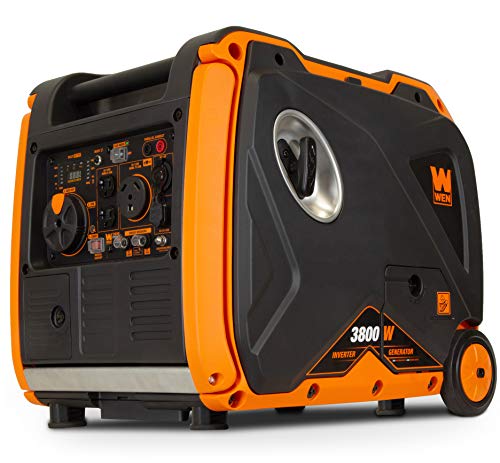
WEN 56380i Super Quiet 3800-Watt Portable Inverter Generator with Electric Start: Electric start with a protective fuel shutoff
Best for: Buyers who want push-button starting
Electric start is the headline feature here, and it pairs with a genuinely useful fuel shutoff that burns the carburetor dry before the engine stops. WEN rates the 56380i at 3,800 surge watts and 3,400 rated watts, close to a true 3,500-watt generator, with total harmonic distortion under 1.2 percent at full load for sensitive electronics. Built-in wheels and a folding handle help with its roughly 99-pound weight. The weak spot is the 2.2-gallon tank, which WEN rates at over 8.5 hours at half load, so plan on more frequent refueling than larger-tank rivals.
- Electric start standard
- 3,400 rated watts, near true 3,500 class
- Fuel shutoff protects the carburetor
- 2.2-gallon tank limits runtime
- Heavy at roughly 99 pounds
4.4/5
4.1/5
3.8/5

Generac GP3500iO Open Frame Inverter Generator: Lightest pick with one-dial operation
Best for: Truck beds, camping, and tool power
Generac’s GP3500iO is the lightest 3,500-class generator on this list at 74.3 pounds, which makes it the easiest to load into a truck bed or carry to a campsite. Running power is 3,000 watts, with 3,500 starting watts and PowerRush technology that boosts surge capacity for motor loads. A single PowerDial handles choke, run, and off, and status lights flag low oil or overload. Parallel readiness lets you add a second unit. The limit is output: 3,000 running watts is below the 3,400 to 3,700 rated by several rivals, and the 2.37-gallon tank means about 8 hours at half load.
- Lightest here at 74.3 pounds
- PowerRush boosts starting capacity
- Single-dial start, status warning lights
- 3,000 running watts trails several rivals
- 2.37-gallon tank, about 8 hours half-load
4.0/5
4.1/5
3.9/5
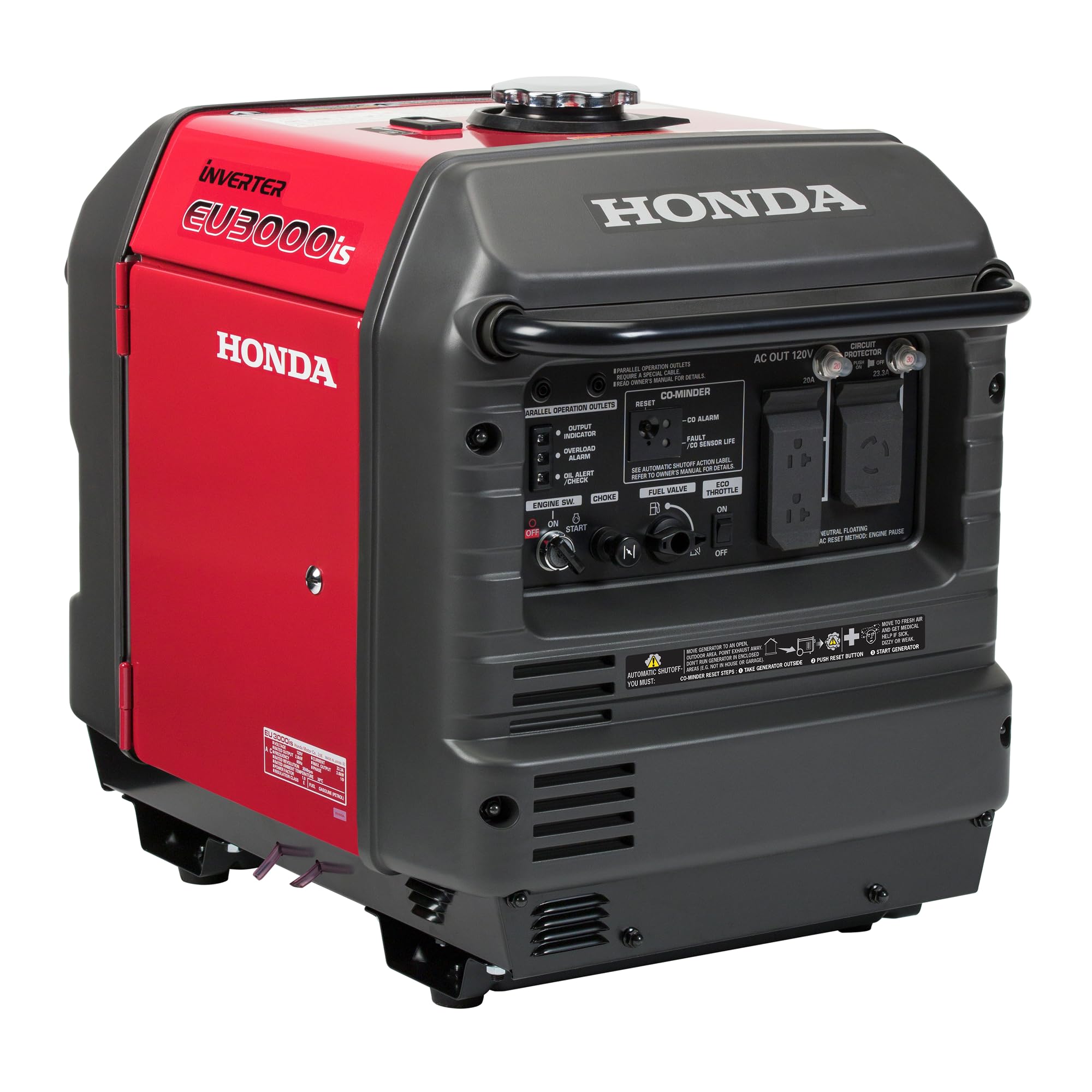
Honda EU3000iS Electric Start Inverter Generator: Premium refinement, lower wattage
Best for: Quiet-first buyers who accept 2,800 running watts
Honda’s EU3000iS does not reach 3,500 running watts, so it ranks near the bottom on raw power. What it offers instead is proven refinement: 2,800 rated watts, 3,000 maximum, and noise of 50 to 57 dBA, the quietest range in this guide. Honda lists up to 19.6 hours at quarter load on 3.4 gallons, plus electric start and CO-MINDER protection. That is plenty for a refrigerator, lights, and most 13,500 BTU RV air conditioners according to Honda. The trade-off is physical and financial: at about 131 pounds it is the heaviest here, and it sits in the premium tier.
- 50 to 57 dBA, quietest range here
- Up to 19.6 hours at quarter load
- Electric start and CO-MINDER protection
- 2,800 rated watts, below the 3,500 class
- Heaviest here at about 131 pounds
2.7/5
4.9/5
4.2/5

Westinghouse WGen3600v Portable Generator with RV Ready Outlet: Plain open-frame power for appliances and tools
Best for: Tools, appliances, and basic home backup
If you need raw running watts and do not care about whisper-quiet operation, the WGen3600v is the straightforward choice. Westinghouse rates it at 3,600 running watts and 4,650 peak, above the open-frame Champions here. A 4-gallon tank with a built-in fuel gauge supports up to 14 hours of runtime, and the 30-amp RV outlet covers camper hookups. At a rated 69 dBA it is also the loudest pick in this guide. Because it is a conventional generator rather than an inverter, distortion is listed under 23 percent, so it suits tools and appliances better than sensitive electronics.
- 3,600 running watts, 4,650 peak
- 4-gallon tank with built-in fuel gauge
- Automatic low-oil shutdown, 3-year warranty
- Loudest here at 69 dBA
- Not clean enough for sensitive electronics
4.2/5
3.2/5
4.1/5
Top 3 Head-to-Head: Champion 4250 Dual Fuel vs Westinghouse iGen4500c vs iGen4500DFc
These three are the most common final choices because they pair the highest running watts with the strongest rated runtime or noise figures. The real decision is open-frame flexibility versus enclosed quiet.
| Feature | #1 Champion 4250 DF | #2 iGen4500c | #3 iGen4500DFc |
|---|---|---|---|
| Running watts (gas) | 3,500 | 3,700 — Best | 3,700 — Best |
| Noise | 64 dBA | As low as 52 dBA — Best | As low as 52 dBA — Best |
| Rated runtime | 22 hrs at 25% — Best | 18 hrs at 25% | 18 hrs gas, 22 hrs propane |
| Weight | 79 lb — Best | About 106 lb | About 106 lb |
| Propane option | Yes — Best | No | Yes — Best |
| CO sensor | Not listed | Yes — Best | Yes — Best |
| Choose if… | You want propane, the lightest weight, and the longest runtime | You want quiet operation and CO shutdown on gasoline | You want quiet operation, CO shutdown, and propane |
Who These Generators Are NOT For
A 3500 watt generator is a capable portable unit, but it has clear limits.
If you want silent or indoor-safe power, a battery power station is a better fit than any gas generator here. And if you plan to run laptops or medical electronics, choose one of the inverter models rather than the conventional WGen3600v.
Common Mistakes to Avoid
Most generator problems trace back to a handful of avoidable buying and setup errors.
Frequently Asked Questions About 3500 Watt Portable Generators
What can a 3500 watt generator run?
A 3500 watt generator can typically run a refrigerator, lights, a TV, a modem, a sump pump, and a small window air conditioner together, as long as the combined running watts stay under the rating. Motors such as pumps and compressors need extra watts to start, so add the largest starting load to your total and stagger startups.
Can a 3500 watt generator run a house?
Not a whole house. A 3500 watt generator can power essentials such as a refrigerator, lights, a furnace blower, and phone chargers, but central air conditioning, electric ranges, and electric water heaters exceed its capacity. Connect it to selected circuits through a properly installed transfer switch or interlock rather than backfeeding an outlet, which is dangerous.
Can a 3500 watt generator run an RV air conditioner?
Usually yes, for a single air conditioner. Honda says its 3,000-watt EU3000iS handles most 13,500 BTU RV units, and Champion markets its 3,500-running-watt models for RV air conditioners. Check your unit’s starting watts, since a soft-start device can reduce the surge. For help matching a unit to your camper, read our guide to sizing a generator for an RV.
How long will a 3500 watt generator run on a tank of gas?
It depends on load and tank size. Champion rates its 4-gallon dual-fuel inverter at up to 22 hours at 25 percent load, while the WEN 56380i is rated at over 8.5 hours at half load on a 2.2-gallon tank. Heavier loads shorten those figures, so plan fuel for your real appliance load, not the label.
Is a 3500 watt generator the same as 3500 running watts?
No. Starting, or peak, watts are a short surge for motor startup, while running watts are what the generator can supply continuously. A generator sold as 3500 watts may only deliver 3,000 running watts, as the Generac GP3500iO does. Always size your load against running watts and use starting watts only for your biggest motor.
Is an inverter generator better than a conventional one at 3500 watts?
For most buyers, yes. Inverter models such as the Champion and Westinghouse units here list under 3 percent total harmonic distortion, which is safer for laptops and electronics, and they usually run quieter. A conventional unit like the Westinghouse WGen3600v lists under 23 percent distortion, which suits tools and many appliances but not sensitive devices.
Where should I run a portable generator?
Run it outdoors on a flat, dry surface, well away from doors, windows, and vents, with the exhaust pointed away from the house. Never operate a portable generator in a garage, basement, or enclosed space, even with the door open. A model with CO shutdown adds protection, but a battery-powered CO alarm indoors is still recommended.
Our Final Verdict
Most buyers should start with the Champion 4250-Watt Dual Fuel Open Frame Inverter. It combines 3,500 running watts, propane flexibility, and a long rated runtime. Choose the Westinghouse iGen4500c if quiet operation and CO shutdown matter more, and treat the Honda EU3000iS as a premium, lower-wattage alternative.

Hi, I’m Michael Turner. I own a generator workshop in the United States and founded HomeGeneratorBlog to share practical, hands-on guidance about generator installation, maintenance, troubleshooting, safety, and backup power solutions. My goal is to help homeowners make smarter, more confident decisions through clear and reliable information