What Is the Downside of an Inverter Generator?
Quick Answer
The biggest downside of an inverter generator is cost: you normally pay more for each watt of usable power than with a basic open-frame generator. Smaller inverter models can also have limited output, small fuel tanks, expensive electronic components, and fewer 240-volt options, so choosing the right size matters; my inverter portable generator buying guide explains what to check before buying.
Main inverter generator downsides
- Higher purchase price: The inverter electronics, sound enclosure, and variable-speed controls usually increase cost.
- Less power per dollar: A conventional generator often gives you more raw wattage at the same budget.
- Limited small-unit output: Popular compact models may only provide around 1,700–1,850 running watts.
- More complex repairs: Inverter boards and electronic controls can make some electrical failures more specialized to diagnose.
- Small fuel tanks: Compact designs save weight but may require more frequent refueling under heavy loads.
- Still produces exhaust: A gasoline or propane inverter generator has the same carbon-monoxide hazard as other engine-driven generators.
The practical takeaway
- Choose an inverter when low noise, portability, and clean power matter more than getting the maximum wattage for your budget.
I like inverter generators, but I don’t recommend them automatically. Their advantages are excellent for the right job, while their weaknesses become obvious when you need several large appliances or whole-home backup.
What Is an Inverter Generator?
An inverter generator is an engine-driven generator that electronically converts its electrical output into stable AC power. The system can also reduce engine speed when electrical demand is low.
That design is why inverter generators are known for quieter operation, good fuel efficiency at partial loads, and clean power for electronics.
- Alternator: Produces the generator’s initial electrical power.
- Rectifier: Converts the raw AC output into DC electricity.
- Inverter module: Converts that DC power back into controlled household AC.
- Electronic throttle: Adjusts engine speed according to electrical demand on many models.
If you want the complete electrical process, see my guide explaining how a portable generator works.
What Is the Biggest Disadvantage of an Inverter Generator?
The biggest disadvantage for most buyers is the higher cost for the amount of power you receive. You’re paying for noise reduction, electronic power conditioning, portability, and variable-speed operation rather than raw wattage alone.
That trade-off can make perfect sense for camping or electronics. It can be less attractive when your main goal is running pumps, heaters, air conditioners, and other high-demand loads.
You often get fewer running watts for your budget
Consider the Honda EU2200i as a real 2026 example. Honda lists 2,200 maximum watts and 1,800 rated watts, with a current listed MSRP of $1,199.
The EU2200i weighs 47.4 pounds and operates at 48 dB(A) at quarter load or 57 dB(A) at rated load. Those are impressive portability and noise numbers, but the rated output is still only 1,800 watts.
You can check the Honda EU2200i specifications if you’re comparing the cost against larger conventional generators.
High-demand home backup changes the equation
A refrigerator, internet equipment, lights, chargers, and a television can work well with a compact inverter generator. Adding a sump pump, furnace blower, microwave, window AC, or well pump changes the calculation quickly.
That’s why I always calculate the load before deciding between generator types.
- Add the running watts of everything you expect to operate simultaneously.
- Identify appliances with a large starting surge.
- Leave reasonable capacity instead of planning to operate continuously at the generator’s maximum output.
My portable generator wattage guide explains those numbers in more detail.
What Other Downsides Do Inverter Generators Have?
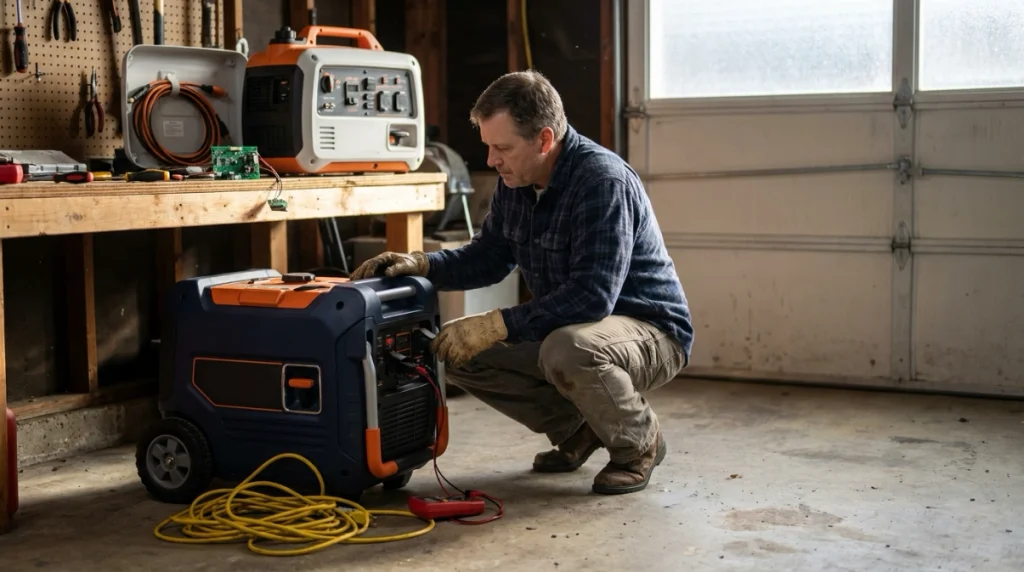
Price gets most of the attention, but it isn’t the only drawback. Output, repair complexity, fuel capacity, and electrical configuration can matter just as much.
1. Small inverter generators have limited output
Many popular suitcase-style models sit around the 2,000- to 2,500-watt starting-output class. Their continuous output is lower than the large number printed on the case.
For example, Champion lists 2,500 starting watts and 1,850 running watts for its model 201183 dual-fuel inverter on gasoline.
That’s plenty for many camping setups and selected emergency loads. It isn’t enough for unrestricted household operation.
2. Larger inverter generators stop feeling lightweight
Inverter technology doesn’t automatically mean a generator is easy to carry. Output usually brings a larger engine, more fuel, wheels, handles, and a heavier enclosure.
The Westinghouse iGen4500DF illustrates the point clearly.
- Peak output: 4,500 watts on gasoline.
- Running output: 3,700 watts on gasoline.
- Weight: 104.7 pounds.
- Fuel capacity: 3.4 gallons.
- Noise: Listed as low as 52 dBA.
It has wheels and a telescoping handle, which helps. Still, it’s a completely different portability experience from a 39-pound suitcase generator.
3. Electronic repairs can be more complicated
A conventional generator has electrical controls too, but an inverter generator depends heavily on its inverter circuitry. That extra electronics package introduces another expensive component that can potentially fail.
Mechanical problems such as spark plugs, carburetors, fuel lines, filters, or recoil starters remain familiar. A failed electronic inverter module may require more model-specific diagnosis and replacement parts.
4. Parallel operation can add cost and complexity
Many compact inverter generators let you connect two compatible units with a parallel kit. That’s useful when one small generator isn’t enough.
However, buying two generators plus the required connection equipment can erase the original cost and simplicity advantage.
- Both generators must be compatible with the parallel system.
- The correct parallel accessory may be sold separately.
- You now have two engines to fuel and maintain.
- Storage requires room for two units instead of one.
5. Some smaller models only supply 120 volts
This is an easy specification to overlook. The Honda EU2200i, for example, is a 120-volt generator rather than a 120/240-volt unit.
That doesn’t matter for ordinary 120-volt appliances. It matters if your backup plan includes equipment or a transfer setup requiring 240 volts.
Inverter Generator vs. Conventional Generator: Which Has More Downsides?
Neither design is universally better. An inverter generator trades higher purchase cost for quieter operation, cleaner electrical output, and better light-load efficiency, while a conventional generator usually prioritizes simple, economical high-wattage power.
| Factor | Inverter Generator | Conventional Generator |
|---|---|---|
| Purchase cost per watt | Usually higher | Usually lower |
| Noise | Usually quieter, especially at light load | Usually louder |
| Power quality | Designed for stable, low-distortion output | Varies considerably by model |
| Light-load fuel use | Engine can usually throttle down | Often operates at a more constant engine speed |
| High-output value | Can become expensive | Often better for maximum watts per dollar |
| Electronic complexity | Higher because of inverter circuitry | Typically simpler power architecture |
If your priority is affordable high-output emergency power, don’t assume an inverter is automatically best. Compare the trade-offs with the broader disadvantages of portable generators before buying.
Can an Inverter Generator Run a Whole House?
A small inverter generator normally cannot run an entire house at once. Larger inverter generators can support more circuits, but your appliances determine the required capacity.
A 2,000-watt class unit might comfortably handle selected essentials. Central air conditioning, electric water heating, well pumps, electric ranges, and other large loads can push demand far beyond that level.
- Small emergency setup: Refrigerator, lights, router, phones, and selected electronics.
- Medium backup setup: Adds pumps, furnace blower, or selected kitchen loads when properly sized.
- Heavy backup setup: May need a much larger portable generator and careful load management.
- Near whole-home operation: Often makes a professionally sized standby system more practical.
Before spending extra for a large inverter model, calculate your actual requirement using my home generator sizing guide.
Are Inverter Generators Safer Than Regular Generators?
Cleaner electrical output doesn’t make an engine-driven inverter generator safe to operate indoors. Gasoline and propane models still produce carbon monoxide, exhaust heat, and fire hazards.
The U.S. Consumer Product Safety Commission says portable generators should be operated outdoors, at least 20 feet from homes and buildings, with exhaust directed away from openings. See the CPSC generator safety guidance before using any portable generator.
Never treat a built-in CO shutoff system as permission to move the generator closer to your home. A safety sensor is a backup feature, not a substitute for correct placement.
Electrical connection safety matters too
Never connect a portable generator to house wiring by improvising a connection through an ordinary wall outlet. A properly designed transfer setup is required when supplying building circuits.
OSHA’s portable-generator safety resources cover grounding, shock, extension-cord, and connection hazards in more detail.
- Keep the generator dry and follow the manufacturer’s weather instructions.
- Use correctly rated outdoor extension cords when supplying cord-connected equipment.
- Don’t refuel a hot or running generator.
- Install and maintain working carbon-monoxide alarms inside the home.
Ready.gov also recommends planning which appliances you will prioritize during an outage because a portable generator may not run everything simultaneously. Its power-outage preparedness guidance is worth reviewing before storm season.
When Are the Downsides Worth Accepting?
An inverter generator makes the most sense when you value quiet operation and clean electrical output more than raw wattage. That’s especially true for camping, RV use, electronics, and lighter home-backup loads.
I’d lean toward an inverter in these situations:
- You regularly power laptops, televisions, chargers, or other electronics.
- You camp or use a generator around nearby neighbors.
- You normally operate well below maximum generator capacity.
- You need something one person can move.
- You want the option of parallel operation later.
A conventional generator deserves a closer look when high output at the lowest practical purchase cost is the priority.
Real Inverter Generator Specs: How the Trade-Off Changes With Size
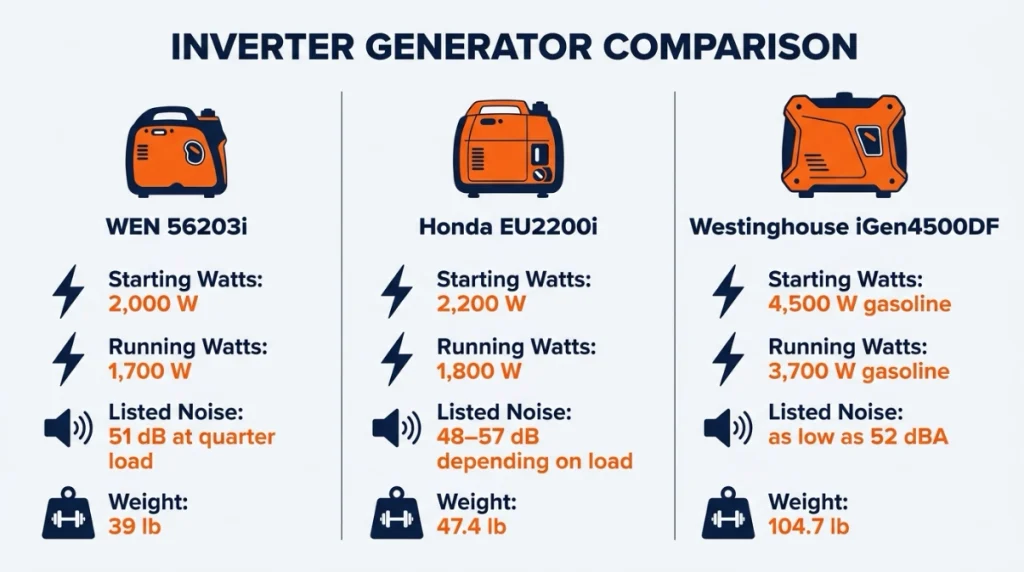
These three models show why it’s important to compare running watts, weight, noise, and features instead of focusing only on the word “inverter.”
| Model | Starting Watts | Running Watts | Listed Noise | Weight |
|---|---|---|---|---|
| WEN 56203i | 2,000 W | 1,700 W | 51 dB at quarter load | 39 lb |
| Honda EU2200i | 2,200 W | 1,800 W | 48–57 dB depending on load | 47.4 lb |
| Westinghouse iGen4500DF | 4,500 W gasoline | 3,700 W gasoline | As low as 52 dBA | 104.7 lb |
The pattern is useful. More inverter power is available, but higher output can quickly reduce the lightweight portability that attracts buyers to inverter generators in the first place.
Which Inverter Generators Would I Consider?
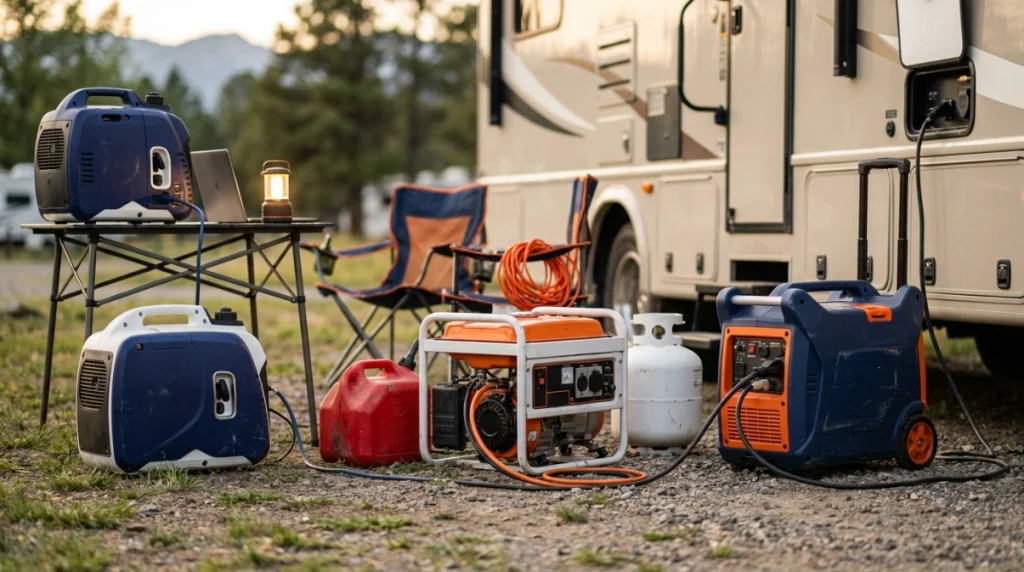
If the disadvantages still fit your needs, these are three models I’d put on the comparison list before buying.
🏆 Best for Quiet Portable Power
Honda EU2200i
★★★★★
It provides 2,200 maximum watts and 1,800 rated watts while weighing 47.4 pounds. I like it for buyers who care more about compact, quiet backup power than maximizing watts per dollar.
💰 Best Lightweight Value
Champion 2500W Dual Fuel Inverter 201183
★★★★☆
Champion lists 2,500 starting watts, 1,850 running watts on gasoline, a 39-pound weight, and 53 dBA noise output. Dual-fuel capability makes this one more flexible when long-term fuel storage matters.
🚐 Best for More Output
Westinghouse iGen4500DF
★★★★☆
It provides 4,500 peak and 3,700 running watts on gasoline, plus dual-fuel operation and remote starting. At 104.7 pounds, I’d choose it when extra output matters more than one-person carrying weight.
Frequently Asked Questions
Are inverter generators worth the extra money?
Inverter generators are often worth the extra cost when you need quiet operation, portable size, and clean electricity for electronics. If you mainly need maximum emergency wattage for pumps, tools, heaters, and large appliances, a conventional generator may provide better value.
What can go wrong with an inverter generator?
An inverter generator can experience the same engine, carburetor, ignition, fuel, and maintenance problems as another portable generator. It also has inverter circuitry and electronic controls, so some electrical failures may require more specialized parts or troubleshooting.
Can an inverter generator run a refrigerator?
Yes, a correctly sized inverter generator can run most refrigerators. Check both the refrigerator’s normal running demand and compressor starting surge because a generator that handles the running watts may still overload when the compressor starts.
Can you run an inverter generator all night?
A generator can operate for long periods when its manufacturer allows it and you follow maintenance and refueling requirements. However, always operate an engine-driven generator outdoors at least 20 feet from occupied buildings, with exhaust directed away from openings.
Is an inverter generator better than a regular generator for home backup?
It depends on the load. An inverter generator is attractive for electronics, moderate emergency loads, and situations where noise matters, while a conventional or standby generator may make more financial sense when your priority is supplying several large household loads.
Final Takeaway
The main downside of an inverter generator is simple: you usually pay more to get less raw wattage. You also accept extra electronic complexity, possible 120-volt limitations on smaller units, and reduced portability as you move into higher-output models.
Those drawbacks don’t make inverter generators a bad choice. They simply mean you should buy one because you need its quieter operation, stable power, or light-load efficiency rather than because the word “inverter” sounds more advanced.
For 2026, my approach is still to calculate the required running and starting watts first. Then decide whether the inverter advantages are worth the additional cost for the loads you actually plan to power.

Hi, I’m Michael Turner. I own a generator workshop in the United States and founded HomeGeneratorBlog to share practical, hands-on guidance about generator installation, maintenance, troubleshooting, safety, and backup power solutions. My goal is to help homeowners make smarter, more confident decisions through clear and reliable information