What Size House Will a 20kW Generator Run?
Quick Answer
A 20kW generator can often provide broad whole-house backup for a typical 2,000- to 3,000-square-foot home, especially when heating, water heating, and cooking use gas. However, an all-electric home can exceed 20kW even at a smaller size, so calculate your actual generator power capacity instead of choosing from square footage alone.
Where a 20kW generator usually fits
- 1,500–2,000 sq ft: Usually plenty of capacity unless the home has several large electric loads.
- 2,000–2,500 sq ft: A strong whole-home starting point for many homes with gas heat and normal central air.
- 2,500–3,000 sq ft: Often workable when large loads are managed instead of operating together.
- 3,000+ sq ft: Possible in lower-load homes, but a professional electrical calculation becomes more important.
- All-electric homes: Electric heat, water heating, dryers, ranges, and EV charging can quickly push demand above 20kW.
Most important sizing rule
- List the circuits you need during an outage, then account for both continuous load and motor-starting demand.
If you’re considering a 20kW standby generator, square footage is useful only as a first filter. Two identical houses can have completely different electrical demands.
One may use natural gas for heat, hot water, and cooking. The other may have electric resistance heat, an electric range, two air conditioners, and an EV charger.
What Size House Will a 20kW Generator Run in Real Life?
For many homes, I treat 20kW as serious whole-house territory rather than an essentials-only generator. A typical 2,000- to 3,000-square-foot home is a reasonable place to start evaluating this size.
That does not mean every 3,000-square-foot house will fit under 20kW. It also doesn’t mean a 1,800-square-foot house automatically will.
Definition: A 20kW generator is a generator capable of producing up to 20 kilowatts, or 20,000 watts, under its specified rating conditions. The actual rating can change with fuel type on some residential standby models.
As of 2026, current residential sizing guidance from major manufacturers also looks beyond floor area. HVAC equipment, fuel choice, motor starting, and the appliances you want available all affect the final recommendation.
- Gas-heavy home: A 20kW system can cover considerably more because the furnace, water heater, and range do not rely on large electric heating elements.
- Electric-heavy home: Simultaneous HVAC, water heating, cooking, and laundry loads can consume capacity quickly.
- Managed home: Load-management controls can temporarily pause lower-priority appliances when demand gets close to the generator’s limit.
- Unmanaged home: The generator must tolerate more large appliances attempting to operate at the same time.
Why Doesn’t Square Footage Tell You the Exact Generator Size?
Generator size follows electrical demand, not the amount of flooring in your house. Square footage only gives a rough clue about how many HVAC systems, rooms, and appliances a house might contain.
I prefer to think of the house as a collection of loads. That immediately makes the sizing decision clearer.
- Central air conditioning: The compressor adds both continuous load and a short starting demand.
- Well pumps: Motor startup matters, especially when the pump cycles while another major appliance is operating.
- Electric water heaters: Resistance heating can create a substantial sustained load.
- Electric dryers and ranges: These are high-demand 240-volt appliances.
- Heat pumps: The compressor matters, while electric auxiliary heat can change the sizing calculation dramatically.
- EV charging: This is usually a controllable load that many homeowners can simply postpone during an outage.
Generac’s home standby sizing tool asks about heating type, EV charging, coverage goals, and load usage rather than relying on floor area alone.
How Many Amps Can a 20kW Generator Supply?
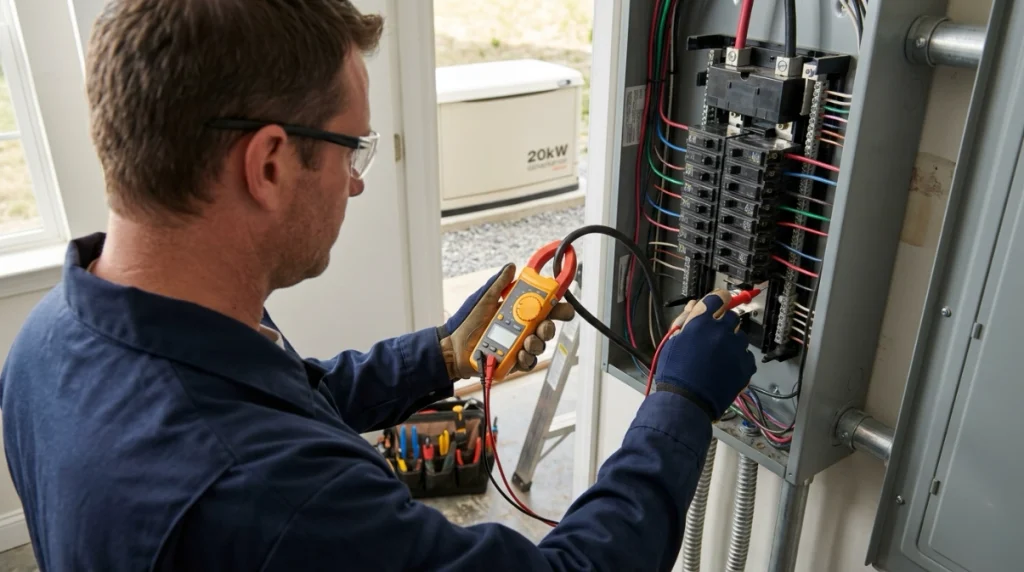
At 240 volts, 20,000 watts equals about 83.3 amps for a single-phase load at a power factor of 1. That gives you another useful way to understand the generator’s capacity.
Fuel type matters, though. Two current 20kW residential examples drop to 18kW when operating on natural gas.
| Current 20kW Model | LP Rating | Natural Gas Rating | 240V Current, LP | 240V Current, NG |
|---|---|---|---|---|
| Generac Guardian 20kW | 20,000W | 18,000W | 83.3A | 75A |
| KOHLER 20RCA | 20,000W | 18,000W | 83A | 75A |
This is why I always check both the model and fuel before finalizing a load worksheet. A homeowner expecting 20,000 watts may have 18,000 watts available when that specific generator runs on natural gas.
Will a 20kW Generator Run Central Air Conditioning?
Yes, a properly sized 20kW standby generator can run central air in many homes. The deciding issue is often compressor starting demand rather than the air conditioner’s normal running load.
The generator also has to carry everything else that happens to be running when the compressor starts.
- Check the HVAC equipment’s nameplate electrical information.
- Identify the largest motor-starting requirement in the home.
- Include refrigerators, pumps, blowers, and other loads already operating.
- Determine whether the installation uses approved load-management equipment.
- Have the installer confirm the generator’s motor-starting capability.
If air conditioning is your main concern, my guide to choosing a generator for an air conditioner explains why compressor startup can change the required generator size.
Can a 20kW Generator Run an All-Electric House?
It can run some all-electric homes, but I would never assume 20kW is enough from floor area alone. Electric resistance heating is where the numbers can become difficult.
A home may also have several other large 240-volt loads competing for the same 20kW capacity.
| Home Setup | 20kW Outlook | Main Reason |
|---|---|---|
| Gas furnace, gas water heater, gas range | Strong candidate | Fewer high-watt electric heating loads |
| Heat pump with managed auxiliary heat | Often possible | Load management can protect priority circuits |
| Electric water heater, dryer, range, central AC | Needs careful calculation | Several large loads can overlap |
| Electric resistance heat plus normal household loads | 20kW may be too small | Heating alone can consume substantial capacity |
KOHLER’s generator sizing guidance similarly recommends evaluating HVAC, appliances, fuel, and the amount of the home you want powered.
Does Natural Gas Reduce a 20kW Generator’s Output?
It can. Always read the rating for the exact model rather than assuming the number on the generator represents identical output on every fuel.
For example, both the current Generac Guardian 20kW specification and KOHLER 20RCA specification list 20kW on liquid propane and 18kW on natural gas.
- 20kW at 240V: About 83.3 amps.
- 18kW at 240V: 75 amps.
- Difference: 2,000 watts of continuous rated capacity.
That 2kW difference can matter when your load calculation already sits near the generator’s limit. Fuel supply sizing also needs to meet the manufacturer’s requirements at full demand.
How Do I Calculate Whether 20kW Is Enough?
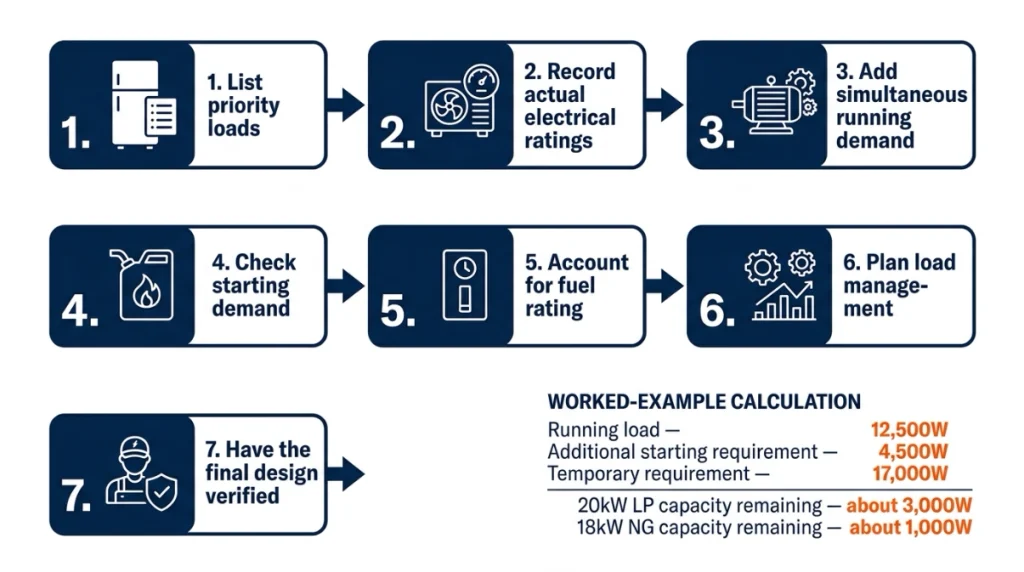
Start with the equipment you expect to use during the outage. Don’t total every breaker simply because it exists.
- List priority loads. Include refrigeration, HVAC, pumps, lighting, communications, medical equipment, and other must-have circuits.
- Record actual electrical ratings. Use appliance nameplates, manuals, HVAC data plates, or measurements taken by a qualified professional.
- Add simultaneous running demand. Focus on equipment that could realistically operate together.
- Check starting demand. Motors and compressors can require extra power for a short period.
- Account for fuel rating. Confirm whether your chosen generator produces its full advertised output on natural gas or only on propane.
- Plan load management. Decide which nonessential loads can pause when HVAC or another priority load starts.
- Have the final design verified. A generator installer or qualified electrician should confirm the electrical and fuel calculations.
A simple 20kW sizing example
Suppose your nameplates and installer worksheet show 12,500 watts of realistic simultaneous running load. Your largest additional motor-starting requirement is 4,500 watts.
That produces a temporary target of about 17,000 watts. A 20kW LP rating leaves roughly 3,000 watts between that example demand and maximum rated output.
- Running load: 12,500W
- Additional starting requirement: 4,500W
- Temporary requirement: 17,000W
- 20kW LP capacity remaining: About 3,000W
- 18kW NG capacity remaining: About 1,000W
That example shows why fuel selection can turn a comfortable-looking calculation into a tight one. It also shows why load management can be more valuable than simply buying a larger generator.
Is 20kW Enough for a 2,000-, 2,500-, or 3,000-Square-Foot House?
A 20kW generator falls inside a useful whole-home range for many houses across these sizes. The larger the home, the more I want to know about HVAC and electric heating before making a recommendation.
| House Size | How I View 20kW | Main Check |
|---|---|---|
| Around 2,000 sq ft | Often strong whole-home capacity | Electric heat and large 240V appliances |
| Around 2,500 sq ft | Common whole-home candidate | Central AC startup and fuel rating |
| Around 3,000 sq ft | Often workable with sensible management | Multiple HVAC systems and electric heating loads |
| Above 3,000 sq ft | Possible, but increasingly load-dependent | Number of major loads operating together |
For a closer look at smaller homes, see my guide on generator sizing for a 2,000-square-foot house.
I also break down the calculation separately for a 2,500-square-foot house and a 3,000-square-foot house.
Can Load Management Make a 20kW Generator Run More of the House?
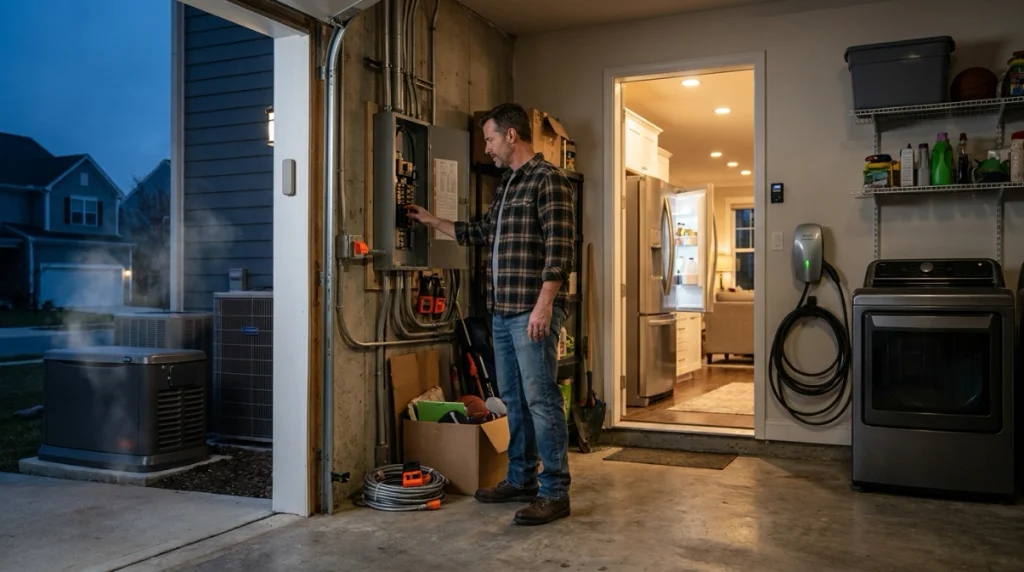
Yes. Load management allows the system to protect priority equipment while delaying lower-priority loads when generator demand becomes too high.
That can make a properly sized 20kW system feel much more capable during a real outage.
- Keep refrigeration and critical circuits available first.
- Prioritize one central air-conditioning system.
- Temporarily delay an electric dryer or water heater.
- Prevent multiple large HVAC loads from starting together.
- Leave EV charging off until utility power returns.
Automatic transfer equipment is also an important part of a permanently installed standby system. The Pacific Northwest National Laboratory’s transfer-switch guidance explains how an ATS transfers loads between utility and standby power while preventing backfeed.
What Safety Issues Should You Consider With a 20kW Generator?
A 20kW standby generator is permanent electrical and fuel equipment. Placement, transfer equipment, gas piping, permits, and wiring need to follow the manufacturer’s instructions and locally adopted codes.
I would have the final installation designed and completed by qualified professionals. This isn’t equipment I would treat like a large plug-in appliance.
- Use approved transfer equipment that isolates generator and utility power.
- Confirm fuel piping can supply the generator at maximum required load.
- Follow the manufacturer’s required clearances around doors, windows, vents, and combustible surfaces.
- Keep the generator accessible for inspections and maintenance.
- Test the system on the schedule required by its manufacturer.
If you’re comparing a standby unit with a portable generator, read the CPSC carbon monoxide safety guidance. Portable combustion generators must be operated outdoors and well away from occupied buildings.
If you’re ready to narrow the equipment list, these are the two 20kW-class standby models I’d put near the top of my comparison:
🏆 Best Overall
Generac Guardian 20kW Standby Generator
★★★★☆ 4.7/5 editorial rating
Rated at 20kW on LP and 18kW on natural gas, with about 83.3 amps available at 240 volts on LP. I like this class for homeowners who want broad automatic backup while still using sensible load management.
⚡ Best for Motor Starting
KOHLER 20RCA 20kW Standby Generator
★★★★☆ 4.6/5 editorial rating
The 20RCA is rated at 20kW on LP and 18kW on natural gas, with KOHLER listing 41 kVA of peak motor-starting capability at 240 volts. I’d put it on the shortlist when central air or another substantial motor load is a major sizing concern.
Frequently Asked Questions
Will a 20kW generator run a 2,000-square-foot house?
In many cases, yes. A 20kW standby generator is a strong starting size for broad backup in a 2,000-square-foot home, but electric heat, large HVAC systems, an electric water heater, and other high-demand appliances can change the calculation.
Will a 20kW generator run a 3,000-square-foot house?
A 20kW generator can run many 3,000-square-foot homes, particularly homes using gas for heating, hot water, and cooking. Homes with multiple air conditioners or several large electric appliances may need load management or a larger generator.
Can a 20kW generator power my entire electrical panel?
A whole-house transfer switch can make the entire panel available, but that does not mean every appliance can run simultaneously. Load-management controls may temporarily prevent lower-priority equipment from operating when total demand approaches generator capacity.
Is a 20kW generator the same as 20,000 running watts?
Twenty kilowatts equals 20,000 watts, but check the manufacturer’s fuel-specific rating. Some current residential generators advertised as 20kW produce 20,000 watts on propane and 18,000 watts on natural gas.
Should I buy a generator larger than 20kW just to be safe?
Not automatically. First calculate your actual loads, motor-starting requirements, fuel rating, and load-management options, then have the installation professionally reviewed. Buying more capacity only makes sense when your present or planned electrical demand justifies it.
Final Takeaway
A 20kW generator can provide whole-house-style backup for many homes in roughly the 2,000- to 3,000-square-foot range. Homes above that range may also work when their electrical demand stays moderate and large loads are managed.
The number I trust most isn’t square footage. It’s the calculated electrical demand of the appliances and systems you intend to use during an outage.
Before buying, confirm your HVAC starting load, fuel-specific generator rating, 240-volt appliances, transfer-switch design, and load-management plan. That calculation tells you whether 20kW is comfortably enough or whether the next generator size makes more sense.