How Big of a Generator to Run a 2000 Sq Ft House?
Quick Answer
A typical 2,000-square-foot house often needs a 7,500 to 10,000-watt generator for practical outage backup, including a refrigerator, lights, furnace blower, pumps, electronics, and selected larger loads. If you want central air and most household circuits available at the same time, a 14 to 22 kW standby generator may be more appropriate. Square footage alone cannot give you the exact answer, so use your actual loads and our generator power capacity guide before choosing a unit.
Useful starting ranges
- Basic essentials: Around 5,000–7,500 watts can cover refrigeration, lighting, electronics, and several smaller loads.
- Typical outage setup: Around 7,500–10,000 watts gives more room for a furnace blower, sump pump, well pump, or window AC.
- Central air: Compressor startup demand can push the required generator capacity significantly higher.
- Whole-home backup: Many 2,000-square-foot homes fall around 14–22 kW when large 240-volt loads are included.
- Electric-heavy homes: Electric heat, water heating, cooking, dryers, and EV charging can increase the requirement substantially.
Before buying
- Write down what must operate during an outage and check each appliance nameplate for its real electrical requirements.
A 2,000-square-foot house sounds like it should have one simple generator size. It doesn’t, because two houses with identical floor plans can have completely different electrical loads.
My rule is simple: size the outage, not the floor plan. Here is how I work through that calculation without paying for capacity you will never use.
What Size Generator Do You Need for a 2000 Sq Ft House?
For most 2,000-square-foot homes, I would start by looking at 7,500 to 10,000 running watts for portable backup. That range works well when you are deliberately managing which appliances operate together.
A whole-home setup is different. Central air, water heating, electric cooking, pumps, and other 240-volt loads can move the requirement into the 14 to 22 kW range or higher.
| Backup Goal | Typical Generator Range | What It May Cover |
|---|---|---|
| Minimum essentials | 5,000–7,500 W | Refrigerator, lights, electronics, gas-heating controls, selected small loads |
| Comfortable portable backup | 7,500–10,000 W | Essentials plus pumps, furnace blower, microwave, or selected cooling |
| Large-load backup | 10,000–14,000 W | More simultaneous circuits and some larger 240-volt equipment |
| Whole-home standby | 14–22 kW+ | Central AC and broader household coverage, depending on actual loads |
These are planning ranges, not substitutes for an electrical load calculation. An electrician may recommend load management to reduce the generator capacity needed.
Why Doesn’t Square Footage Tell You the Exact Generator Size?
Generator sizing is the process of matching available generator output to the electrical loads you expect to operate. Running watts and startup demand matter more than floor area.
Consider two neighboring 2,000-square-foot houses. One may have natural-gas heat and water heating, while the other uses electric heat, an electric water heater, a well pump, and central AC.
- Fuel-fired heating: A gas furnace mainly needs electricity for its blower and controls.
- Electric resistance heat: Heating elements can create thousands of watts of continuous demand.
- Well water: A well pump adds a motor-driven load with startup demand.
- Central air: The compressor can become one of the largest startup loads in the home.
- Electric cooking: Ranges and ovens add substantial sustained demand.
- Electric water heating: A conventional tank heater may use around 4,000 watts while heating.
That is why I treat square footage as a rough filter. Your appliance list makes the final decision.
How Many Watts Do Common Household Appliances Need?
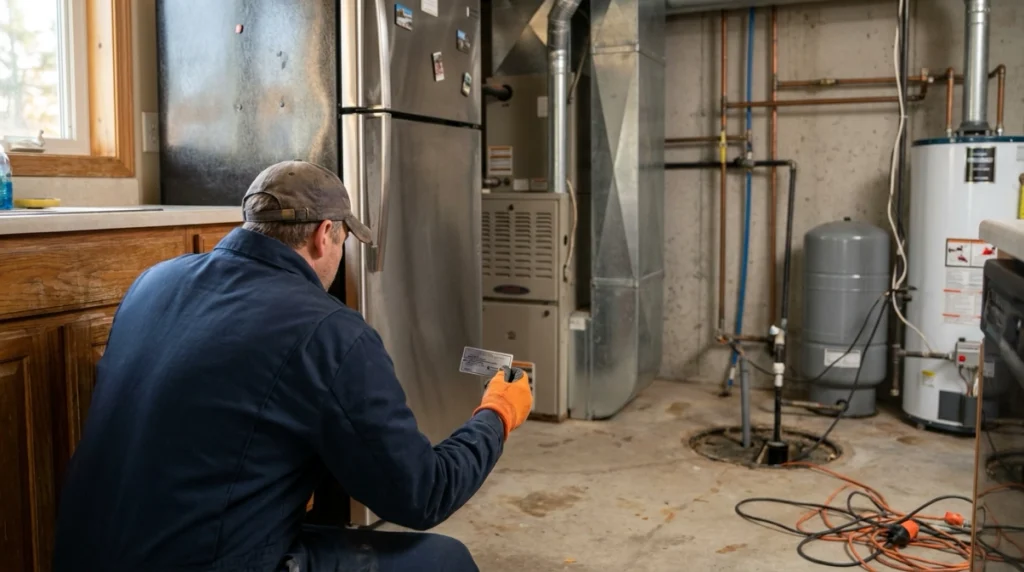
Actual wattage varies by model, so the appliance nameplate should always win over an online chart. Still, typical values help you understand why generator sizes climb so quickly.
| Load | Example Running Watts | Possible Extra Startup Demand |
|---|---|---|
| Refrigerator/freezer | About 700 W | Up to about 2,200 W additional |
| 1/3 HP sump pump | About 800 W | About 1,300 W additional |
| 1/3 HP well pump | About 1,000 W | About 2,200 W additional |
| 1/2 HP furnace blower | About 800 W | About 2,350 W additional |
| Electric water heater | About 4,000 W | Usually little motor surge |
Motor loads are where homeowners commonly get caught. I explain that difference further in this guide to running watts versus starting watts.
How Do You Calculate the Generator Size You Actually Need?
Add the running watts for everything you plan to operate simultaneously. Then allow enough generator surge capacity for the largest motor startup event likely to occur.
- Choose your outage loads. Do not automatically include every circuit in the house.
- Record running watts. Check appliance labels and manuals wherever possible.
- Identify motor loads. Refrigerators, pumps, blowers, and air conditioners can need extra power at startup.
- Add simultaneous running loads. This gives your continuous requirement.
- Account for startup demand. Make sure the generator’s surge rating can handle your largest expected startup event.
- Leave practical headroom. Avoid choosing a generator that must operate at its limit whenever several loads overlap.
A worked example for a 2000 sq ft house
Suppose your outage plan includes a 700-watt refrigerator, 800-watt furnace blower, 800-watt sump pump, 1,200-watt microwave, 100 watts of LED lighting, and 200 watts of electronics. The combined running load is about 3,800 watts.
If the furnace blower adds roughly 2,350 watts during startup, the temporary requirement can climb to about 6,150 watts. That is why a generator in the 7,500-watt-and-up class gives this setup much more breathing room than a 4,000-watt unit.
For a second check, you can compare your calculation with a manufacturer’s home generator sizing tool. For a permanently installed standby system, I would still have a qualified installer confirm the final load calculation.
Is a 7500-Watt Generator Enough for a 2000 Sq Ft House?
Yes, a 7,500-watt generator can be enough when you are backing up selected circuits instead of trying to operate every appliance normally. It is a common practical range for essential-load backup.
You will still need to manage large loads. Running a microwave, well pump, electric water heater, and large air conditioner together can overwhelm capacity quickly.
- Refrigerator and freezer
- Gas furnace blower
- Sump pump
- Selected well pumps
- LED lighting
- Internet equipment and electronics
- Microwave used selectively
- Some window air conditioners
If you routinely need more loads together, moving toward 9,000–10,500 running watts gives you greater flexibility.
What Size Generator Do You Need for Central Air?
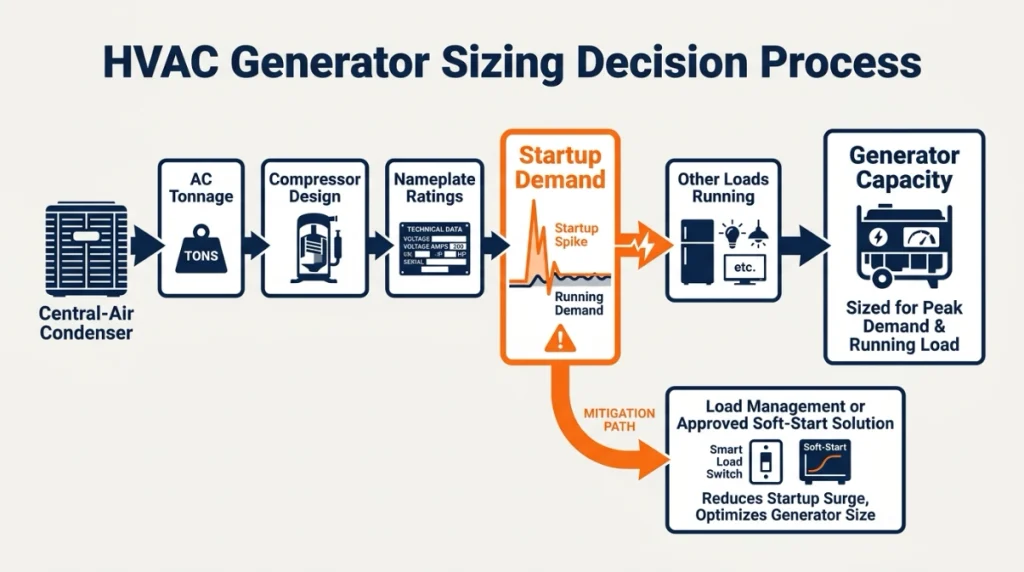
Central air can completely change the calculation because its compressor requires a startup surge. Never size the generator using the AC’s normal running consumption alone.
The exact requirement depends on tonnage, compressor design, nameplate ratings, and what else is running. See my detailed generator sizing guide for air conditioners before assuming a portable unit can start your system.
Practical tip: If central AC is essential during an outage, have an electrician or HVAC professional check the compressor’s real starting requirements. Load-management equipment or an approved soft-start solution may change the generator capacity needed.
Portable or Standby Generator for a 2000 Sq Ft House?
A portable generator is usually the better value when you only need selected essential circuits. A standby generator makes more sense when automatic operation and broader whole-home coverage matter.
| Factor | Portable Generator | Standby Generator |
|---|---|---|
| Typical role | Selected circuits | Partial or whole-home backup |
| Startup | Manual or remote | Usually automatic |
| Fuel | Gasoline, propane, or multi-fuel | Usually natural gas or propane |
| Best fit | Budget-conscious backup | Frequent outages and automatic coverage |
For a portable unit, I usually prefer enough capacity to avoid constant load juggling while still keeping the generator practical. Bigger is not automatically better if most of that capacity will sit unused.
Does Fuel Type Change Generator Output?
Yes. Multi-fuel generators often produce different wattage depending on whether they run on gasoline, propane, or natural gas.
For example, some models deliver their highest rated output on gasoline and less on propane or natural gas. Always size from the specifications for the fuel you expect to use during an outage.
This matters especially when a generator appears barely large enough on gasoline. See the dual-fuel generator buying guide if fuel flexibility is part of your decision.
How Do You Connect a Generator to a House Safely?
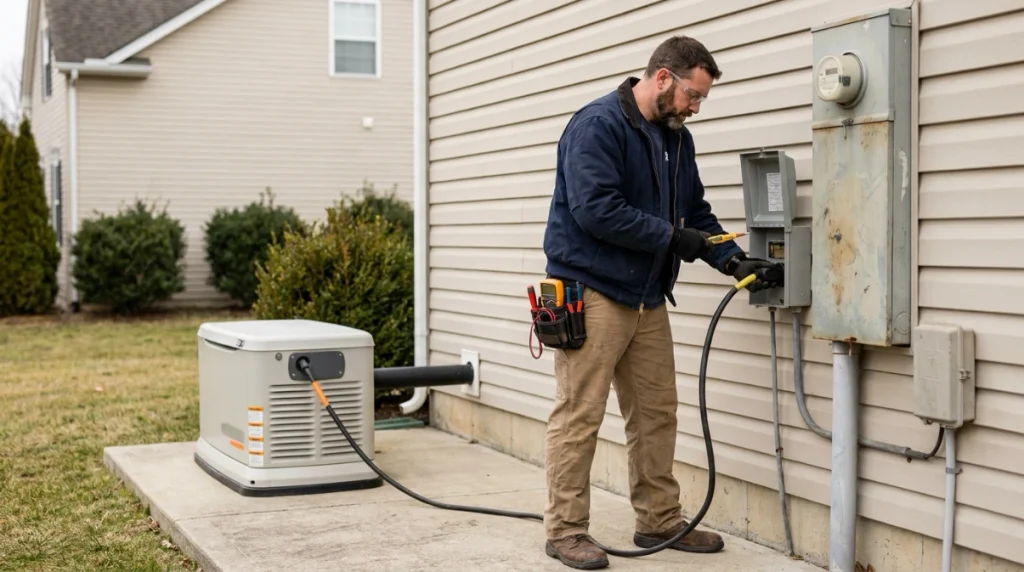
Never improvise a connection from a portable generator into household wiring. Feeding a panel incorrectly can cause dangerous backfeeding and expose utility workers and occupants to electrical hazards.
The Electrical Safety Foundation International’s generator guidance recommends an appropriate transfer switch when powering household wiring. Have the connection equipment installed according to applicable codes by a qualified electrician.
Carbon monoxide is another critical hazard. The U.S. Consumer Product Safety Commission says portable generators must be operated outdoors and well away from openings into buildings.
The CDC’s carbon monoxide guidance recommends keeping portable generators more than 20 feet from windows, doors, and vents, with exhaust directed away. Working carbon-monoxide alarms should also be installed in the home.
- Never run it indoors: Garages, basements, sheds, and similar enclosed areas are unsafe.
- Prevent backfeeding: Use approved transfer equipment for household circuits.
- Keep it dry: Follow the manufacturer’s wet-weather instructions.
- Use CO alarms: Test them before storm season and outages.
- Do not overload it: Add large loads carefully and monitor generator capacity.
Generators I Would Consider for a 2000 Sq Ft House
If you have completed your wattage calculation and a portable generator fits the plan, these three models land in useful capacity ranges. The scores below are editorial fit ratings, not retailer customer-review scores.
🏆 Best Overall Portable
Westinghouse WGen9500DFc
★★★★★ 4.8/5 editorial fit
It provides 9,500 running and 12,500 peak watts on gasoline, while propane output is lower. I like this capacity for homeowners who want substantial portable backup without immediately moving to a fixed standby system.
⛽ Best Fuel Flexibility
DuroMax XP13000HXT
★★★★★ 4.7/5 editorial fit
This tri-fuel model is rated at 10,500 running watts on gasoline, 9,500 on propane, and 8,500 on natural gas. I would consider it where fuel choice during a long outage is almost as important as raw capacity.
🏠 Best Gasoline Home Backup
Generac GP9200E
★★★★☆ 4.5/5 editorial fit
The GP9200E is rated for 9,200 running watts and 11,250 starting watts. Its capacity fits the middle ground well for selected home circuits when a gasoline-only portable generator meets your backup plan.
Frequently Asked Questions
Will a 10,000-watt generator run a 2000 sq ft house?
A 10,000-watt generator can run many essential circuits in a 2,000-square-foot house, especially when heating and water heating use gas. It may not support central AC, electric water heating, electric cooking, pumps, and other large loads simultaneously, so calculate your actual demand first.
Will a 5000-watt generator run a 2000 sq ft house?
A 5,000-watt generator can provide basic emergency power, but it is not normally enough for unrestricted whole-home operation. It may handle a refrigerator, lights, electronics, and selected heating or pump equipment if you carefully manage startup loads.
What size generator runs a whole house with central AC?
Whole-home backup with central air often moves homeowners into roughly the 14–22 kW standby-generator class, but AC startup demand and other appliances can change that number. Have the electrical loads calculated before purchasing a permanently installed system.
Should I buy a generator bigger than my calculated load?
Some headroom is sensible because motor startups and overlapping appliance loads can temporarily increase demand. However, there is little benefit in buying dramatically more generator than you need, especially when a smaller properly sized unit can cover your outage priorities efficiently.
Is a portable generator enough for a 2000 sq ft home?
Yes, if your goal is selected-circuit backup rather than operating the home exactly as you would on utility power. A roughly 7,500–10,000-running-watt portable generator is a useful starting range for many homes, but your appliance list decides the final size.
Final Takeaway
For a typical 2,000-square-foot house, 7,500 to 10,000 running watts is a practical place to start when choosing a portable generator for essential and selected comfort loads. For automatic whole-home coverage with central air and other large appliances, expect to investigate roughly 14 to 22 kW or more.
Do not buy from square footage alone. List your loads, calculate running and startup requirements, check the output on your intended fuel, and have household transfer equipment installed correctly.
That extra calculation takes a few minutes. It can prevent years of living with a generator that is either too small for the job or far larger than you ever needed.

Hi, I’m Michael Turner. I own a generator workshop in the United States and founded HomeGeneratorBlog to share practical, hands-on guidance about generator installation, maintenance, troubleshooting, safety, and backup power solutions. My goal is to help homeowners make smarter, more confident decisions through clear and reliable information