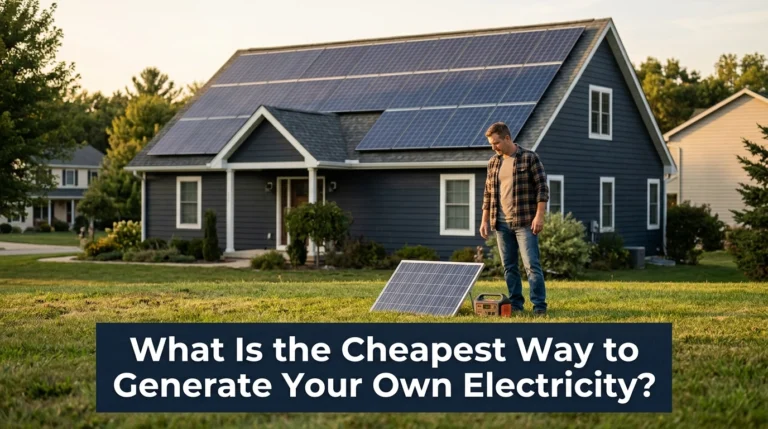
Is a Jackery Better Than a Generator? 2026 Guide
Quick Answer
A Jackery is better than a fuel generator when you need quiet, exhaust-free portable power for electronics, refrigerators, camping, or short outages. A conventional generator is better for high-wattage appliances and long outages because you can keep adding fuel instead of waiting for a battery to recharge. Before choosing either, calculate how much backup power your home actually needs.
Choose a Jackery when:
- Quiet operation: You don’t want a combustion engine running outside your home or campsite.
- Indoor power: You need battery power without carbon-monoxide exhaust.
- Sensitive electronics: You want pure sine-wave AC power for laptops, TVs, routers, and chargers.
- Short outages: Your priority is refrigeration, communication, lighting, and selected appliances.
- Solar charging: You want the option to recharge from compatible solar panels.
Choose a fuel generator when:
- Heavy loads matter: You need pumps, air conditioners, multiple appliances, or broader home backup.
- Outages last days: Refueling can restore your available energy in minutes.
- Maximum watts matter: Large portable generators offer far more continuous output than most single battery stations.
I get why people compare Jackery power stations with generators. Both can keep equipment running when the wall outlet stops working, but they solve the problem in different ways.
A Jackery stores electricity in a battery. A conventional generator creates electricity continuously by burning gasoline, propane, or another fuel.
That difference affects almost everything: noise, runtime, safety, maintenance, power capacity, and how quickly you can restore your available energy.
Is a Jackery Actually a Generator?
A Jackery portable power station is primarily a rechargeable battery system with an inverter, not a combustion-powered electrical generator. It stores energy first, then converts that stored DC battery energy into usable AC power.
Definition: A portable power station is a rechargeable battery, inverter, charging system, and power outlets combined in one portable unit. When paired with solar panels, these systems are often marketed as solar generators.
That distinction matters during a long blackout. A gas generator can continue producing electricity as long as you safely supply fuel and maintain the engine.
A Jackery eventually reaches an empty battery. You then need AC power, a vehicle connection, compatible solar panels, or another charging source.
For example, the Jackery Explorer 2000 Plus specifications list a 2,042.8Wh LiFePO₄ battery and 3,000W total AC output. Jackery also specifies up to 6,000W instantaneous output.
The important number isn’t only watts. Battery capacity determines how long those watts remain available.
Jackery vs. Generator: Which One Provides More Power?
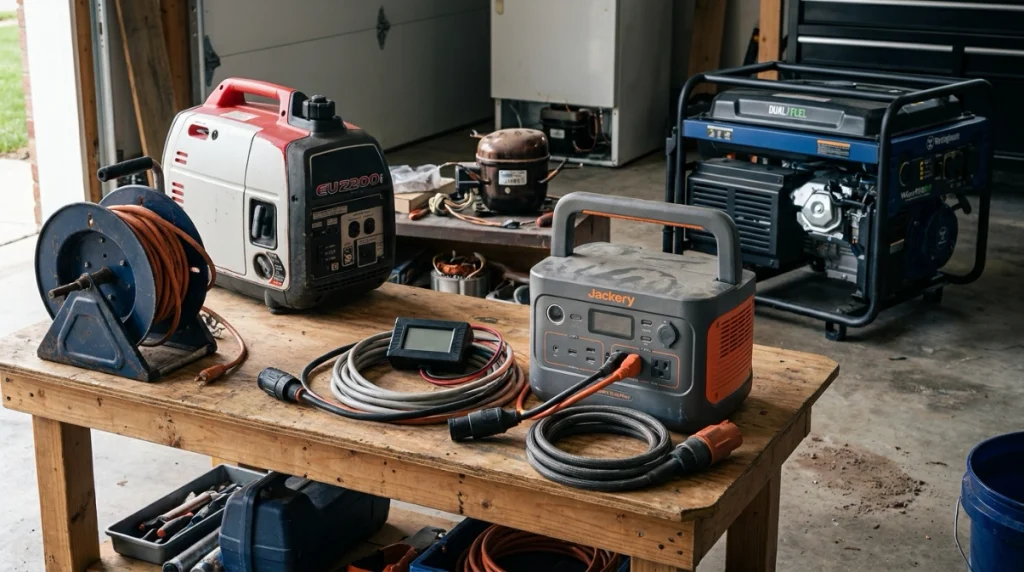
A conventional fuel generator usually wins when the job requires lots of electricity for many hours. A Jackery can provide impressive short-term output, but its battery stores a finite amount of energy.
This is where shoppers often confuse watts with watt-hours. They measure different things.
- Watts (W): How much power equipment can deliver at one moment.
- Watt-hours (Wh): How much electrical energy a battery stores.
- Running watts: Continuous output available during normal operation.
- Starting watts: Short extra output needed when motors and compressors start.
If those numbers feel confusing, my guide to running watts vs. starting watts explains how to compare them before buying backup equipment.
| Specification | Jackery Explorer 2000 Plus | Honda EU2200i | Westinghouse WGen9500DF |
|---|---|---|---|
| Power source | LiFePO₄ battery | Gasoline | Gasoline or propane |
| Continuous/rated output | 3,000W | 1,800W | 9,500W gasoline / 8,500W propane |
| Maximum/peak output | 6,000W instantaneous | 2,200W | 12,500W gasoline / 11,200W propane |
| Stored fuel/energy | 2,042.8Wh battery | 0.95-gallon tank | 6.6-gallon gasoline tank |
| Refueling | Recharge battery | Add gasoline | Add gasoline or connect propane |
| Engine maintenance | None | Yes | Yes |
| Combustion exhaust | No | Yes | Yes |
The table shows why there isn’t one winner. The Jackery beats the small Honda on rated electrical output, while the large Westinghouse provides more than three times the Jackery’s continuous wattage.
However, a fuel generator’s biggest advantage is refillable energy. Once the Jackery’s battery is depleted, its useful runtime depends on how quickly you can recharge it.
How Long Will a Jackery Run During a Power Outage?
Runtime depends on the appliance load, battery capacity, inverter losses, temperature, and other operating conditions. You shouldn’t estimate runtime from the advertised wattage alone.
A simple theoretical calculation divides battery watt-hours by appliance watts.
- 100W load: 2,042.8Wh ÷ 100W = about 20.4 theoretical hours.
- 500W load: 2,042.8Wh ÷ 500W = about 4.1 theoretical hours.
- 1,000W load: 2,042.8Wh ÷ 1,000W = about 2 theoretical hours.
- 2,000W load: 2,042.8Wh ÷ 2,000W = about 1 theoretical hour.
Actual AC runtime will be lower because the inverter and electronics consume some energy. Appliances such as refrigerators also cycle on and off, so their real runtime cannot be predicted from nameplate watts alone.
This is why I start with the intended loads rather than a product name. My generator power capacity guide shows how to total those loads properly.
Is a Jackery Better for Indoor Use and Safety?
A battery power station has a major advantage indoors because it doesn’t burn gasoline or propane and doesn’t create engine exhaust. A fuel-powered portable generator must never be treated the same way.
The U.S. Consumer Product Safety Commission generator guidance warns that portable generators produce deadly carbon monoxide. The CPSC says they must be operated outdoors, away from buildings, doors, windows, and vents.
- Jackery: No fuel combustion or engine exhaust during battery operation.
- Gas generator: Produces carbon monoxide and must remain outdoors.
- Propane generator: Still creates dangerous combustion exhaust.
- Either system: Must be operated within the manufacturer’s electrical, temperature, moisture, and load limits.
That makes a battery station much easier when I want backup electricity in a bedroom, office, apartment, or other occupied space. I still follow the manufacturer’s battery safety and ventilation instructions.
Which Is Quieter: Jackery or a Generator?
Jackery wins easily on noise because there is no continuously running combustion engine. You may hear cooling fans under heavier loads, but that isn’t comparable to an engine running for hours.
Jackery lists a cooling-fan noise level of 30 dB or less for the Explorer 2000 Plus. Honda lists its EU2200i at 48 dB(A) at one-quarter load and 57 dB(A) at rated load.
The larger Westinghouse WGen9500DF is rated around 74 dBA. That added noise comes with dramatically higher household power capacity.
For camping, nighttime backup, apartments, remote work, photography, and electronics, I give Jackery the advantage. For keeping several major household loads operating during a storm, I’d accept more noise for the extra power.
Is a Jackery Better Than a Generator for Running a House?
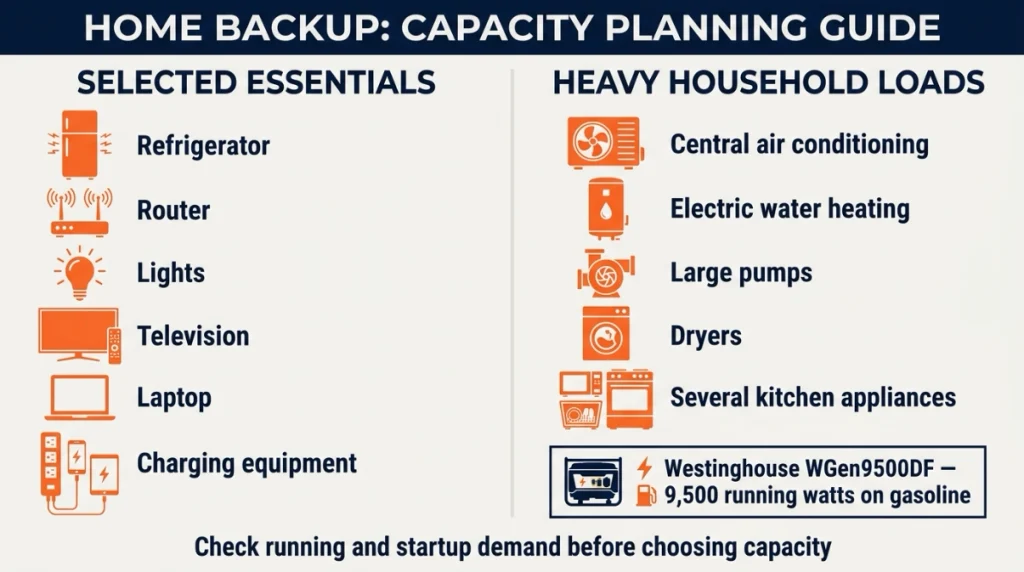
For a few essential appliances, a large Jackery can work well. For broad whole-house backup, a conventional generator usually offers more practical capacity and endurance.
A refrigerator, router, lights, television, laptop, and charging equipment can be a realistic battery-backup load. Central air conditioning, electric water heating, large pumps, dryers, and several kitchen appliances change the calculation quickly.
As a reference point, the WGen9500DF provides 9,500 running watts on gasoline according to Westinghouse’s published specifications. That is a different class of home backup than a 2kWh portable battery.
If your target is around 5,000 watts, see exactly what a 5,000W generator can run in a house before deciding how much capacity you need.
What about air conditioning?
Air conditioners are difficult because compressors can require a large startup surge. A battery station’s inverter must handle that surge even when the AC’s normal running watts look manageable.
Central AC deserves its own calculation. My generator sizing guide for air conditioners explains why compressor startup demand often decides the result.
When Would I Choose a Jackery Instead?
I would choose a Jackery when convenience matters more than unlimited runtime. There is no oil change, gasoline storage, carburetor, spark plug, or pull-start routine to manage.
- Camping: Quiet power for lights, phones, laptops, fans, and small appliances.
- Short outages: Simple backup for refrigeration, communication, and electronics.
- Home office: Clean battery power for routers, monitors, laptops, and networking equipment.
- Indoor backup: No combustion exhaust during operation.
- Solar setups: Compatible solar panels can extend off-grid use when sunlight and charging conditions cooperate.
I also like battery stations for outages that happen at night. Switching one on takes seconds, and I don’t have to immediately move a generator outside and deal with fuel.
When Is a Traditional Generator the Better Choice?
I would choose a fuel generator for high electrical demand or an outage that may continue for several days. Fuel is energy you can stock and replace quickly.
- Well pumps: Motors may have high starting demand.
- Sump pumps: Reliable extended operation can matter during severe weather.
- Furnace blowers: Heating equipment may need to run throughout a long outage.
- Air conditioning: Larger systems demand substantial running and startup watts.
- Multiple circuits: Larger generators provide far more simultaneous capacity.
A smaller inverter generator can also provide a middle ground. The Honda EU generator range, for example, combines gasoline runtime with inverter-regulated output and quieter operation than many large open-frame machines.
Jackery vs. Generator: My 2026 Verdict
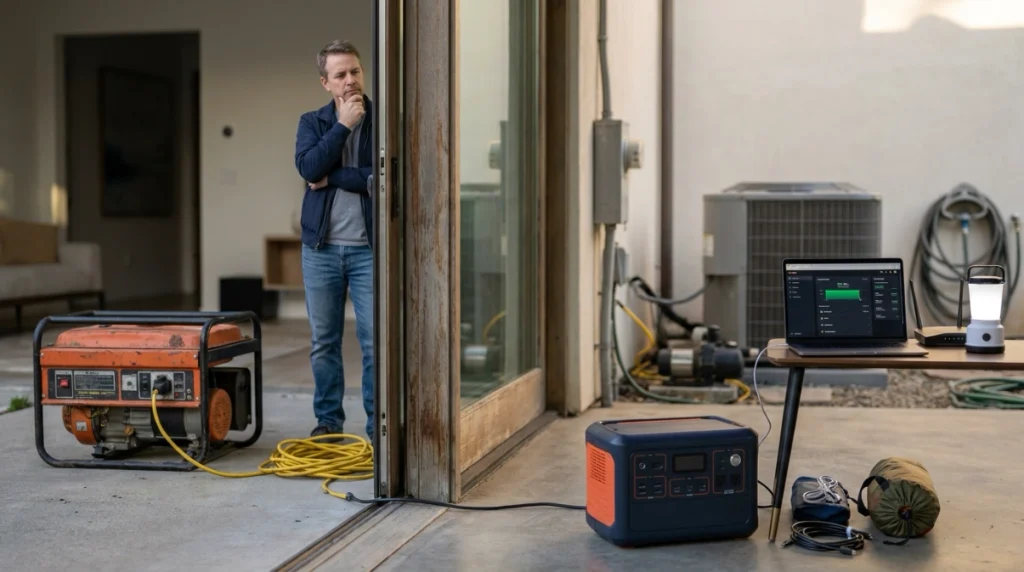
A Jackery isn’t universally better than a generator, and a generator isn’t universally better than a Jackery. They are strongest at opposite ends of the backup-power problem.
| Priority | Better Choice |
|---|---|
| Quiet operation | Jackery |
| Indoor emergency power | Jackery |
| Low maintenance | Jackery |
| High household wattage | Fuel generator |
| Multi-day outage with available fuel | Fuel generator |
| Camping and electronics | Jackery |
| Heavy pumps and central AC | Fuel generator |
For my own buying decision, I would first ask how many watts I need and how long I need them. That answer usually makes the choice obvious.
If you’re ready to pick one, these are three different types of backup power I would compare:
🏆 Best battery option
Jackery Explorer 2000 Plus
★★★★★
A 2,042.8Wh LiFePO₄ power station with 3,000W continuous AC output and solar-charging support. This is my pick when quiet operation, simple setup, and indoor-friendly battery power matter more than unlimited runtime.
🔇 Best fuel inverter
Honda EU2200i
★★★★★
Honda rates the EU2200i at 1,800 continuous watts and 2,200 maximum watts. I like this type of generator when I want refillable gasoline runtime without stepping up to a loud, heavy open-frame machine.
🏠 Best for heavy home loads
Westinghouse WGen9500DF
★★★★☆
This dual-fuel model provides 9,500 running watts on gasoline and 8,500 on propane. I would consider this class when pumps, several appliances, or broader household backup matter more than portability and low noise.
Frequently Asked Questions
Can a Jackery replace a gas generator?
A Jackery can replace a gas generator for low-to-moderate loads and shorter outages if its inverter output and battery capacity match your needs. It becomes less practical for heavy household loads or long outages unless you have enough battery expansion and a reliable way to recharge.
Can you use a Jackery inside the house?
A Jackery battery power station does not burn fuel or produce carbon-monoxide exhaust during normal battery operation, which makes it far more suitable for indoor backup than a gasoline generator. Follow Jackery’s instructions for operating temperature, charging, ventilation, moisture, and battery safety.
Can a Jackery run a refrigerator?
Many Jackery models can run a refrigerator if their continuous and surge output exceed the refrigerator’s requirements. Runtime depends on battery capacity, compressor cycling, temperature, refrigerator efficiency, and the other equipment connected at the same time.
Is a Jackery cheaper to run than a generator?
A Jackery doesn’t require gasoline or engine oil during normal use, and solar charging can reduce purchased electricity use. However, large battery systems can cost more upfront, so total cost depends on capacity, charging method, outage frequency, and how much power you need.
What is better for a long power outage?
A fuel generator is usually more practical for a long outage when gasoline or propane remains available because you can restore its energy supply quickly. A Jackery becomes more competitive when you have adequate battery expansion, modest electrical loads, and reliable solar or grid recharging.
Final Takeaway
So, is a Jackery better than a generator? Yes for quiet, low-maintenance, exhaust-free portable electricity, but not when your main goal is maximum household wattage and easily replenished energy during a long outage.
I would choose based on the loads first. List what must stay powered, check its running and startup demand, estimate how many hours you need, and then decide whether stored battery energy or refillable generator fuel fits that job better.

Hi, I’m Michael Turner. I own a generator workshop in the United States and founded HomeGeneratorBlog to share practical, hands-on guidance about generator installation, maintenance, troubleshooting, safety, and backup power solutions. My goal is to help homeowners make smarter, more confident decisions through clear and reliable information