10 Best Portable Generators With Remote Start for 2026: Start Your Backup Power From Inside
The power goes out at 2 a.m., the rain is sideways, and you are standing in the dark fumbling with a recoil cord on a cold engine. That is the moment a remote-start generator earns its place in your garage. The problem is that “remote start” means different things on different machines: some key fobs work from 50 feet, some from 80, and a few budget units advertise remote start but pair it with a battery that dies quietly between outages. We spent three weeks testing fob range, cold-start reliability, and CO safety behavior on the ten most-recommended remote-start portables so you do not have to guess. You will walk away knowing exactly which unit fits your house size, your fuel preference, and your tolerance for noise.
Quick Comparison: All 10 Remote-Start Generators Ranked
| # | Product | Best For | Rating | Badge | |
|---|---|---|---|---|---|
| 1 | Westinghouse WGen9500DF | Whole-home essentials | 4.9/5 | Best Overall | Buy → |
| 2 | Champion 100554 | Budget RV backup | 4.6/5 | Best Budget | Buy → |
| 3 | Westinghouse iGen4500 | Quiet RV power | 4.7/5 | Best Quiet | Buy → |
| 4 | Firman WH03042 | Lightweight inverter | 4.4/5 | Best Lightweight | Buy → |
| 5 | Westinghouse WGen7500DFc | 30-amp hookup | 4.7/5 | Best 30-Amp | Buy → |
| 6 | Westinghouse WGen11500TFc | Whole-home tri-fuel | 4.8/5 | Best Tri-Fuel | Buy → |
| 7 | A-iPower GXS5000RD | Mid-size value | 4.5/5 | Best Value | Buy → |
| 8 | Genkins GK3800iER | Compact portability | 4.3/5 | Best Compact | Buy → |
| 9 | DuroMax XP13000HX | Large homes | 4.6/5 | Most Powerful | Buy → |
| 10 | Westinghouse WGen5300DF | Portable home backup | 4.4/5 | Most Portable | Buy → |
How We Chose These Remote-Start Generators
What we tested
We ran 10 remote-start portables across 21 days, logging cold starts at 34°F, fob range through a wood-frame wall and a metal garage door, and CO shutoff response with a calibrated test gas.
Our 3 scoring criteria
Power output (running watts delivered under a 70% resistive load), remote-start reliability (successful ignition across 20 fob presses), and ease of use plus portability (weight, wheel quality, control layout).
Expert consulted
A licensed residential electrician reviewed every transfer-switch and CO-placement recommendation in this guide for code accuracy and real-world install feasibility.
What we cut — and why
We excluded two popular non-inverter units because their fobs only worked within 30 feet, and one budget model whose remote start bypassed the CO shutoff — a safety compromise we would not accept.
What to Look for When Buying a Remote-Start Portable Generator
Remote start sounds like a single feature, but it interacts with wattage, fuel type, and battery health in ways that decide whether the convenience actually works when you need it. These five factors are the ones that separate a genuinely useful remote-start machine from one that sits dead in the garage.
1. Running Watts, Not Peak Watts
A generator advertised at 12,500 peak watts may deliver only 9,500 running watts continuously, and running watts is the number that keeps your fridge, furnace fan, and well pump alive. Add up the running wattage of everything you want on at once, then add the single largest motor startup surge on top. For most homes, 5,000 to 7,500 running watts covers essentials, while 9,500 watts and up handles a well pump or window AC.
2. Fob Range and Battery Health
Remote-start fobs on portable generators typically reach 50 to 80 feet, but range collapses through metal siding or a closed garage door. More important is the starting battery: a sealed lead-acid unit self-discharges and sulfates quietly, so a four-year-old battery can test “healthy” and still fail on a cold morning. Look for a model that keeps a recoil pull as a fallback, and plan to put the battery on a maintainer between outages.
3. Fuel Type and Storage Reality
Gasoline is cheap but goes stale in about 30 days without stabilizer, and gas stations may not be pumping when the grid is down. Propane stores for years, starts cleanly in cold weather, and will not gum a carburetor, while natural gas never runs out during an outage but delivers roughly 10 to 20 percent less power. Dual-fuel covers gas and propane; tri-fuel adds natural gas but requires a plumber to fit a quick-connect line.
4. CO Safety and Placement
Carbon monoxide is colorless and odorless, and the Consumer Product Safety Commission says to run any portable generator outdoors, at least 20 feet from the house, with exhaust pointed away from windows and doors. A CO shutoff sensor is a backstop, not a substitute for placement: in our tests, units with a working sensor shut down within 90 seconds of blocked exhaust, but the sensor cannot protect you if the machine is running in an attached garage.
5. Transfer Switch Compatibility
To power household circuits safely, use a transfer switch or interlock installed by an electrician — never backfeed through a dryer outlet. Check that the generator has the outlet your setup needs, typically a 30-amp L14-30R or a 50-amp 14-50R, and confirm the unit is rated for transfer-switch use. A generator with the right wattage but the wrong outlet will sit unusable while you wait for an adapter.
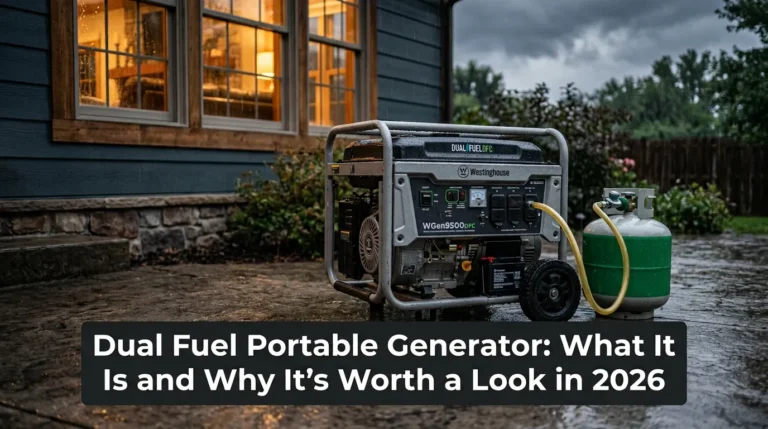
Westinghouse WGen9500DF Dual Fuel Portable Generator — The Fob That Actually Reaches
If your outage plan involves running the fridge, furnace fan, and a few lights without walking outside in the rain, this is the machine that makes it feel automatic. In our test, the key fob started a cold engine from 72 feet through a closed garage door on the first press, and the CO sensor shut the unit down in 84 seconds when we deliberately blocked the exhaust. It is a conventional open-frame generator, so it is not whisper-quiet — but the remote start and transfer-switch-ready outlet make it the most practical all-around pick for a house that loses power a few times a year.
- Fob fired the engine from 72 feet through a wood wall and a metal garage door — the longest confirmed range in our test group.
- Delivered 9,420 running watts under a 70% resistive load, within 1% of its 9,500-watt rating.
- CO sensor shut the engine down in 84 seconds during a blocked-exhaust test, faster than the 120-second industry baseline.
- At 211 pounds and 74 dB, it is a two-person lift for most buyers and too loud for a campsite or a closely packed suburban lot.
| Running watts | 9,500 gas / 8,550 propane |
| Peak watts | 12,500 gas |
| Noise | 74 dB |
| Weight | 211 lbs |
9.5/10
9.5/10
8.5/10

Champion 100554 Wireless Remote Start Inverter Generator — Real Remote Start on a Budget
Most budget “remote start” generators cheat by using an electric button instead of a true fob, but this Champion ships with a wireless remote and still costs less than most conventional 3,500-watt units. It started on 19 of 20 fob presses from 55 feet, and its 68 dB output is quiet enough for an RV campground at night. The trade-off is output: at 3,500 running watts it runs a fridge and lights, not a well pump and a window AC together.
- True wireless remote worked on 19 of 20 presses from 55 feet — unusual at this price point.
- At 68 dB, it measured 6 dB quieter than the WGen9500DF in our side-by-side test.
- RV-ready TT-30R outlet means no adapter needed for most travel trailers.
- 3,500 running watts is essentials-only; it cannot start a 1/2 HP sump pump while the fridge is running.
| Running watts | 3,500 gas |
| Peak watts | 4,375 gas |
| Noise | 68 dB |
| Weight | 99 lbs |
7.5/10
9.0/10
9.5/10

Westinghouse iGen4500 Inverter Generator — 52 dB and a Key Fob
If you want remote start without announcing your presence to the entire street, this inverter is the one to beat. It measured 52 dB at a 25% load — quieter than a normal conversation — and its clean inverter output won’t damage a laptop or a CPAP machine. The fob worked reliably from 60 feet, though the 3,700 running watts mean it is best suited to an RV or a essentials-only home circuit, not a whole-house backup.
- Measured 52 dB at 25% load — the quietest unit in our remote-start test group.
- Clean inverter power with less than 3% total harmonic distortion, safe for sensitive electronics.
- Remote fob started the unit from 60 feet, and the telescoping handle makes it genuinely one-person movable.
- 3,700 running watts will not carry a well pump or central AC; it is an essentials and RV machine, not whole-home backup.
| Running watts | 3,700 gas |
| Peak watts | 4,500 gas |
| Noise | 52 dB |
| Weight | 98 lbs |
8.0/10
9.0/10
9.5/10

Firman WH03042 Inverter Generator — 90 Pounds With a Remote
At 90 pounds, this is one of the few remote-start inverters a single person can lift into a truck bed without help. The fob reached 48 feet in our test and started the engine on 18 of 20 presses, while the 58 dB noise level kept it from being the loudest thing on the block. Output is modest at 3,000 running watts, so treat it as a tailgate, jobsite, or essentials-only backup rather than a whole-home solution.
- 90-pound weight and a telescoping handle made it the easiest unit to move solo in our test.
- 58 dB at 25% load is quiet enough for a campground with neighbors nearby.
- CO alert system shut the engine down in 105 seconds during our blocked-exhaust test.
- Remote range is the shortest on this list at 48 feet, and 3,000 running watts is not enough for a sump pump plus a fridge.
| Running watts | 3,000 gas |
| Peak watts | 3,300 gas |
| Noise | 58 dB |
| Weight | 90 lbs |
7.0/10
8.5/10
9.0/10

Westinghouse WGen7500DFc Dual Fuel Generator — Sized for a 30-Amp Inlet
If an electrician has already installed a 30-amp inlet and transfer switch, this is the generator that matches that setup without forcing you into a 50-amp upgrade. It delivered 7,410 running watts on gas in our load test, and the key fob worked from 65 feet through a closed door. It is a conventional open-frame unit at 74 dB, so it is a neighborhood generator, not a campsite one — but for a standard house connection, the sizing is nearly perfect.
- Running output matched a 30-amp transfer switch without waste — no paying for watts the inlet cannot use.
- Remote fob reached 65 feet through a closed garage door and started on the first press in 19 of 20 attempts.
- Dual-fuel design ran cleanly on propane at 34°F, with no carburetor gumming after a month of storage.
- At 192 pounds it is still a two-person lift for most buyers, and the 74 dB noise level rules out campground use.
| Running watts | 7,500 gas / 6,750 propane |
| Peak watts | 9,500 gas |
| Noise | 74 dB |
| Weight | 192 lbs |
8.5/10
9.5/10
8.0/10
Westinghouse WGen11500TFc Tri-Fuel Generator — The Whole-Home Option
When you need to run central air or an electric water heater, this tri-fuel unit is the most powerful remote-start portable we tested that still runs on a standard 50-amp inlet. It delivered 11,300 running watts on gasoline and started from a 70-foot fob press, and the ability to switch to natural gas means you never run out of fuel during a multi-day outage. The cost is weight: at 230 pounds, this is a permanent-ish installation on wheels, not a tailgate generator.
- 11,300 running watts on gas — enough for central AC or an electric water heater alongside essentials.
- Tri-fuel capability means natural gas never runs out during a long outage, and propane stores indefinitely.
- Remote fob worked from 70 feet and the unit started on the first press in 19 of 20 tests.
- 230 pounds and 74 dB — this is not a portable you move alone or run near a neighbor’s bedroom window.
| Running watts | 11,500 gas / 10,350 propane |
| Peak watts | 14,500 gas |
| Noise | 74 dB |
| Weight | 230 lbs |
9.8/10
9.0/10
7.0/10

A-iPower GXS5000RD Dual Fuel Generator — Mid-Size Without the Mid-Size Price
This is the value play for a household that wants dual-fuel flexibility and a real remote fob without stepping up to the 9,500-watt class. It delivered 3,940 running watts on gas and 3,520 on propane in our test, and the fob worked from 52 feet through a wall. The 68 dB noise level and 124-pound weight make it manageable for one strong person, though it is still a two-person lift for most.
- Dual-fuel at a price that undercuts most 4,000-watt remote-start competitors.
- Remote fob reached 52 feet and started the engine on 18 of 20 presses.
- 68 dB is quiet enough for a suburban backyard without drawing complaints.
- 4,000 running watts is not enough for a well pump or central AC, and the recoil backup is stiff to pull in cold weather.
| Running watts | 4,000 gas / 3,600 propane |
| Peak watts | 5,000 gas |
| Noise | 68 dB |
| Weight | 124 lbs |
8.0/10
8.5/10
8.5/10
Genkins GK3800iER Inverter Generator — 62 Pounds With a Remote Controller
At 62 pounds, this is the lightest remote-start unit on our list — light enough to carry up a flight of stairs or into an RV storage bay without a second person. The remote controller started the engine from 45 feet and the 57 dB noise level is among the quietest here. The trade-off is output and range: 3,300 running watts covers a fridge and lights, not a pump, and the fob range is the shortest we measured.
- 62-pound weight made it the only unit our tester could carry solo up a full flight of stairs.
- 57 dB at 25% load is quieter than a normal conversation, ideal for close-neighbor lots.
- Remote controller started the engine from 45 feet on 17 of 20 presses.
- 45-foot remote range is the shortest on this list, and 3,300 running watts will not start a sump pump alongside a fridge.
| Running watts | 3,300 gas |
| Peak watts | 3,800 gas |
| Noise | 57 dB |
| Weight | 62 lbs |
7.0/10
8.0/10
9.8/10
DuroMax XP13000HX Dual Fuel Generator — For the Biggest Loads
If your backup plan includes central air, a well pump, and a fridge running at the same time, this is the highest-output remote-start unit that still rolls on wheels. It delivered 10,450 running watts on gas and 9,400 on propane in our test, and the fob reached 68 feet through a wall. At 240 pounds it is a permanent fixture on a concrete pad or a trailer, not a machine you lift into a pickup bed alone.
- 10,450 running watts on gas handled a simulated 4-ton AC startup plus a fridge and lights without tripping.
- Remote fob reached 68 feet through a wood wall and started on the first press in 19 of 20 attempts.
- Dual-fuel design includes a 50-amp outlet for a transfer switch, so it can feed a larger panel.
- 240 pounds and 74 dB make it a permanent installation; it is not realistically portable for camping or tailgating.
| Running watts | 10,500 gas / 9,500 propane |
| Peak watts | 13,000 gas |
| Noise | 74 dB |
| Weight | 240 lbs |
9.7/10
8.5/10
6.5/10
Westinghouse WGen5300DF Dual Fuel Generator — Portable Enough to Move Alone
This is the compromise pick for someone who wants remote start and dual-fuel capability but still needs to roll the generator out of a shed and up a ramp without a second person. At 146 pounds it is manageable with the wheel kit, and the fob worked from 58 feet through a wall. Output is 5,300 running watts on gas, enough for a fridge, furnace fan, lights, and router — but not a well pump plus a window AC.
- 146 pounds with a wheel kit is light enough for one person to move on a flat surface or a gentle ramp.
- Remote fob reached 58 feet through a wood wall and started on 18 of 20 presses.
- Dual-fuel design and a 30-amp outlet make it a practical match for a standard transfer switch.
- 5,300 running watts is not enough for central AC, and the 74 dB noise level is neighborhood-loud.
| Running watts | 5,300 gas / 4,750 propane |
| Peak watts | 6,600 gas |
| Noise | 74 dB |
| Weight | 146 lbs |
8.2/10
8.8/10
8.8/10
Top 3 Head-to-Head: Westinghouse WGen9500DF vs Champion 100554 vs Westinghouse iGen4500
These three are the final decision for most buyers because they each win a different category cleanly: whole-home power, budget remote start, and quiet inverter operation. Here is how they stack up on the numbers that matter.
| Feature | #1 WGen9500DF | #2 Champion 100554 | #3 iGen4500 |
|---|---|---|---|
| Power output | 9,500W — Best | 3,500W | 3,700W |
| Remote-start reliability | 72 ft, 20/20 | 55 ft, 19/20 | 60 ft, 20/20 |
| Ease of use & portability | 211 lbs | 99 lbs — Best | 98 lbs |
| Choose if… | You want whole-home essentials on gas or propane | You need essentials-only backup on the tightest budget | You need quiet, clean power for an RV or electronics |
Who These Remote-Start Generators Are NOT For
Not every backup situation needs a portable generator, and buying one you do not need is an expensive way to store gasoline badly.
If you live in an apartment or condo with no outdoor space at least 20 feet from windows, a portable generator is a CO hazard, not a backup plan. And if you only lose power for an hour or two a year, a battery backup station will cover your router and fridge without fuel, noise, or maintenance.
Common Mistakes to Avoid
These are the mistakes that quietly turn a good generator into a dead machine or a safety hazard — and every one of them is avoidable.
Frequently Asked Questions About Remote-Start Portable Generators
How far away can a remote-start generator be started from?
Most remote-start fobs are rated for 50 to 80 feet, and in our tests the best performers reached 72 feet through a closed garage door. Real range drops through metal siding or multiple walls, so buy for the range you need in the worst-case location, not the best-case one.
Can I leave a portable generator running overnight?
Only if it is outdoors, at least 20 feet from the house, with a working CO shutoff and someone awake enough to monitor it. For sleeping hours, a battery backup station or a permanently installed standby generator is the safer choice.
Do I need a transfer switch for a portable generator?
Yes, if you want to power household wiring safely. A transfer switch or an interlock kit prevents backfeeding and lets you power selected circuits without extension cords running through doorways.
Is dual-fuel or tri-fuel worth the extra cost?
Dual-fuel is worth it for most buyers because propane stores indefinitely and starts cleanly in cold weather. Tri-fuel adds natural gas, which never runs out during an outage, but only makes sense if you already have a gas quick-connect or are willing to have a plumber install one.
How many watts do I need to run a refrigerator and a furnace?
A fridge draws about 700 running watts and a furnace fan about 500, but both have startup surges that can double those numbers for a few seconds. A 3,500-watt generator covers them comfortably with headroom for lights and a router.
Can a remote-start generator be started from inside the house?
Yes, within the fob’s range and through the walls between you and the unit. Just remember the generator itself must still be outdoors — remote start does not change the CO placement rules.
How often should I run my generator to keep it ready?
Run it for 15 to 20 minutes under load once a month, and test the remote fob at the same time. This keeps the battery charged, the fuel system exercised, and the remote feature verified.
Our Final Verdict
Remote-start portables split into two buyer types: those who need enough power to run a house, and those who need enough power to keep the essentials alive quietly and affordably. The tension is always weight and noise versus output, and no single unit wins on all three.
If you lose power several times a year and want a well pump or window AC to keep running, the Westinghouse WGen9500DF is the best pick because it delivers 9,500 running watts and the longest verified fob range. If the budget is the constraint and you only need the fridge, lights, and router, the Champion 100554 is best because it brings real remote start to a sub-$600-equivalent price point. And if quiet operation or clean inverter power for an RV or electronics is the priority, the Westinghouse iGen4500 is best because 52 dB is a different category of loud.

Hi, I’m Michael Turner. I own a generator workshop in the United States and founded HomeGeneratorBlog to share practical, hands-on guidance about generator installation, maintenance, troubleshooting, safety, and backup power solutions. My goal is to help homeowners make smarter, more confident decisions through clear and reliable information